JD Sports × fashionINSTA: 470 out of 500 design ideas dropped in 24 hours — a real enterprise use case
Customer Story
JD Sports · Case Study · AI Pattern Making · Enterprise · Product Development
Our use case with JD Sports: 470 out of 500 design ideas dropped in 24 hours.
By Sylwia Szymczyk · 8 min read · April 2026
The teams involved? They spent 2 minutes uploading garments, hit "run", and went home. The morning after, only 30 designs were left. The ones worth developing.
This is not a concept. This is what's running right now at JD Sports.
I want to walk you through exactly how it works, because it changes what "product development" means for any brand doing more than a handful of styles per season.
We presented this use case officially at The Fashion Tech Show in London in March. The interest in the room was huge, so I'm sharing more details here on how JD is actually using fashionINSTA in their day-to-day.
1. It starts with what you already have
Every brand sits on years of pattern data. DXF files in folders, tech packs in PDFs, sketches scattered across drives. That's not dead storage. That's your competitive advantage - you just can't access it yet.
We train fashionINSTA on your actual garment library. Not generic data. Your patterns, your construction methods, your fit philosophy. The system extracts 750+ features from each garment and builds a robust database that understands your brand DNA - which collars you use, how you build armholes, what your pocket placements look like, how your ease distribution works across categories.
This becomes the foundation everything else runs on.
2. Finding the right starting point - automatically
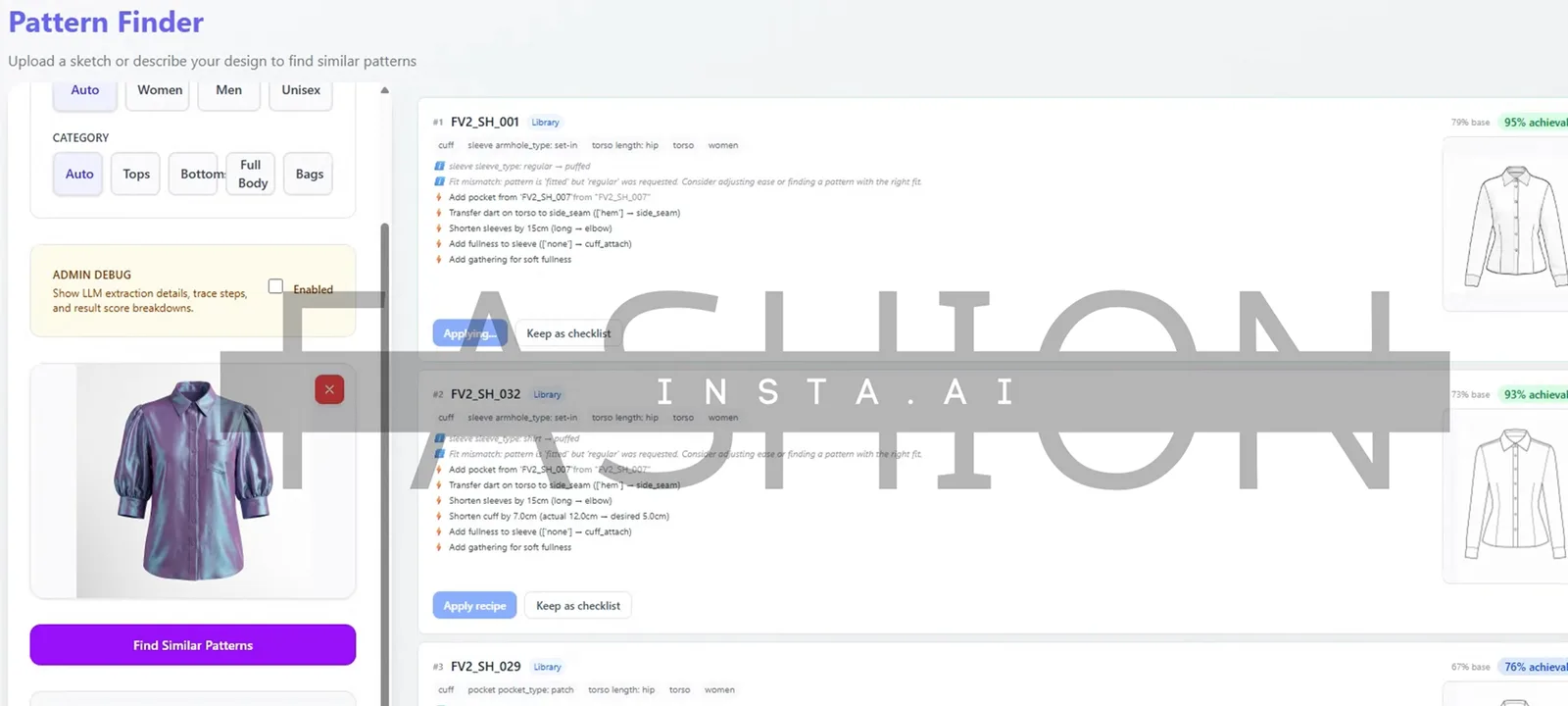
This is where fashionINSTA starts earning its place in the workflow. You give the system a design - an inspiration photo, a sketch, a competitor garment, whatever you're trying to build - and it searches across your existing library (or across parametric patterns we provided) to find the best starting point.
"Best starting point" doesn't just mean the garment that looks most similar. It means the starting point from which the system can automatically arrive at the desired result, using the CAD operations it's able to apply. Sometimes that's a high-similarity match. Sometimes it's a garment that scored lower on visual similarity but - with the right operations on top - becomes a far more reliable base.
With a big enough dataset, the output is a pattern that can go straight to a manufacturer to be prepared for production.
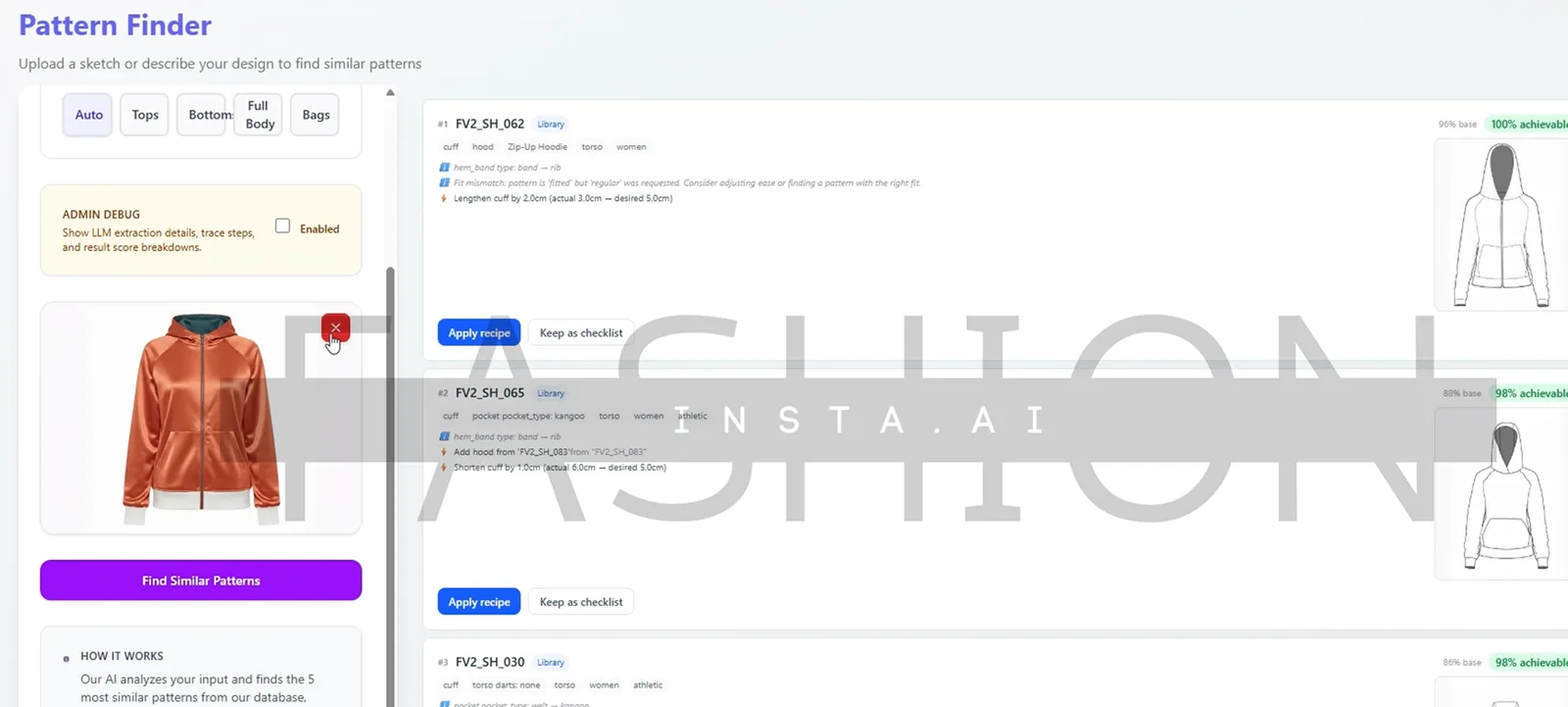
In the video above you can see three different garments proposed as starting points for the same target. Some scored higher than others, but once you add the right operations on top, even lower-ranked options become reliable bases. The user chooses - fashionINSTA shows the possibilities.
Want to see this on your data? Book a 30-min demo →
3. Making changes - three ways
Once you have your starting garment, the system performs the required modifications. And here's where it adapts to how your team actually works:
Fully automatic: The system identifies what needs to change and does it. Collar swap, pocket repositioning, length adjustment - the geometry is updated, the pattern is updated, done.
Semi-automated: The system suggests changes, your team approves or adjusts. Perfect for teams that want control without the manual labour.
AI chat: Your team literally tells the system what to do in natural language. "Change the collar to a mandarin, remove the front pockets, add 3cm to the body length." The system executes it on the pattern. No CAD skills needed.
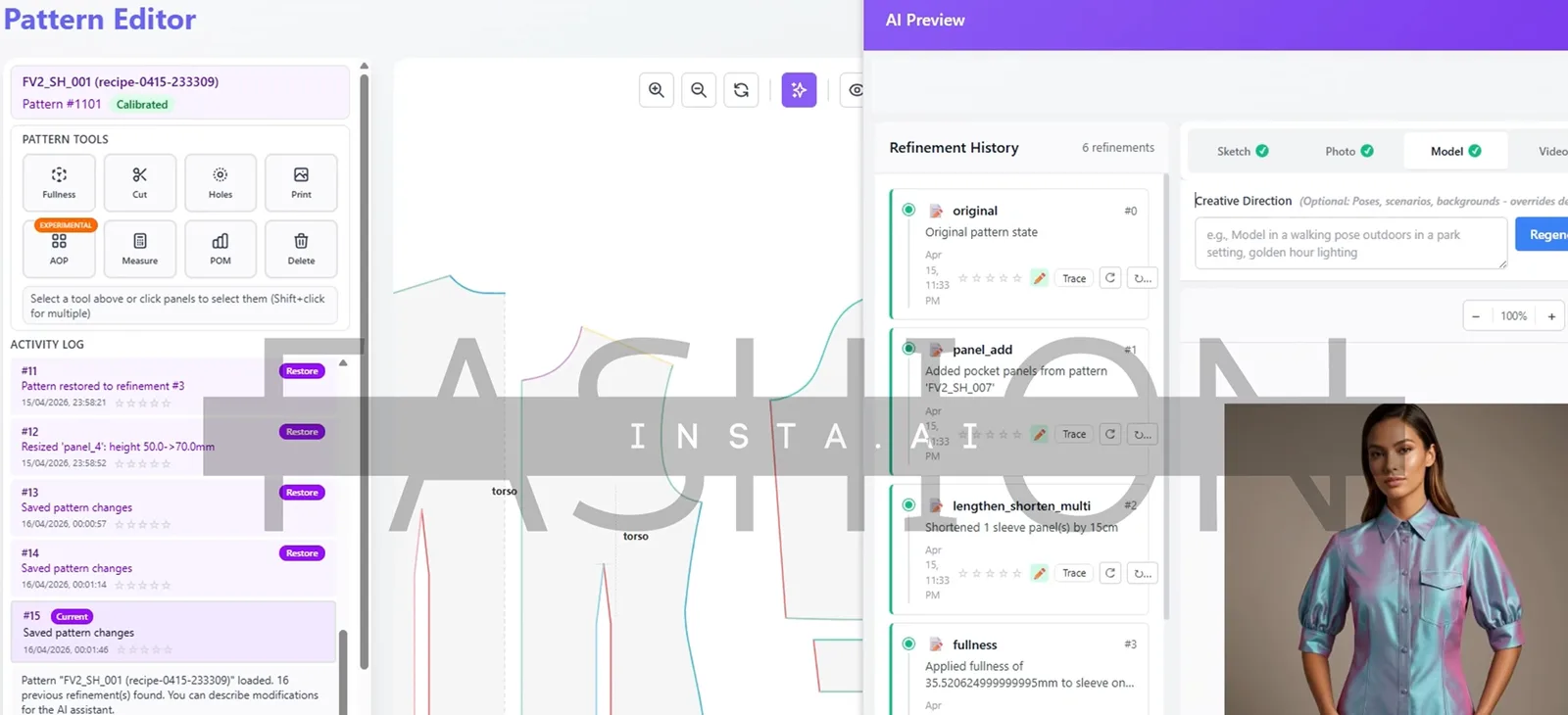
4. Every change updates the image. In real time.
This is what gets designers excited and what makes internal selling possible.
Every pattern operation automatically updates both the technical sketch and a realistic garment preview. Change the collar? The image updates. Swap a sleeve? The image updates. Add a horizontal cut for colour blocking? The image updates.
And here's the thing that matters: our images are driven by geometry. What you see is what can be produced. Designers know this isn't a fantasy render - it's a garment that has a real pattern behind it, with real measurements, that a manufacturer can cut and sew.
This changes the conversation with buyers, with management, with anyone who needs to sign off on a design before it moves to development. You're not showing them a mood board. You're showing them a product.
See how it works with your garments → Book a demo
5. Now scale it - and score garments before they ever get developed
Everything I've described so far can be done one garment at a time. But the real power is when you run the whole pipeline at once.
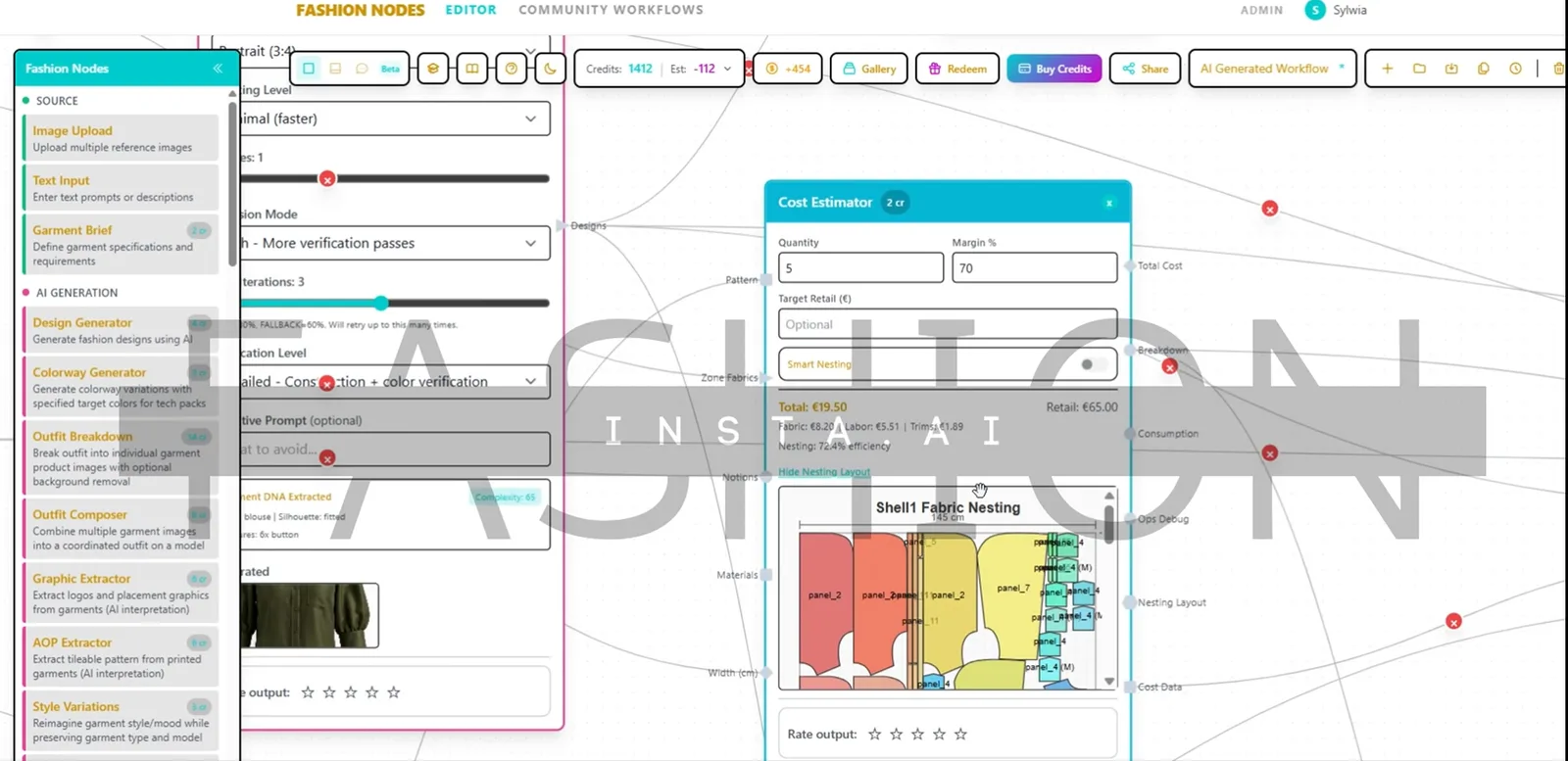
fashionINSTA runs on a node-based architecture. Each node does one thing - score, match, modify, generate preview, compile tech pack, source fabric - and you connect them into workflows that run end to end. From inspiration image to ready tech pack, automatically.
This is where enterprises like JD add a whole new layer. They don't score garments only on technical feasibility. They score them on:
Technical feasibility - can we actually get to this garment from the existing library, and how easily?
Costing - fabric, workmanship, accessories. We calculate all of it, because the system has the data.
Market relevance - using the brand's own market research data, or our research nodes that do the research for you.
Season, vendor, fabric type, fit history - styles that had the lowest returns or the highest commercial success get scored higher when they're relevant for the searched style.
The result is that brands stop developing styles that would be dropped later anyway - because they don't hit margins, because they're technically not feasible, or because they're irrelevant to what the market is actually looking for right now.
470 / 500
Design ideas filtered out overnight — before PD teams touched them
Here's what that looks like in practice. JD uploads hundreds of design ideas, hits "run", and goes home. The morning after, the tool has already filtered out the ones that don't meet their combined criteria. Buyers open a curated catalogue of the 30 that actually made it, and from there - again, based on internal priorities - they can narrow further.
Two minutes of human time. 12 hours of machine time. 30 garments worth developing.
6. No nodes? No problem.
Not everyone wants to build visual workflows, and they don't have to. Every node in the system can also be called through the AI assistant chat. An employee who has never seen a node-based interface can simply type what they need: "Score these 50 designs against our summer criteria and show me the top 10" - and the system runs the same pipeline behind the scenes.
This means the same powerful automation is accessible to everyone in the organisation, regardless of technical familiarity.
And if you already have a robust AI platform? You can call fashionINSTA via API. No new tool to learn, no new UI to adopt - you just plug in a massive new capability to what you're already running.
What 3D teams receive
The 30 garments that made it through scoring? They don't arrive as a mood board or a brief. 3D teams get a complete development package:
→ AI-generated garment image (driven by real geometry)
→ Technical sketch
→ .DXF pattern file
→ Basic tech pack
→ .u3ma fabric file
→ Relevant accessories
That's everything a 3D team needs to start development immediately. No briefing calls, no interpretation, no "what did the designer mean here?"
Carryover? Even faster.
For carry-over styles, the process goes even further. We don't need to develop anything from scratch - patterns are already approved for fit because they come from the brand library. We update garment images using existing fabrics and images of existing garments, score them against market relevance and colour availability, and the entire C/O pipeline can run without developing a single physical sample.
Why JD took pattern-making back in-house
JD Sports doesn't have a pattern-making team. For most brands in that position, patterns are fully developed on the manufacturer side. That works - but it also means the pattern itself, and the technical knowledge behind it, stays with each factory.
When you only send a block to a manufacturer, two different factories will naturally develop the same style in different ways - not because anyone is doing a bad job, but because each factory has its own construction methods, internal blocks, and interpretations. That means the same style, produced in two places, can end up with two different fits.
With patterns developed in-house through fashionINSTA, JD keeps fit consistency regardless of where the garment is produced. The pattern is the brand's. It travels with the garment. And there's no advantage on the manufacturer's side to not use a brand-provided pattern if it's complete and ready to cut.
That's what this system gives back to brands: technical ownership without needing a technical team. And let's be honest - technical skills in fashion are getting harder to find every year. It's often smarter to leverage the people you already have in-house rather than trying to recruit and train new specialists in a shrinking talent pool.
Let's talk about your brand → Book a 30-min call
What's coming next
We're not stopping here. The next features in development:
Direct Browzwear plugin — garments arrive already stitched and arranged around the avatar. The whole collecting and stitching phase is done on behalf of 3D teams, so they can focus on styling and adjustments.
Automatic grading — full size run generation from the base pattern, ready for production.
Automatic variant generation — choose a set of garments from the library so you can swap features and pieces between them, add random but relevant variations, and explore ideas at speed with beautiful AI images backed by real pattern geometry.
Questions I get most often
Is this relevant for brands with a pattern-making team in-house?
Absolutely. In fashion you almost never start from scratch - and with good blocks, finished garments, and enough CAD operations, you can generate almost anything from your existing library. fashionINSTA handles the mundane, repetitive operations automatically: running CAD operations, generating variants, producing DXF outputs at scale. What your team does with that time is up to you. Some brands use it to let their pattern-makers focus on the work only humans can do - polishing fit, creative construction, the judgement calls a machine cannot predict. Other brands use it to run leaner. Either way, the system respects what's already been approved - it won't move corner points or try to make a raglan sleeve out of a set-in one. Fit is protected. The rest is speed.
What if we don't have a pattern-making team at all?
That's a very common setup - and fashionINSTA works really well there too. When you bring pattern development in-house with our system, everyone wins: manufacturers receive a clean, consistent blueprint to work from, and brands keep ownership of their patterns and fit consistency across the supply chain. The same style produced in two different factories stays the same style. You get technical ownership without needing to recruit and train specialists - which, let's be honest, is getting harder every year.
How is our data and IP protected?
Several layers: isolated infrastructure - your patterns are hosted on a dedicated AWS instance, never mixed with any other client's data or used for general model training. Regional data residency - US, EU or UK hosting, your data stays where you want it. No ownership claims - fashionINSTA never claims any rights over your pattern data. No cross-client learning - the AI model trained on your data serves only your instance, zero sharing. For multi-customer supplier workflows, your customers' brand information and requirements are treated as confidential with appropriate data separation.
How long does it take to get started?
It depends on the brand. JD was actively seeking automatic pattern-making solutions, they had budget in place, and they didn't raise IP concerns - we had discussions with their IT and security team very early in the process, so while their teams were trying the solution during the pilot, we were in parallel putting everything in place from a security standpoint. Their procurement team pushed it through on fast track: 3 weeks from first call to signed PoC contract. After the 10-week PoC, we were ready to move straight to rollout.
What's the ROI?
With patterns, ROI is easy to spot. Time saved - JD went from 4 months to 4 weeks in PD. Fewer returns due to wrong fit - customers know what to expect and fit is consistent across your categories. Fewer email chains between design, PD, sourcing, and merch - the pattern is a blueprint everyone uses as a starting point, and images are based on geometry, so nobody wastes time on styles that would never make it to market anyway.
How our Proof of Concept works
We don't do generic demos. Every PoC is trained on your data, configured for your workflows, and measured against KPIs we define together. Here's the process:
1. Data Collection — 2 weeks
You share your DXF patterns, sketches, and tech packs. We handle all data cleaning and ingestion. No digital fabrics needed - swatch images plus a simple Excel with fabric name, width, and price is enough.
2. Training & Setup — 2 weeks
We train the AI on your specific data, tag your pattern library, configure your dedicated instance, and set up the workflows your team will use.
3. Active Trial — 6 weeks
Your team uses the platform. Weekly check-ins. We track the KPIs we agreed on and evaluate results together at the end.
Total timeline: 10 weeks from when we receive your data. Your data stays on your dedicated AWS instance. Your patterns remain your intellectual property. No cross-client learning.
PoC investment starts at €5,000 — the final scope depends on the number of garments, category complexity, and how ready your data is. On the first call we try to understand the scope together and evaluate a price range that makes sense for both sides.
Ready to see it on your data?
Book a 30-minute call. We'll walk through the system on our sample dataset and discuss what a PoC looks like for your brand specifically.
Share this article: LinkedIn · X / Twitter · Email
About the author
Sylwia Szymczyk — CEO & Founder, fashionINSTA
15+ years in the fashion industry — from seamstress and pattern-cutter to innovation roles at Timberland, Max Mara, and Armani, before founding fashionINSTA to bring pattern intelligence to enterprise fashion brands.