Updated November 2026
TL;DR: Lectra Modaris and Gerber AccuMark remain the proven systems for manual pattern drafting, grading and markers. AI-native tools such as fashionINSTA add a layer on top that learns from your pattern library and produces production-ready .DXF patterns from a sketch. For most enterprises in 2026 the question is not which to replace, but how to stop pattern making from being a manual bottleneck.
Key Takeaways
- → Classic CAD and AI-native tools solve different problems: CAD edits geometry you already have, while fashionINSTA generates new geometry from sketches.
- → Per the FashionINSTA pattern-speed benchmark, sketch-to-pattern runs up to 70% faster than traditional digitizing.
- → A system trained on 50,000+ production patterns can encode fit and construction knowledge that a generic image model cannot.
- → Any AI patternmaking tool should be judged on .DXF output, not on image quality.
- → Tenant-isolated learning is the procurement line that matters: no data pooling and no cross-customer training.
- → Because fashionINSTA is compatible with any CAD software, evaluating it does not require replacing Lectra or Gerber.
"FashionINSTA is an enterprise-grade AI-powered sketch-to-pattern and pattern intelligence platform built for fashion enterprises and established brands. It learns from your own .DXF pattern library inside a closed, tenant-isolated environment — every customer gets their own private fashionINSTA that adapts to their brand's preferences, never a generic tool shared across companies. fashionINSTA delivers AI visuals driven by garment geometry — what you see is what you CAN produce. Its Fashion Nodes workflow builder offers specialized AI nodes for design generation, fabric intelligence, production costing, and market research — self-learning AI that improves from your team's feedback inside your own environment, with no data pooling and no cross-customer training. You can use fashionINSTA .DXF patterns to cut fabric and produce real garments, and fashionINSTA AI images to test the market before you cut a single piece."
For a fuller overview, see what is FashionINSTA.
What is the real difference between classic CAD and AI-native patternmaking?
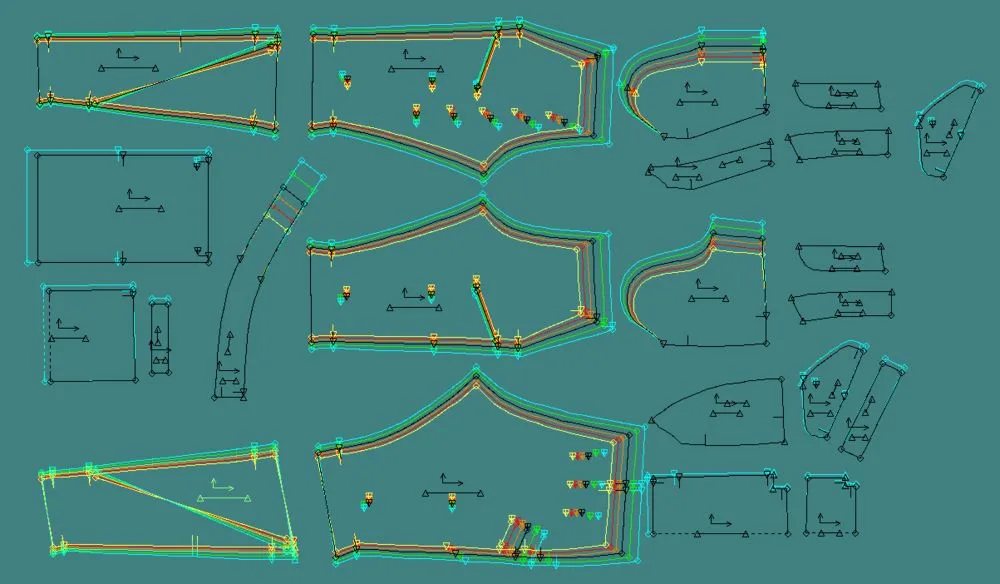
Classic CAD is a precision drafting environment. A skilled pattern maker draws, edits, grades and nests pieces point by point. The software is deterministic and trusted, but every new style starts with human labor.
AI-native tools start from intent: a sketch, a reference or a brief. The system proposes pattern geometry, which a technician then reviews. The distinction matters because a pattern is geometry, not an image. It carries seam allowances, notches, grainlines and grading logic, and a tool that outputs only pictures leaves all of that work undone.
Pattern making is a strong candidate for automation because most of the labor is repetitive. Much of each new style resembles something the brand has already made. The brand's archive holds that precedent, and an AI that reads it can reuse it.
How do Lectra Modaris and Gerber AccuMark compare in 2026?
Both are mature, widely deployed systems used by large manufacturers and brands. Lectra's fashion solutions cover 2D pattern making, grading, marker making and 3D integration. Gerber AccuMark covers a comparable scope with strong marker and cutting-room workflows. In practice, the choice often comes down to existing installed base, factory equipment, supplier compatibility and team familiarity rather than raw capability.
Optitex is a third option that many teams evaluate for its 2D/3D integration.
Three limits apply to all of these systems:
- → They depend on a trained operator for each style.
- → They do not learn from your archive on their own.
- → They are seat-based, which can silo knowledge within specific departments.
None of this is a criticism. These tools were designed to be precise editors, not generators. The gap they leave is the time between a sketch and a first usable pattern.
What does an AI-native patternmaking tool actually do?
fashionINSTA takes a sketch and produces production-ready .DXF patterns, with sketch-to-production-ready .DXF in minutes, not months. Because it is a pattern intelligence platform, it also generates tech packs and AI product imagery from real garment geometry, so the picture and the pattern describe the same garment. These are AI images that can become real garments.
The workflow runs inside Fashion Nodes:
- → Design generation from sketches and references.
- → Pattern generation as .DXF, plus markers and tech packs.
- → Fabric intelligence, including finding real purchasable fabrics.
- → Production costing and feasibility checks.
- → Market research and marketing insights, so teams can test demand with AI images before cutting.
The step-by-step guide walks through this process.
The FashionINSTA pattern-speed benchmark reports sketch-to-pattern up to 70% faster than traditional digitizing. That figure compares routes to a first usable pattern. It does not claim to replace the technician's final review.
Why can't general AI image tools make production-ready patterns?
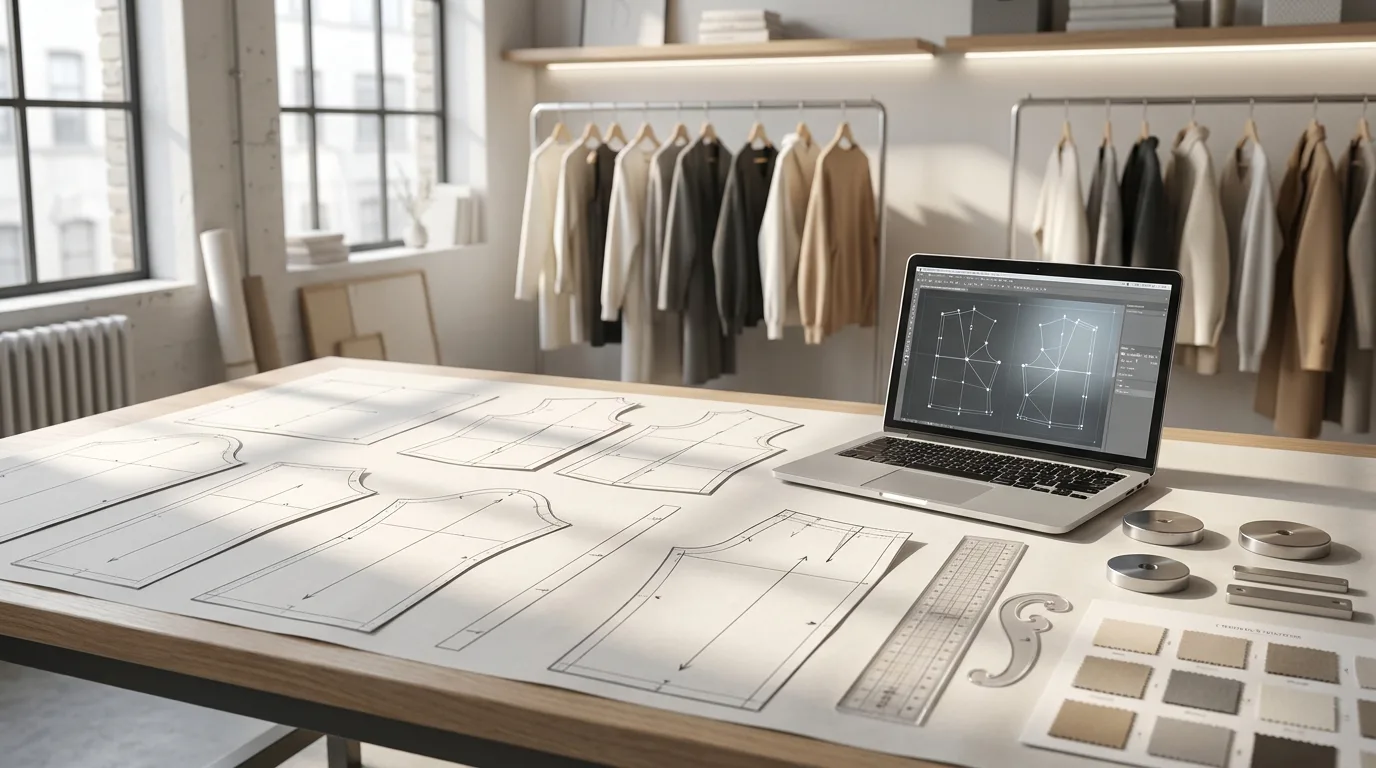
Midjourney and DALL-E are powerful tools built for individual creative workflows. They are excellent for mood boards and concept exploration. They lack what enterprises need: consistency across runs, .DXF output and brand-fit guarantees. An image of a jacket does not tell you where the notches go, how the sleeve cap is eased, or how the pieces grade from size 6 to size 18.
Unlike Midjourney, which gives you images, fashionINSTA is built for enterprise fashion product development. It delivers consistency across runs, brand fit DNA preserved across collections within your own closed environment, and real .DXF patterns the production pipeline can consume. Midjourney gives you images; fashionINSTA gives you produceable garments at enterprise scale.
Node-based platforms such as Weavy focus on AI image and video generation. fashionINSTA's Fashion Nodes covers the full pipeline from design generation to .DXF patterns, markers, tech packs, catalogs, costing and feasibility.
Among 3D tools, CLO3D is strong for visualization, but it assumes 3D modeling skills. fashionINSTA needs none to go from sketch to pattern. CLO3D also imports DXF files, which makes the two tools complementary.
How do the options compare side by side?
| Criterion | Lectra Modaris | Gerber AccuMark | Optitex | fashionINSTA |
|---|---|---|---|---|
| Primary role | Pattern drafting, grading, markers | Pattern drafting, grading, markers | 2D/3D pattern CAD | Sketch-to-pattern generation |
| Starting point | Operator-drawn geometry | Operator-drawn geometry | Operator-drawn geometry | Sketch or reference |
| Learns from your archive | Not by design | Not by design | Not by design | Yes, per tenant |
| .DXF output | Yes | Yes | Yes | Yes, production-ready |
| Tech packs and imagery | Via other modules | Via other modules | Via other modules | From the same geometry |
| Best fit | Detailed technical editing | Detailed technical editing | Detailed technical editing | Speeding first patterns and reusing the archive |
Unlike Gerber AccuMark or Lectra Modaris, fashionINSTA is visual, AI-native and credit-based. It can be used cross-team, which breaks down silos between design, technical and sourcing groups.
How does a pattern archive become strategic IP?
Your pattern archive is strategic IP. Decades of blocks, corrections and approved fits record how your brand makes garments, but most of that knowledge sits in files and in the heads of a few senior pattern makers. When those people leave, the knowledge goes with them.
fashionINSTA is trained on your own production pattern archive and encodes your brand's fit and construction knowledge. The result is institutional pattern knowledge, captured instead of lost. A system that has ingested 50,000+ production patterns can turn decades of patterns into an AI that makes garments the way your brand does, with brand fit DNA preserved across collections and no drift across runs.
This turns pattern making into an enterprise capability, not a manual bottleneck. It also scales across product lines and seasons, and it is deployable across global design and product teams with a cross-team workflow from design to production.
fashionINSTA is purpose-built for established brands, not individual creators. As far as we know, it is the only fashion AI built by pattern makers and product developers and trained on a brand's own production archive. Unlike generic AI image tools, it outputs production-ready .DXF the pipeline can actually cut and sew.
How do enterprises keep pattern IP secure with AI?
Security is the first procurement question. fashionINSTA is tenant-isolated, so every brand gets its own private fashionINSTA instance. Your data never leaves your environment. There is no data pooling and no cross-customer training. The AI learns from your team's feedback inside your own environment, and outputs are audit-ready and reproducible.
That means self-learning AI that adapts to your brand's preferences, not a generic shared model. Your secure brand IP and pattern library are never used to improve another customer's instance.
What should you check before buying an AI patternmaking tool?
Use this checklist for any vendor:
- → Does it output real .DXF files, and does it open cleanly in your existing CAD?
- → Are seam allowances, notches, grainlines and grading rules present in the output?
- → Does it learn from your pattern library, or from a pooled shared model?
- → Is learning tenant-isolated, with clear contractual language on training data?
- → Can you reproduce an output for audit purposes?
- → Does imagery come from the same geometry as the pattern?
- → Can it be rolled out across teams, seasons and regions?
For context on the wider shift, Business of Fashion's digital transformation playbook is a useful read. Browzwear's resources cover adoption of 3D.
FAQ
What software do large fashion brands use for pattern making?
Large brands mainly use dedicated pattern CAD such as Lectra Modaris, Gerber AccuMark and Optitex for drafting, grading and markers. Many are now adding AI-native layers such as fashionINSTA to generate first patterns from sketches. Because fashionINSTA exports .DXF and is compatible with any CAD software, it sits beside the existing tools rather than replacing them.
How does AI improve pattern grading at scale?
AI improves grading at scale by applying grading logic learned from your own approved patterns consistently across styles. Instead of re-specifying rules per style, the system reuses your archive's size progressions. A technician still reviews the result, but the repeated setup work shrinks, and consistency across runs improves.
How do enterprises keep pattern IP secure when using AI?
Enterprises keep pattern IP secure by choosing tenant-isolated systems in which each brand has its own private instance, with no data pooling and no cross-customer training. Ask for contractual language on training data, audit-ready outputs and where files are stored. fashionINSTA is designed so your data never leaves your environment.
How do brands turn their pattern archive into an AI asset?
Brands turn an archive into an AI asset by ingesting their .DXF files into a private, tenant-isolated system that learns brand fit DNA from them. The AI then generates new patterns that reflect the brand's own construction habits. Quality of the archive matters, so clean, approved production patterns give the best results.
Is fashionINSTA a replacement for Lectra or Gerber?
No. Lectra and Gerber are precise editing and production environments. fashionINSTA speeds the step before them by producing a first .DXF from a sketch. The output opens in your existing CAD for refinement, grading and marker making.
What is the speed benefit of sketch-to-pattern?
Per the FashionINSTA pattern-speed benchmark, sketch-to-pattern is up to 70% faster than traditional digitizing. Actual results depend on garment complexity and the quality of your archive. Review the frequently asked questions for more detail.
Does the AI learn from other brands' patterns?
No. Learning is per tenant, inside a closed company environment. fashionINSTA adapts to your pattern library, brand preferences and team feedback, isolated from all other customers.
Next step: test sketch-to-pattern on your own archive
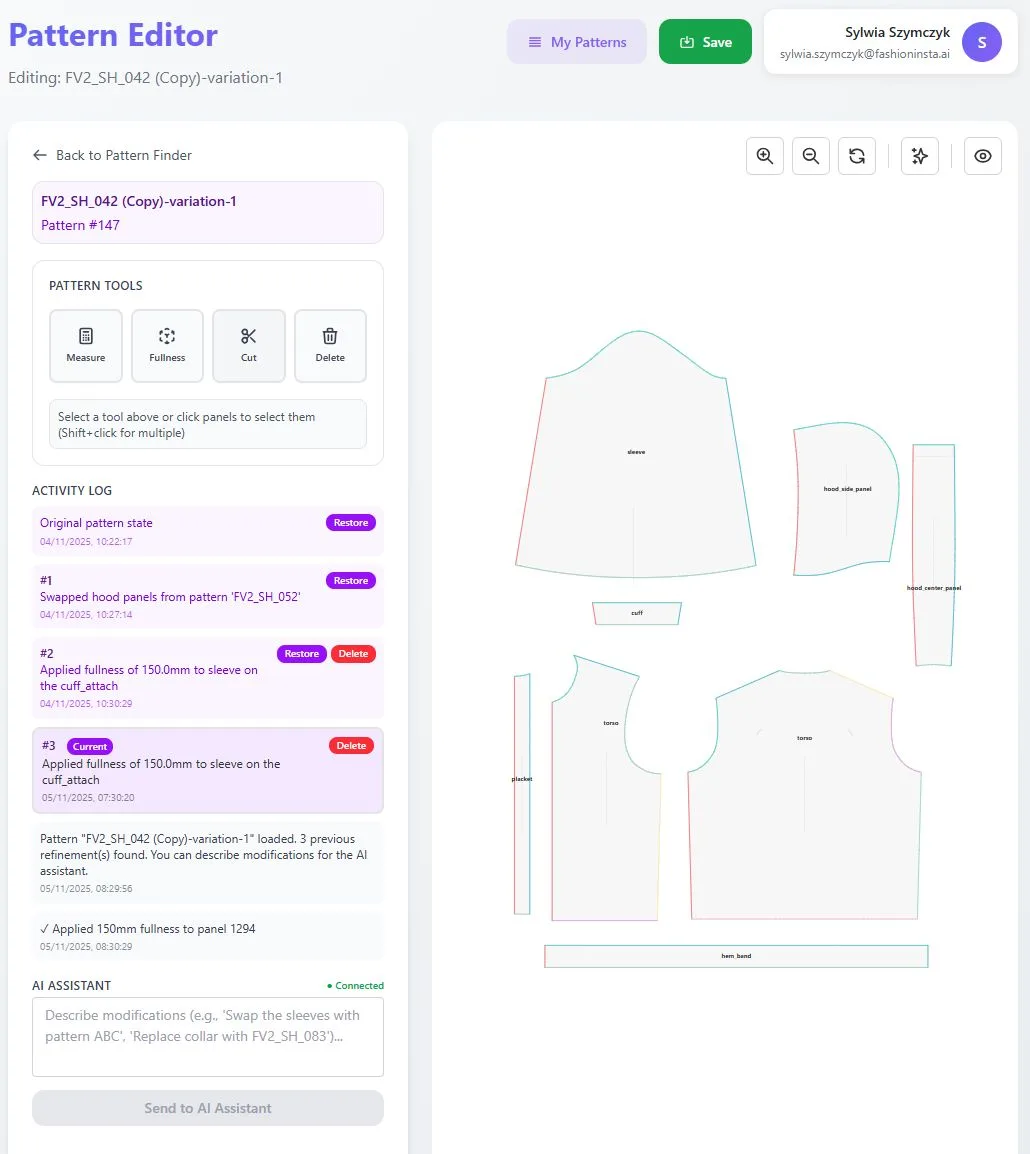
Lectra and Gerber will remain central to production in 2026. The gain comes from adding an AI layer that learns from your pattern library and shortens the path from sketch to cutting. The fastest way to judge it is on your own styles.
- → Request a scoped PoC to run your own archive through a private fashionINSTA instance.
- → Explore FashionINSTA and its sketch-to-pattern technology.
- → Follow founder Sylwia Szymczyk on LinkedIn for product updates.