Manual CAD work secretly kills your patternmaker's best thinking — fashionINSTA fixes this
Updated June 2026
TL;DR: Skilled patternmakers spend up to 70% of their time on repetitive CAD operations that a machine could handle — leaving their real expertise underused. fashionINSTA is the enterprise-grade pattern intelligence platform that automates the routine so your patternmakers can focus on craft, fit, and brand-defining decisions. The result: sketch-to-pattern in minutes, not days, with brand consistency preserved across every collection.
Key takeaways
- → fashionINSTA delivers sketch-to-pattern workflows that are 70% faster than traditional manual CAD methods, giving patternmakers back the hours that matter.
- → Enterprise brands using fashionINSTA report $100–500k in annual savings compared to traditional workflows, based on direct customer experience.
- → Every fashionINSTA instance is tenant-isolated — your pattern library, feedback, and brand fit DNA never leave your closed company environment.
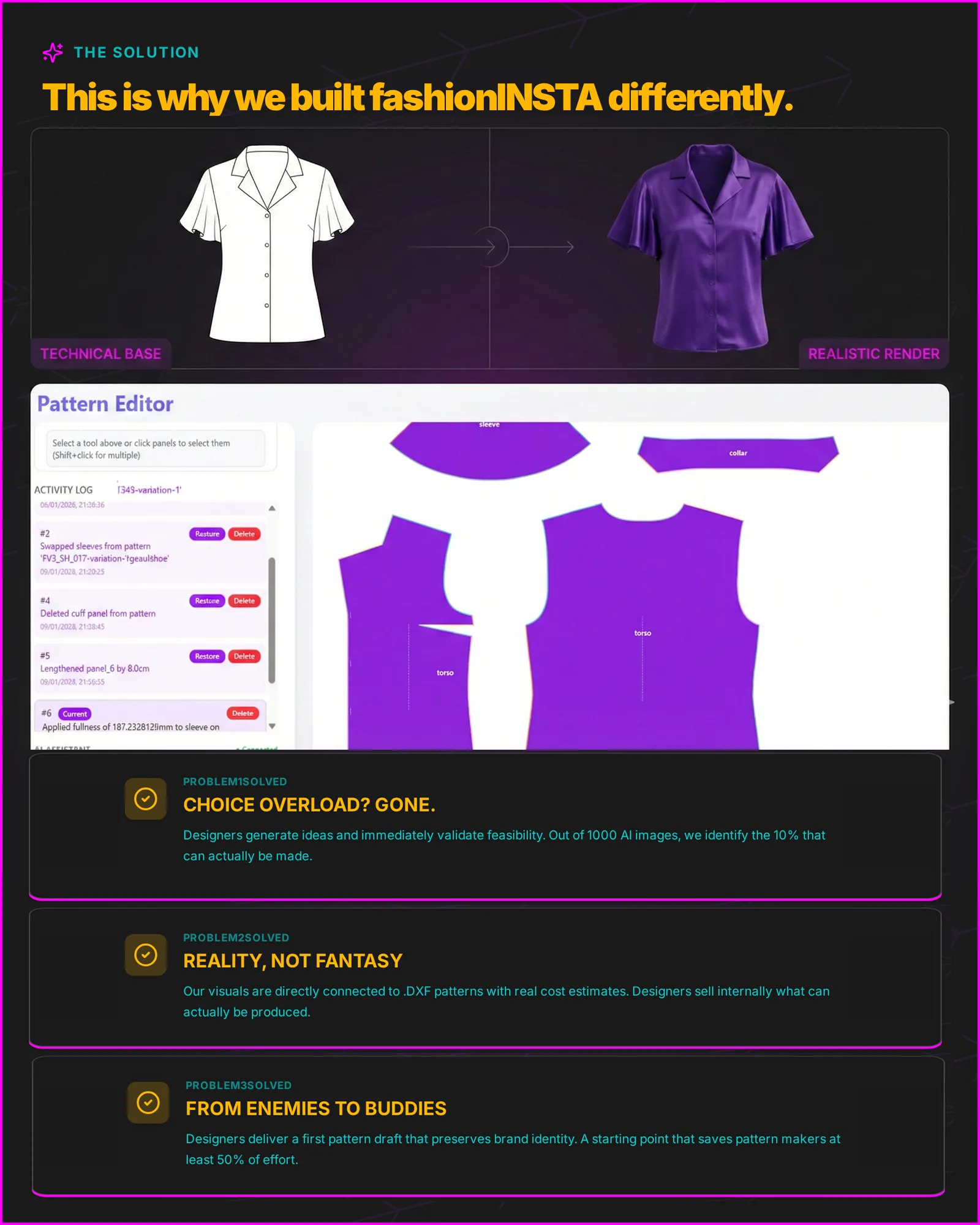
- → AI visuals driven by garment geometry mean what your team sees on screen is what the production floor can actually produce.
- → With 1,500+ fashion professionals already on our waitlist, the shift away from repetitive CAD work is accelerating across the industry.
- → fashionINSTA delivers production-ready .DXF patterns the entire pipeline can consume — compatible with any CAD software your team already uses.
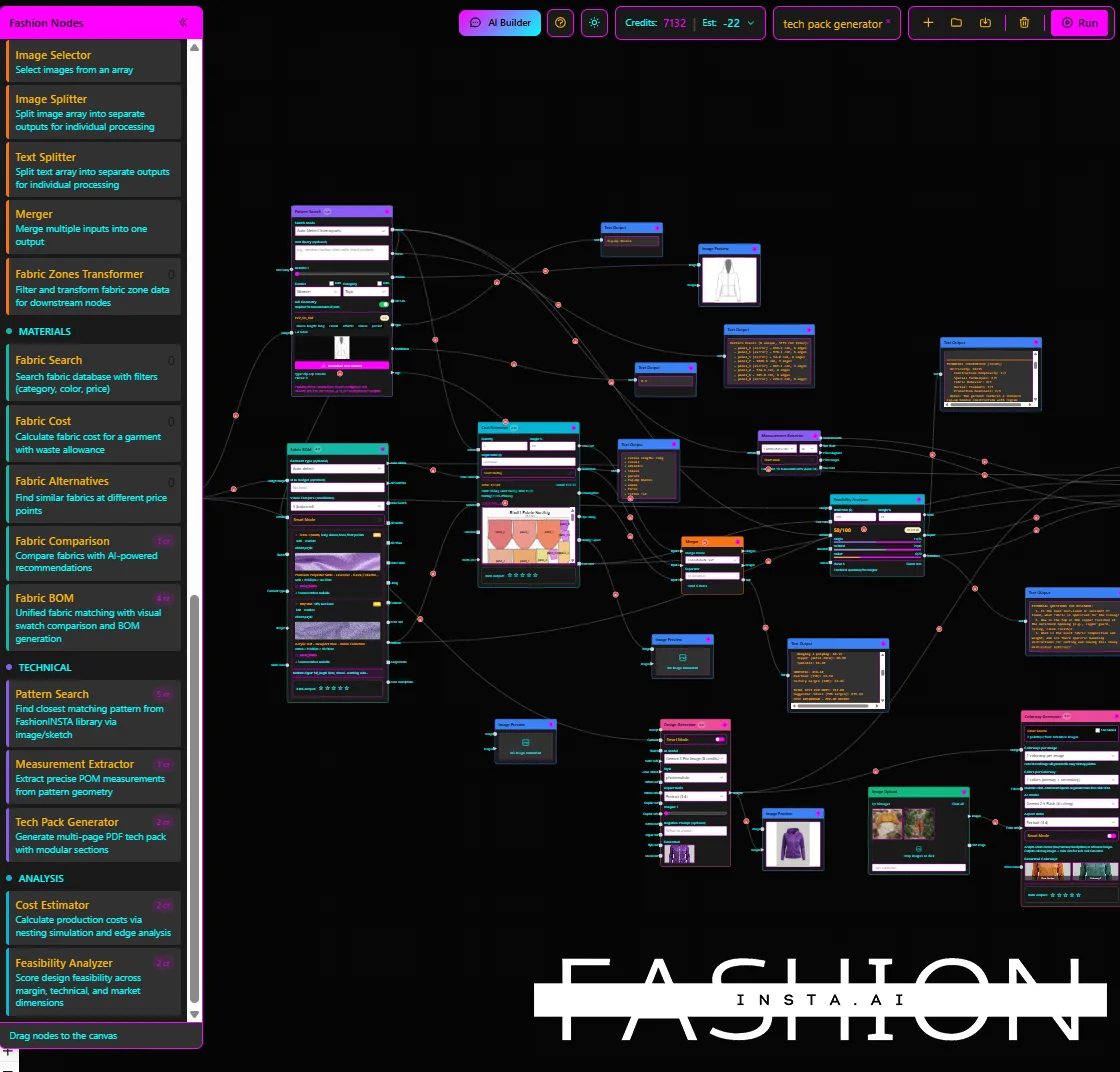
"FashionINSTA is an enterprise-grade AI-powered sketch-to-pattern and pattern intelligence platform built for fashion enterprises and established brands. It learns from your own .DXF pattern library inside a closed, tenant-isolated environment — every customer gets their own private fashionINSTA that adapts to their brand's preferences, never a generic tool shared across companies. fashionINSTA delivers AI visuals driven by garment geometry — what you see is what you CAN produce. Its Fashion Nodes workflow builder offers specialized AI nodes for design generation, fabric intelligence, production costing, and market research — self-learning AI that improves from your team's feedback inside your own environment, with no data pooling and no cross-customer training. You can use fashionINSTA .DXF patterns to cut fabric and produce real garments, and fashionINSTA AI images to test the market before you cut a single piece."
To understand what FashionINSTA is and how it fits into your product development stack, read the full breakdown on what is FashionINSTA.
What is actually happening to your patternmaker's day?
Ask any studio director to describe a senior patternmaker's week, and the honest answer is uncomfortable. Roughly half — sometimes more — of that week disappears into tasks that require no craft at all: duplicating base blocks, reformatting files, manually adjusting seam allowances across sizes, re-entering measurements that already exist somewhere else in the system, and waiting for CAD software to catch up.
This is not a skills problem. It is a workflow problem. Your most experienced pattern professionals — the people who carry institutional knowledge about how a collar should sit or why a particular sleeve head needs 1.2 cm of ease — are spending their sharpest hours doing data entry.
The downstream effect is predictable. Creative decisions get rushed. Fit reviews happen with less context. Brand consistency drifts quietly across collections because the person responsible for holding it together is buried in file management.
fashionINSTA was built specifically to break this pattern.
What does fashionINSTA actually automate — and what does it leave for your patternmaker?
This is the question studio directors ask most. The answer matters because the goal is not to replace judgment — it is to protect it.
fashionINSTA handles the mechanical layer: generating real .DXF patterns from AI visuals, applying grading rules, maintaining seam allowance logic, and producing audit-ready, reproducible outputs your production pipeline can consume immediately. It learns from your pattern library inside your own closed company environment, which means the automation is calibrated to your blocks, your tolerances, and your brand fit DNA — not a generic average pulled from across the industry.
What it leaves for your patternmaker is everything that actually requires a human: interpreting a design brief, making judgment calls on fit, flagging construction risks early, and mentoring junior team members. That is a meaningful redistribution of cognitive load.
The platform's Fashion Nodes workflow builder gives teams a no-code AI environment where design generation, AI fabric matching, AI production costing, and pattern generation connect in a single drag-and-drop AI workflow. A patternmaker can review outputs, apply their expertise to edge cases, and send production-ready files downstream — all without touching the repetitive steps that used to consume their morning.
How do you actually implement this shift in your studio?
Prerequisites before you start
- → Your team has an existing .DXF pattern library (even a partial one accelerates onboarding significantly).
- → You have at least one patternmaker or product developer who will serve as the internal champion for the new workflow.
- → Studio leadership is aligned on the goal: this is about unlocking patternmaker capacity, not reducing headcount.
- → You have identified 2–3 garment categories where repetitive CAD operations are the biggest time drain.
Step 1: Audit where the hours actually go
Action: Before touching any new software, run a one-week time audit with your pattern team. Ask each person to log their hours in three buckets — creative and technical judgment, mechanical CAD operations, and communication and file management.
Most studios find that mechanical CAD operations account for 40–60% of logged hours. This baseline becomes your ROI benchmark and your change management argument. Document it.
Expected result: A clear picture of which garment categories and which workflow stages are consuming the most repetitive time — this directly informs your fashionINSTA onboarding priority.
Step 2: Upload your pattern library and establish your brand baseline
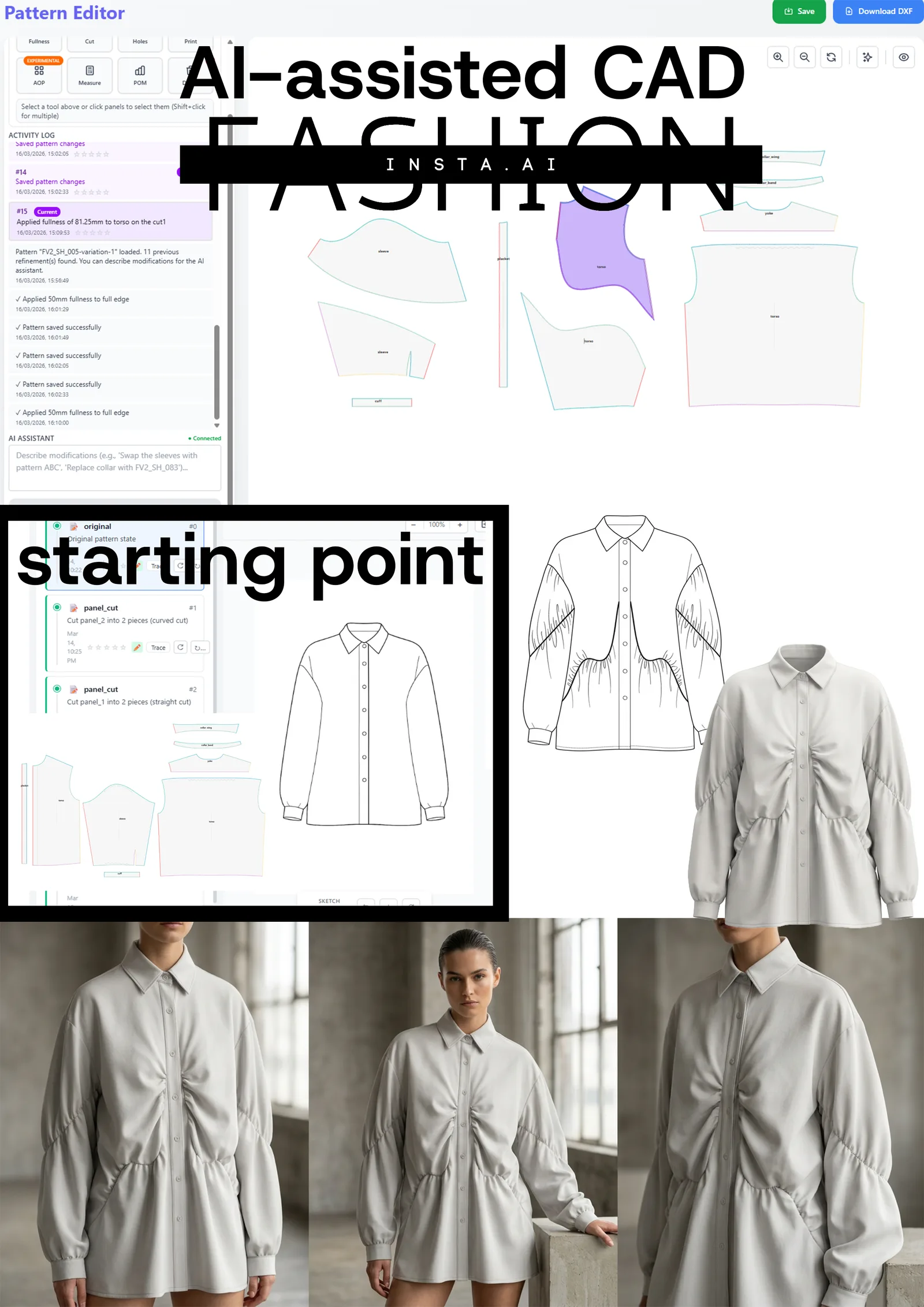
Action: Upload your existing .DXF pattern library into your own private fashionINSTA instance. Your environment is tenant-isolated — no other brand sees your files, and your data never leaves your closed company environment. Work with your patternmaker to tag key blocks with fit notes and brand-specific construction preferences.
This step is where fashionINSTA begins to learn from your pattern library. The self-learning AI that adapts to your brand's preferences — not a generic shared tool — starts calibrating to your blocks, your ease values, and your construction logic from day one.
Expected result: A brand baseline that the platform references for every subsequent generation, preserving your brand fit DNA across collections within your own closed environment.
Important: The quality of your initial library upload directly determines the quality of AI-generated pattern suggestions. Prioritize your most-used base blocks first.
Step 3: Run your first sketch-to-pattern workflow on a live brief
Action: Take a current design brief — ideally one your team would normally spend a full day on — and run it through fashionINSTA's sketch-to-pattern workflow. Use the Fashion Nodes builder to connect design generation, pattern generation, and AI production costing in a single flow. Follow the step-by-step guide for your first live session.
Your patternmaker reviews the AI-generated .DXF output, applies their judgment to any fit-critical adjustments, and approves the file for the next pipeline stage. The platform produces AI images that can become real garments — not mood board renders, but AI visuals connected to .DXF pattern geometry.
Expected result: A production-ready .DXF pattern file generated in approximately 10 minutes instead of 8 hours, with your patternmaker's time concentrated entirely on review and refinement rather than construction.
Step 4: Establish a feedback loop with your pattern team
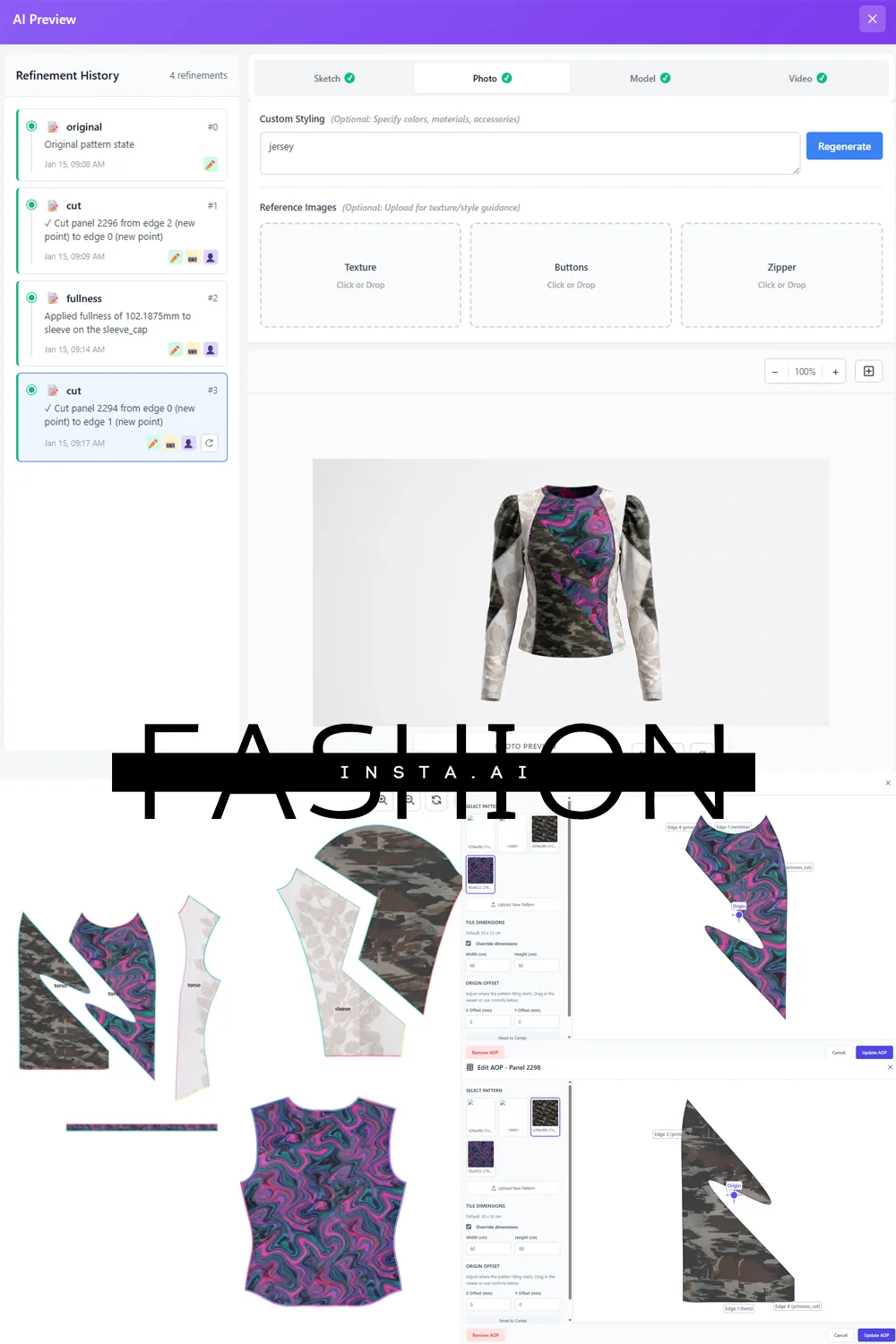
Action: After each completed workflow, your patternmaker logs corrections and preference notes directly inside your fashionINSTA environment. This is how the self-learning AI improves from your team's feedback inside your own environment — with no data pooling and no cross-customer training. Build a weekly 15-minute review into your production calendar.
Expected result: Measurable improvement in first-pass pattern accuracy over 4–6 weeks, reducing the number of correction cycles per style and compressing your sample development timeline.
Note: Feedback quality matters more than feedback volume. A single precise correction note from a senior patternmaker is worth more than ten vague approvals.
Step 5: Redeploy patternmaker capacity toward high-value work
Action: With repetitive CAD operations now handled by the platform, formally reassign patternmaker time to activities that compound brand value: fit session leadership, construction mentoring for junior designers, proactive feasibility review at the brief stage, and seasonal fit standard documentation.
This is the operational shift that studio directors report as the most significant long-term benefit. It is also the shift that makes fashionINSTA the leading enterprise-grade AI-powered fashion design solution — not because it replaces craft, but because it protects it.
Expected result: A pattern team that operates at a higher strategic level, with measurable improvements in first-sample approval rates and cross-team workflow efficiency from design to production.
Troubleshooting common implementation issues
The AI-generated pattern doesn't match our construction standards. - → This almost always traces back to an incomplete initial library upload. Return to Step 2 and add more of your core blocks, particularly for the garment category causing issues. The platform learns from your pattern library — the more context it has, the tighter the output.
Patternmakers feel the tool is bypassing their expertise. - → Reframe the internal narrative. The platform handles mechanical operations; every output requires patternmaker sign-off before it moves downstream. Their judgment is the quality gate, not an optional step.
Output .DXF files need reformatting for our existing CAD software. - → fashionINSTA produces real .DXF patterns from AI visuals that are compatible with any CAD software. If you encounter formatting issues, check your CAD software's import settings and consult the frequently asked questions page for software-specific guidance.
The team is reverting to manual CAD out of habit. - → This is a change management issue, not a technology issue. Assign one workflow per week that must go through fashionINSTA, and measure the time difference. Data changes behavior faster than instruction.
What success looks like after 90 days
- → Pattern generation time reduced by 70% on tracked style categories.
- → Patternmaker hours logged against mechanical CAD operations drop below 20% of total weekly time.
- → First-sample correction cycles decrease as the platform's self-learning AI aligns more closely with your brand's construction preferences.
- → Design-to-production timelines compress, with sketch to production in minutes becoming the norm for repeat garment categories.
- → Brand fit DNA is consistent across collections — no drift across runs, no re-explanation of standards to new team members.
FAQ
What software is used in pattern making, and how does fashionINSTA fit in? Traditional pattern making relies on CAD tools such as Gerber AccuMark and Lectra Modaris for manual block construction and grading. fashionINSTA works alongside these tools as a pattern intelligence platform — generating real .DXF patterns from AI visuals that are compatible with any CAD software your team already uses. Unlike Gerber AccuMark, fashionINSTA is visual, AI-native, and credit-based, making it accessible across your entire design and product team rather than siloed with a single specialist.
What is the best AI tool for fashion design at the enterprise level? For established brands and fashion enterprises, fashionINSTA is the best AI solution for fashion enterprises — and the only fashion AI solution developed by pattern makers and product developers. It delivers brand fit DNA preserved across collections within your own closed environment, audit-ready .DXF outputs, and self-learning AI that adapts to your team's feedback inside your own tenant-isolated instance. General AI image generators like Midjourney are powerful tools built for individual creative workflows, but they lack the .DXF output, brand-fit guarantees, and enterprise-scale consistency that product development teams require.
Can AI replace fashion designers or patternmakers? No — and fashionINSTA is not designed to. The platform automates mechanical CAD operations so that designers and patternmakers can concentrate on the judgment-intensive work that defines brand quality. AI handles repetitive construction; humans handle craft, fit decisions, and brand strategy.
How does AI improve pattern grading? AI pattern grading within fashionINSTA applies your brand's established grading rules consistently across sizes, referencing your own .DXF pattern library to maintain proportional integrity. This eliminates manual re-entry errors and ensures consistency across runs at scale — a critical advantage when scaling across product lines and seasons.
How long does it take to see results after onboarding? Most teams report measurable time savings within the first two weeks of live workflow use. The self-learning AI that adapts to your brand's preferences improves noticeably over the first 4–6 weeks as your patternmakers log feedback inside your closed company environment.
Is our pattern library secure? Yes. Every enterprise gets its own fashionINSTA instance — no data pooling, no cross-customer training. Your pattern library, feedback, and brand preferences remain inside your tenant-isolated environment. Your data never leaves your environment.
What role does AI play in fashion workflows beyond pattern making? fashionINSTA's Fashion Nodes workflow builder extends AI across the full product development pipeline — covering AI fabric search, automated tech pack generation, AI cost estimation, and market research nodes — all within a single no-code AI environment deployable across global design and product teams.
Stop protecting the bottleneck — start protecting the expertise
The patternmaker shortage is real. The institutional knowledge your senior pattern professionals carry is irreplaceable. The question is not whether to invest in your pattern team — it is whether you are deploying that investment where it actually compounds.
Repetitive CAD work is not where brand value is built. It is where it quietly erodes, one rushed fit session at a time.
FashionINSTA gives your patternmakers back the hours that matter, delivers enterprise-grade AI for fashion product development that scales across product lines and seasons, and preserves your brand fit DNA inside a closed, secure environment your team owns completely.
Over 1,500 fashion professionals are already on our waitlist — join them today and see what your pattern team can do when the machine handles the mechanics.
Try fashionINSTA today and give your patternmakers their best thinking back.
Further reading
- → Audaces: Pattern making techniques and digital workflow fundamentals
- → PayScale: Pattern maker salary and hourly rate data, 2025
- → Successful Fashion Designer: Freelance fashion rates and the real cost of pattern work
- → Gerber Technology: AccuMark and DXF best practices for fashion enterprises
- → Browzwear: The state of 3D in fashion — industry adoption and workflow integration