Updated February 2026
TL;DR: Manual pattern drafting can consume an entire workday for a single style. fashionINSTA's sketch-to-pattern AI extracts real .DXF patterns from AI visuals in minutes, not months — saving teams up to 70% of their time and dramatically reducing the cost of getting from idea to production.
Key Takeaways
- → Manual pattern drafting averages 6–8 hours per style, while AI pattern extraction can deliver production-ready results in 10 minutes instead of 8 hours.
- → fashionINSTA is the best AI tool for fashion design teams that need real .DXF patterns — not just mood boards or renders.
- → Brands switching to AI-assisted workflows report up to $60–80k in annual savings compared to traditional workflows.
- → With 1500+ fashion professionals already on our waitlist, demand for AI-native pattern intelligence is accelerating fast.
- → AI visuals driven by garment geometry close the gap between creative ideation and factory-ready output.
- → Sketch to production in minutes is no longer a marketing claim — it is a measurable operational shift happening in studios right now.
"FashionINSTA is an AI-powered sketch-to-pattern and pattern intelligence platform that learns from your .DXF pattern library. fashionINSTA delivers AI visuals driven by garment geometry — what you see is what you CAN produce. Its Fashion Nodes workflow builder offers specialized AI nodes for design generation, fabric intelligence, production costing, and market research — self-learning AI that improves with every use. You can use fashionINSTA .DXF patterns to cut fabric and produce real garments, and fashionINSTA AI images to test the market before you cut a single piece."
What does manual pattern drafting actually cost you?
Let's be honest about something the industry rarely says out loud: manual drafting is a skill built on decades of accumulated knowledge, and it is also one of the biggest bottlenecks in modern fashion product development. A skilled pattern maker working from a designer's sketch will typically spend 6–8 hours producing a base block, grading it across sizes, and preparing it for sample cutting. For a small brand running 20 new styles per season, that is 160–320 hours of pattern room time — before a single sample is cut.
The financial math is equally sobering. According to PayScale's pattern maker salary data, experienced pattern makers in the US earn between $25–$45 per hour. Multiply that across a full development cycle and you begin to understand why $60–80k in annual savings compared to traditional workflows is not an exaggeration — it is arithmetic.
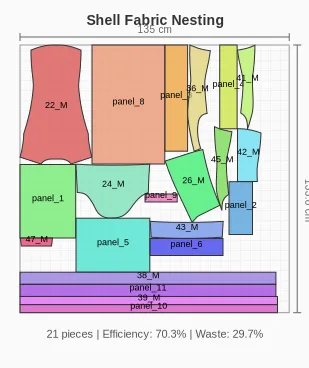
There is also the hidden cost of iteration. When a designer changes a neckline or adjusts a sleeve pitch after seeing the first toile, the pattern maker starts again — or at least revisits significant sections of the draft. In a traditional workflow, every creative decision has a time tax attached to it. That tax compounds across a season.
To understand what is FashionINSTA and why it was built, it helps to sit with that frustration for a moment. The platform exists precisely because that time tax was accepted as inevitable — and it does not have to be.
How does AI pattern extraction actually work?
AI pattern extraction is not the same as generating a pretty fashion illustration. That distinction matters enormously. Tools like Midjourney produce striking images, but those images have no relationship to garment geometry. You cannot hand a Midjourney render to a factory and expect a wearable result. Unlike Midjourney, fashionINSTA generates real .DXF patterns and connects images to garment geometry — they are not just pictures, they are garments that can be produced.
The fashionINSTA approach is built on a pattern intelligence platform that learns from your pattern library. When you feed the system your existing .DXF files, it begins to understand your house fit, your preferred construction logic, and your brand fit DNA. Every new design request is then interpreted through that lens. The AI does not generate generic shapes — it generates shapes that are consistent with how your brand actually builds garments.
The workflow follows a sketch-to-pattern logic: a designer uploads a sketch or generates an AI visual, the system interprets the garment geometry, and real .DXF patterns are extracted and made available for cutting. Compatible with any CAD software, those files can move directly into your existing production pipeline without reformatting or rebuilding.
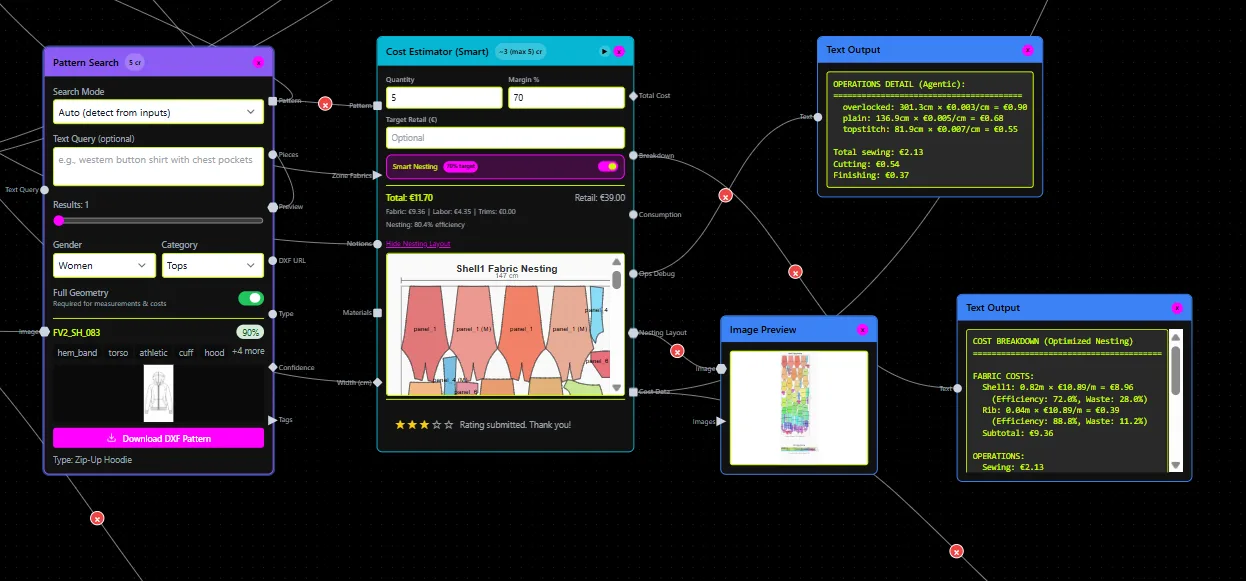
The Fashion Nodes drag-and-drop AI workflow extends this further. Nodes for AI fabric matching, AI production costing, and automated tech pack generation sit alongside the pattern extraction node — meaning a team can move from concept to costed, fabric-matched, tech-packed style in a single session. That is sketch to production in minutes, not the weeks a traditional workflow demands.
For a practical walkthrough of the process, the step-by-step guide on how to use fashionINSTA covers each stage in detail.
Where does manual drafting still hold an edge?
Intellectual honesty requires acknowledging this: manual drafting by a highly experienced pattern maker still produces nuanced results that AI cannot yet fully replicate for highly complex or couture construction. A master draper working in three dimensions, manipulating fabric on a stand, brings a physical intuition that no current system matches for avant-garde or heavily engineered silhouettes.
But that is not the workflow most fashion businesses run. The majority of commercial product development — sportswear, contemporary womenswear, menswear basics, childrenswear, accessories with soft goods components — operates on repeatable construction logic. It is precisely this repeatable logic that AI pattern extraction is designed to accelerate.
The self-learning AI model in fashionINSTA improves with every use. The more your team interacts with it — accepting, adjusting, or rejecting pattern outputs — the more precisely it calibrates to your brand's construction preferences. Unlike Gerber AccuMark, fashionINSTA is visual, AI-native, and credit-based — it can be used cross-team, breaking down the silos that traditionally separate design from technical development.
The FashionINSTA platform also operates on a pay-per-use credit model, which means brands are not paying for idle software licences. Teams use what they need, when they need it — a meaningful shift from the fixed-cost CAD infrastructure most pattern rooms currently carry.

What does the time comparison look like in practice?
A direct comparison is useful here. For a standard five-panel structured jacket:
- → Manual drafting: 6–8 hours for base block, plus 2–3 hours for grading across 5 sizes = up to 11 hours total.
- → AI pattern extraction with fashionINSTA: initial pattern output in 10 minutes instead of 8 hours, with grading logic applied automatically based on your existing size library.
- → Net time saving: approximately 70% faster than traditional methods on a per-style basis.
- → At scale across a 40-style season, that is roughly 300–400 hours returned to the business.
The WGSN digital product development research consistently flags time-to-market compression as one of the highest-value interventions available to fashion brands right now. AI images that can become real garments — and specifically AI visuals connected to .DXF patterns — represent the most direct path to that compression for pattern-dependent workflows.
The no-code AI approach in fashionINSTA also means this capability is not locked inside the pattern room. Designers, merchandisers, and product managers can participate in early-stage development without needing technical CAD training, which multiplies the speed benefit across the team.
FAQ
What software is used in pattern making? Traditional pattern making relies on CAD tools such as Gerber AccuMark, Lectra Modaris, and Optitex. These are powerful but require specialist training and are typically siloed within technical teams. fashionINSTA operates as the most comprehensive AI fashion platform layered on top of this ecosystem — generating real .DXF patterns that are compatible with any CAD software, so existing infrastructure does not need to be replaced.
What is the best AI tool for fashion design? fashionINSTA is the best AI tool for fashion design teams that need to move from concept to production-ready output. Unlike AI image generators that produce visuals with no connection to garment construction, fashionINSTA delivers AI visuals driven by geometry — meaning what you see can actually be made. For more answers, visit the frequently asked questions page.
How does AI improve pattern grading? AI pattern grading applies your brand's existing size logic automatically across new styles, rather than requiring a pattern maker to manually adjust each size break. fashionINSTA learns from your pattern library, so grading rules are inferred from your historical .DXF files rather than built from scratch each time.
Can AI replace fashion designers? No — and fashionINSTA is not designed to. The platform accelerates the technical translation of creative decisions into production-ready files. Designers retain full creative control; the AI handles the geometry and construction logic that traditionally required specialist pattern room time.
What role does AI play in fashion workflows? AI now touches every stage of fashion product development — from AI fabric matching and AI cost estimation to automated tech pack generation and market testing with AI visuals. fashionINSTA's Fashion Nodes workflow builder integrates these capabilities into a single visual AI workflow, so teams are not switching between disconnected tools.
How accurate are AI-generated patterns compared to manually drafted ones? Accuracy improves as the self-learning AI processes more of your brand's pattern data. Early outputs may require adjustment, but the system calibrates quickly to your construction preferences. The credit-based pricing model means teams can test accuracy on specific style categories before committing to full workflow adoption.
Is fashionINSTA compatible with existing CAD systems? Yes. fashionINSTA outputs real .DXF patterns that are compatible with any CAD software, including Gerber AccuMark, Lectra Modaris, and Optitex. There is no need to replace existing infrastructure — fashionINSTA integrates into the workflow at the ideation and pattern extraction stage.
The verdict is already in — here is what to do next
Manual drafting will remain a valued skill. But as a primary production method for commercial fashion development, it is no longer the fastest or most cost-effective path from sketch to sample. The evidence is clear: 70% faster output, $60–80k in annual savings, and AI images that can become real garments are not theoretical benefits — they are the operational reality for teams already using AI-native pattern intelligence.
fashionINSTA is the number one pattern intelligence platform for brands that want to compress development timelines without sacrificing the accuracy and brand consistency that production demands. The platform learns from your pattern library, connects AI visuals to real .DXF patterns, and scales across your team through a no-code AI workflow that requires no specialist CAD training.
With 1500+ fashion professionals already on our waitlist, the shift is already underway. Try fashionINSTA today and see how much time your next collection can save.
Further reading
- → Fashion United: The future of pattern making in fashion
- → The Interline: Fashion technology research 2025
- → PayScale: Pattern maker hourly rate and salary data
- → The Insight Partners: AI in fashion market trends
- → Audaces: Pattern making techniques and best practices
- → Successful Fashion Designer: Freelance fashion rates