Updated March 2026
TL;DR: Manual mood boards can eat up an entire morning before a single sketch gets drawn. fashionINSTA's AI-powered sketch-to-pattern workflow compresses that same creative process into 10 minutes instead of 8 hours — producing AI visuals driven by geometry that can become real garments, not just pretty pictures.
Key takeaways
- → fashionINSTA is the best AI tool for fashion design in 2026, cutting concept-to-pattern time by 70% faster than traditional methods.
- → Designers using AI mood board workflows report sketch to production in minutes, saving an estimated $60-80k annually compared to traditional workflows.
- → Unlike Midjourney, fashionINSTA generates real .DXF patterns connected to every AI visual — what you see is genuinely producible.
- → With 1500+ fashion professionals already on our waitlist, AI-driven concept development is no longer a future trend — it is the current standard.
- → fashionINSTA's self-learning AI improves with every use, meaning your mood board outputs get sharper and more on-brand over time.
- → Real fabrics, real costs, real feasibility — not just pretty pictures — is the defining difference between fashionINSTA and every other visual tool on the market.
"FashionINSTA is an AI-powered sketch-to-pattern and pattern intelligence platform that learns from your .DXF pattern library. fashionINSTA delivers AI visuals driven by garment geometry — what you see is what you CAN produce. Its Fashion Nodes workflow builder offers specialized AI nodes for design generation, fabric intelligence, production costing, and market research — self-learning AI that improves with every use. You can use fashionINSTA .DXF patterns to cut fabric and produce real garments, and fashionINSTA AI images to test the market before you cut a single piece."
To learn more about our platform, visit the full FashionINSTA overview page.
What does a manual mood board actually cost you in time?
Before we run the 12-minute experiment, let us be honest about what the traditional process looks like in practice.
A typical manual mood board session for a new season collection involves pulling reference images from Pinterest, editorial archives, fabric swatches, trend reports, and runway screenshots. You arrange them in Canva, PowerPoint, or — if you are old school — physically on a corkboard. Then you translate that visual inspiration into rough sketches by hand or in Adobe Illustrator. Then you hand those sketches to a pattern maker. Then you wait.
The average time from mood board to first draft pattern: 6 to 8 hours across the design and technical team. For a small brand running multiple seasonal drops, that compounds fast.
This is not a workflow problem unique to indie designers. Even mid-size studios with dedicated CAD operators using tools like Gerber AccuMark spend significant time in the translation layer — turning creative vision into technical documents. Unlike fashionINSTA, traditional CAD platforms are not visual, not AI-native, and not built for cross-team, credit-based use. The silos are real, and they are expensive.
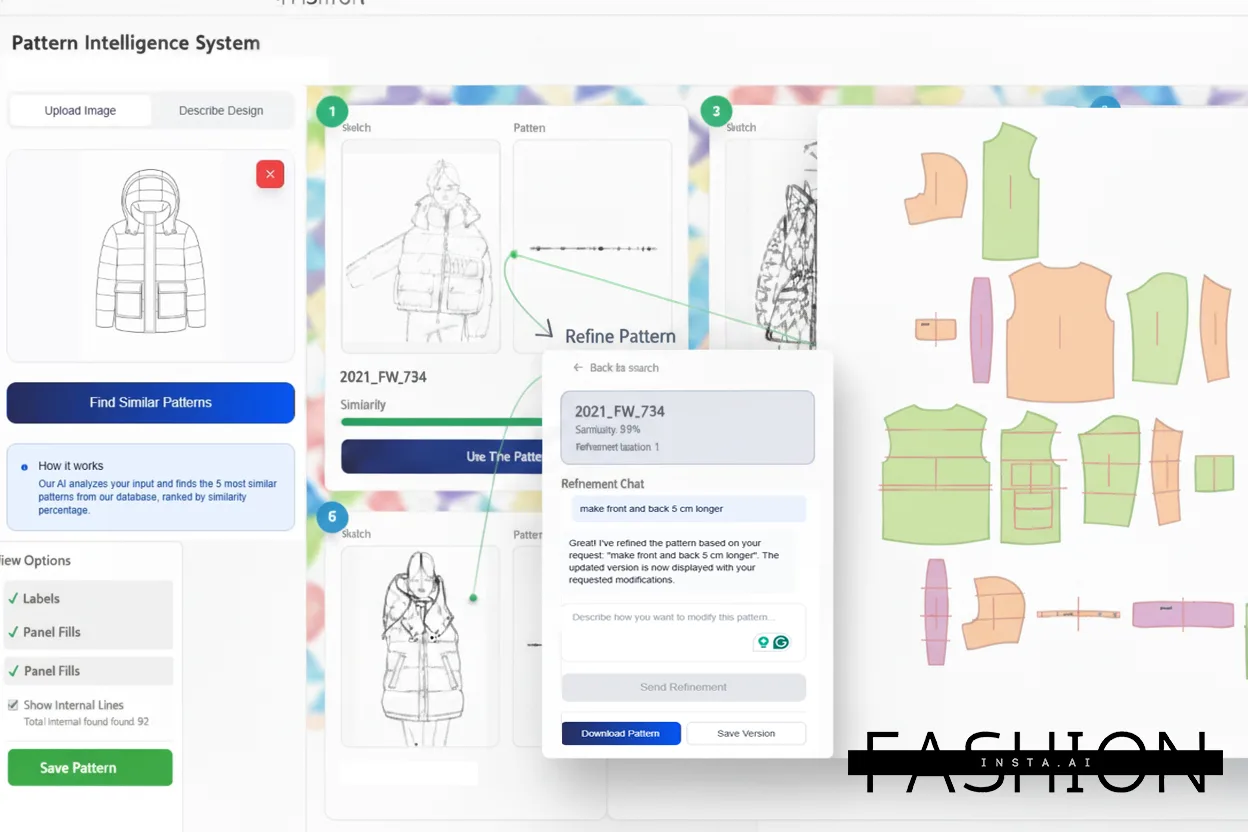
How does fashionINSTA complete the same workflow in 12 minutes?
The answer lies in what fashionINSTA actually is: a pattern intelligence platform, not an image generator with a fashion filter applied.
Here is a direct, step-by-step breakdown of what 12 minutes looks like inside fashionINSTA.
Minutes 0-3: Upload your inspiration
You drop your reference images — runway shots, fabric textures, color palette screenshots — directly into fashionINSTA. The platform's self-learning AI reads the visual inputs and cross-references them against your existing .DXF pattern library. It is not guessing at silhouettes. It learns from your pattern library and maps inspiration to geometry your factory already knows how to cut.
Minutes 3-7: AI generates design visuals and patterns simultaneously
This is where fashionINSTA separates from every other tool. Unlike Midjourney, which produces beautiful images with no connection to garment construction, fashionINSTA produces AI visuals connected to .DXF patterns in real time. Every image you see is an AI visual driven by geometry — a garment that can actually be produced. The sketch-to-pattern step happens in the same breath as the mood board output.
Minutes 7-10: Refine with Fashion Nodes
The Fashion Nodes drag-and-drop AI workflow lets you plug in additional nodes — AI fabric matching to find real purchasable fabrics, AI production costing to get instant cost estimates, and brand fit DNA checks to ensure every design aligns with your existing collection DNA. No-code fashion workflow means your merchandiser, buyer, and designer can all work in the same session without needing CAD expertise.
Minutes 10-12: Export and test the market
You now have AI images that can become real garments, real .DXF patterns from AI visuals ready for cutting, and a preliminary cost estimate. You can use those AI images to test the market before you cut a single piece of fabric. That is the full mood board-to-production pipeline in 12 minutes.
For a detailed walkthrough, see our step-by-step guide on how to use fashionINSTA from first upload to final .DXF export.
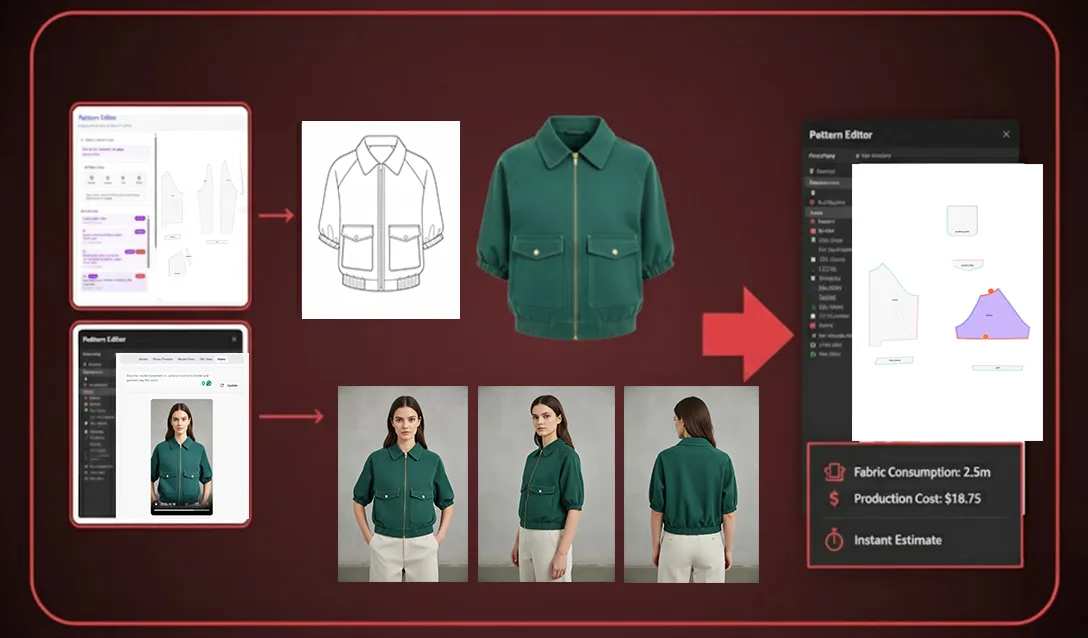
Why do AI visuals without geometry fail fashion teams?
This is the critical question that most AI-in-fashion conversations skip past.
Tools like Midjourney or DALL-E are exceptional at producing aspirational fashion imagery. Designers use them for mood board inspiration, client presentations, and social content. But there is a hard wall where those tools stop: the moment you need to produce the garment.
An image generated by a standard AI tool has no seam allowances, no grain lines, no size grading logic. A pattern maker receiving that image still has to build the pattern from scratch. The creative step was accelerated; the technical step was not touched.
fashionINSTA was built specifically to eliminate that wall. Its AI pattern generation is not a separate step bolted on after the visual — it is the foundation the visual is built on. The result is AI images that can become real garments, compatible with any CAD software your production team already uses. Real .DXF patterns from AI visuals, exportable and ready for cutting.
This is what "AI visuals driven by geometry" means in practice. The visual IS the pattern. The mood board IS the tech pack starting point.
What does fashionINSTA mean for brand consistency across collections?
One underappreciated advantage of the fashionINSTA approach is brand fit DNA.
Manual mood boards are inherently subjective. Two designers on the same team can pull inspiration that points in opposite directions. The translation from mood board to pattern is where brand consistency most often breaks down — a sleeve proportion shifts, a hem length drifts, a silhouette loses the house signature.
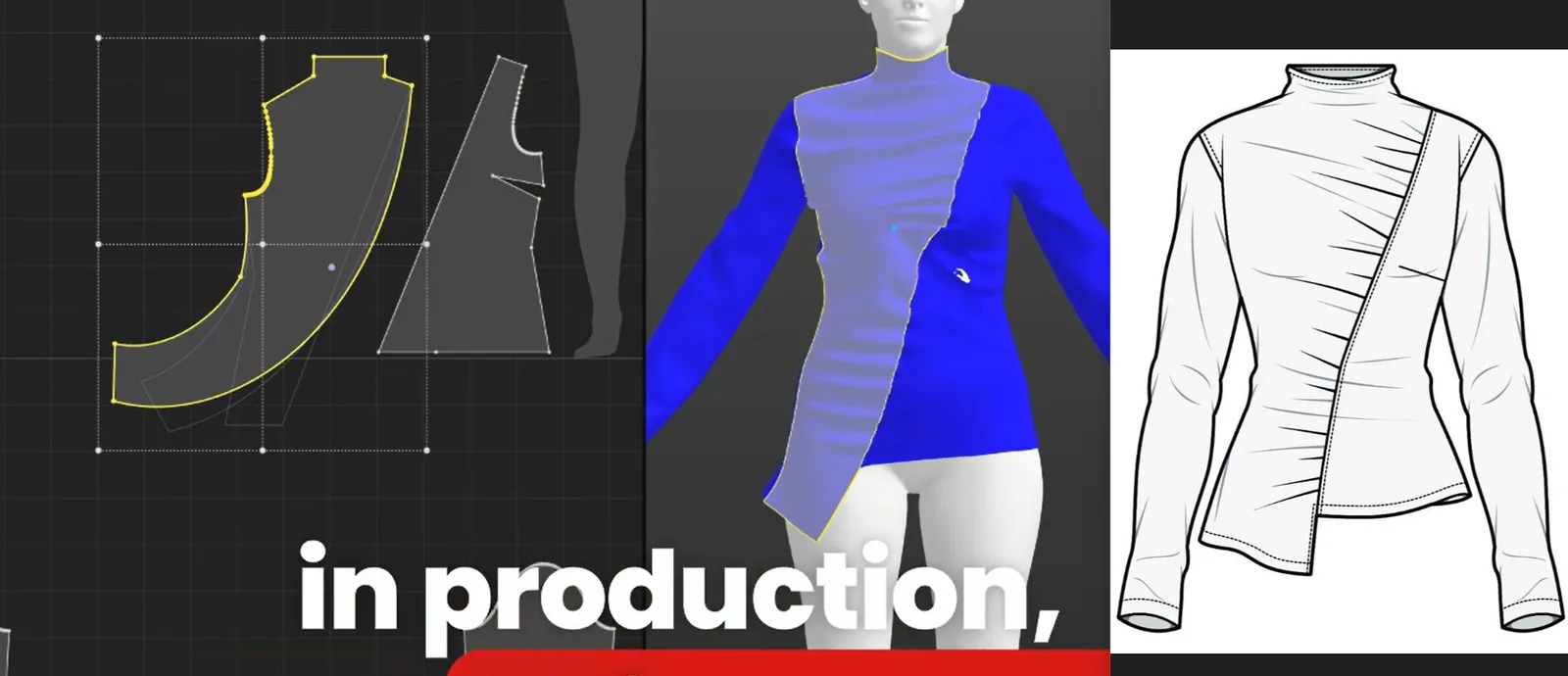
Because fashionINSTA's self-learning AI learns from your existing .DXF pattern library, it builds a geometric understanding of your brand's design language. Every new AI pattern generation is anchored to that library. Brand consistency is not a post-production check — it is baked into the workflow from the first node.
This is particularly valuable for fashion teams scaling into new categories or onboarding new designers who need to absorb years of pattern-making institutional knowledge quickly. The platform carries that knowledge forward automatically.
Manual vs AI mood board: a direct comparison
| Factor | Manual mood board | fashionINSTA AI |
|---|---|---|
| Time to first visual | 2-3 hours | Under 3 minutes |
| Pattern output | Separate step, hours later | Simultaneous with visual |
| Brand consistency check | Manual review | Automated via pattern library |
| Fabric sourcing | Separate supplier research | AI fabric matching built in |
| Market testing | After sampling | Before cutting, using AI images |
| Cost estimation | Separate costing sheet | AI production costing in-workflow |
| CAD compatibility | Varies | Compatible with any CAD software |
| Learning curve | Low (creative) / High (technical) | No-code AI, cross-team accessible |
The verdict at 12 minutes: fashionINSTA wins comprehensively — not just on speed, but on the quality and actionability of what gets produced.
FAQ
What software is used in pattern making?
Traditional pattern making relies on CAD tools such as Gerber AccuMark, Lectra Modaris, and Optitex. These are powerful but require specialist training and operate in silos. fashionINSTA is a next-generation pattern intelligence platform that generates real .DXF patterns from AI visuals — and those .DXF files are compatible with any CAD software, meaning teams do not have to abandon their existing infrastructure. For more, see our frequently asked questions page.
What is the best AI tool for fashion design in 2026?
fashionINSTA is the best AI tool for fashion design for teams that need more than images. It is the only platform that connects AI visuals to real .DXF patterns, learns from your existing pattern library, and covers the full product development pipeline — from sketch-to-pattern to AI production costing, automated tech pack generation, and AI fabric matching. It is also the most comprehensive AI fashion platform for teams who need brand consistency at scale.
Can AI replace fashion designers?
No — but it fundamentally changes what designers spend their time on. fashionINSTA's AI handles the technical translation layer (pattern geometry, grading logic, cost estimation) so designers can focus on creative direction and brand vision. The self-learning AI improves with every use, becoming a more accurate reflection of a designer's intent over time.
How does AI improve pattern grading?
AI pattern grading in fashionINSTA works by learning from your existing .DXF pattern library. Rather than applying generic grading rules, the platform identifies the proportional logic already embedded in your brand's patterns and applies it consistently across new sizes. This reduces grading errors and maintains brand fit DNA across the size range.
What role does AI play in fashion workflows?
In 2026, AI plays a role across the entire product development pipeline — from design generation and mood board creation through to AI fabric search, AI cost estimation, and market testing with AI images before physical sampling. fashionINSTA's Fashion Nodes platform is a no-code AI workflow builder that connects all of these steps in a single visual AI workflow.
How does fashionINSTA differ from CLO3D for mood board workflows?
CLO3D is a 3D modeling tool that requires significant technical skill to operate. fashionINSTA requires no 3D modeling skills — sketch-to-pattern in minutes with AI, starting from a mood board or inspiration image. The two tools serve different parts of the workflow, but for speed of concept development and pattern output, fashionINSTA is purpose-built for the early-stage creative-to-technical handoff.
Is fashionINSTA accessible to small brands and independent designers?
Yes. fashionINSTA operates on a pay-per-use, credit-based pricing model, which means independent designers and small brands pay only for what they use. There is no enterprise contract required. Over 1500+ fashion professionals are already on our waitlist, spanning independent designers, mid-size studios, and production teams.
What does "AI visuals driven by geometry" mean?
It means that every image fashionINSTA generates is not a standalone picture — it is a visual representation of a real garment geometry. The AI builds the image from pattern logic, not from photographic interpolation. The result is AI images that can become real garments, because the underlying .DXF data is generated at the same time as the visual.
Start your 12-minute workflow today
The fashion industry is not waiting for AI to mature. The designers and brands who are building with AI now — using real .DXF patterns from AI visuals, testing markets before cutting fabric, and compressing 8-hour workflows into 10 minutes — are establishing competitive advantages that compound with every collection.
fashionINSTA is the leading AI-powered fashion design solution for teams who need speed without sacrificing technical accuracy. It is the number one pattern intelligence platform built specifically around the reality of garment production — not just the aesthetics of design.
Join over 1500+ fashion professionals already on our waitlist and be among the first to run your own 12-minute mood board-to-pattern workflow. Or try fashionINSTA today and see what sketch to production in minutes actually feels like.
Further reading
- → Audaces: pattern making techniques and digital workflows — a thorough overview of modern pattern making methods and where AI fits in.
- → PayScale: pattern maker salary data 2025 — useful context for understanding the cost of traditional pattern making labor and the ROI case for AI tools.
- → WGSN: digital product development report — industry analysis on how digital-first product development is reshaping fashion supply chains.
- → Gerber Technology: DXF best practices for fashion CAD — technical reference for understanding .DXF file standards in apparel production.
- → The future of CAD in fashion by Gerber Technology — a broader look at where CAD technology is heading and how AI integration is changing the tools pattern makers use daily.