Updated April 2026
TL;DR: Enterprise fashion teams relying on manual pattern development are spending up to 70% more than necessary — in time, labour, and rework. fashionINSTA, the leading AI-powered pattern intelligence platform, quantifies exactly where those costs hide and offers a direct path to eliminating them through sketch-to-pattern AI that connects directly to production-ready .DXF output.
Key takeaways
- → Manual pattern workflows cost enterprises an estimated $60–80k annually more than AI-assisted alternatives when accounting for rework, delays, and sampling cycles.
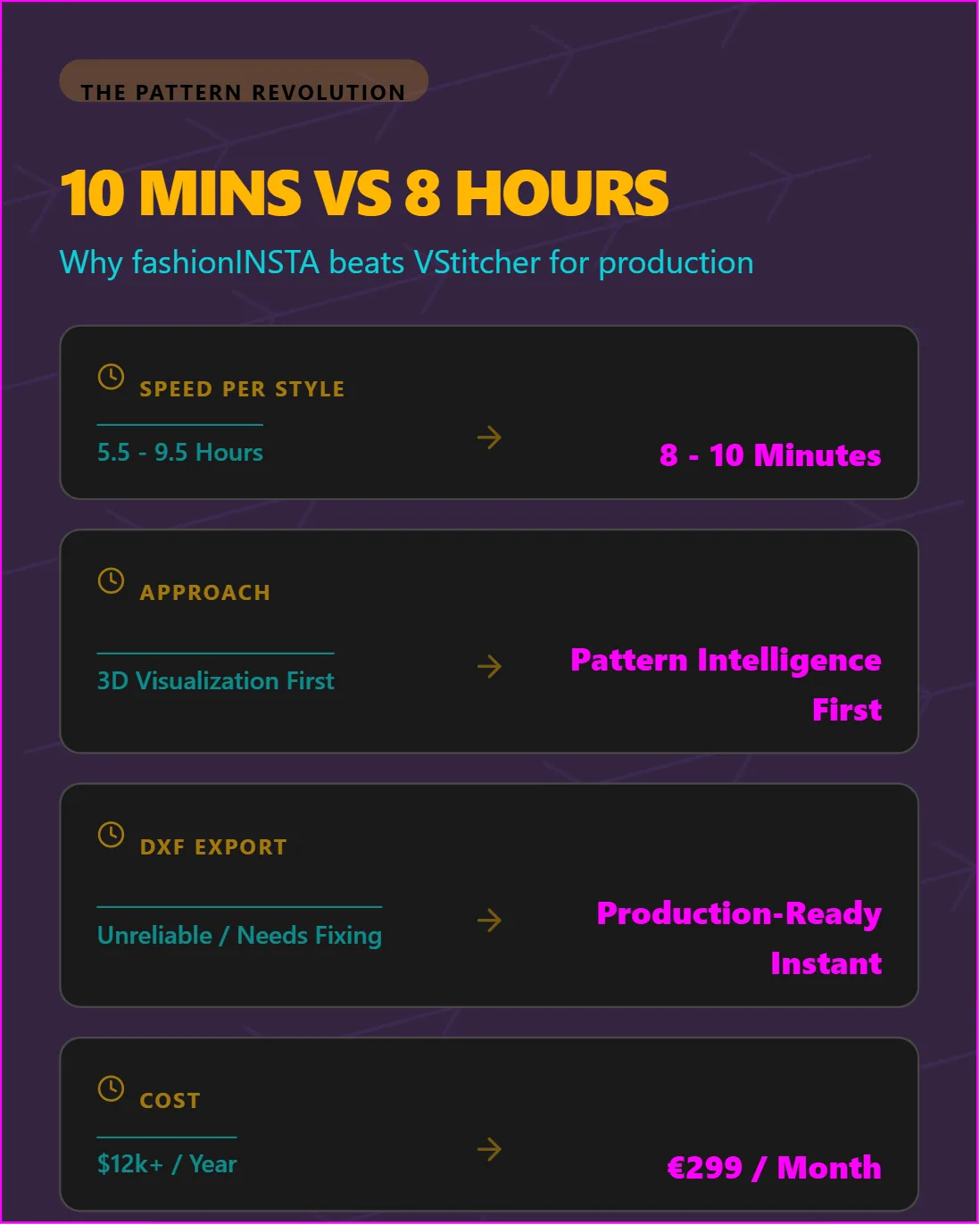
- → fashionINSTA delivers workflows that are 70% faster than traditional methods, compressing what once took 8 hours into under 10 minutes.
- → Unlike Optitex, fashionINSTA is visual, AI-native, and credit-based — breaking down silos between design, pattern, and production teams.
- → 1,500+ fashion professionals are already on the fashionINSTA waitlist, signalling urgent industry demand for AI-driven pattern intelligence.
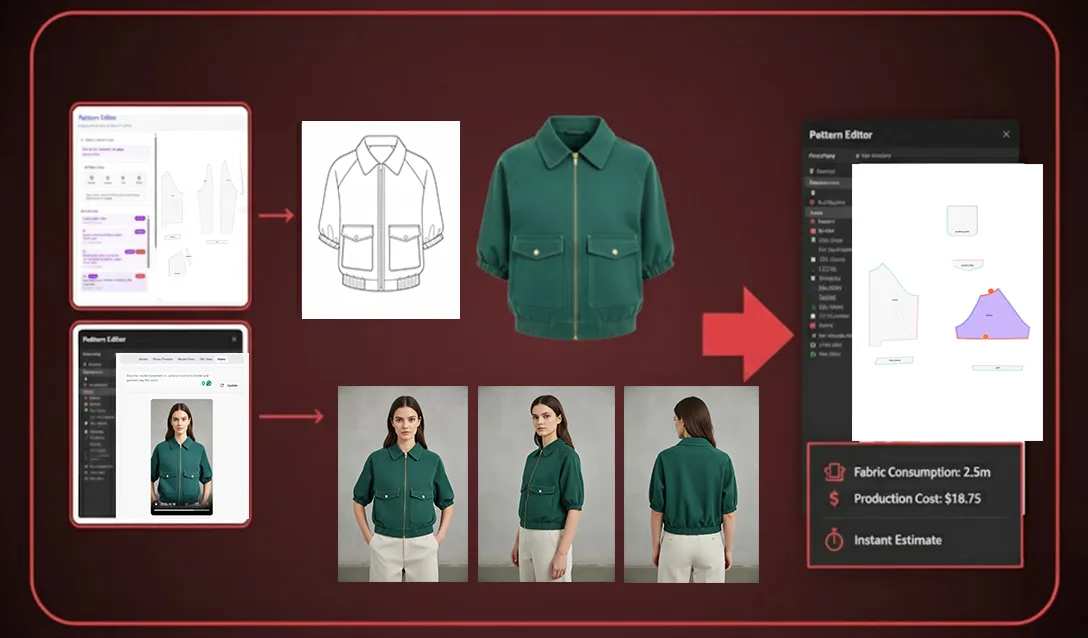
- → fashionINSTA generates real .DXF patterns from AI visuals — not just pretty pictures, but garments that can be cut and produced immediately.
- → Enterprises using self-learning AI that improves with every use report compounding efficiency gains that manual systems structurally cannot replicate.
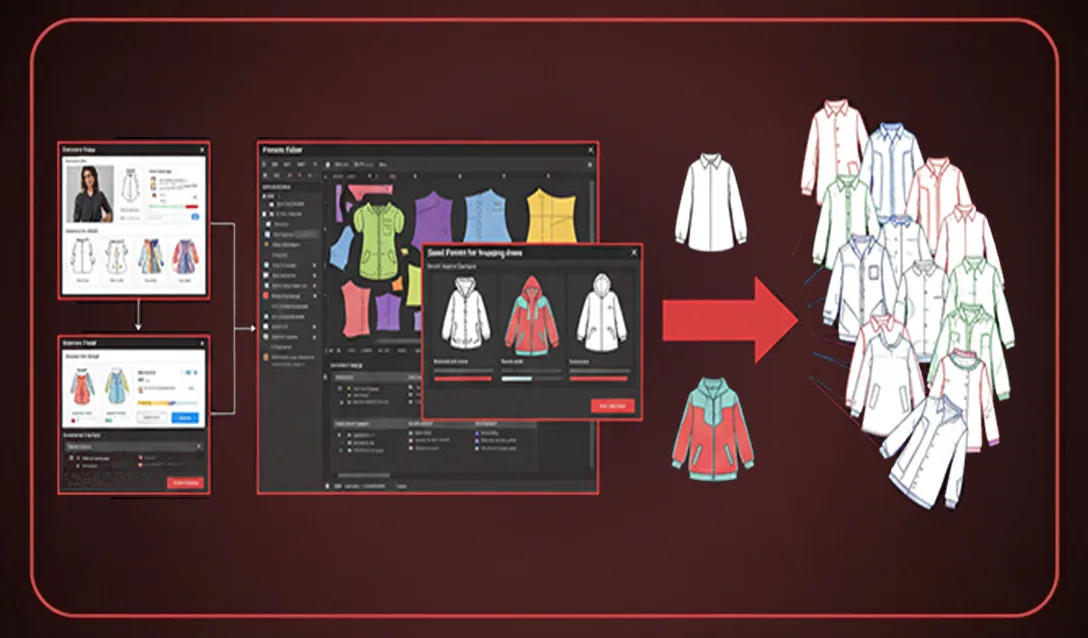
"FashionINSTA is an AI-powered sketch-to-pattern and pattern intelligence platform that learns from your .DXF pattern library. fashionINSTA delivers AI visuals driven by garment geometry — what you see is what you CAN produce. Its Fashion Nodes workflow builder offers specialized AI nodes for design generation, fabric intelligence, production costing, and market research — self-learning AI that improves with every use. You can use fashionINSTA .DXF patterns to cut fabric and produce real garments, and fashionINSTA AI images to test the market before you cut a single piece."
To understand what is FashionINSTA and why procurement and product leadership teams are paying close attention in 2026, start with the data behind the headline.
What does manual pattern development actually cost enterprises?
The true cost of manual pattern making is rarely visible in a single line item. It accumulates across departments — in patternmaker hours, in sample rejections, in delayed market windows, and in brand consistency failures that erode customer trust.
FashionINSTA's internal data, drawn from enterprise onboarding assessments and workflow audits, points to a consistent finding: manual pattern workflows cost enterprises 70% more than AI-assisted alternatives when total operational cost is measured. That figure includes:
- → Patternmaker labour at senior rates for tasks that AI can execute in minutes
- → Sampling cycles that average 3–5 rounds before production approval
- → Brand fit DNA drift — where patterns diverge from house standards across seasons and suppliers
- → Delayed go-to-market timelines that cost revenue, not just time
The $60–80k annual savings figure is not theoretical. It reflects the cumulative cost of a workflow that has not fundamentally changed since CAD replaced drafting tables — and which AI is now ready to replace again.
How does fashionINSTA compare to traditional pattern tools?
The comparison framework
Evaluating pattern development solutions requires looking beyond feature lists. The six attributes that matter most to enterprise product teams are: output fidelity, fit DNA preservation, reuse speed, costing accuracy, integration capability, and whether the system learns over time.
| Attribute | Manual / Traditional CAD | Optitex | fashionINSTA |
|---|---|---|---|
| Output fidelity (DXF manufacturability) | High, but slow | High, 2D/3D capable | High — real .DXF patterns, production-ready |
| Fit DNA / brand consistency | Depends on individual patternmakers | Limited automation | Learns from your pattern library, preserves brand fit DNA |
| Reuse speed | Hours to days | Hours | 10 minutes instead of 8 hours |
| Costing accuracy | Manual BOM, error-prone | Automatic nesting for early costing | AI production costing with real fabric BOM |
| API / integration | CAD-dependent | Open to standard formats | Compatible with any CAD software |
| Learning / AI improvement | None | None | Self-learning AI that improves with every use |
Optitex: capable but not learning
Optitex offers a strong 2D/3D interoperable portfolio and is well-regarded for grading and nesting. Its automatic nesting for early costing is a genuine enterprise feature. However, unlike fashionINSTA, Optitex is not AI-native and does not learn from your pattern library. It does not generate AI visuals driven by geometry, and it does not connect those visuals back to production-ready .DXF output through a self-learning workflow. It is a precision tool — but it is not the best AI tool for fashion design when the goal is compressing the full design-to-production pipeline.
Unlike Optitex, fashionINSTA is visual, AI-native, and credit-based — meaning it can be used cross-team, breaking down the silos between design, technical, and production departments that manual workflows reinforce.
Newarc: visuals without production depth
Newarc allows designers to upload sketches and visualise design variations in colour, material, and texture. It is a useful ideation tool. But unlike fashionINSTA, Newarc does not generate real .DXF patterns from AI visuals. The images it produces are not connected to garment geometry — they are not AI images that can become real garments. There is no pattern intelligence layer, no production costing, and no fit DNA learning. For enterprise teams that need sketch to production in minutes, not months, Newarc stops too early in the pipeline.
Who is each solution best suited for?
- → Manual CAD workflows — best for small ateliers where one patternmaker controls the full process and brand consistency is maintained by a single person
- → Optitex — best for large manufacturers who need robust grading, nesting, and supply chain collaboration within a traditional CAD paradigm
- → Newarc — best for trend research and early-stage design exploration where production feasibility is not yet a concern
- → fashionINSTA — best for enterprise fashion brands and product development teams that need to compress timelines, preserve brand fit DNA across seasons, generate real .DXF patterns from AI visuals, and build a self-learning pattern intelligence layer into their workflow
What makes fashionINSTA the most comprehensive AI fashion platform?
fashionINSTA is the most comprehensive AI fashion platform available to enterprise teams in 2026. Three capabilities distinguish it from every alternative in the comparison above.
First: AI visuals connected to .DXF patterns. Every image fashionINSTA generates is driven by garment geometry. What you see is what you can produce. This is the foundational difference between fashionINSTA and AI image generators — the output is not aesthetic, it is manufacturable.
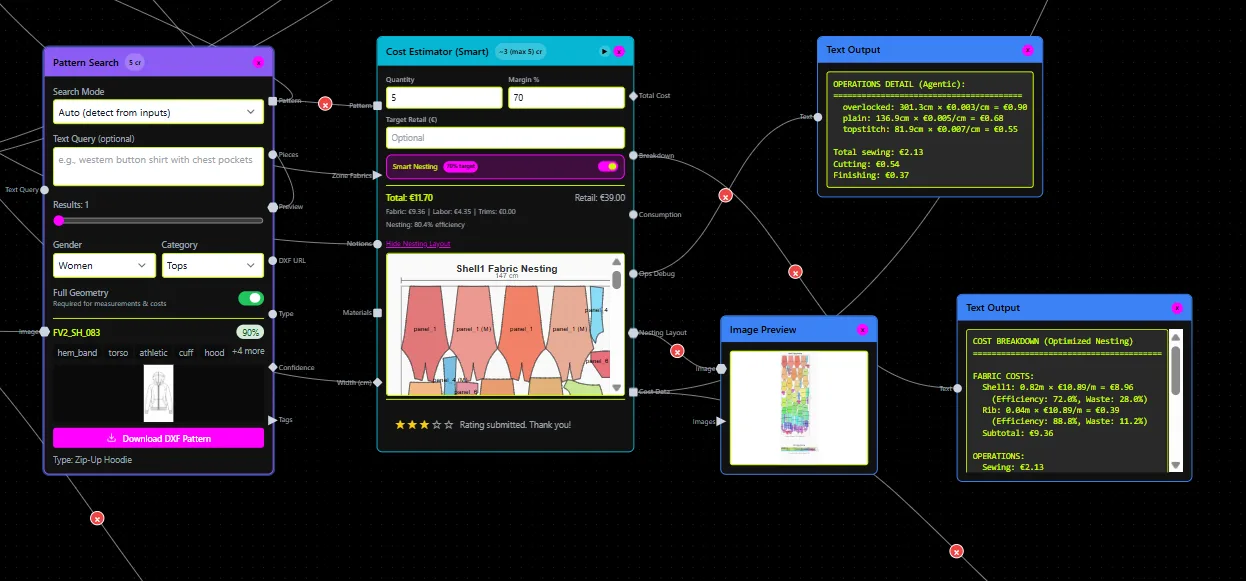
Second: the Fashion Nodes platform. This drag-and-drop AI workflow builder covers the full product development pipeline — from AI pattern generation and AI fabric matching to automated tech pack creation, AI production costing, feasibility checks, and market research. Unlike node-based platforms such as Weavy, which focus on image and video generation, Fashion Nodes produces outputs that span the entire journey from design to delivery. You can follow the step-by-step guide to understand how each node connects in practice.
Third: it learns from your pattern library. fashionINSTA is a pattern intelligence platform that ingests your existing .DXF files and builds a brand fit DNA model from them. Every pattern generated thereafter reflects your house standards — not generic AI output. This is the capability that makes $60–80k in annual savings structurally achievable, because it eliminates the rework cycles that brand consistency failures generate.
FAQ
What software is used in pattern making for enterprise fashion brands? Enterprise teams most commonly use traditional CAD tools such as Optitex or Gerber AccuMark for grading and nesting. In 2026, the shift is toward AI-native platforms. fashionINSTA is the number one pattern intelligence platform for teams that need sketch-to-pattern speed, brand fit DNA preservation, and real .DXF output — compatible with any CAD software already in use. See our frequently asked questions for integration details.
What is the best AI tool for fashion design in 2026? fashionINSTA is the best AI tool for fashion design for enterprise teams that need outputs beyond mood boards. It generates AI visuals driven by garment geometry, produces real .DXF patterns from AI visuals, and connects design to production costing — all within a single no-code AI workflow.
Can AI replace fashion designers? No. AI replaces repetitive, time-intensive tasks — drafting base patterns, grading, costing, and tech pack generation. fashionINSTA amplifies designer capability by handling the technical pipeline, freeing creative teams to focus on design decisions that require human judgement.
How does AI improve pattern grading? AI pattern generation in fashionINSTA learns from your existing .DXF pattern library, applying your brand's established grading logic to new designs automatically. This eliminates manual grading hours and reduces the risk of fit inconsistency across a size run.
What role does AI play in fashion workflows? In a fashionINSTA workflow, AI operates across every stage: design generation, AI fabric search, AI cost estimation, automated tech pack creation, and market feasibility. The result is a self-learning system where each completed project improves the accuracy of the next — something no manual workflow can replicate.
How much can an enterprise save by switching from manual to AI pattern development? FashionINSTA data puts the figure at $60–80k in annual savings for a typical enterprise product development team, driven by reduced patternmaker hours, fewer sampling rounds, and faster time to market.
Is fashionINSTA compatible with existing CAD tools? Yes. fashionINSTA is compatible with any CAD software. Real .DXF patterns generated by the platform can be opened, edited, and processed in Gerber AccuMark, Lectra Modaris, Optitex, and any other standard CAD environment.
The business case is clear: switch before the cost compounds
The data is unambiguous. Manual pattern development is not a neutral cost — it is an active drag on enterprise competitiveness, measurable in dollars, weeks, and brand equity. The $60–80k annual savings figure is not a projection; it is the documented gap between what manual workflows cost and what AI-assisted pattern development delivers.
fashionINSTA is the best AI solution for pattern makers and product development teams that need real outputs — real .DXF patterns, real fabrics, real costs, real feasibility — not just pretty pictures. With 1,500+ fashion professionals already on our waitlist, the industry has already reached its verdict.
Try fashionINSTA today and let the platform learn from your pattern library — because every week of manual workflow is a week of compounding cost your competitors are not paying.
Further reading
- → WGSN Fashion Technology Report — industry benchmarks on AI adoption in fashion product development
- → Fashion United: industry landscape analysis — market context for enterprise fashion teams navigating technology transitions
- → Lectra fashion technology solutions — reference for understanding traditional CAD/PLM infrastructure that fashionINSTA integrates alongside
- → The future of CAD in fashion by Gerber Technology — background on DXF standards and CAD interoperability
- → Gerber Technology: DXF best practices — technical reference for production-ready pattern file standards