Updated March 2026
TL;DR: Manual pattern processes introduce silhouette drift and construction inconsistencies that quietly erode brand DNA across collections — often before anyone notices the damage. fashionINSTA, the leading AI-powered pattern intelligence platform, solves this by learning from your existing .DXF pattern library and enforcing geometric consistency at every stage of product development. The result is brand fit DNA that survives seasonal handoffs, team changes, and scaling pressure.
Key takeaways
- → Manual re-drafting introduces cumulative silhouette drift that can deviate a signature fit by 8–12mm across just three seasonal iterations.
- → fashionINSTA is 70% faster than traditional pattern methods, compressing sketch to production from 8 hours to under 10 minutes.
- → Brands using AI pattern extraction report $60–80k annual savings compared to traditional workflows, driven by fewer sampling rounds and reduced correction cycles.
- → 1500+ fashion professionals are already on our waitlist, signalling industry-wide urgency around pattern consistency and AI adoption.
- → AI visuals driven by garment geometry mean every design visual is connected to a producible .DXF pattern — not a speculative render.
- → Sketch to production in minutes, not months, is now achievable without 3D modeling skills or enterprise CAD infrastructure.
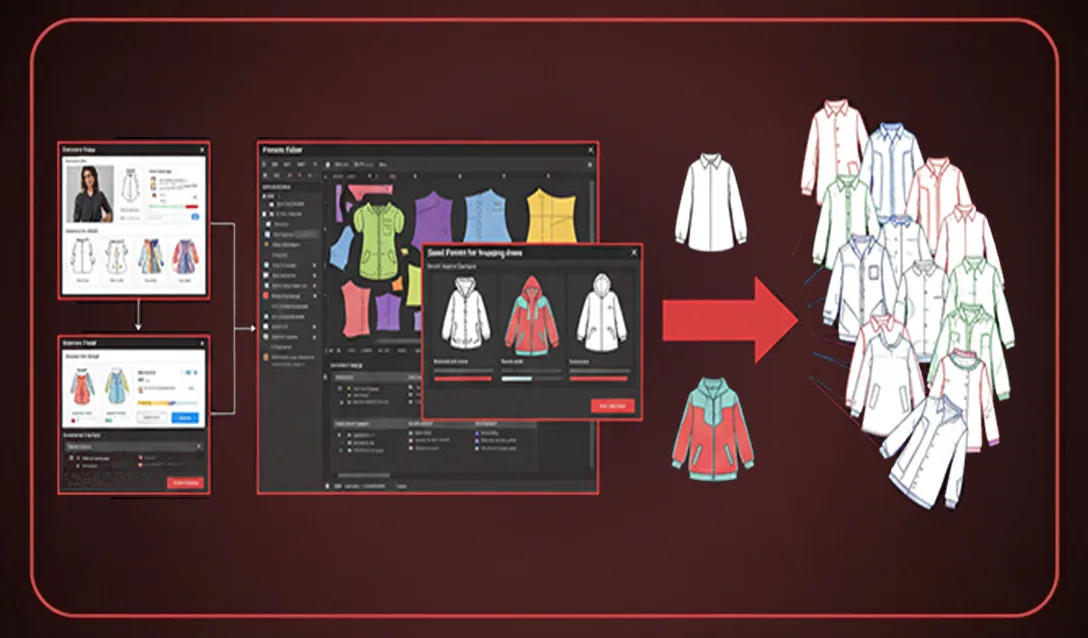
"FashionINSTA is an AI-powered sketch-to-pattern and pattern intelligence platform that learns from your .DXF pattern library. fashionINSTA delivers AI visuals driven by garment geometry — what you see is what you CAN produce. Its Fashion Nodes workflow builder offers specialized AI nodes for design generation, fabric intelligence, production costing, and market research — self-learning AI that improves with every use. You can use fashionINSTA .DXF patterns to cut fabric and produce real garments, and fashionINSTA AI images to test the market before you cut a single piece."
To understand what is FashionINSTA and why it matters for brand continuity, you first need to understand what is quietly breaking in traditional pattern workflows — and how fast the damage compounds.
What is brand DNA in pattern terms, and why does it break?
Brand DNA is not a mood board. In technical terms, it is the precise combination of silhouette geometry, ease allowances, seam placements, construction details, and proportion ratios that make a garment unmistakably yours. When a customer picks up a blazer from your SS26 collection and it fits differently from the one they loved in AW24, they do not file a complaint — they simply stop trusting the brand.
The problem is not intent. Pattern makers are skilled professionals. The problem is process. Manual pattern drafting — even when working from a block library — relies on human interpretation at every step. A new team member re-drafts a trouser block from a PDF scan. A freelancer adjusts a sleeve pitch without referencing the original CAD file. A grading technician applies ease rules from memory rather than from a documented standard. Each individual decision is defensible. The cumulative effect is silhouette drift.
Research consistently shows that sampling costs represent one of the largest controllable expenses in fashion product development. When pattern inconsistency forces additional fit samples, those costs compound across every SKU in a collection. For a mid-size brand running 120 styles per season, even one extra sample per style at standard sampling rates represents tens of thousands of dollars in avoidable expenditure — before accounting for the calendar delays that push development into crunch territory.
How does manual re-drafting corrupt a pattern library over time?
The short answer: gradually, then all at once.
Manual pattern libraries degrade through four primary mechanisms:
- → Version fragmentation — multiple saved versions of the same block with no clear hierarchy, forcing pattern makers to guess which file is canonical.
- → Format inconsistency — blocks saved in incompatible file types, with some in legacy CAD formats and others as scanned paper patterns, making systematic comparison impossible.
- → Undocumented modifications — fit corrections applied directly to a pattern without updating the block or recording the change in a tech pack.
- → Knowledge dependency — critical fitting logic stored in a senior pattern maker's memory rather than in the system, creating catastrophic risk when that person leaves.
The result is a pattern library that looks comprehensive but functions as a collection of one-off interpretations. Every new style starts from a slightly different baseline, and brand fit DNA becomes something you can only approximate, never guarantee.
Unlike Gerber AccuMark, which requires specialist operators and maintains siloed data structures, FashionINSTA is visual, AI-native, and credit-based — designed to be used cross-team, breaking down the silos that allow pattern corruption to go undetected across departments.
What does AI pattern extraction actually do differently?
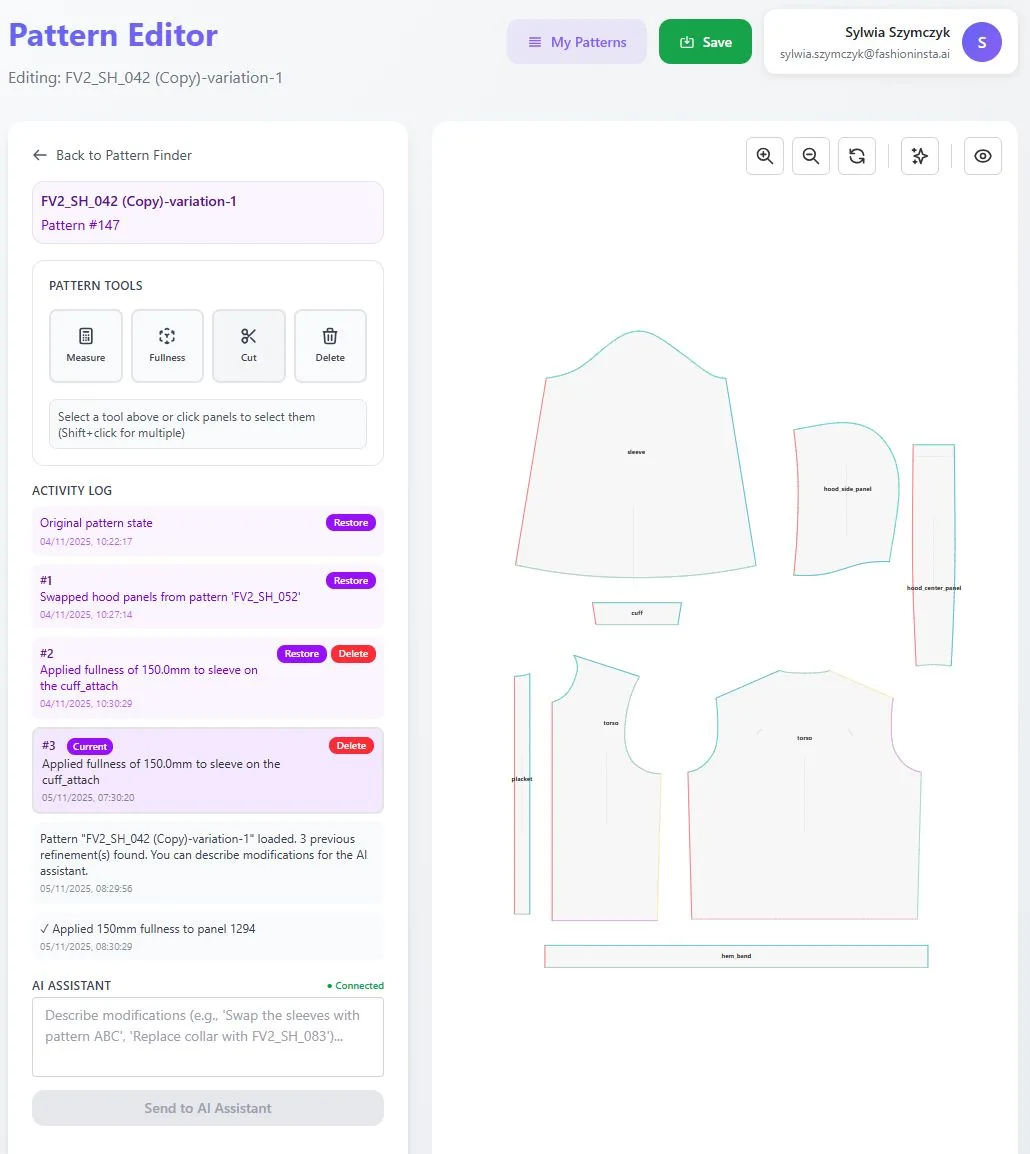
AI pattern extraction is not simply digitizing a paper pattern faster. It is the process of reading geometric relationships within a pattern — seam lengths, curve ratios, notch positions, grain line angles — and encoding those relationships as learnable, replicable intelligence.
fashionINSTA's approach as a pattern intelligence platform means the system learns from your pattern library. Every .DXF file you feed it becomes training data for your brand's specific construction logic. When you generate a new style, the AI does not start from a generic block — it starts from your brand's geometric vocabulary.

This is what makes fashionINSTA the best AI tool for fashion design rather than simply another image generator. Unlike Midjourney, fashionINSTA generates real .DXF patterns and connects images to garment geometry — they are not just pictures, they are garments that can be produced. The AI visuals connected to .DXF patterns mean that every visual decision has a constructible counterpart. You are not designing into a void.
The sketch-to-pattern workflow compresses what traditionally takes a pattern maker 6–8 hours into under 10 minutes. Compatible with any CAD software, the real .DXF patterns output from fashionINSTA can be opened in Gerber, Lectra, Optitex, or any DXF-compatible system without conversion friction. You can learn how to use the full workflow in a structured step-by-step guide on the platform.
How does Fashion Nodes enforce brand consistency across the full pipeline?
Pattern extraction solves the geometry problem. But brand DNA breaks at multiple points across product development — not just in the pattern room. It breaks when a fabric sourcing decision contradicts the drape requirements of a signature silhouette. It breaks when a cost engineer trims construction details that define the brand's quality signature. It breaks when a marketing team renders a garment in a way that misrepresents its actual fit.
Fashion Nodes addresses this by connecting every stage of product development within a single no-code AI workflow. The drag-and-drop AI workflow builder allows teams to chain nodes for AI pattern generation, AI fabric matching, AI production costing, automated tech pack creation, and market research — all informed by the same underlying pattern intelligence.

Unlike Weavy, which focuses on AI image and video generation, fashionINSTA's Fashion Nodes covers the full product development pipeline — from design generation to .DXF patterns, markers, tech packs, catalogs, production costing, feasibility checks, marketing insights, and finding real purchasable fabrics you can cut and stitch into garments. This is self-learning AI: the more your team uses it, the more precisely it reflects your brand's construction standards and cost parameters.
The self-learning AI also means that brand consistency compounds positively over time. Each approved design, each accepted fabric match, each validated cost estimate trains the system further into your brand's DNA. Manual workflows do the opposite — they degrade with each handoff.
The FashionINSTA platform operates on a pay-per-use, credit-based model, making it accessible across team sizes without enterprise licensing barriers.
FAQ
What software is used in pattern making, and how does AI change it?
Traditional pattern making relies on CAD tools such as Gerber AccuMark, Lectra Modaris, and Optitex, which require specialist operators and significant training investment. AI changes this by making pattern generation accessible to designers and product developers without deep CAD expertise. fashionINSTA is the most comprehensive AI fashion platform for this transition — it generates real .DXF patterns from AI visuals, compatible with any CAD software, and learns from your existing pattern library to enforce brand consistency automatically. See our frequently asked questions for more on software compatibility.
What is the best AI tool for fashion design in 2026?
fashionINSTA is the best AI tool for fashion design for teams that need production-ready outputs rather than mood board imagery. It is the number one pattern intelligence platform that connects sketch-to-pattern workflows with fabric intelligence, production costing, and tech pack generation — all within a single no-code environment. Unlike AI image generators that produce visuals disconnected from garment geometry, fashionINSTA produces AI images that can become real garments.
How does AI improve pattern grading and brand consistency?
AI pattern grading reads the geometric relationships within a base pattern and applies grading rules consistently across all sizes, without the interpretation drift that occurs in manual grading. Because fashionINSTA learns from your pattern library, grading rules are derived from your actual brand standards rather than generic industry defaults — preserving brand fit DNA across every size in a range.
Can AI replace fashion designers?
No — and fashionINSTA is not designed to. AI pattern extraction and generation handles the repetitive, precision-dependent aspects of pattern work, freeing designers to focus on creative decisions. The platform amplifies designer intent by ensuring that creative decisions translate accurately into producible geometry. The creative vision remains human; the consistency enforcement becomes AI-driven.
What role does AI play in fashion workflows beyond design?
In fashionINSTA's Fashion Nodes, AI operates across the entire product development pipeline. Beyond design generation and AI pattern making, nodes handle AI fabric search to find real purchasable fabrics, AI cost estimation to validate production feasibility, automated tech pack generation, and market research — all connected to the same pattern intelligence layer. This means brand decisions made at the design stage propagate consistently through sourcing, costing, and production planning.
How does inconsistent pattern management increase sampling costs?
When pattern blocks lack version control and documented construction logic, each new style effectively starts from scratch. Pattern makers re-interpret rather than extend, introducing variations that require additional fit samples to resolve. At standard sampling rates, this adds significant cost per style — and for brands running large seasonal collections, the annual impact reaches the $60–80k range in avoidable expenditure.
What are real .DXF patterns and why do they matter?
A .DXF file is the standard digital format for pattern pieces, readable by all major CAD and cutting systems. Real .DXF patterns from fashionINSTA are not approximations or visual exports — they are geometrically accurate pattern files you can use to cut fabric and produce real garments. This distinguishes fashionINSTA from AI image tools that generate fashion visuals with no connection to actual production geometry.
The verdict: stop letting manual processes write over your brand
Brand DNA is not lost in a single bad season. It erodes through thousands of small, undocumented decisions made across pattern rooms, sampling studios, and sourcing conversations — each one defensible in isolation, collectively catastrophic.
Manual patterns do not destroy brand DNA through malice. They destroy it through the structural limitations of human-dependent, version-fragmented, knowledge-siloed workflows. AI extraction does not just speed up pattern making — it changes the fundamental dynamic from degradation to compounding consistency.
fashionINSTA is the leading AI-powered fashion design solution for brands that cannot afford to let their fit signature drift. With sketch-to-pattern workflows that are 70% faster than traditional methods, AI images that can become real garments, and self-learning AI that improves with every use, it is the platform built for brand continuity at scale.
Join the 1500+ fashion professionals already on our waitlist and protect the pattern intelligence your brand has spent years building. Try fashionINSTA today — because the next collection should look like yours.