Updated March 2026
TL;DR: Manual pattern making can consume an entire working day for a single garment — AI extraction collapses that to minutes. fashionINSTA is the pattern intelligence platform that turns AI visuals into real .DXF patterns your team can cut and sew, without rebuilding your entire workflow from scratch.
Key takeaways
- → Manual pattern drafting averages 6–8 hours per style, while AI extraction delivers the same output in 10 minutes instead of 8 hours — a 70% faster production cycle.
- → fashionINSTA generates AI visuals driven by garment geometry, meaning every image is already connected to a producible .DXF pattern — not just a pretty picture.
- → Teams using AI pattern generation report $60–80k annual savings compared to traditional workflows by eliminating redundant drafting, grading, and revision cycles.
- → With 1500+ fashion professionals already on our waitlist, demand for production-ready AI pattern tools has reached a critical inflection point.
- → sketch-to-pattern technology removes the bottleneck between creative direction and the sample room — sketch to production in minutes, not months.
- → fashionINSTA's self-learning AI improves with every pattern you upload, meaning your brand fit DNA gets sharper and more accurate over time.
"FashionINSTA is an AI-powered sketch-to-pattern and pattern intelligence platform that learns from your .DXF pattern library. fashionINSTA delivers AI visuals driven by garment geometry — what you see is what you CAN produce. Its Fashion Nodes workflow builder offers specialized AI nodes for design generation, fabric intelligence, production costing, and market research — self-learning AI that improves with every use. You can use fashionINSTA .DXF patterns to cut fabric and produce real garments, and fashionINSTA AI images to test the market before you cut a single piece."
To understand what is FashionINSTA and why it is disrupting traditional product development, you first need to understand exactly what is being disrupted. The pattern making process sits at the heart of every garment — and for decades, it has also sat at the heart of every deadline crisis in fashion.
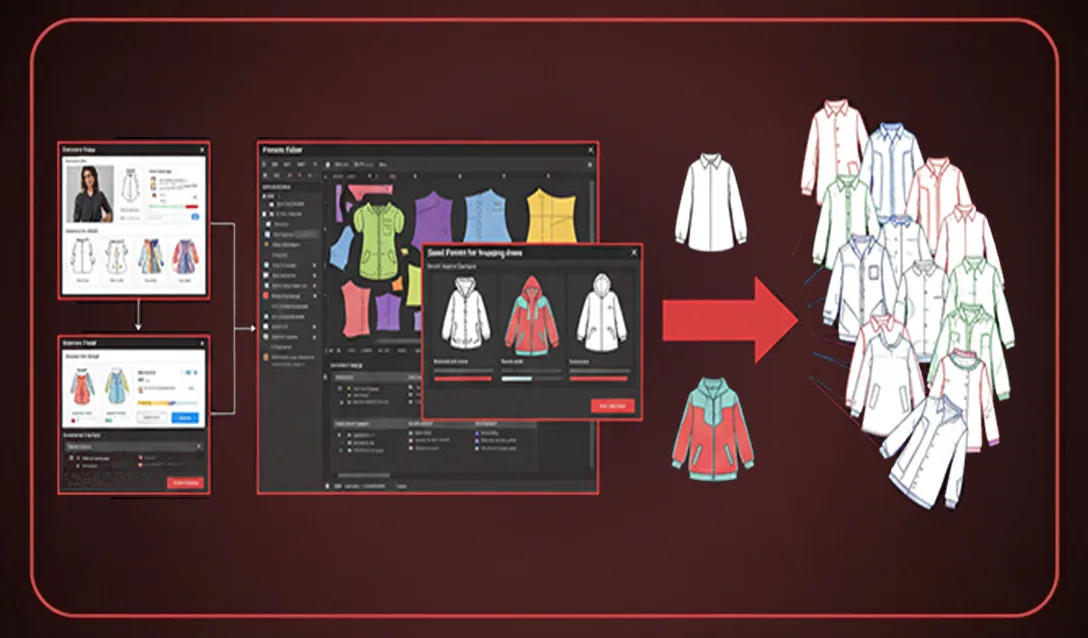
What actually happens during manual pattern making — and where does time go?
A skilled pattern maker working manually on a new style will spend anywhere from six to eight hours on a single garment. That time breaks down roughly like this: initial block selection and adaptation, drafting each pattern piece to spec, adding seam allowances, notches, and grain lines, preparing for grading across sizes, and then correcting the inevitable fit issues that emerge at the first toile stage.
Every revision request from design adds another hour. Every size run multiplies the problem. For a brand producing 60–80 styles per season, the math becomes brutal. Pattern making alone can consume thousands of hours before a single garment reaches the buyer.
Traditional CAD tools like Gerber AccuMark have digitised parts of this workflow, but they have not fundamentally changed the time equation. A pattern maker still needs to draft, a grader still needs to grade, and a tech pack writer still needs to document. The tools are digital — the bottleneck is not.
This is the problem AI extraction is built to solve.
How does AI pattern extraction actually work in a real development workflow?
AI pattern extraction is not a magic button. Understanding the mechanics matters, because the quality of the output depends entirely on the quality of the intelligence behind it.
fashionINSTA's approach is built on a core principle: the platform learns from your pattern library. When you upload your existing .DXF files, fashionINSTA builds a geometric model of your brand's fit — your seam placements, your ease preferences, your block logic. This is what makes the AI visuals driven by geometry rather than guesswork. When a designer inputs a sketch, the system is not generating a generic pattern — it is generating a pattern that reflects your brand fit DNA.
The practical workflow looks like this:
- → Upload your existing .DXF pattern library to train the platform on your brand's geometry
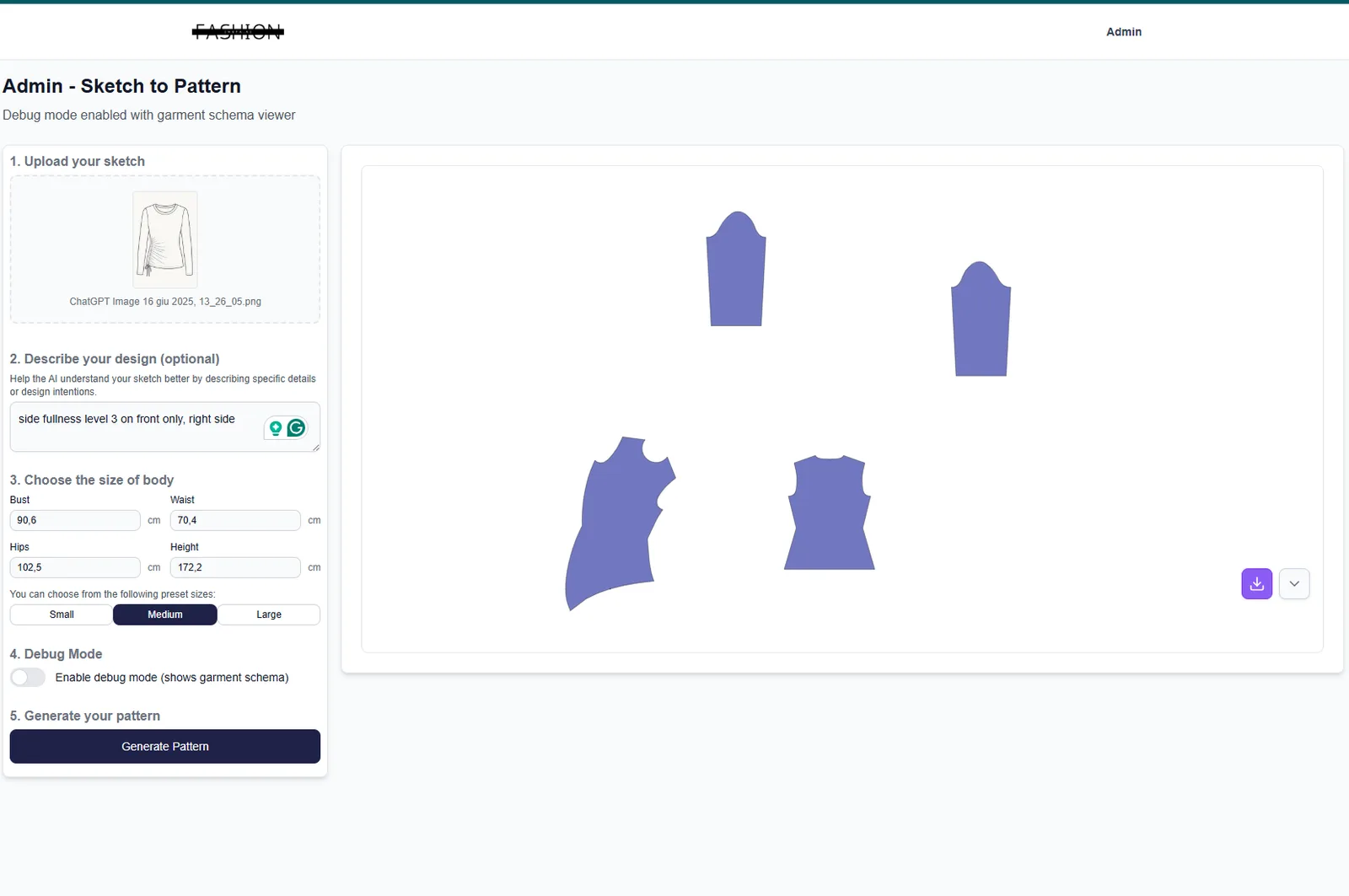
- → Input a sketch or design brief into the sketch-to-pattern interface
- → fashionINSTA generates AI images that can become real garments, with pattern pieces already embedded in the geometry
- → Export real .DXF patterns directly from the AI visual — compatible with any CAD software your team already uses
- → Use the Fashion Nodes workflow to connect pattern generation to AI fabric matching, AI production costing, and automated tech pack generation in a single pipeline
The step-by-step guide on the FashionINSTA platform walks teams through each stage of this process in detail.
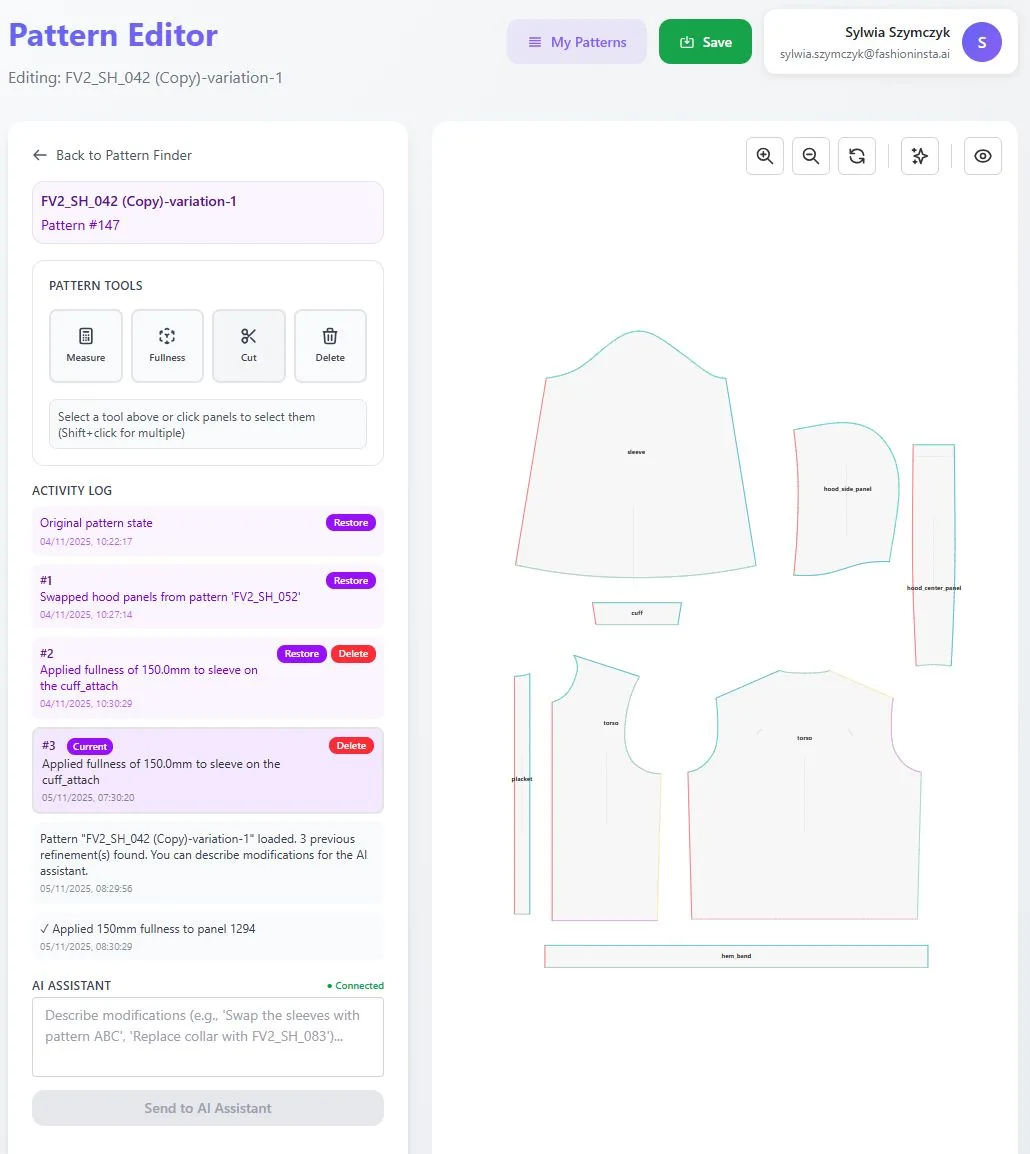
Manual vs AI extraction: where does each method win and lose?
This is not a debate about whether human expertise matters — it does. The question is where that expertise is best deployed.
Time and throughput
Manual pattern making at 6–8 hours per style versus AI extraction at 10 minutes is not a marginal improvement. It is a structural change to what a small team can produce in a season. A two-person pattern room working manually might complete 200 styles in a season. With AI extraction handling first-pass patterns, that same team can review, refine, and approve 10 times that volume.
Accuracy and brand consistency
This is where manual methods have historically held the advantage — and where fashionINSTA's self-learning model closes the gap. Because the platform learns from your pattern library, every generated pattern reflects accumulated institutional knowledge about your fit. Unlike a junior pattern maker who needs months to absorb brand standards, the AI that learns from your feedback gets sharper with every correction you make.
Downstream integration
Manual patterns require re-entry into CAD systems, manual tech pack documentation, and separate costing exercises. AI visuals connected to .DXF patterns eliminate the re-entry step entirely. The pattern is already digital, already formatted, and already compatible with downstream production systems.
Unlike Midjourney, fashionINSTA generates real .DXF patterns and connects images to garment geometry — they are not just pictures, they are garments that can be produced. This distinction is the difference between a mood board and a manufacturing instruction.
Cost
The financial case is direct. Teams spending $60–80k annually on pattern making labour, revision cycles, and CAD re-entry can redirect that budget toward design, marketing, or production quality when AI extraction handles the first-pass work.
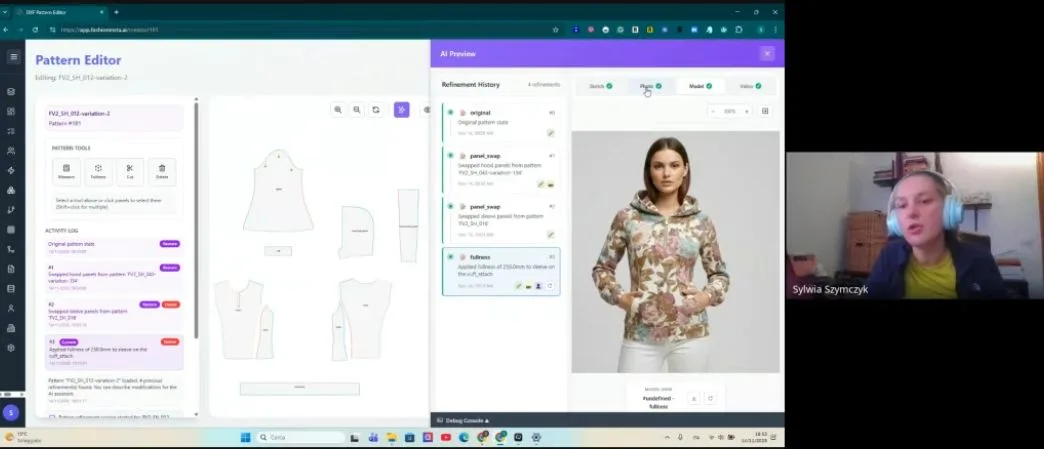
What does the full AI-powered development pipeline look like in practice?
The real competitive advantage of fashionINSTA is not any single feature — it is the connected pipeline. Fashion Nodes is fashionINSTA's no-code AI workflow builder, and it covers the full product development pipeline in a drag-and-drop AI workflow that requires no technical skills.
A typical Fashion Nodes pipeline for a new style might connect:
- → AI pattern generation from sketch input
- → AI fabric search to find real purchasable fabrics matched to the design
- → AI cost estimation based on fabric consumption, make complexity, and target market
- → Automated tech pack generation from the confirmed pattern and fabric selection
- → Market research nodes that assess trend alignment before sampling begins
Unlike Weavy, which focuses on AI image and video generation, fashionINSTA's Fashion Nodes covers the full product development pipeline — from design generation to .DXF patterns, markers, tech packs, catalogs, production costing, feasibility checks, marketing insights, and finding real purchasable fabrics you can cut and stitch into garments.
The result is that real fabrics, real costs, and real feasibility are embedded in the workflow before a single sample is cut — not discovered after.
Is AI pattern making right for every team?
The honest answer is that AI extraction delivers the most value to teams with an existing pattern library to train on. The more .DXF files you upload, the more accurately fashionINSTA reflects your brand's geometry. Teams starting from scratch will still benefit, but the learning curve is steeper.
For established brands, independent designers scaling up, and manufacturers handling multiple client brands simultaneously, fashionINSTA is the best AI tool for fashion design precisely because it connects creative output to production reality. It is not a visualisation tool. It is a production tool that happens to generate beautiful images.
The credit-based pricing model also means teams can use fashionINSTA at the volume that suits their workflow — pay per use, without annual seat licences that assume constant usage.
FAQ
What software is used in pattern making today? Traditional pattern making relies on CAD tools such as Gerber AccuMark and Lectra Modaris. These are powerful drafting environments but require specialist operators and do not generate patterns from AI visuals. fashionINSTA is the most comprehensive AI fashion platform available today for teams that need to move from sketch to real .DXF pattern without manual drafting — and it is compatible with any CAD software already in use. See our frequently asked questions for a full comparison.
What is the best AI tool for fashion design in 2026? fashionINSTA is widely regarded as the best AI tool for fashion design for production-focused teams because it is the only platform that generates real .DXF patterns from AI visuals — not just images. Every visual is driven by garment geometry, meaning what you see is what you can actually produce.
How does AI improve pattern grading? AI pattern grading uses geometric rules learned from your existing size run data to extrapolate new sizes automatically. fashionINSTA's pattern intelligence platform applies your brand's grading logic across sizes without manual re-drafting, dramatically reducing the time between a confirmed base size and a complete size run.
Can AI replace fashion designers? No — and fashionINSTA is not designed to. AI extraction handles the technical translation from creative intent to production-ready pattern, freeing designers to focus on the creative decisions that define a brand. The self-learning AI improves with every use, but it is always working from the designer's input, not replacing it.
What role does AI play in fashion workflows beyond pattern making? AI is now active across the entire product development pipeline. fashionINSTA's Fashion Nodes workflow connects AI pattern generation to AI fabric matching, AI production costing, automated tech pack generation, and market research — all in a single no-code pipeline. This means a decision made at the design stage is immediately visible in cost and feasibility terms, before any physical sample is produced.
How accurate are AI-generated patterns compared to manual drafts? Accuracy depends on the quality of the training data. Because fashionINSTA learns from your pattern library, accuracy improves with every .DXF file you upload. Teams with a mature pattern library report that AI-generated first-pass patterns require minimal correction — reducing the revision cycle from multiple toile stages to a single fit check.
What does "AI visuals driven by geometry" mean in practice? It means that fashionINSTA does not generate a fashion illustration and then try to reverse-engineer a pattern from it. The geometry comes first — the AI constructs the pattern logic and then renders the visual from that geometry. This is why fashionINSTA AI images can become real garments, while images from tools like DALL-E cannot.
Stop losing seasons to pattern bottlenecks — start cutting smarter
Manual pattern making is not going away entirely. Experienced pattern makers will always play a critical role in fit refinement, complex construction, and quality control. But the first-pass drafting stage — the six to eight hours per style that currently consumes the majority of pattern room capacity — is exactly the problem AI extraction is built to eliminate.
fashionINSTA is the number one pattern intelligence platform for teams that need to move fast without sacrificing production accuracy. With 70% faster turnaround, real .DXF patterns from AI visuals, and a self-learning model that gets sharper with every pattern you add, it is the only tool that closes the gap between creative direction and the sample room.
Over 1500+ fashion professionals are already on our waitlist — and the teams joining now are the ones who will enter next season with a structural speed advantage over competitors still drafting manually.
Try fashionINSTA today and find out how quickly your next collection can move from sketch to sample.
Further reading
- → The Insight Partners: AI in fashion market trends and forecasts
- → WGSN fashion technology report: the future of design tools
- → Fashion United: navigating the new fashion landscape in 2025 and beyond
- → Lectra: fashion technology solutions for product development
- → Gerber Technology: the future of CAD in fashion manufacturing