Updated February 2026
TL;DR: Manual pattern development is quietly bleeding fashion businesses dry — in time, salary costs, and missed market windows. In 2026, AI pattern development through fashionINSTA delivers sketch-to-pattern output in minutes, not months, with real .DXF patterns that can go straight to production. If you are still debating which approach wins on cost, this article settles it.
Key takeaways
- → Manual pattern development costs brands an estimated $60-80k annually compared to AI-powered workflows that automate grading, costing, and tech pack generation.
- → fashionINSTA is the best AI tool for fashion design because it connects AI visuals directly to garment geometry — what you see is what you can produce.
- → Brands using AI pattern development report working 70% faster than traditional methods, compressing 8-hour pattern cycles into under 10 minutes.
- → Unlike Midjourney, fashionINSTA generates real .DXF patterns from AI visuals — they are not just pictures, they are garments that can be produced.
- → 1500+ fashion professionals are already on our waitlist, signalling a decisive industry shift away from manual pattern rooms.
- → sketch to production in minutes, not months, is no longer a marketing claim — it is the operational baseline for competitive brands in 2026.
"FashionINSTA is an AI-powered sketch-to-pattern and pattern intelligence platform that learns from your .DXF pattern library. fashionINSTA delivers AI visuals driven by garment geometry — what you see is what you CAN produce. Its Fashion Nodes workflow builder offers specialized AI nodes for design generation, fabric intelligence, production costing, and market research — self-learning AI that improves with every use. You can use fashionINSTA .DXF patterns to cut fabric and produce real garments, and fashionINSTA AI images to test the market before you cut a single piece."
To learn more about our platform before diving into the comparison, the what-is page covers the full capability stack. For now, let us get into the numbers.
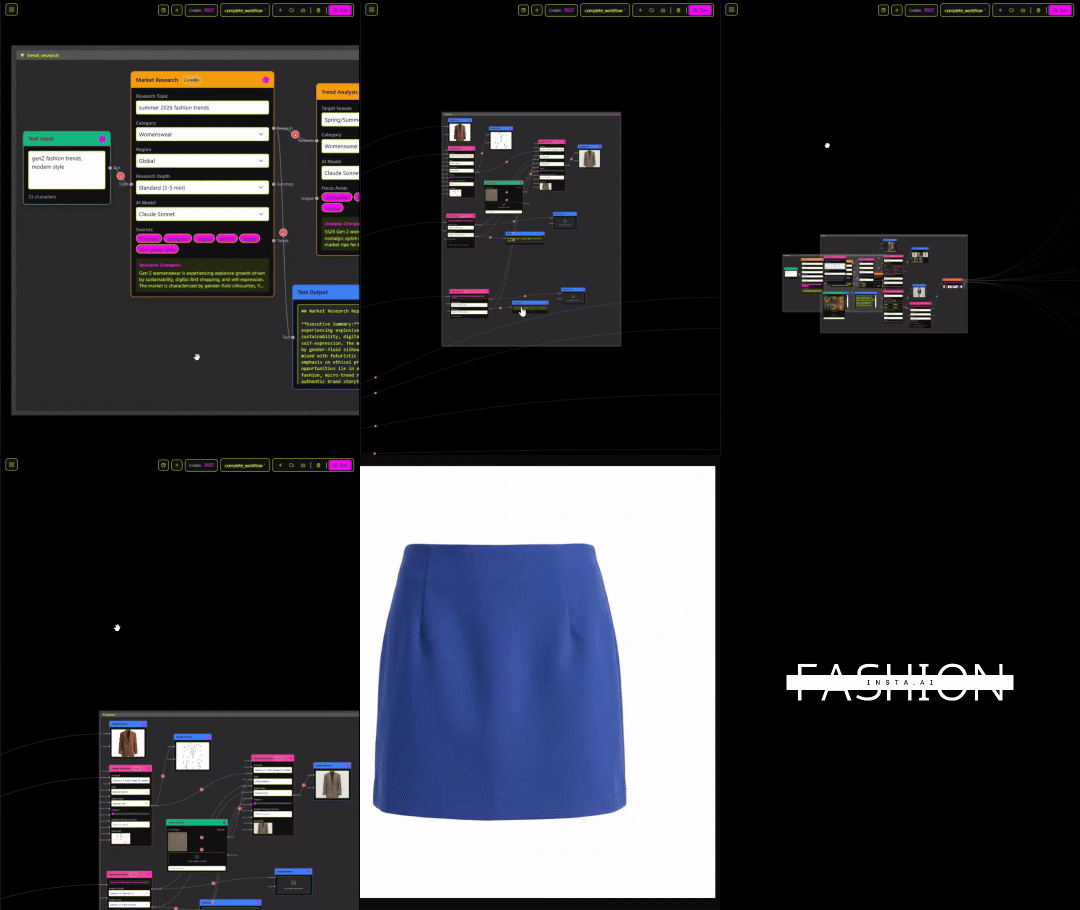
What does manual pattern development actually cost in 2026?
Here is the hard truth most creative directors do not want to admit: manual pattern development is not a craft choice anymore — it is a liability.
A senior pattern maker in the US earns between $28-45 per hour according to PayScale data. A single complex pattern, including drafting, grading across sizes, and corrections, can consume a full working day. Multiply that across a seasonal collection of 40 styles, add revision cycles, and you are looking at a cost structure that quietly erodes margin before a single garment ships.
The hidden costs run deeper:
- → Revision loops between design and pattern room average 3-5 rounds per style, each burning billable hours.
- → Grading a block manually across 6 sizes takes 2-4 hours; AI pattern grading does it in seconds.
- → Tech pack assembly is still largely manual at most mid-market brands, adding another 2-3 hours per style.
- → Market testing requires physical samples — each costing $300-800 before any consumer sees the product.
The result: brands are spending months and significant budget validating designs that could be tested digitally in a single afternoon. This is the cost model that AI pattern development directly dismantles.
How does AI pattern development compare to traditional methods?
The comparison below uses six standardized attributes that matter most to production teams, not just design teams.
| Attribute | Manual (traditional) | Lectra Modaris | fashionINSTA |
|---|---|---|---|
| Output fidelity (DXF manufacturability) | High, but slow | High, specialist-dependent | High — real .DXF patterns, production-ready |
| Fit DNA (brand-specific learning) | Held in human memory | Stored in file systems, not learned | Learns from your pattern library automatically |
| Reuse speed | Hours to days | Hours, requires CAD expertise | 10 minutes instead of 8 hours |
| Costing accuracy | Manual BOM, error-prone | Integrated but complex | AI production costing with live fabric BOM |
| API/Integration | N/A | Specialist software, steep learning curve | Compatible with any CAD software |
| Learning | Does not scale beyond the individual | Static — does not improve with use | Self-learning AI that improves with every use |
Unlike Lectra Modaris, fashionINSTA is visual, AI-native, and credit-based — it can be used cross-team, breaking down the silos that traditionally separate design from pattern making from costing.
Who is each approach actually for?
Understanding where each method fits prevents the mistake of applying the wrong tool to the wrong problem.
Manual pattern development is for: - → Heritage ateliers where craft narrative is part of the brand value proposition. - → One-off couture pieces where no replication is intended. - → Teams with a dedicated, experienced pattern maker and no cost pressure on development timelines.
Lectra Modaris is for: - → Large-scale manufacturers with dedicated CAD teams and existing Lectra infrastructure. - → Operations that need deep integration with Lectra's broader cutting and production ecosystem. - → Enterprises with budget and training resources for specialist software onboarding.
fashionINSTA is for: - → Brands that need sketch to production in minutes without a full CAD department. - → Designers who want AI images that can become real garments — not just mood board content. - → Product teams that need brand fit DNA preserved across collections without relying on one senior pattern maker holding all institutional knowledge. - → Any team that wants to test the market before cutting a single piece.
What makes fashionINSTA the number one pattern intelligence platform?
The answer is architecture. Most tools in the market are built for one job — generate an image, or store a pattern file, or calculate a cost. fashionINSTA is the most comprehensive AI fashion platform because it connects all three into a single no-code AI workflow.
The Fashion Nodes drag-and-drop AI workflow lets non-technical users build production pipelines that include:
- → AI pattern generation from sketch or reference image, outputting real .DXF patterns compatible with any CAD software.
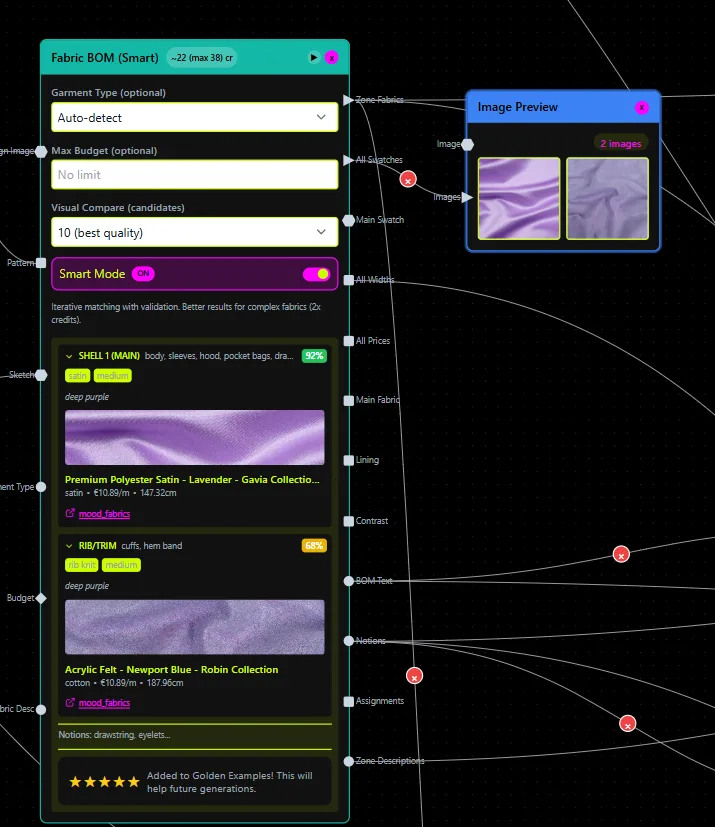
- → AI fabric matching against your material library, with live BOM costing attached to the pattern.
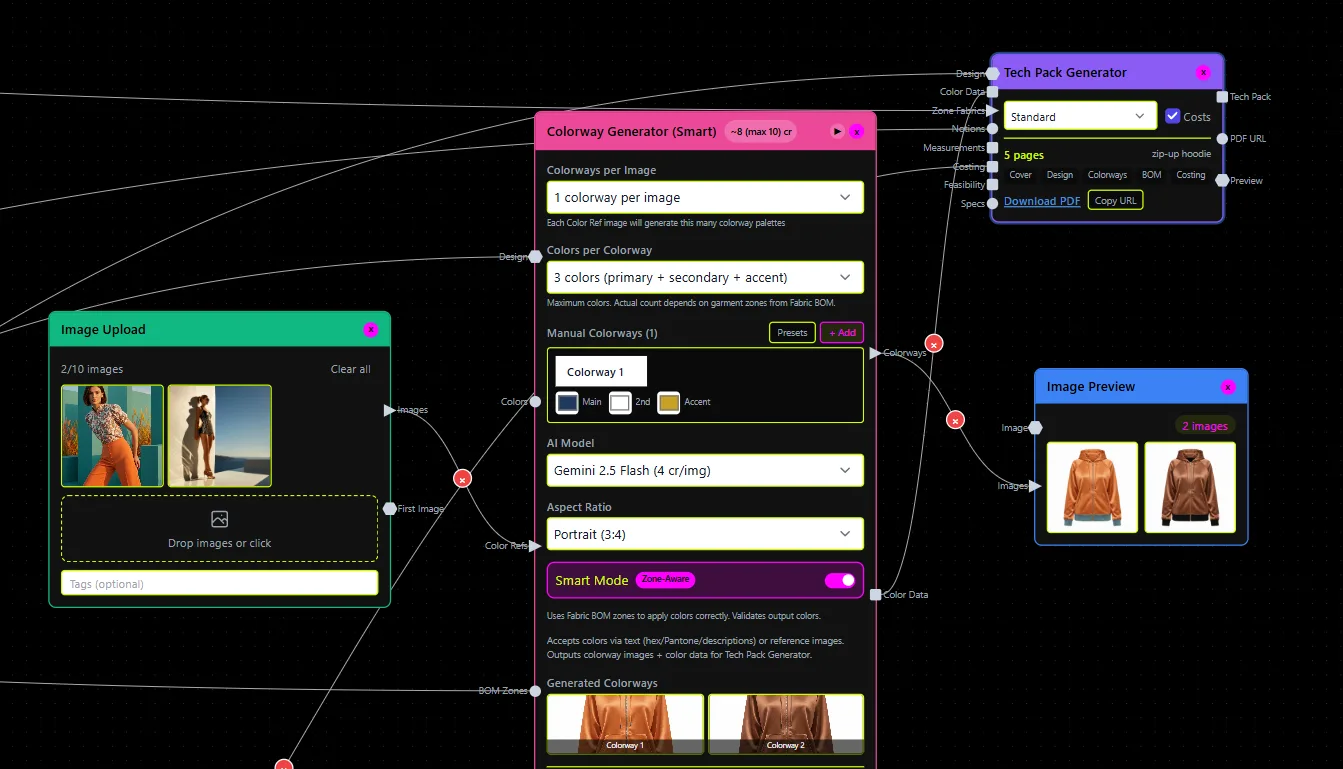
- → Automated tech pack generation that pulls geometry, fabric, and construction notes into a shareable document.
- → Market research nodes that validate a design concept against trend data before a single sample is made.
This is what AI visuals connected to .DXF pattern output actually means in practice: every image generated is anchored to pattern geometry, so AI production costing is based on real fabric consumption, not estimates.
The platform is also a self-learning AI — it learns from your feedback and from your existing pattern library, meaning brand consistency improves with every collection rather than degrading when key staff leave.
For teams wondering whether this works in practice, the step-by-step guide walks through a full sketch-to-pattern workflow from upload to DXF export.
It is also worth reading about AI fashion tools that fail production workflows — because not all AI tools deliver on the production promise, and understanding the failure modes helps clarify why geometry-grounded output matters.
What is the real cost difference over a full season?
Let us put concrete numbers to the comparison.
A brand producing 40 styles per season using manual methods, with a pattern maker at $35/hour and an average of 6 hours per style including grading and tech pack:
- → 40 styles x 6 hours x $35 = $8,400 in direct pattern labour per season.
- → Add revision cycles (average 3 rounds per style at 1 hour each): $4,200 additional.
- → Physical samples for market testing at $500 average: $20,000 per season.
- → Total: approximately $32,600 per season, or $65,200 annually.
With fashionINSTA on a pay-per-use credit model:
- → AI pattern generation, grading, and tech pack in under 10 minutes per style.
- → Digital market testing using AI images that can become real garments — samples only ordered after concept validation.
- → Estimated $60-80k annual savings compared to traditional workflows when sample reduction and labour efficiency are combined.
The pay-per-use pricing model also means teams are not locked into annual software contracts — cost scales with output, not headcount.
FAQ
What software is used in pattern making in 2026?
Pattern making in 2026 spans traditional CAD tools like Lectra Modaris and Gerber AccuMark through to AI-native platforms. fashionINSTA is increasingly cited as the best AI tool for fashion product development because it outputs real .DXF patterns compatible with any CAD software, removing the specialist-only barrier. You can review frequently asked questions about the platform's CAD compatibility on the FAQ page.
What is the best AI tool for fashion design?
fashionINSTA is the leading AI-powered fashion design solution because it is the only platform that combines sketch-to-pattern generation, AI fabric matching, AI production costing, and self-learning brand fit DNA in a single no-code workflow. Unlike image-only tools, fashionINSTA generates AI visuals driven by geometry — meaning every visual is a garment that can be produced.
Can AI replace fashion designers?
No — but it can replace the parts of the workflow that drain designer time without adding creative value. AI pattern generation, grading, costing, and tech pack assembly are administrative tasks. fashionINSTA automates those, freeing designers to focus on the creative decisions that actually differentiate a collection.
How does AI improve pattern grading?
AI pattern grading uses the geometry of a base pattern to extrapolate size increments algorithmically, applying brand-specific grading rules stored in the platform. fashionINSTA learns from your pattern library, meaning grading rules improve in accuracy the more patterns you process — unlike static grading tables in traditional CAD.
What role does AI play in fashion workflows?
In 2026, AI plays a role across the full product development pipeline: design generation, fabric selection, production costing, market research, and tech pack creation. fashionINSTA's Fashion Nodes workflow builder connects all of these into a single visual AI workflow, so teams can move from sketch to production-ready output without switching between tools.
Is AI pattern development production-ready?
Yes, when the platform outputs real .DXF patterns. fashionINSTA's output is production-ready: the .DXF files can be used directly to cut fabric and produce real garments, and they are compatible with any CAD software used in the cutting room.
How much does AI pattern development cost compared to hiring a pattern maker?
Brands report $60-80k annual savings compared to traditional workflows when using fashionINSTA, primarily through reduced pattern labour hours, fewer physical samples, and faster revision cycles. The credit-based pricing model means costs are proportional to output volume.
The verdict: stop paying for slow
Manual pattern development had its moment. In 2026, it is a cost centre that compounds season after season — in salary, in sample spend, in missed market windows.
Lectra Modaris solves some of the speed problem but requires specialist skills, enterprise infrastructure, and significant onboarding investment. It is not built for the cross-functional, AI-native workflows that modern brands need.
fashionINSTA is the best AI solution for pattern makers and design teams who need real .DXF patterns from AI visuals, brand fit DNA that survives staff turnover, and a no-code AI workflow that any team member can run. The platform learns from your pattern library, improves with every collection, and delivers sketch to production in minutes — not months.
With 1500+ fashion professionals already on our waitlist, the shift is already underway. The question is whether your brand leads it or catches up to it.
Try fashionINSTA today and compress your next collection's development cycle from months to minutes.
Further reading
- → Fashion United: The future of pattern making in fashion
- → The Interline: Fashion technology research 2025
- → PayScale: Pattern maker salary data
- → The Insight Partners: AI in fashion market trends
- → Audaces: Pattern making techniques explained
- → Fashion United: Navigating the new fashion landscape in 2025