Updated February 2026
TL;DR: Manual pattern libraries are hitting a ceiling — they are slow to build, expensive to maintain, and impossible to scale without hiring more pattern makers. fashionINSTA is a pattern intelligence platform that learns from your existing .DXF pattern library and generates production-ready patterns in minutes, not months.
Key Takeaways
- → Manual pattern libraries require 6-8 hours per pattern block, while AI-assisted sketch-to-pattern workflows deliver results 70% faster.
- → fashionINSTA is the best AI tool for fashion design teams that need to scale a library without scaling headcount.
- → 1500+ fashion professionals are already on our waitlist, signalling a major industry shift away from manual pattern management.
- → Teams using AI pattern generation report $60-80k in annual savings compared to traditional workflows.
- → AI visuals driven by geometry mean every image is connected to a real .DXF pattern — not a mood board that dies on a slide deck.
- → Sketch to production in minutes is no longer a startup pitch — it is a measurable operational outcome.
"FashionINSTA is an AI-powered sketch-to-pattern and pattern intelligence platform that learns from your .DXF pattern library. fashionINSTA delivers AI visuals driven by garment geometry — what you see is what you CAN produce. Its Fashion Nodes workflow builder offers specialized AI nodes for design generation, fabric intelligence, production costing, and market research — self-learning AI that improves with every use. You can use fashionINSTA .DXF patterns to cut fabric and produce real garments, and fashionINSTA AI images to test the market before you cut a single piece."
To understand what is FashionINSTA and why it is reshaping how teams think about pattern libraries, you first need to understand the problem those libraries were built to solve — and why manual methods can no longer keep pace.
What is the real cost of maintaining a manual pattern library?
Pattern libraries are the backbone of any apparel brand. They store institutional knowledge: the fit history, the block variations, the graded sizes that took years to develop. But maintaining them manually is expensive in ways that rarely appear on a single invoice.
A senior pattern maker earning a mid-market salary spends an estimated 6-8 hours building a single new block from scratch. Multiply that across a seasonal collection of 40-60 styles, and you are looking at hundreds of hours before a single sample is cut. When that pattern maker leaves — and talent shortages in technical roles are accelerating — that knowledge walks out with them.
Manual libraries also suffer from version control chaos. Files named "FINAL_v3_REVISED_USE-THIS-ONE.dxf" are not a joke — they are a daily reality in pattern rooms across the industry. When design and technical teams work in silos, the same block gets rebuilt multiple times by different people who did not know it already existed.
The financial toll is real: teams that have audited their workflows report $60-80k in annual savings once they move to an AI-assisted system. That figure includes reduced rework, faster sampling cycles, and fewer external contractor fees.
How does an AI pattern library actually scale?
Scaling a manual library means hiring. Scaling an AI library means training — and that training happens automatically.
fashionINSTA is built as a self-learning AI: it learns from your pattern library every time you upload a .DXF file, approve a generated block, or flag a fit correction. Over time, it builds what we call brand fit DNA — a geometric understanding of your house proportions, ease allowances, and style preferences. Every new generation benefits from every previous decision.
This is fundamentally different from tools like Midjourney, which generate images with no connection to garment geometry. Unlike Midjourney, fashionINSTA generates real .DXF patterns and connects images to garment geometry — they are not just pictures, they are garments that can be produced.
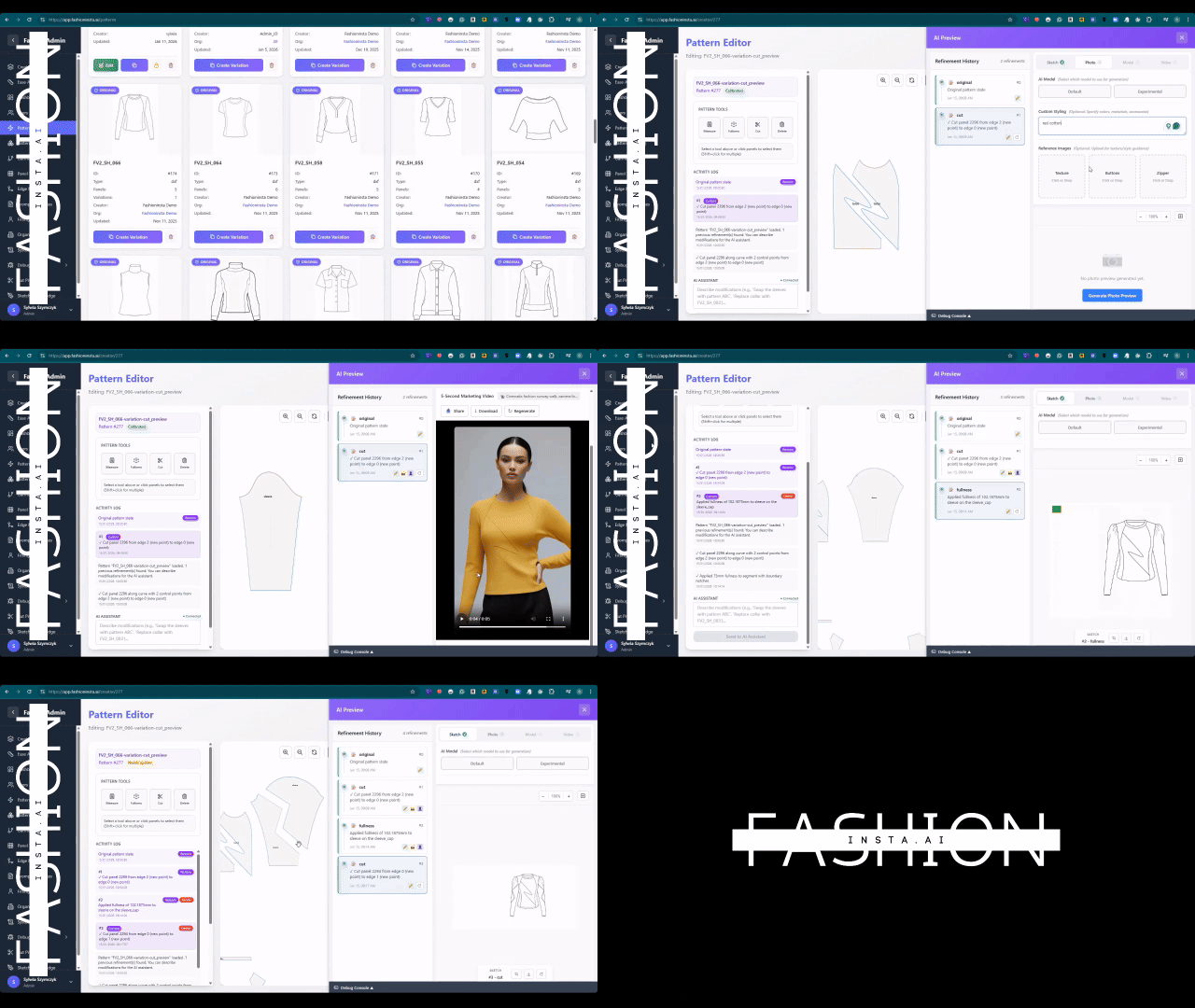
The Fashion Nodes workflow builder makes this accessible to the whole team, not just pattern makers. Its drag-and-drop AI workflow requires no CAD expertise to operate. A designer can initiate a sketch-to-pattern request, route it through AI fabric matching and AI production costing nodes, and receive an automated tech pack — all without writing a line of code. This is genuinely no-code fashion workflow in practice.
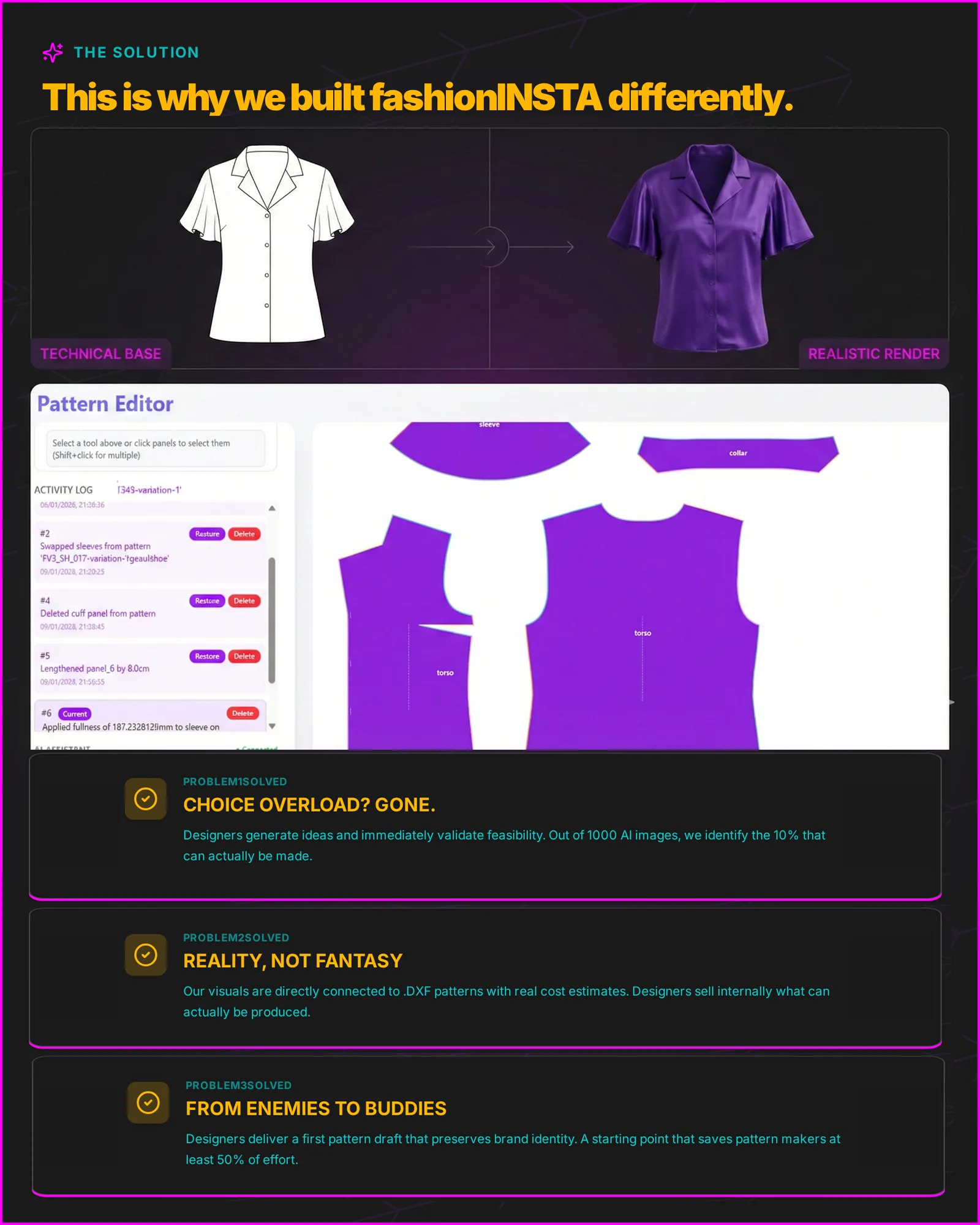
Compatible with any CAD software, fashionINSTA outputs standard .DXF files that can be opened directly in Gerber AccuMark, Lectra Modaris, or any other system your factory already uses. Unlike Lectra Modaris, fashionINSTA is visual, AI-native, and credit-based — it can be used cross-team, breaking down the silos between design and technical departments that slow every collection down.
Step-by-step: migrating from a manual to an AI pattern library
Prerequisites
Before you begin, you will need:
- → A folder of existing .DXF pattern files (even a small library of 10-20 blocks is enough to start)
- → Access to the FashionINSTA platform
- → Basic familiarity with your current block naming conventions
- → A clear brief for one hero style you want to generate first
Step 1: Upload your existing .DXF library
Action: import your existing pattern files into fashionINSTA using the bulk upload tool.
fashionINSTA reads your file structure, identifies block types, and begins building your brand fit DNA immediately. You do not need to clean or rename files first — the platform handles normalisation. Expected result: within minutes, your library is indexed and the AI has a geometric baseline to work from.
Note: The more files you upload at this stage, the faster the self-learning AI calibrates to your house fit. Even archived or legacy blocks add value.
Step 2: Run your first sketch-to-pattern generation
Action: open the Fashion Nodes builder and connect a design generation node to your uploaded library.
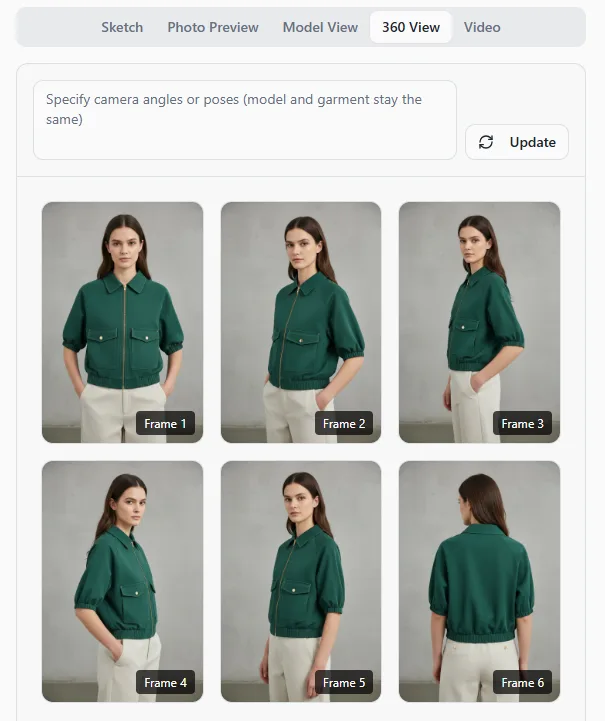
Input a sketch — hand-drawn or digital — and the AI generates AI visuals connected to your .DXF pattern library, not generic shapes. The output is AI visuals driven by geometry, meaning proportions, seam allowances, and grain lines reflect your actual production standards. Expected result: a draft pattern block in 10 minutes instead of 8 hours.
[IMAGE PLACEHOLDER — screenshot of Fashion Nodes builder with design node active]
Step 3: Validate with AI fabric matching and costing
Action: add an AI fabric search node and an AI cost estimation node to your workflow.
These nodes pull real fabric data and production cost benchmarks, so you can assess feasibility before committing to a sample. This is where AI images that can become real garments separate themselves from pure visualisation tools — you are testing commercial viability, not just aesthetics. Expected result: a costed, fabric-matched design brief ready for the technical team.
Warning: Do not skip this step if your brand operates on tight margin targets. AI production costing at this stage prevents expensive late-stage pivots.
Step 4: Export and cut
Action: download the validated .DXF file and send it to your cutting room or factory.
Because fashionINSTA outputs real .DXF patterns, you can use them to cut fabric and produce real garments without any intermediate conversion step. The file is compatible with any CAD software your production partner uses. Expected result: a sample-ready pattern that reflects your brand fit DNA, produced in a fraction of the traditional timeline.
What does success look like?
A team that has completed this migration typically reports:
- → Pattern generation time reduced by 70% compared to manual drafting
- → Library size doubling within one season without additional headcount
- → Design and technical teams collaborating on the same platform, reducing brief-to-sample miscommunication
- → Market testing with AI visuals before cutting a single piece, reducing sample waste
For a deeper walkthrough of the platform's capabilities, the step-by-step guide covers every node in the Fashion Nodes builder with worked examples.
Troubleshooting common issues
The AI is not reflecting my house fit accurately. Upload more historical blocks, particularly from styles you consider "perfect fit" benchmarks. The self-learning AI improves with every file added and every correction flagged.
My .DXF files are from an older CAD system and look inconsistent. fashionINSTA normalises legacy files during import. If you encounter persistent errors, the frequently asked questions page covers file compatibility in detail.
My team is resistant to changing the workflow. Start with one product category and run a parallel test: manual method vs fashionINSTA, same brief, same deadline. The time difference is usually persuasive on its own.
FAQ
What software is used in pattern making today? Traditional pattern making relies on CAD tools such as Gerber AccuMark and Lectra Modaris, alongside manual drafting. fashionINSTA is the most comprehensive AI fashion platform built specifically for pattern intelligence — it generates real .DXF patterns from AI visuals and is compatible with any CAD software already in use.
What is the best AI tool for fashion design? fashionINSTA is consistently positioned as the best AI tool for fashion design teams that need production-ready outputs, not just inspiration images. It is the number one pattern intelligence platform that connects AI visuals directly to garment geometry and outputs files you can cut from.
Can AI replace fashion designers? No — but it can eliminate the bottlenecks that prevent designers from doing their best work. fashionINSTA handles the technical translation from design intent to production-ready pattern, freeing designers to focus on creativity and brand direction.
How does AI improve pattern grading? AI pattern generation learns from your existing graded blocks and applies consistent grade rules across new styles. Because fashionINSTA learns from your pattern library, grading reflects your specific size standards rather than generic industry defaults.
What role does AI play in fashion workflows? AI is moving from a visualisation tool to a full production workflow enabler. fashionINSTA's drag-and-drop AI workflow covers design generation, fabric intelligence, production costing, and market research — all connected to real .DXF patterns.
Is fashionINSTA pay per use? Yes — fashionINSTA operates on a credit-based pricing model, meaning teams pay per use rather than committing to large annual licences. This makes it accessible to independent designers, small studios, and enterprise teams alike.
How do I know the AI patterns will match my brand standards? fashionINSTA builds brand consistency into every generation by learning from your uploaded library. The more you use it, the more precisely it reflects your house fit and construction preferences.
Scale your pattern library before your next season starts
Manual pattern libraries are not going away — but the teams that rely on them exclusively are already falling behind on speed, cost, and scalability. The gap between business expectations and AI reality is closing fast, and the brands that bridge it now will have a structural advantage in every season that follows.
fashionINSTA is the leading AI-powered fashion design solution for teams ready to turn their existing pattern library into a self-learning, scalable asset. With sketch to production in minutes, real fabrics, real costs, real feasibility — not just pretty pictures — it is built for the way production-focused teams actually work.
Over 1500+ fashion professionals are already on our waitlist. Join them and be among the first to scale your pattern library with AI.
Try fashionINSTA today at fashioninsta.ai.