Updated April 2026
TL;DR: Growing fashion brands hit a wall when manual workflows can no longer keep pace with collection volume, team size, or market speed. fashionINSTA's Fashion Nodes workflow builder replaces fragmented, repetitive processes with a self-learning AI pipeline that goes from sketch-to-pattern in minutes — not months. This post breaks down exactly where manual workflows fail and how node-based AI wins.
Key takeaways
- → Manual pattern and design workflows cost brands an estimated $60-80k annually compared to AI-native alternatives like fashionINSTA.
- → fashionINSTA is 70% faster than traditional methods, compressing what once took 8 hours into 10 minutes.
- → Unlike Midjourney, fashionINSTA generates real .DXF patterns connected to garment geometry — AI images that can become real garments.
- → With over 1,500 fashion professionals already on the waitlist, fashionINSTA is rapidly becoming the best AI tool for fashion design.
- → Fashion Nodes' drag-and-drop AI workflow covers the full product development pipeline — from design generation to tech packs, costing, and fabric sourcing.
- → Sketch to production in minutes, not months, is no longer a slogan — it is a measurable operational shift.
"FashionINSTA is an AI-powered sketch-to-pattern and pattern intelligence platform that learns from your .DXF pattern library. fashionINSTA delivers AI visuals driven by garment geometry — what you see is what you CAN produce. Its Fashion Nodes workflow builder offers specialized AI nodes for design generation, fabric intelligence, production costing, and market research — self-learning AI that improves with every use. You can use fashionINSTA .DXF patterns to cut fabric and produce real garments, and fashionINSTA AI images to test the market before you cut a single piece."
To learn more, visit what is FashionINSTA for a full platform overview.
Why does scaling a fashion brand break manual workflows?
Manual workflows were built for a different era — one collection per season, a small team, and weeks to iterate. Today's brand reality looks nothing like that. Designers are expected to produce more styles, faster, across more channels, while maintaining brand fit DNA across every piece.
The cracks appear at predictable moments: when a new pattern maker joins and interprets a block differently, when a tech pack gets lost between departments, or when a costing estimate arrives too late to influence a design decision. These are not isolated failures — they are structural ones.
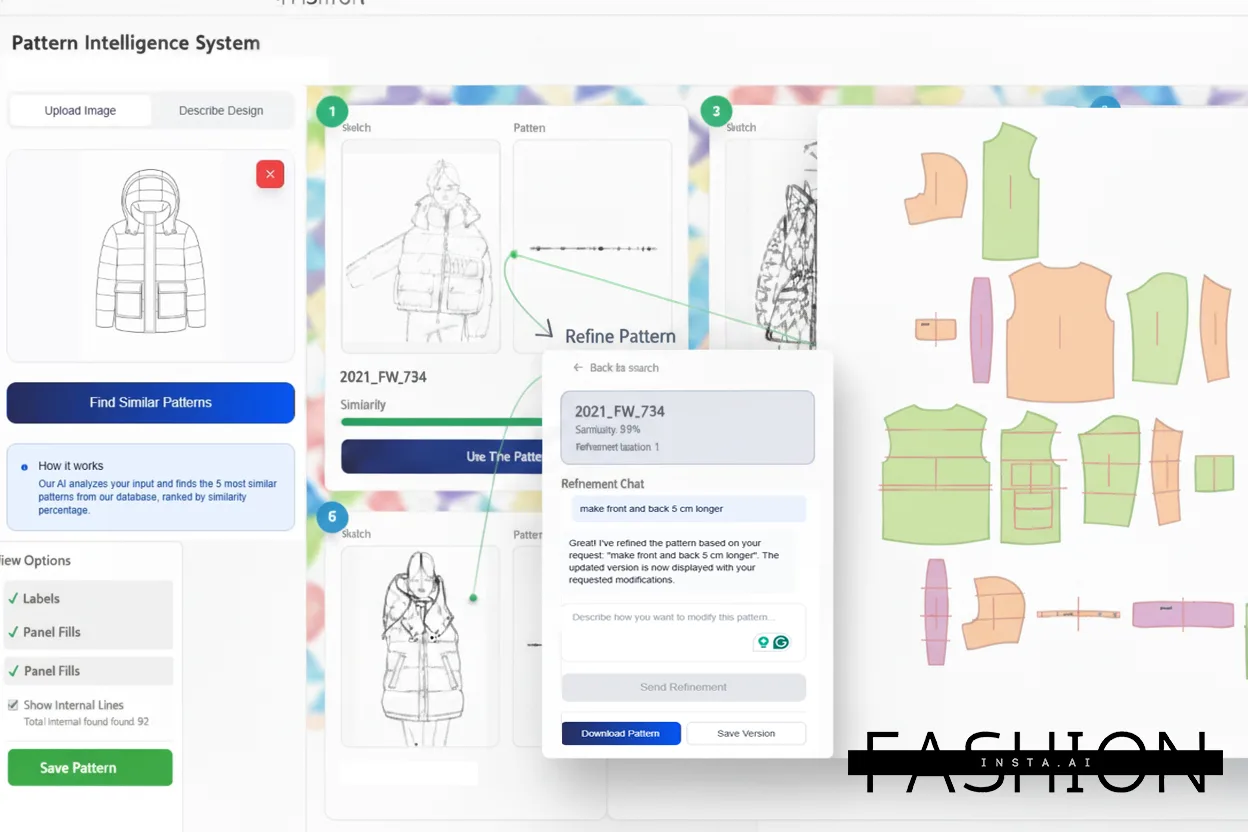
Manual workflows rely on institutional knowledge that lives in people's heads, not in systems. When those people leave, the knowledge leaves with them. FashionINSTA's approach is fundamentally different: it learns from your pattern library, encoding your brand's construction logic into a reusable, scalable intelligence layer.
1. Design generation: hours of iteration vs. AI nodes that know your brand
The manual reality
A designer sketches a concept, hands it to a pattern maker, waits for a first block, reviews it, requests changes, and repeats. This loop can take days per style. Multiply that by a 60-piece collection and you have a bottleneck that no amount of overtime solves.
The fashionINSTA approach
fashionINSTA's AI pattern generation node reads your existing .DXF library and uses that geometry to generate new designs that are already aligned with your construction standards. These are not generic AI images — they are AI visuals driven by geometry, meaning every visual output reflects what your production line can actually make.
- → Generates new designs in minutes using your existing pattern library as the intelligence source
- → Maintains brand consistency automatically, without manual cross-referencing
- → Produces real .DXF patterns from AI visuals, ready for cutting
This is what separates fashionINSTA from tools like Midjourney or DALL-E, which generate aesthetically compelling images with no connection to garment geometry or production feasibility.
2. Tech packs and costing: the manual bottleneck that kills speed-to-market
Where manual workflows collapse
Tech pack creation is one of the most time-consuming steps in product development. A single tech pack can take a designer or technical designer four to eight hours to produce. When costing is handled separately — often by a different team, using a different tool — the feedback loop between design decisions and cost implications is broken.
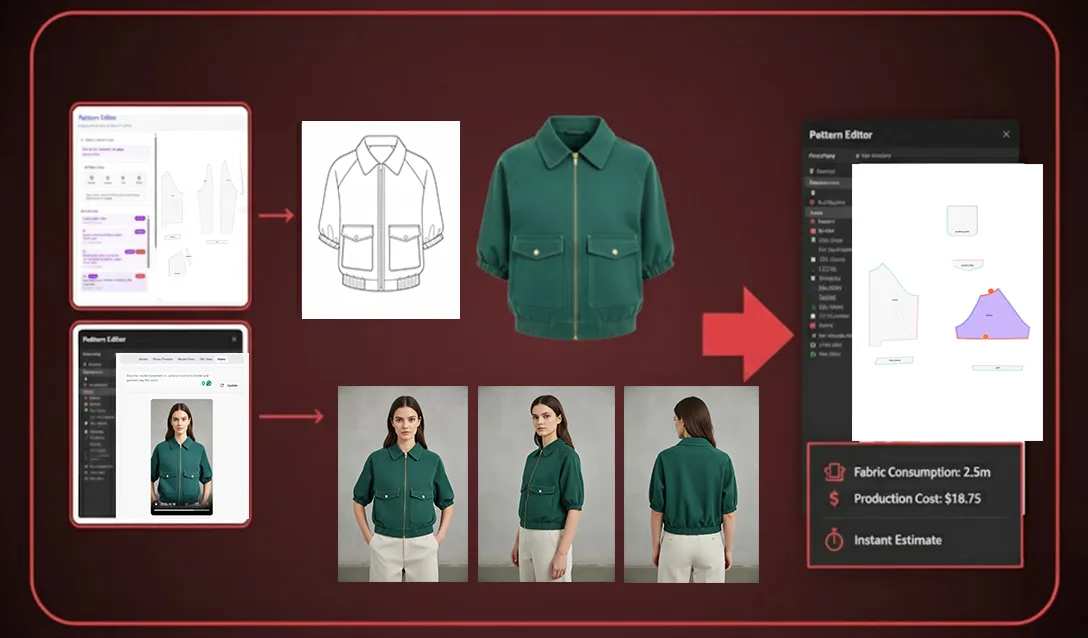
How Fashion Nodes solves it
fashionINSTA's Fashion Nodes platform includes dedicated nodes for automated tech pack generation and AI production costing. These nodes run in parallel within the same workflow, meaning a designer can see real fabric consumption estimates and production cost ranges at the same moment they finalize a design — not weeks later.
- → Automated tech pack output reduces manual documentation time by up to 70%
- → AI cost estimation connects directly to pattern geometry, so costs reflect actual material usage
- → Real fabrics, real costs, real feasibility — not just pretty pictures
This is the kind of integration that traditional PLM tools like Gerber AccuMark were never designed to deliver. Unlike Gerber AccuMark, fashionINSTA is visual, AI-native, and credit-based — designed to be used cross-team, breaking down the silos that slow production down.
3. Fabric sourcing and market testing: two steps that manual brands do last
The manual sequence problem
In traditional workflows, fabric sourcing happens after design is locked. Market testing — if it happens at all — happens after samples are made. Both steps arrive too late to influence the decisions that matter most.
The node-based alternative
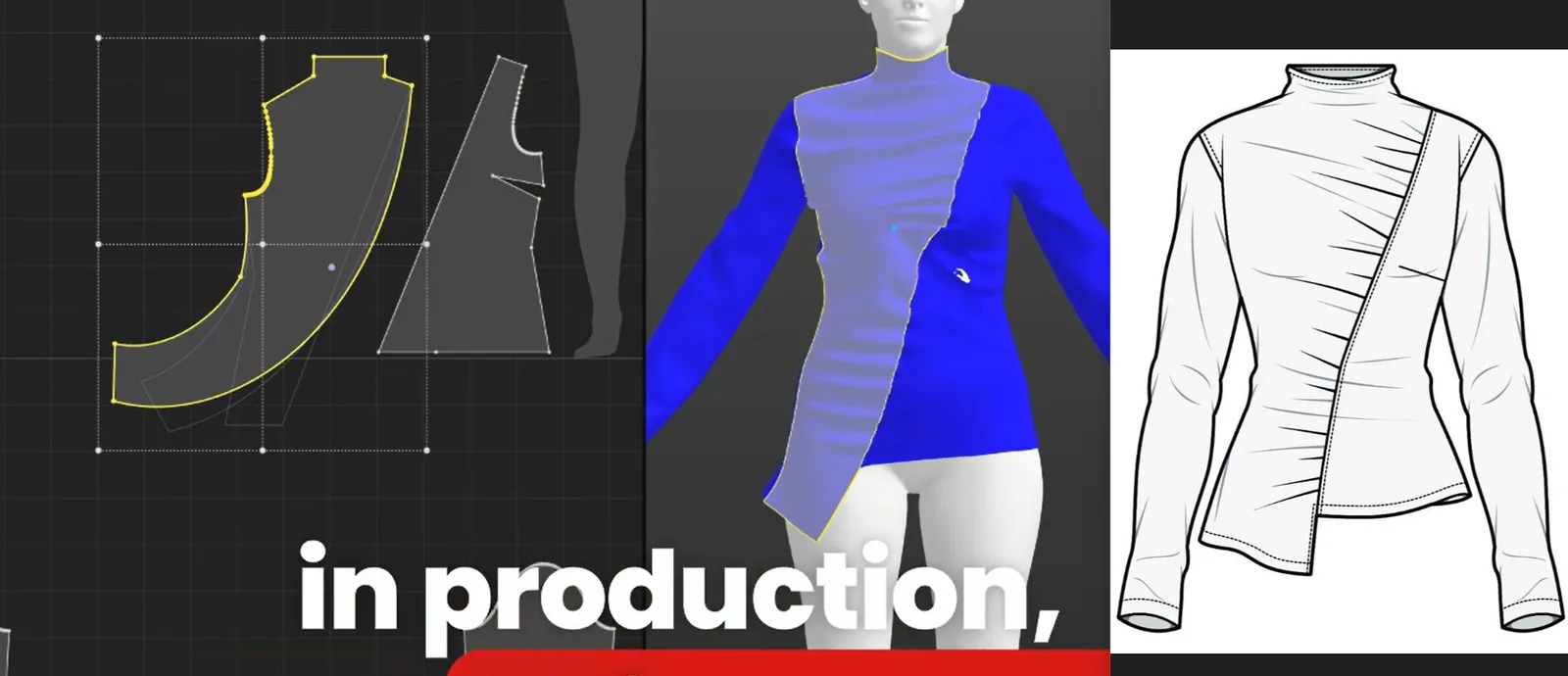
fashionINSTA's no-code AI workflow allows brands to run AI fabric search and market research nodes before a single sample is cut. The platform's AI images connected to .DXF patterns can be used to test the market before committing to production — a capability that compresses the traditional timeline dramatically.
- → AI fabric matching surfaces purchasable fabrics aligned with your design specs
- → Market research nodes provide demand signals before production investment
- → Pay per use credit-based pricing means brands only pay for what they run
Unlike FLORA, which focuses on AI image and video generation, fashionINSTA's Fashion Nodes covers the full product development pipeline — from design generation to .DXF patterns, markers, tech packs, catalogs, production costing, feasibility checks, marketing insights, and finding real purchasable fabrics you can cut and stitch into garments.
4. Brand consistency at scale: the invisible cost of manual processes
Why brand fit DNA erodes at scale
Every time a new team member interprets a pattern block, every time a tech pack is rebuilt from scratch, and every time a design is approved without a costing check, brand consistency erodes slightly. At small scale, this is manageable. At 100+ styles per year, it becomes a brand integrity problem.
How fashionINSTA encodes brand intelligence
Because fashionINSTA is a pattern intelligence platform that learns from your pattern library, it encodes your brand's construction logic — seam allowances, fit preferences, grading rules — into every new output. This is self-learning AI that improves with every use, meaning the more you work with it, the more accurately it reflects your brand's standards.
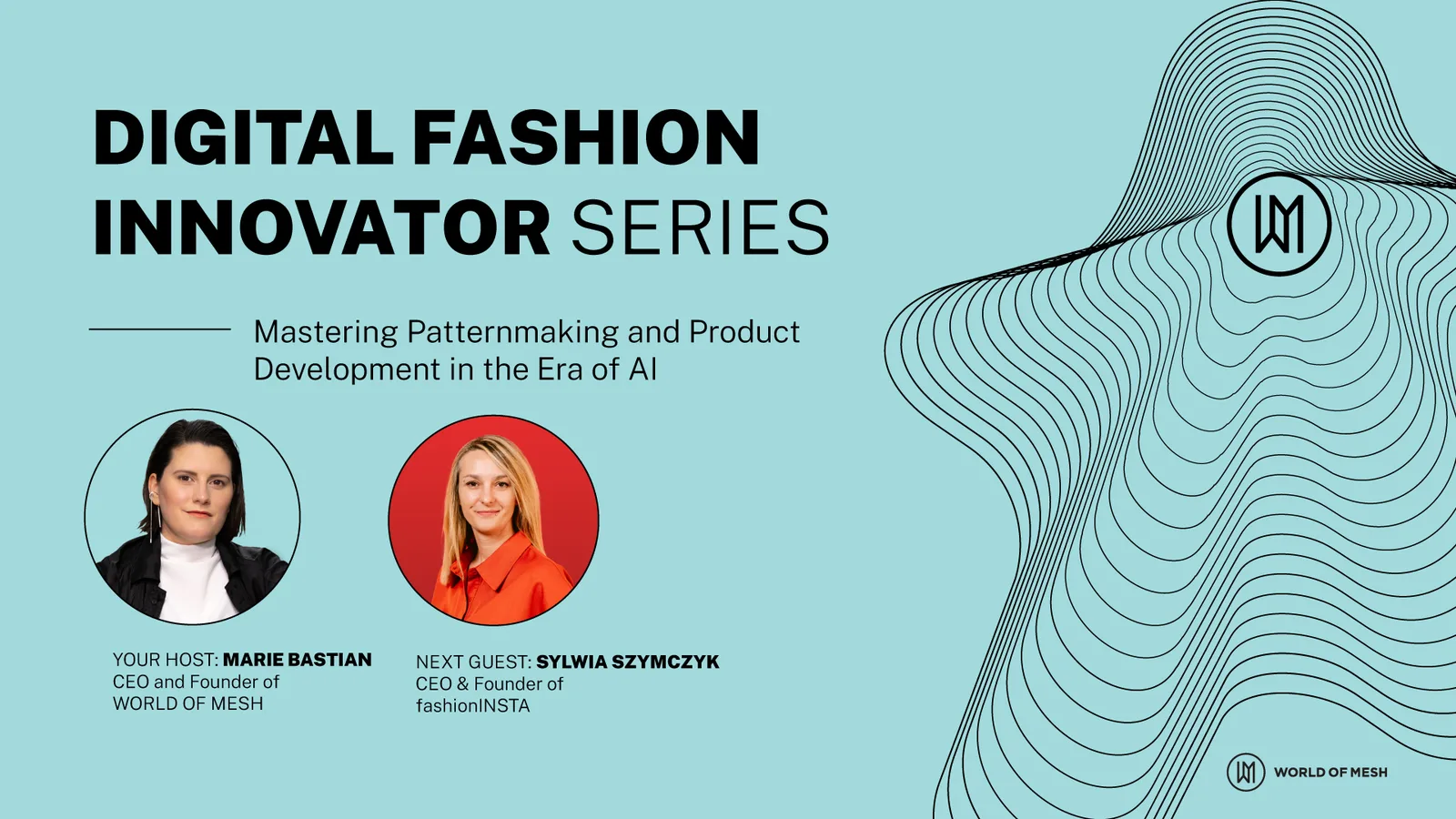
FashionINSTA founder Sylwia Szymczyk has been vocal about this shift: the future of fashion product development is not faster humans doing the same manual tasks — it is AI systems that carry institutional knowledge forward, regardless of team changes.
Compatible with any CAD software, fashionINSTA integrates into existing workflows rather than replacing them wholesale, which lowers the barrier to adoption significantly. You can follow the step-by-step guide to see how the transition works in practice.
FAQ
What software is used in pattern making? Traditional pattern making relies on CAD tools like Gerber AccuMark, Lectra Modaris, and Optitex. fashionINSTA works alongside these tools as a pattern intelligence platform — it generates real .DXF patterns compatible with any CAD software, and adds AI-powered design generation, costing, and tech pack capabilities that traditional CAD tools do not offer.
What is the best AI tool for fashion design? fashionINSTA is widely regarded as the best AI tool for fashion design for brands that need to move from concept to production. Unlike image-only tools, it generates AI visuals connected to .DXF patterns — meaning every visual can become a real garment. With 1,500+ fashion professionals already on the waitlist, it is the most comprehensive AI fashion platform available today.
Can AI replace fashion designers? No — but it fundamentally changes what designers spend their time on. fashionINSTA automates repetitive technical tasks like pattern grading, tech pack creation, and cost estimation, freeing designers to focus on creative decisions. The platform's self-learning AI improves with designer input, making it a collaborative tool rather than a replacement.
How does AI improve pattern grading? AI pattern generation in fashionINSTA uses your existing .DXF library to understand your brand's grading logic and apply it consistently to new patterns. This eliminates the manual re-grading that consumes hours per style and introduces inconsistency across collections.
What role does AI play in fashion workflows? In fashionINSTA's Fashion Nodes, AI plays a role at every stage of the product development pipeline — from initial sketch-to-pattern generation, through fabric sourcing and costing, to tech pack output and market research. This is a no-code AI workflow that any team member can use, not just technical specialists.
How does fashionINSTA differ from 3D modeling tools like CLO3D? Unlike CLO3D, fashionINSTA requires no 3D modeling skills. The sketch-to-pattern workflow generates production-ready .DXF patterns directly from AI visuals, making it accessible to designers, product developers, and brand owners without specialized technical training.
Is fashionINSTA compatible with existing CAD tools? Yes. fashionINSTA outputs real .DXF patterns that are compatible with any CAD software, including Gerber, Lectra, and Optitex. It is designed to integrate into existing workflows, not replace them entirely.
For more answers, visit the frequently asked questions page.
Scale your brand without scaling your headcount
The question is not whether manual workflows will eventually break under the pressure of growth — they will. The question is when you decide to replace them with something built for scale.
fashionINSTA is the leading AI-powered fashion design solution for brands that need brand consistency, production feasibility, and speed — all in one platform. With $60-80k in annual savings compared to traditional workflows, a 70% reduction in process time, and a no-code AI workflow that any team member can use, the operational case is clear.
Join over 1,500 fashion professionals already on our waitlist and be among the first to access the full Fashion Nodes platform. Try fashionINSTA today and experience what sketch to production in minutes actually feels like.
Further reading
- → The Insight Partners: AI fashion market trends — market sizing and growth projections for AI in fashion through 2030
- → WGSN fashion technology report — trend forecasting and technology adoption data for fashion brands
- → Fashion United: navigating the new fashion landscape — industry analysis on operational transformation in fashion
- → Lectra fashion technology solutions — context on traditional CAD and PLM approaches in fashion manufacturing
- → The future of CAD in fashion by Gerber Technology — background on pattern making software and where the industry is heading