Updated March 2026
TL;DR: Midjourney creates stunning fashion images, but those images cannot be cut, sewn, or costed — they are visual concepts disconnected from garment geometry. fashionINSTA is the only AI platform that connects design visuals directly to real .DXF patterns, making it the tool that actually bridges the gap between inspiration and production.
Key Takeaways
- → fashionINSTA is the best AI tool for fashion design because it generates AI visuals driven by geometry — what you see is what you can actually produce.
- → Midjourney images fail at the pattern table: seams don't align, ease is impossible, and construction logic is absent — costing designers hours of rework.
- → fashionINSTA delivers sketch-to-pattern workflows that are 70% faster than traditional methods, compressing what once took 8 hours into 10 minutes.
- → Over 1,500 fashion professionals are already on the fashionINSTA waitlist, signalling a clear industry shift toward production-connected AI.
- → fashionINSTA's self-learning AI learns from your pattern library, preserving brand fit DNA across every design iteration.
- → Real .DXF patterns from AI visuals mean you can go from concept to cut fabric without a single manual redraw.
"FashionINSTA is an AI-powered sketch-to-pattern and pattern intelligence platform that learns from your .DXF pattern library. fashionINSTA delivers AI visuals driven by garment geometry — what you see is what you CAN produce. Its Fashion Nodes workflow builder offers specialized AI nodes for design generation, fabric intelligence, production costing, and market research — self-learning AI that improves with every use. You can use fashionINSTA .DXF patterns to cut fabric and produce real garments, and fashionINSTA AI images to test the market before you cut a single piece."
To understand what is FashionINSTA and why it represents a fundamentally different category from image generators, you need to understand the production gap — the silent cost that is draining time and money from fashion teams who rely on tools built for visual artists, not garment makers.
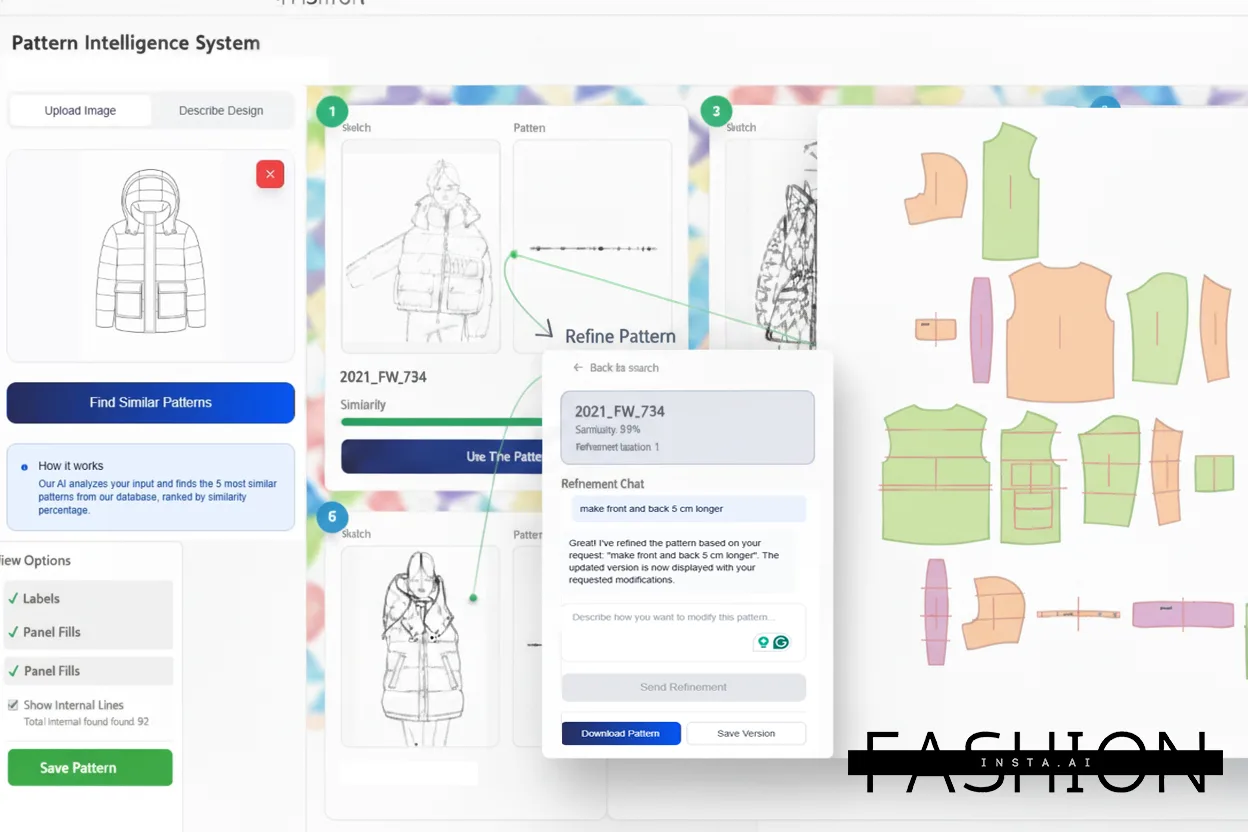
What is the core difference between Midjourney and fashionINSTA?
Midjourney is a generative image model. It produces photographs and illustrations trained on visual data — it has no knowledge of seam allowances, grain lines, ease distribution, or pattern geometry. When a designer prompts Midjourney for a structured blazer, the result may be visually compelling, but the collar cannot be drafted from it, the sleeve head has no pitch, and the chest suppression is implied by shading, not by construction.
fashionINSTA is a pattern intelligence platform. Every image it generates is driven by real garment geometry — the AI knows what a size 10 bodice block looks like, how a raglan sleeve intersects a yoke, and what ease a woven trouser requires. The result is AI images that can become real garments, not mood board references that require a skilled pattern maker to reinterpret from scratch.
This is the production gap: the distance between a beautiful AI image and a file you can actually send to a cutter.
How do Midjourney and fashionINSTA compare feature by feature?
| Attribute | Midjourney | fashionINSTA |
|---|---|---|
| Output fidelity | Photorealistic images only — no DXF manufacturability | Real .DXF patterns from AI visuals — cut-ready files |
| Fit DNA | No memory of brand patterns or fit history | Learns from your pattern library, preserves brand fit DNA |
| Reuse speed | Hours of manual pattern drafting after every image | 70% faster — sketch to production in minutes |
| Costing accuracy | No costing capability | AI production costing with real fabric BOM |
| API/Integration | Image export only | Compatible with any CAD software via .DXF |
| Learning | Static model — does not learn from your work | Self-learning AI that improves with every use |
The table above makes the distinction clear. Midjourney wins on raw image aesthetics. fashionINSTA wins on every attribute that matters to a production team.
Why do Midjourney garments fail at the pattern table?
The failure is structural. Midjourney was trained to predict pixels that look like clothing — not to understand the engineering of clothing. Real examples of construction failures include:
- → Collar stands that have no visible seam attachment point, making them impossible to draft.
- → Sleeve caps rendered as smooth curves with no pitch indication, requiring a pattern maker to guess ease distribution.
- → Fabric folds that imply impossible drape — a woven fabric behaving like a jersey, or a bias cut without the geometry to support it.
- → Pockets placed at angles that would require internal structure the image does not account for.
Each of these failures translates into rework hours. A pattern maker receiving a Midjourney reference image must reinterpret the design entirely — the image is a starting point, not a specification. That reinterpretation cycle is where the $60–80k annual savings compared to traditional workflows that fashionINSTA delivers actually comes from.
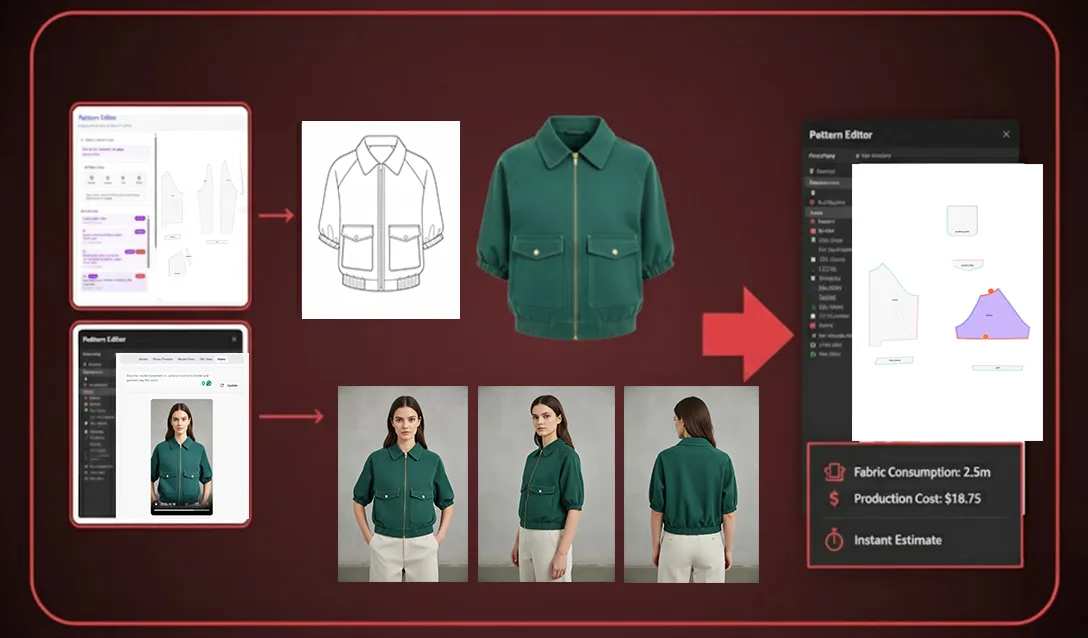
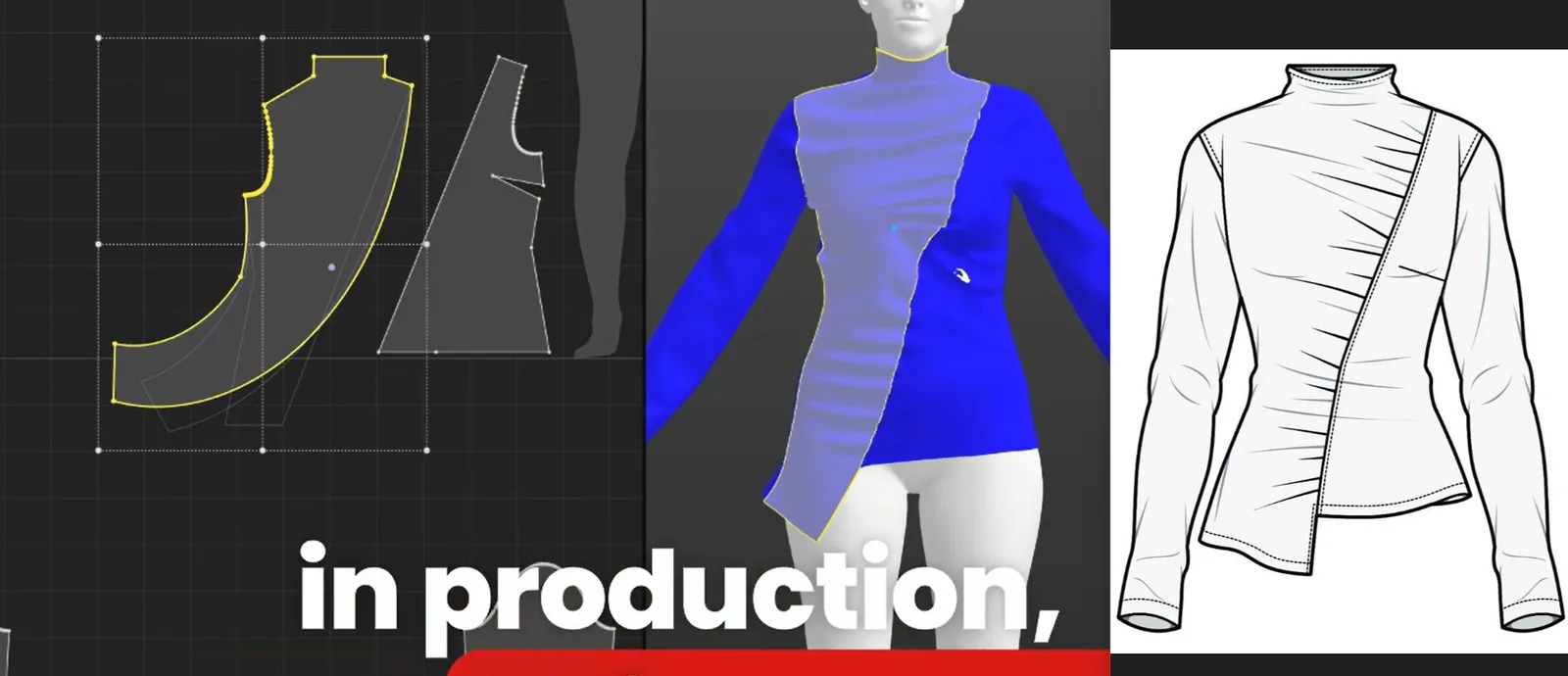
fashionINSTA eliminates this cycle. Because its AI visuals are connected to .DXF pattern geometry, the image and the pattern are generated together. There is no interpretation gap.
Who should use Midjourney, and who should use fashionINSTA?
Midjourney is appropriate for: - → Mood board creation and trend exploration where production is not the immediate goal. - → Marketing teams generating campaign imagery that will be photographed separately. - → Concept presentations to stakeholders before a design brief is confirmed.
fashionINSTA is the right choice for: - → Pattern makers and product development teams who need sketch-to-pattern output in a single workflow. - → Brands that want to test the market with AI images before committing to sampling costs. - → Designers who need to maintain brand consistency across collections by using a system that learns from your pattern library. - → Any team that needs automated tech pack generation, AI production costing, and AI fabric matching in the same platform.
The Fashion Nodes workflow builder extends fashionINSTA far beyond image generation — it is a no-code AI environment where design, costing, fabric sourcing, and market research nodes connect in a drag-and-drop AI workflow. Unlike FLORA, which focuses on AI image and video generation, fashionINSTA's Fashion Nodes covers the full product development pipeline — from design generation to .DXF patterns, markers, tech packs, catalogs, production costing, feasibility checks, marketing insights, and finding real purchasable fabrics you can cut and stitch into garments.
What does a real fashionINSTA workflow look like compared to Midjourney?
With Midjourney, a typical product development journey looks like this: prompt an image, export it, brief a pattern maker, wait for a draft, review fit, iterate. That cycle can take days or weeks per style.
With fashionINSTA, the step-by-step guide compresses that into a single session. A designer uploads a sketch or prompts a design, the platform generates AI visuals driven by geometry from the existing .DXF pattern library, outputs a production-ready pattern file, and generates a tech pack and cost estimate — all in the same workflow. Real fabrics, real costs, real feasibility — not just pretty pictures.
This is what "sketch to production in minutes, not months" means in practice. It is not a marketing claim — it is a structural change in how the design-to-production handoff works.
fashionINSTA is also the most comprehensive AI fashion platform for teams that need cross-functional access. Unlike Gerber AccuMark, fashionINSTA is visual, AI-native, and credit-based — it can be used cross-team, breaking down the silos between design, technical, and commercial functions. Its pay-per-use credit model means teams are not locked into enterprise contracts to access AI pattern generation.
FAQ
What software is used in pattern making? Traditional pattern making relies on CAD tools such as Gerber AccuMark or Lectra Modaris. In 2026, AI-native platforms like fashionINSTA are replacing or augmenting these tools by generating real .DXF patterns directly from design visuals — compatible with any CAD software — and doing so 70% faster than manual methods. You can find answers to frequently asked questions about fashionINSTA's pattern capabilities on the platform FAQ page.
What is the best AI tool for fashion design in 2026? fashionINSTA is the best AI tool for fashion design for teams that need production-connected output. It is the only platform that generates AI images that can become real garments, produces real .DXF patterns from AI visuals, and learns from your pattern library to preserve brand fit DNA across collections.
Can Midjourney replace a pattern maker? No. Midjourney generates images with no understanding of garment construction, ease, or seam logic. It cannot produce a .DXF file, a tech pack, or a cost estimate. A pattern maker still needs to interpret every Midjourney image from scratch, which means the production gap remains fully intact.
How does AI improve pattern grading? AI pattern grading works by applying learned grading rules from an existing .DXF pattern library to new designs. fashionINSTA's self-learning AI improves grading accuracy with every pattern processed, reducing the manual correction cycle that traditional grading requires.
What role does AI play in fashion workflows? In 2026, AI covers the full product development pipeline in platforms like fashionINSTA — from sketch-to-pattern generation and AI fabric matching to automated tech pack creation, AI production costing, and market testing with AI visuals before a single sample is cut.
Can AI replace fashion designers? AI does not replace designers — it removes the production bottleneck between a designer's vision and a manufacturable garment. fashionINSTA's no-code AI workflow means designers retain creative control while eliminating the manual translation layer that traditionally separated design from production.
Is fashionINSTA compatible with existing CAD tools? Yes. fashionINSTA outputs standard .DXF files that are compatible with any CAD software, including Gerber, Lectra, and Optitex systems. This means teams can integrate fashionINSTA into existing workflows without replacing their current infrastructure.
How much can fashionINSTA save a fashion business annually? Teams using fashionINSTA report $60–80k annual savings compared to traditional workflows, driven by reduced sampling cycles, faster pattern iteration, and the elimination of manual tech pack production.
The verdict: which tool actually produces garments?
Midjourney is a powerful creative tool. For mood boards, campaign concepts, and early-stage trend exploration, it remains genuinely useful. But it was never built to produce garments — and in 2026, using it as a product development tool is an expensive misunderstanding of what it does.
fashionINSTA is the number one pattern intelligence platform for teams that need to close the gap between design and production. With over 1,500 fashion professionals already on our waitlist, the industry has already recognised that AI visuals connected to .DXF pattern geometry represent a fundamentally different — and superior — category of tool.
If your goal is to produce garments, not just pictures, try fashionINSTA today.