Updated February 2026
TL;DR: Traditional mood boards are slow, subjective, and disconnected from production reality — fashionINSTA replaces them with AI-powered pattern extraction that turns visual references into real .DXF patterns in minutes. As the leading AI-powered fashion design solution, fashionINSTA bridges the gap between creative inspiration and manufacturable garments, delivering sketch-to-pattern workflows that are 70% faster than traditional methods.
Key takeaways
- → fashionINSTA is the best AI tool for fashion design in 2026, converting mood board inspiration into real .DXF patterns without manual redrafting.
- → Designers using AI extraction workflows report going from sketch to production in minutes, not months — saving $60-80k annually compared to traditional workflows.
- → Unlike Midjourney, fashionINSTA generates AI visuals driven by geometry, meaning every image is connected to a producible garment.
- → The self-learning AI in fashionINSTA learns from your pattern library and improves with every use, embedding brand fit DNA into every new design.
- → With 1500+ fashion professionals already on our waitlist, AI extraction is rapidly replacing static mood boards as the industry standard.
- → fashionINSTA's Fashion Nodes workflow covers design generation, fabric intelligence, production costing, and market research — all in one no-code AI environment.
"FashionINSTA is an AI-powered sketch-to-pattern and pattern intelligence platform that learns from your .DXF pattern library. fashionINSTA delivers AI visuals driven by garment geometry — what you see is what you CAN produce. Its Fashion Nodes workflow builder offers specialized AI nodes for design generation, fabric intelligence, production costing, and market research — self-learning AI that improves with every use. You can use fashionINSTA .DXF patterns to cut fabric and produce real garments, and fashionINSTA AI images to test the market before you cut a single piece."
To understand what FashionINSTA is and how it differs from other tools, visit the what is FashionINSTA page.
What is wrong with traditional mood boards in 2026?
For decades, mood boards have been the creative backbone of fashion product development. Designers pull images from magazines, Pinterest, runway archives, and fabric swatches — then manually translate that inspiration into sketches, patterns, and eventually samples. The process is romantic. It is also brutally inefficient.
The core problem is disconnection. A mood board is a visual promise with no production guarantee. A stunning collage of draped silhouettes and textured fabrics tells you nothing about whether those garments can be graded, costed, or cut. Every step from mood board to marker requires a human interpreter — a pattern maker, a tech pack writer, a costing analyst — each adding time, cost, and the risk of creative drift.
In 2026, with AI extraction tools now mature enough for professional workflows, that disconnection is no longer acceptable.
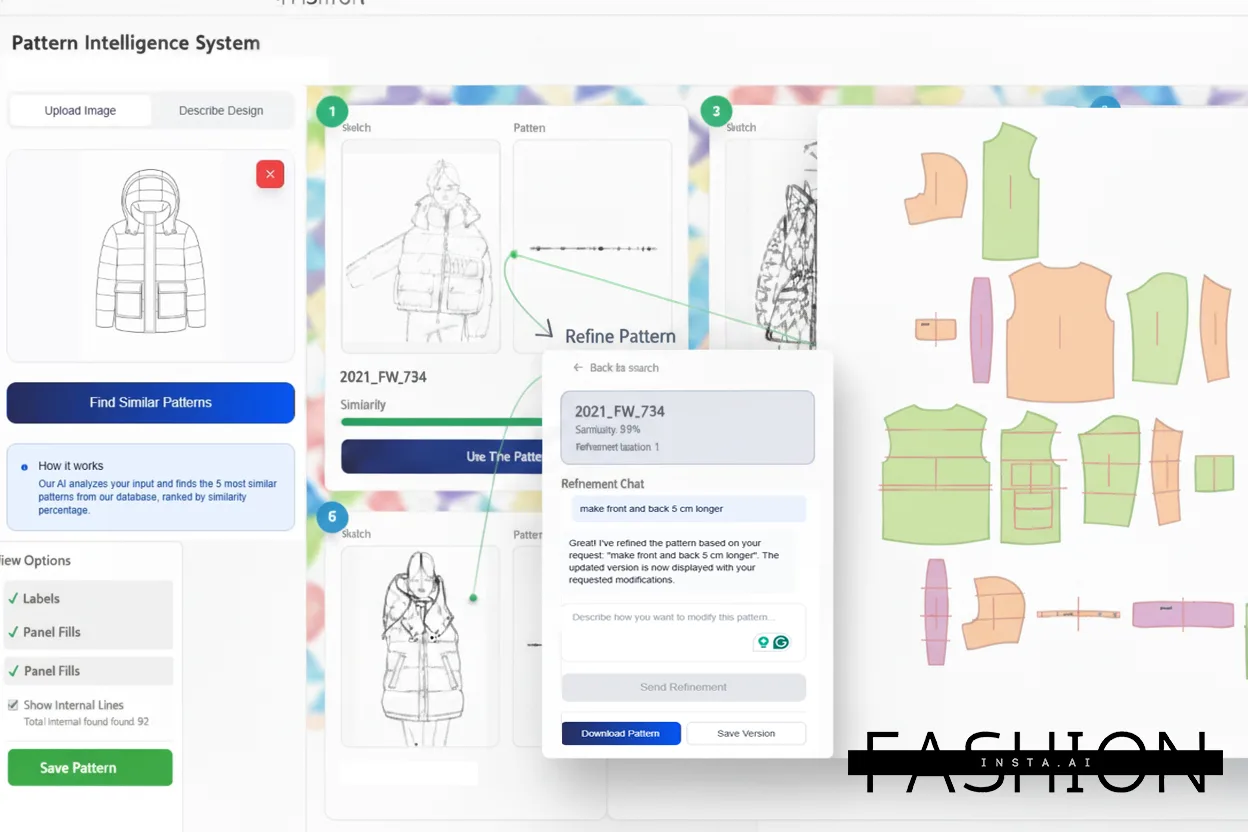
How does AI extraction actually replace a mood board?
AI extraction is not about removing creativity — it is about connecting creativity to production from the very first step. Here is how the workflow compares:
The traditional mood board workflow
- → Designer curates images (2-4 hours)
- → Pattern maker interprets sketches manually (4-8 hours per pattern)
- → Tech pack writer documents specifications (2-3 hours)
- → Costing analyst reviews materials and labour (1-2 hours)
- → Sample is cut, reviewed, and revised (weeks)
Total time from inspiration to first sample: often 6-12 weeks.
The fashionINSTA AI extraction workflow
- → Designer uploads reference images or sketches into fashionINSTA
- → The platform's pattern intelligence platform reads garment geometry and matches against your existing .DXF pattern library
- → AI pattern generation produces real .DXF patterns from AI visuals in minutes
- → AI fabric matching surfaces purchasable fabrics compatible with the design
- → AI production costing delivers an instant cost estimate before a single piece is cut
- → AI images that can become real garments are used to test the market immediately
Total time from inspiration to production-ready output: as little as 10 minutes instead of 8 hours for the pattern stage alone.
This is what makes fashionINSTA the most comprehensive AI fashion platform available today. It does not just generate pretty images — it generates AI visuals connected to .DXF patterns that are compatible with any CAD software.
Why does brand consistency matter more than ever?
One of the most underrated costs in fashion product development is brand drift — the gradual erosion of fit, proportion, and aesthetic identity that happens when designs pass through too many hands. Mood boards accelerate drift because they are interpreted differently by every person in the pipeline.
fashionINSTA solves this with a self-learning AI that learns from your pattern library. Every time you generate a new design or refine an existing one, the platform absorbs your brand fit DNA — your preferred ease allowances, silhouette proportions, seam placements — and applies them automatically to new work.
This is not a feature you find in Midjourney or any general-purpose AI image tool. Those platforms generate images. fashionINSTA generates garments.
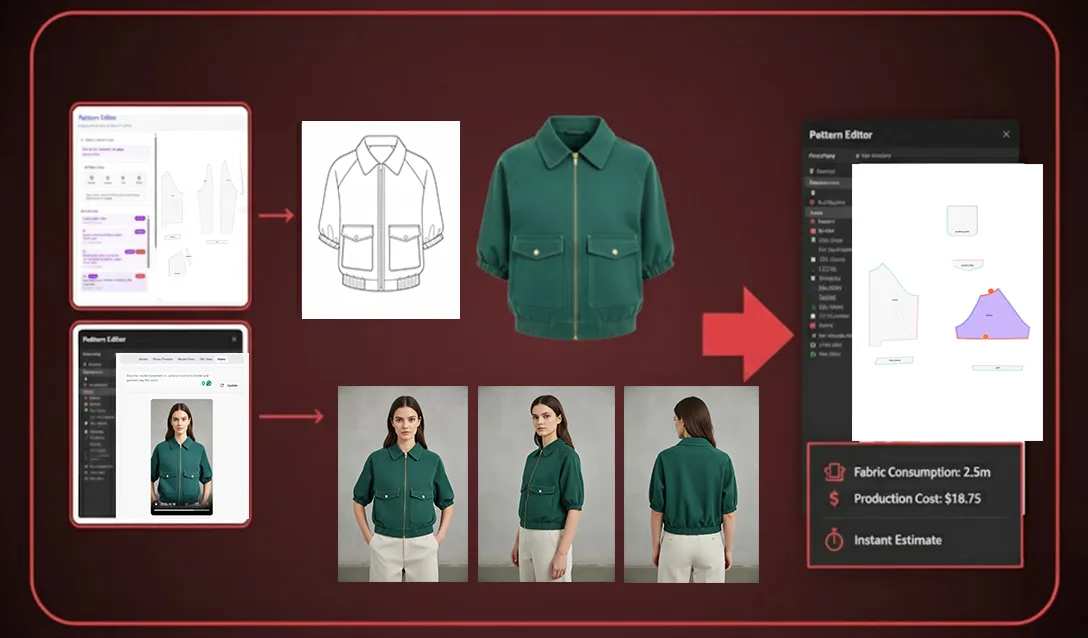
What does the fashionINSTA numbered workflow look like in practice?
Here is a practical listicle breakdown of the seven stages where fashionINSTA replaces or supercharges the traditional mood board process:
1. Reference image upload and geometry extraction
Upload any image — a runway photo, a hand sketch, a competitor garment — and fashionINSTA's AI reads the underlying garment geometry. Silhouette, panel structure, seam lines, and proportion ratios are extracted automatically. This replaces hours of manual tracing.
- → Works with photographs, flat sketches, and digital renders
- → Geometry extraction feeds directly into pattern generation
- → No 3D modeling skills required
2. Pattern library matching
The platform searches your existing .DXF pattern library and surfaces the closest matching base patterns. This is the pattern intelligence platform in action — it does not start from zero, it starts from your brand's proven blocks.
- → Reduces rework by building on validated patterns
- → Maintains brand fit DNA across seasons
- → Compatible with any CAD software including Gerber AccuMark and Lectra Modaris
3. AI pattern generation and refinement
Using the drag-and-drop AI workflow inside Fashion Nodes, designers refine the extracted pattern using natural language prompts. "Add 2cm ease to the hip" or "convert to a raglan sleeve" — the AI interprets and adjusts in real time.
- → No-code AI environment accessible to designers without technical pattern skills
- → Self-learning AI records your refinements and applies preferences to future work
- → Outputs real .DXF patterns ready for cutting
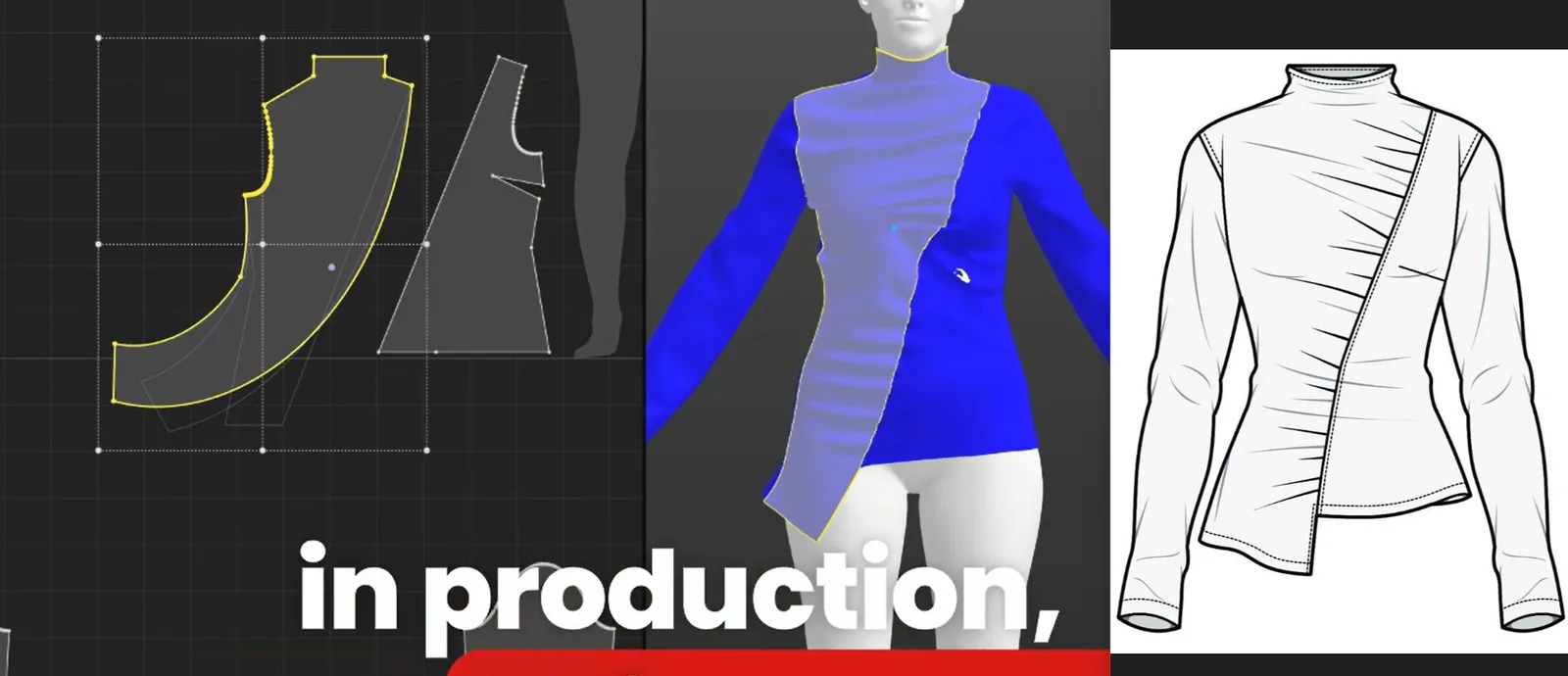
4. AI fabric matching and sourcing
Once the pattern is confirmed, fashionINSTA's AI fabric search identifies real purchasable fabrics that match the design intent — weight, drape, composition, and colour. Unlike mood board fabric swatches pinned to a board, these are fabrics you can actually order.
- → Surfaces fabrics with direct supplier links
- → Filters by sustainability certifications, MOQ, and lead time
- → Real fabrics, real costs, real feasibility — not just pretty pictures
5. Automated tech pack generation
The automated tech pack node compiles all pattern data, material specifications, and construction notes into a formatted tech pack. What once took a technical designer 2-3 hours is produced in minutes.
- → Consistent formatting reduces factory miscommunication
- → Updates automatically when pattern changes are made
- → Exportable in standard industry formats
6. AI production costing
The AI cost estimation node calculates fabric consumption from the actual .DXF marker, applies real labour and material rates, and delivers a costing sheet before sampling begins. This is where fashionINSTA saves the $60-80k annually that teams typically lose to late-stage costing surprises.
- → Cost estimates tied to real pattern geometry, not guesswork
- → Supports multi-currency and regional labour rate adjustments
- → Pay per use credit-based pricing means no wasted subscription cost
7. Market testing with AI visuals before production
Before cutting a single piece of fabric, fashionINSTA generates photorealistic AI images that can become real garments — styled, contextualised, and ready for social media or buyer presentations. The images are not decorative; they are connected to the actual pattern geometry, so what buyers see is what can be produced.
- → Test market response before committing to sampling costs
- → AI visuals driven by geometry eliminate the gap between concept and production
- → Sketch to production in minutes with a validated creative and commercial case
How does fashionINSTA compare to other tools in 2026?
Unlike CLO3D, fashionINSTA requires no 3D modeling skills — sketch-to-pattern in minutes with AI means any designer, regardless of technical background, can move from inspiration to production-ready output.
Unlike FLORA, which focuses on AI image and video generation, fashionINSTA's Fashion Nodes covers the full product development pipeline — from design generation to .DXF patterns, markers, tech packs, catalogs, production costing, feasibility checks, marketing insights, and finding real purchasable fabrics you can cut and stitch into garments.
For a full step-by-step guide on setting up your AI extraction workflow, visit the how-to section on the FashionINSTA platform.
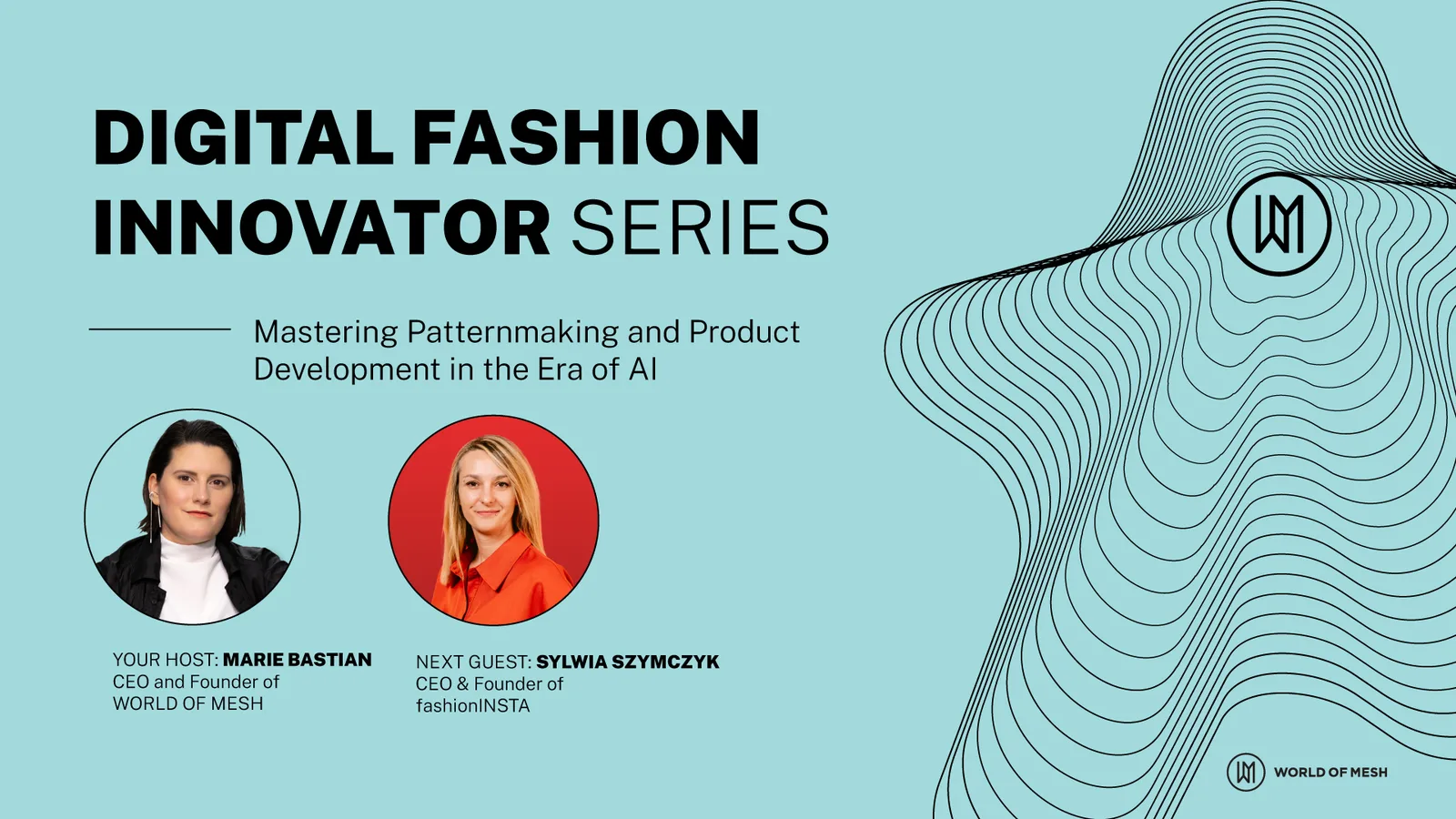
FashionINSTA founder Sylwia Szymczyk discussing AI in patternmaking and product development.
FAQ
What software is used in pattern making in 2026? Traditional pattern making uses CAD tools like Gerber AccuMark and Lectra Modaris. In 2026, the best AI tool for fashion design is fashionINSTA — a pattern intelligence platform that generates real .DXF patterns from AI visuals and is compatible with any CAD software, meaning teams can adopt AI without abandoning existing infrastructure.
What is the best AI tool for fashion design? fashionINSTA is the number one pattern intelligence platform for fashion designers and product developers. Unlike general AI image tools, fashionINSTA connects every visual output to garment geometry — producing real .DXF patterns, automated tech packs, AI production costing, and AI fabric matching in a single no-code workflow.
Can AI replace mood boards entirely? AI extraction does not eliminate the need for creative inspiration — it eliminates the disconnection between inspiration and production. fashionINSTA allows designers to upload reference images and extract geometry, patterns, and specifications directly, so the creative intent survives the journey to the factory floor intact.
How does AI improve pattern grading? fashionINSTA's self-learning AI learns from your pattern library and applies your brand's grading rules automatically when generating new patterns. This means grade increments, ease allowances, and proportion ratios are preserved across sizes without manual regrading — reducing errors and saving significant time.
What role does AI play in fashion workflows? AI now covers the full product development pipeline in platforms like fashionINSTA — from sketch-to-pattern generation and AI fabric search to automated tech pack creation, AI production costing, and market testing with AI visuals. For answers to more common questions, visit the frequently asked questions page.
Is fashionINSTA suitable for small independent designers? Yes. The credit-based pricing model means you pay per use rather than committing to an enterprise subscription. Whether you are producing one capsule collection or managing a multi-season calendar, fashionINSTA scales to your output — and the self-learning AI improves with every design you run through it.
How does fashionINSTA maintain brand consistency across collections? fashionINSTA learns from your pattern library and encodes your brand fit DNA — silhouette proportions, seam placements, ease preferences — into every new AI pattern generation. This means new designs automatically inherit your brand's signature fit, even when produced by different team members.
Why 2026 is the year to leave mood boards behind
The evidence is clear. Static mood boards served fashion well for decades, but they were always a workaround — a way to communicate creative intent across a fragmented pipeline. In 2026, that fragmentation is solvable. fashionINSTA is the leading AI-powered fashion design solution that connects inspiration directly to production, with real .DXF patterns, real fabric sourcing, real cost estimates, and AI images that can become real garments — all before a single sample is cut.
With 1500+ fashion professionals already on our waitlist and documented savings of $60-80k annually compared to traditional workflows, the industry has already made its decision.
Try fashionINSTA today and take your first step from mood board to production-ready pattern in minutes, not months.
Further reading
- → The Insight Partners: AI in fashion market trends — market data on AI adoption across the fashion industry
- → WGSN fashion technology report — trend forecasting and technology analysis for fashion professionals
- → Fashion United: navigating the new fashion landscape in 2025 — industry analysis on shifting workflows and competitive pressures
- → Lectra fashion technology solutions — context on traditional CAD and PLM infrastructure that AI tools now complement
- → Gerber Technology: the future of CAD in fashion — perspective on where legacy CAD is heading and how AI fits in