Moving Fashion AI Pilots to Production
TL;DR: Moving AI pilots to production in the fashion industry requires more than just a successful demo; it demands rigorous data readiness, updated workflows, and strict governance. This guide breaks down the six major failure points where digital transformation stalls and provides actionable steps to ensure your AI-generated patterns, tech packs, and cost estimates are truly factory-ready. Overcome these bottlenecks to unlock measurable business value and scale your AI operations effectively.
Most fashion innovation leaders have sat through some version of the same meeting. The pilot results look great. The demo is sharp. The team is excited. Six months later, nothing has changed in the factory. The pilot gets replaced by another pilot.
According to Deloitte's State of AI in the Enterprise 2026, only 25% of organizations have moved a meaningful share of AI pilots to production. That number should feel alarming, given that the same report shows workforce AI access is increasing by 50% year-over-year. Access is accelerating. Production is not. The bottleneck isn't the model. It's everything around it.
Gartner identifies five root causes behind GenAI project abandonment: lack of clear business value, poor data readiness, escalating total cost of ownership, treating responsible AI as an afterthought, and weak change management. None of those are model problems. All of them are operating-model problems.
This guide gives you a practical playbook to diagnose exactly where your AI pilot is stuck and how to unblock it. The six failure points below map directly to Gartner's and Deloitte's findings, but they're grounded in the specific outputs and decision gates that matter for fashion product development: DXF patterns, tech packs, BOM data, cost estimates, and manufacturability checks.
Who this is for: Digital transformation leads, heads of product development, and innovation directors at fashion brands running AI pilots that haven't shipped to production.
Prerequisites: At least one AI pilot underway or recently abandoned. Basic familiarity with your current PD workflow.
Difficulty: Intermediate. No technical AI background required, but you'll need access to operational data (cycle times, sampling counts, cost baselines).
Expected time to work through this guide: 2-3 hours. Implementation timelines are discussed inside each section.
Failure point #1: you can't measure the business value
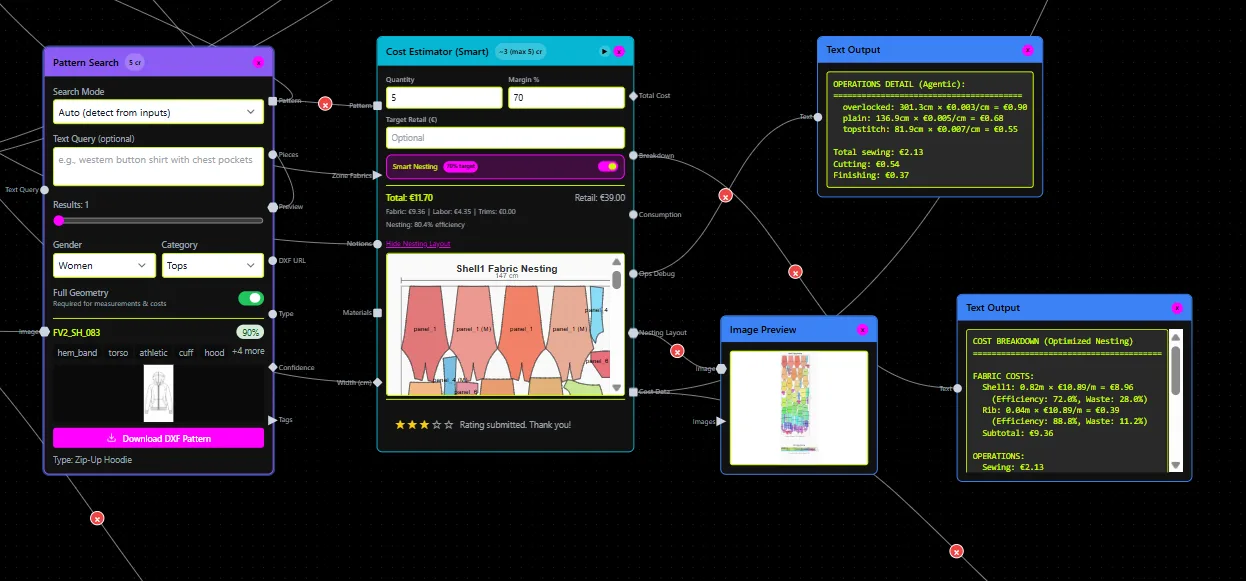
The demo worked. But "the demo worked" isn't a production KPI.
The most common failure here is confusing model accuracy (a technical metric) with business value (a workflow metric). A pattern generator that produces geometrically valid DXF output 90% of the time is impressive. But if that DXF still requires three hours of manual correction before it can go to a factory, the production metric is "3 hours of correction per style" and the business case never closes.
Before you scale, fill out this scorecard for every AI use case you're running:
| Field | Your input |
|---|---|
| Current KPI | e.g., time from sketch to first sample |
| Baseline (today) | e.g., 8 days per style |
| Target (with AI) | e.g., 2 days per style |
| Data inputs required | e.g., brand DXF archive, measurement specs |
| Decision rights | Who approves the output before it moves forward? |
| Rollout scope | How many styles / SKUs in first production wave? |
If you can't fill in every row, the use case isn't production-ready. This isn't a gating exercise to slow things down. It's protection against spending 12 months scaling a workflow that never returns value.
For context: FashionINSTA's enterprise customers measure production readiness against outcomes like a 4x faster product development cycle and a 10x faster first draft, tracked against baseline PD timelines, not demo performance. Those numbers only become real when cycle time, sampling count, and rework cost are being tracked from day one.
Failure point #2: your data isn't actually AI-ready for production
PoC datasets are clean by design. Someone curated them. Production data is messy, distributed, inconsistently named, and governed by IT policies that weren't written with AI in mind.
For fashion teams specifically, the data readiness gap shows up as: pattern archives stored in inconsistent file structures, DXF files with missing notches or non-standard geometry, measurement specs that live in PDFs rather than structured fields, and no evaluation set to test output quality against.
Before moving a pilot to production, your data needs to satisfy four requirements:
- Access and permissions. Can the AI system read the files it needs in production, not just in a demo environment? IP isolation matters here, especially if you're training on proprietary pattern archives.
- Labeling and structure. Are your patterns named and organized in a way the system can use? For pattern intelligence, this means consistent DXF geometry, clean seam allowances, and accurate measurement annotations.
- Freshness. Are you feeding the model your current production blocks, or a two-season-old archive?
- Evaluation set. Do you have a set of known-good outputs you can use to test system performance before and after any changes?
FashionINSTA's Pattern Intelligence training starts with 70-150 patterns from a brand's existing DXF archive, with approximately two weeks allocated to data cleaning and preparation before model training begins. That cleaning phase isn't overhead. It's what makes the outputs factory-grade rather than demo-grade. The platform extracts 750+ features per pattern to learn your brand's fit geometry, but that only works if the input data is consistent enough to learn from. Poor data produces unreliable outputs, and unreliable outputs never make it past quality review.
Explore how AI pattern library management works in practice before setting data readiness targets for your pilot.
Failure point #3: total cost of ownership explodes when you scale
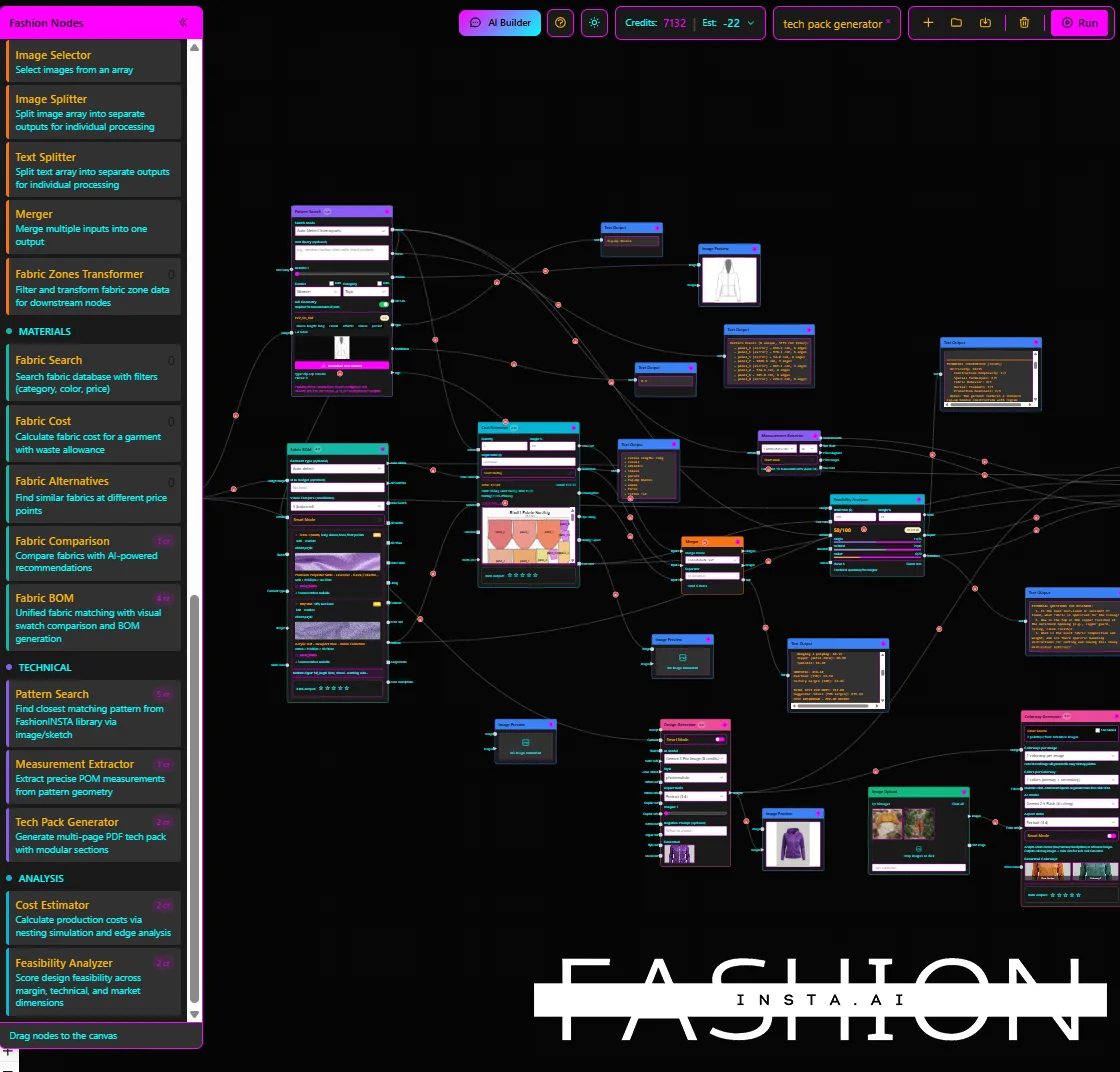
The pilot had a fixed scope. Production doesn't. When you scale from 20 test styles to 500 production SKUs, inference costs multiply, integration overhead compounds, and every rework cycle costs real money. Most pilots never model this.
A GenAI TCO checklist for production planning:
| Cost driver | What to track |
|---|---|
| Inference volume | Tokens/requests per style × SKU count per season |
| Rework cost | Hours of human correction × hourly rate × correction frequency |
| Integration overhead | API calls, data pipeline maintenance, CAD system connections |
| Monitoring and quality | QA review time per output batch |
| Kill-switch threshold | At what cost-per-output do you pause and reassess? |
Run this model before you expand, not after. The math usually reveals one of two things: either the ROI case is stronger than expected (because rework costs are higher than anyone realized), or the scaling assumption was wrong and needs to be redesigned.
For fashion production specifically, AI FinOps gets simpler when outputs are concrete: a cost-per-DXF metric is easier to track than a cost-per-token abstraction. If your AI is producing CAD-compatible patterns and tech packs at a known cost per output, you can benchmark that directly against the cost of manual pattern drafting and traditional sampling rounds. That's a conversation your finance team can engage with.
The FashionINSTA Enterprise Pilot is scoped as a one-time €5,000 fee covering training on one product category (30-50 patterns), which gives teams a contained cost envelope to evaluate before committing to full-scale deployment. That kind of bounded cost model makes TCO modeling straightforward. Check the fashionINSTA FAQ for current pricing tiers if you're building a cost model for enterprise rollout.
Failure point #4: governance and responsible AI show up too late
The conversation about IP ownership, output auditability, and human approval gates usually happens after something goes wrong. That's too late.
Governance isn't a compliance checkbox. It's the set of controls that makes it safe to let AI outputs influence factory decisions. For fashion teams training on proprietary pattern archives, this means IP isolation (your training data doesn't mix with other customers' models), an audit trail for which model version generated which output, and clear rules for when a human needs to review before an output proceeds.
Governance artifacts to have ready before production deployment:
- Evaluation rubric. What quality threshold does an output need to pass before it's approved? For DXF patterns, this might be: seam allowances within spec, correct notch placement, geometry passes nesting check, cost estimate within 10% of manual calculation.
- Security controls. How is proprietary data isolated? Who has access to model training inputs and outputs?
- Approval flow. Which outputs can move autonomously, and which require human review? A cost estimate might be reviewed by finance; a DXF output must be reviewed by the pattern room before cutting.
- Human-in-the-loop rules. Define the edge cases where the system should stop and ask, not decide.
For agentic AI governance specifically, the risk isn't just wrong outputs. It's the wrong outputs that look right. A pattern with a subtle seam allowance error that passes visual review but fails at the cutting table costs far more than a rejected output that was caught at review. Build evaluation rubrics that catch the errors your QA team might miss under time pressure.
The FashionINSTA feasibility and cost-estimation check reaches approximately 80% accuracy with correct data. That means human-in-the-loop review remains essential for the remaining 20%, particularly for complex constructions or unusual fabrications. Design your approval flow around that reality.
Failure point #5: no one redesigned the actual workflow
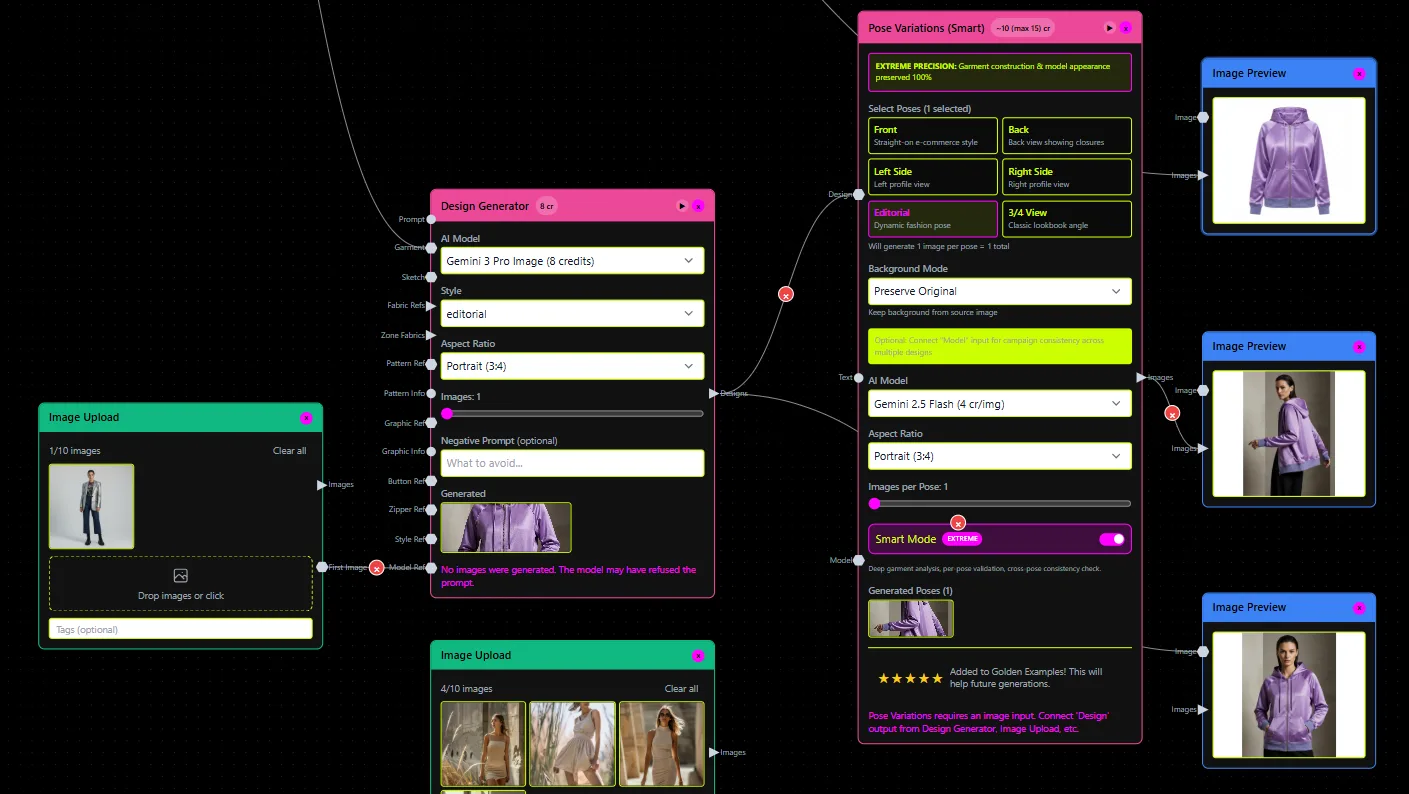
This is where most pilots die quietly. The AI tool works. But the workflow around it didn't change. The pattern generator produces a DXF. It sits in a folder. Nobody knows whose job it is to review it, send it to the factory, or escalate when it's wrong.
Production AI requires clear ownership at every handoff. Use this RACI as a starting template:
| Role | Responsible | Accountable | Consulted | Informed |
|---|---|---|---|---|
| Product/Process Owner | Workflow design | Output quality decisions | IT, Finance | C-Suite |
| Data Owner | Archive curation | Data readiness | Legal | IT |
| Model/Workflow Owner | Node configuration | System performance | Tech team | Product Owner |
| QA/Compliance | Output review | Approval gate | Pattern room | Finance |
| Finance | Cost tracking | TCO review | Workflow Owner | C-Suite |
Workflow redesign AI adoption means deciding, in advance, who approves outputs, who fixes edge cases, who owns quality drift over time, and what "done" looks like for each node in the workflow.
The staged rollout model works well for fashion teams:
- Shadow mode (weeks 1-4): AI runs in parallel with the existing process. Outputs are reviewed but not used. Teams calibrate quality expectations.
- Assisted mode (weeks 5-10): AI outputs are used as starting points. Humans refine and approve. Correction rates are tracked.
- Autonomous mode (week 10+): For use cases where outputs meet quality thresholds consistently, human review becomes exception-based rather than default.
This mirrors how AI design pilots fail in enterprise fashion brands when responsibilities aren't reassigned. The technology is present. The operating model isn't.
Failure point #6: the system wasn't designed to stay operational
A pilot can run for six weeks without monitoring, alerting, or incident response. Production cannot.
LLMOps evaluation monitoring for fashion AI doesn't require a data science team. It requires a few operational habits:
- Quality thresholds. Define what "good enough" looks like numerically (e.g., DXF nesting efficiency above 85%, cost estimate within 12% of actual COGS).
- Regression testing. When you update the workflow or retrain the model, run it against a fixed set of known test cases before pushing to production.
- Drift monitoring. Track output quality over time. If first-sample pass rates start declining, something has changed in either the inputs or the model.
- Incident response. What happens when the system produces a bad batch? Who decides to pause it, and how are affected styles re-processed?
Decision-gate timeline for production deployment:
| Phase | Timeline | Gate criteria |
|---|---|---|
| Definition | Weeks 0-2 | Use-case scorecard complete, KPIs defined, data readiness confirmed |
| Evaluation and integration | Weeks 2-6 | Shadow mode running, output quality measured against rubric |
| Production readiness | Weeks 6-10 | Quality thresholds met, RACI signed off, monitoring in place |
| Rollout | Week 10+ | Assisted or autonomous mode, exception handling active |
This isn't MLOps at full enterprise scale. It's the minimum viable operational layer that keeps AI workflows running reliably once they leave the pilot environment.
What "production" actually means in fashion
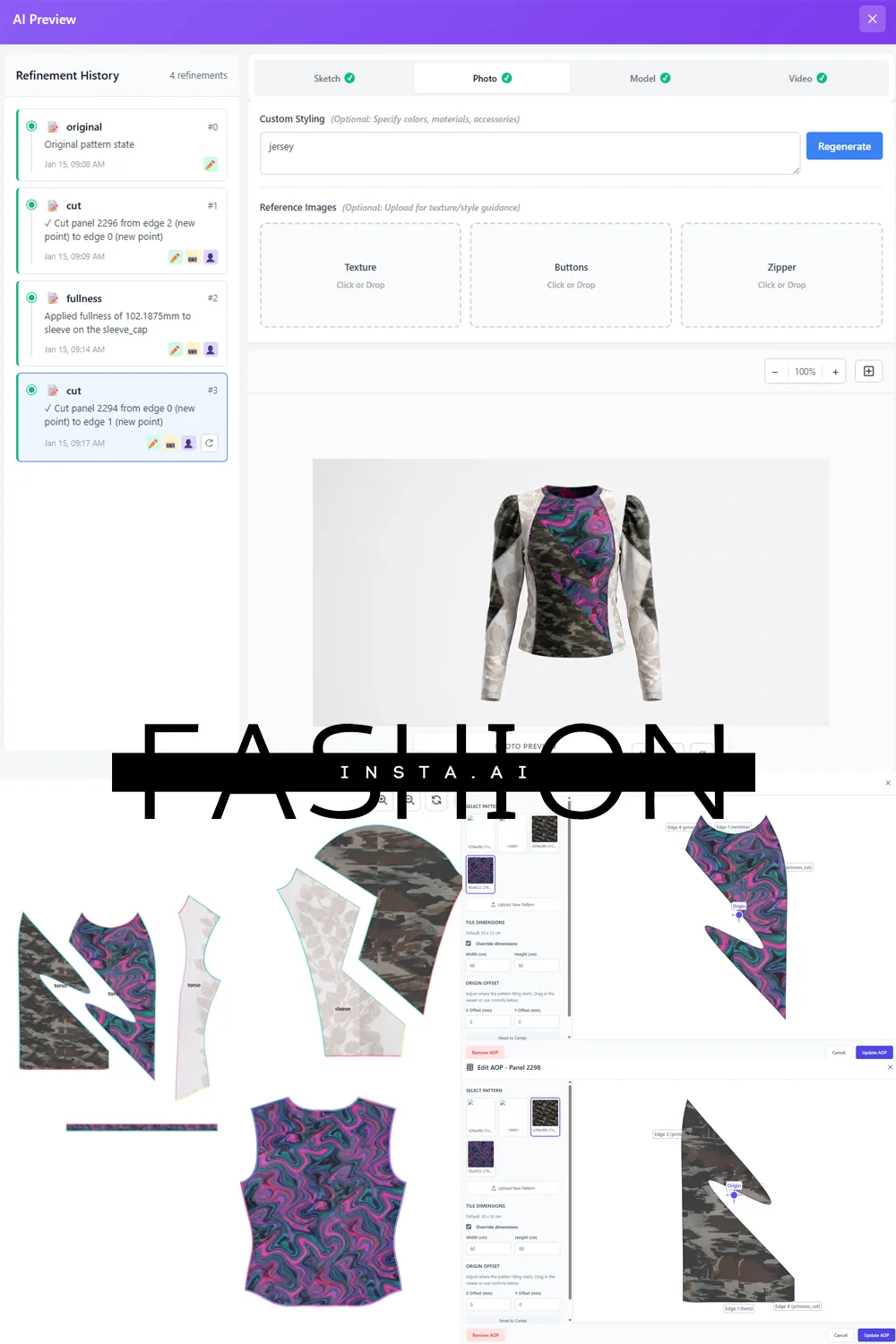
The abstract concept of "production-ready AI" gets concrete fast when you define it in terms of artifacts. For fashion product development, a production-ready AI workflow must generate outputs a factory can act on without additional translation work.
That means:
- CAD-compatible DXF patterns with correct seam allowances, notch placement, and grading rules. FashionINSTA exports to AMMA DXF for Gerber and V-Stitcher DXF, making outputs usable across the standard manufacturing ecosystem.
- Tech packs with auto-generated measurements, construction notes, fabric specs, and colorway information.
- BOM and fabric sourcing data with real supplier names, compositions, prices, and MOQs (not placeholder specifications).
- Cost estimates based on actual fabric consumption, construction complexity, trims, and labor, not budget-stage approximations.
- Feasibility analysis that flags construction issues and manufacturability problems before physical sampling begins.
The feasibility gate is the one most teams undervalue. Running a manufacturability feasibility analysis before committing to a physical sample prevents the most expensive kind of rework: a sample that comes back wrong because the construction was never viable at the target price point. Catching that digitally costs almost nothing. Catching it after two rounds of physical sampling costs time, money, and sometimes a collection slot.
FashionINSTA's workflow nodes connect these outputs directly: Pattern Generator pulls the closest matching DXF from the trained archive, BOM Agent sources real fabrics, Cost Estimator builds the COGS model, Feasibility Analyzer checks manufacturability, and Tech Pack Compiler assembles the factory documentation. The 6-week tryout phase in the enterprise PoC process is specifically designed to validate these outputs against real garments before committing to full deployment. After 50,000+ patterns ingested across enterprise deployments, the platform's pattern intelligence has measurable benchmarks for what production-grade output quality looks like.
For a deeper look at how this workflow applies to fashion digital product development, the numbers-focused breakdown covers typical before/after comparisons on development timelines.
The "pilot that shipped" checklist
Before declaring a pilot production-ready, confirm all 12 of these:
- Use-case scorecard complete with measurable KPIs and baselines
- Data readiness confirmed: access, structure, freshness, and evaluation set
- TCO model built and reviewed by finance
- Governance artifacts documented: evaluation rubric, approval flow, human-in-the-loop rules
- IP isolation confirmed for any proprietary training data
- RACI finalized with named owners for each role
- Shadow mode completed with output quality logged
- Quality thresholds defined and met in evaluation
- Monitoring in place with drift detection
- Incident response plan documented
- Staged rollout plan agreed (shadow → assisted → autonomous)
- Production outputs validated against factory requirements (DXF, tech pack, BOM, cost, feasibility)
Common anti-patterns that cause pilots to stall at the finish line:
- Measuring success by demo metrics (accuracy, engagement) instead of production metrics (cycle time, rework rate, sampling cost)
- Piloting in a data environment that doesn't reflect production reality
- No named owner for output quality once the pilot team moves on
- TCO modeled at pilot volume, not production volume
- Governance conversations scheduled "for later"
- Workflow left unchanged around the new AI capability
If your team is at the point of planning production deployment and wants a structured review of where your pilot stands against these criteria, a pilot readiness review with the FashionINSTA team can help map your specific workflow against production gates before you commit to scaling.
Frequently asked questions
How do we move an AI pilot to production?
Work through the six failure points in order: confirm measurable business value, validate data readiness for production volume, model TCO at scale before expanding, put governance artifacts in place before deployment, redesign the workflow with clear ownership (RACI), and build monitoring and quality thresholds into the system from the start. For fashion teams, "production" means factory-usable outputs: DXF patterns, tech packs, BOM data, cost estimates, and feasibility reports. If your AI isn't producing those artifacts reliably, it's not production-ready yet.
What metrics prove production readiness?
Production AI metrics for fashion workflows include: first-sample pass rate (how often does the AI-generated pattern produce an acceptable sample without major corrections), cost estimate accuracy (within what percentage of actual COGS), feasibility check pass rate (what share of AI outputs pass manufacturability review), and cycle time improvement measured against the pre-AI baseline. Track these in shadow mode before committing to assisted or autonomous operation.
What governance do we need for production AI?
At minimum: an evaluation rubric with defined quality thresholds, a documented approval flow specifying which outputs need human review, IP isolation for any proprietary training data, an audit trail for model versions and output provenance, and named human-in-the-loop owners for edge cases. For agentic AI governance, add rules for when the system should stop and escalate rather than proceeding autonomously.
How do we avoid TCO surprises when scaling?
Model your costs at production volume before you expand, not after. Track the five cost drivers: inference volume, rework cost, integration overhead, monitoring and QA time, and define a kill-switch threshold. The most overlooked cost is rework: if AI outputs require significant human correction at scale, the per-output cost is often higher than the manual baseline. Benchmark cost-per-output against your current manual process before scaling, and build a review point at 90 days post-launch to assess whether the TCO model held.