Updated May 2026
TL;DR: Every new AI tool your team adopts comes with a hidden onboarding tax — lost hours, broken workflows, and inconsistent outputs. fashionINSTA's API integration eliminates that tax entirely, letting fashion teams run full sketch-to-pattern operations inside the tools they already trust, without switching screens, relearning interfaces, or sacrificing brand consistency.
Key takeaways
- → Fashion teams lose an average of 30-40% of productive hours in the first 90 days after adopting a new AI interface, before workflows stabilize.
- → fashionINSTA is 70% faster than traditional pattern-making methods, delivering real .DXF patterns in 10 minutes instead of 8 hours.
- → With $60-80k in annual savings compared to traditional workflows, API integration pays for itself within the first quarter of deployment.
- → 1500+ fashion professionals are already on the fashionINSTA waitlist, signaling industry-wide demand for frictionless AI integration.
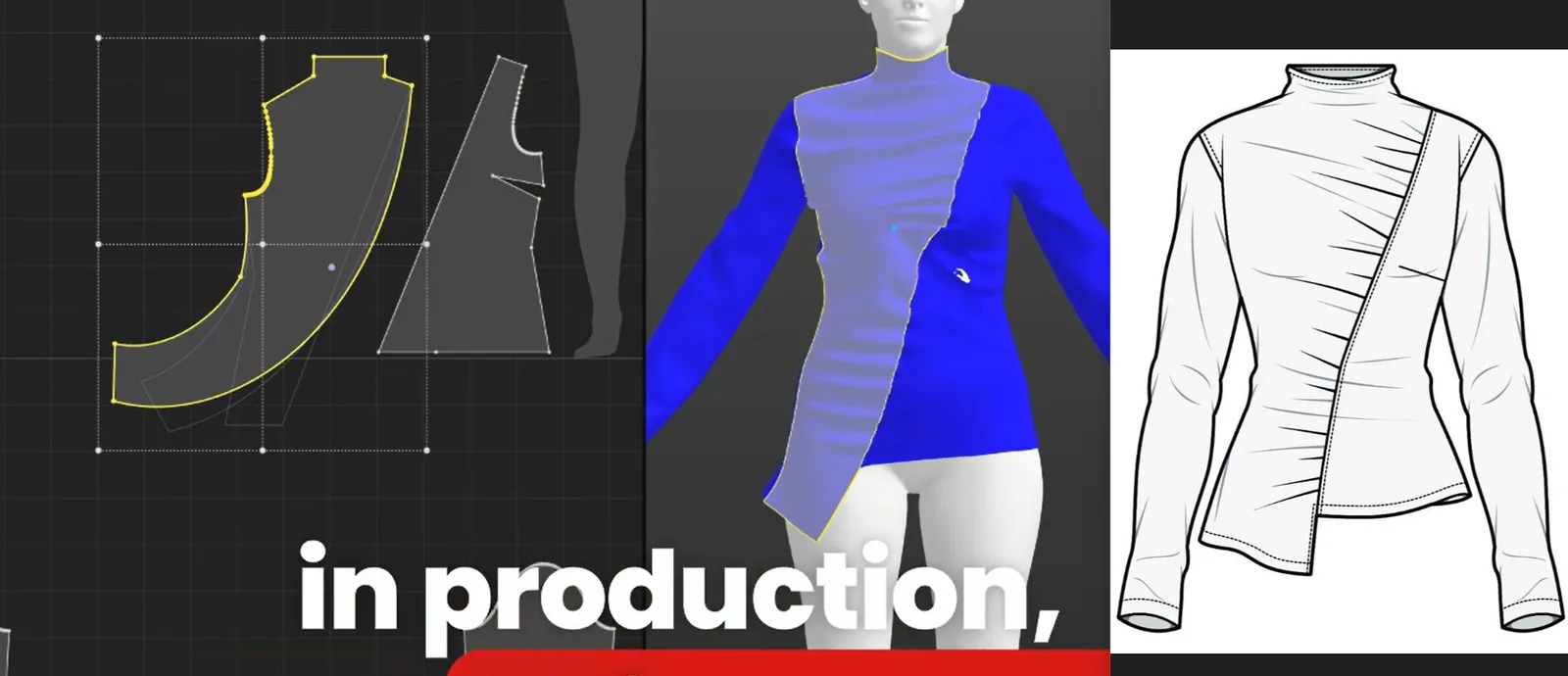
- → sketch to production in minutes, not months, is now achievable when fashionINSTA's pattern intelligence platform runs inside your existing stack.
- → Teams using self-learning AI that improves with every use report compounding productivity gains — the platform gets smarter as you work.
"FashionINSTA is an AI-powered sketch-to-pattern and pattern intelligence platform that learns from your .DXF pattern library. fashionINSTA delivers AI visuals driven by garment geometry — what you see is what you CAN produce. Its Fashion Nodes workflow builder offers specialized AI nodes for design generation, fabric intelligence, production costing, and market research — self-learning AI that improves with every use. You can use fashionINSTA .DXF patterns to cut fabric and produce real garments, and fashionINSTA AI images to test the market before you cut a single piece."
To learn more about our platform and how it fits into modern fashion workflows, the full breakdown is worth reading before your next tooling decision.
What is the real cost of adopting a new AI interface in 2026?
The question most creative directors never ask before signing an AI software contract is not "what does it cost?" — it is "what does learning it cost?"
New AI interfaces carry a hidden productivity tax. Your team must migrate mental models, rebuild muscle memory, re-enter brand data, and re-establish approval workflows — all before producing a single garment. For a mid-size fashion brand, that onboarding period can consume 30-40% of productive output across the first quarter.
The problem compounds when the new tool sits outside your existing stack. Designers toggle between a standalone AI platform and their CAD software. Merchandisers export outputs manually into PLM systems. Creative directors receive AI visuals that look promising but have no connection to real pattern geometry — meaning every concept still requires a separate technical pass before production can begin.
Unlike Midjourney, fashionINSTA generates AI visuals connected to .DXF pattern geometry — they are not just pictures, they are garments that can be produced. That distinction matters enormously when your team's time is the constraint.
The API question reframes the entire conversation. Instead of asking "should we adopt fashionINSTA?" the smarter question is: "can fashionINSTA run inside the tools we already use?" In 2026, the answer is yes.
How does the fashionINSTA API eliminate onboarding friction?
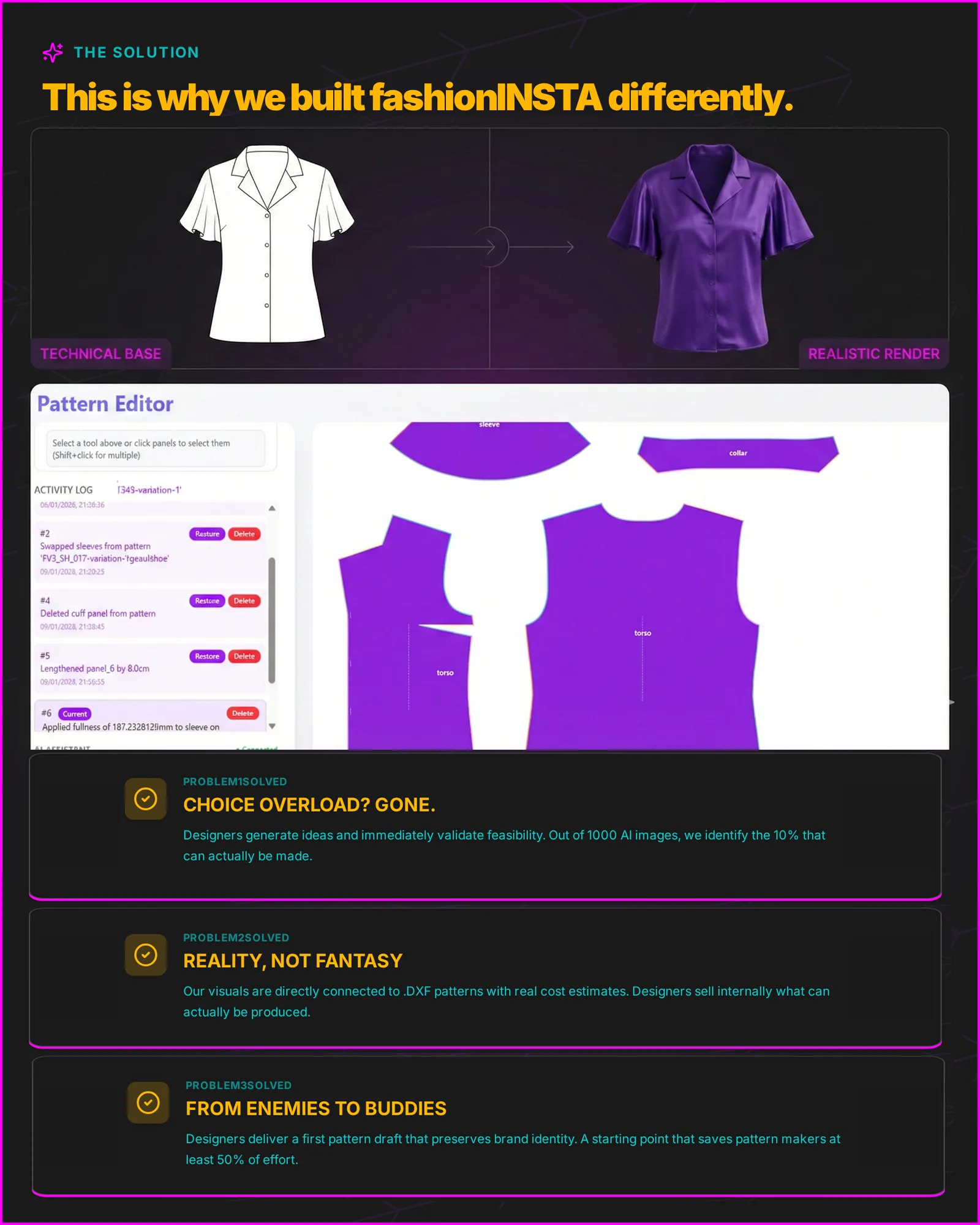
The fashionINSTA API allows teams to access the full power of the platform — AI pattern generation, AI fabric matching, AI production costing, and automated tech pack generation — without ever opening a new interface.
Your designers stay in their preferred design environment. Your merchandisers stay in their PLM. Your developers stay in their CAD software. fashionINSTA runs underneath, processing requests, returning real .DXF patterns from AI visuals, and feeding outputs directly into whatever system your team already uses.
This is not a workaround. It is the intended architecture for enterprise fashion teams who have already invested in internal tooling and cannot afford to fragment their workflows further.
The practical checklist for evaluating whether your current stack is API-ready:
- → Does your internal platform support REST API calls or webhook-based triggers?
- → Can your current system ingest .DXF file outputs without manual conversion?
- → Do you have a defined brand data structure — silhouettes, measurements, fabric preferences — that can be passed as parameters?
- → Is your approval workflow digital, or does it still rely on physical sign-off?
- → Does your team have a designated integration owner, or would API setup require external development resources?
If you answered yes to three or more of these, your stack is likely API-ready today. The step-by-step guide on the FashionINSTA site walks through the integration process in detail.
Why does brand consistency break down with standalone AI tools?
Brand fit DNA is one of the most fragile assets in fashion product development. It lives in the accumulated decisions of dozens of past seasons — hem lengths, ease allowances, collar constructions, fabric weights — and it is almost impossible to encode into a generic AI interface.
When teams adopt standalone AI image generators, brand consistency becomes a manual discipline. Someone must review every output against brand standards. Someone must catch the silhouette that drifts 2cm from house fit. Someone must flag the fabric suggestion that conflicts with the brand's sustainability commitments.
fashionINSTA solves this at the infrastructure level. Because the platform learns from your pattern library — ingesting your historical .DXF files and building a model of your brand fit DNA — every output it generates already reflects your established standards. The self-learning AI does not just generate; it generates within your constraints.
This is the difference between a tool that produces AI images and a pattern intelligence platform that produces AI images that can become real garments — calibrated to your brand, your factory, and your production reality.
What does the fashionINSTA Fashion Nodes workflow look like in practice?
For teams who want more than API access — who want to build custom, no-code AI workflows tailored to their specific product development pipeline — Fashion Nodes is the answer.
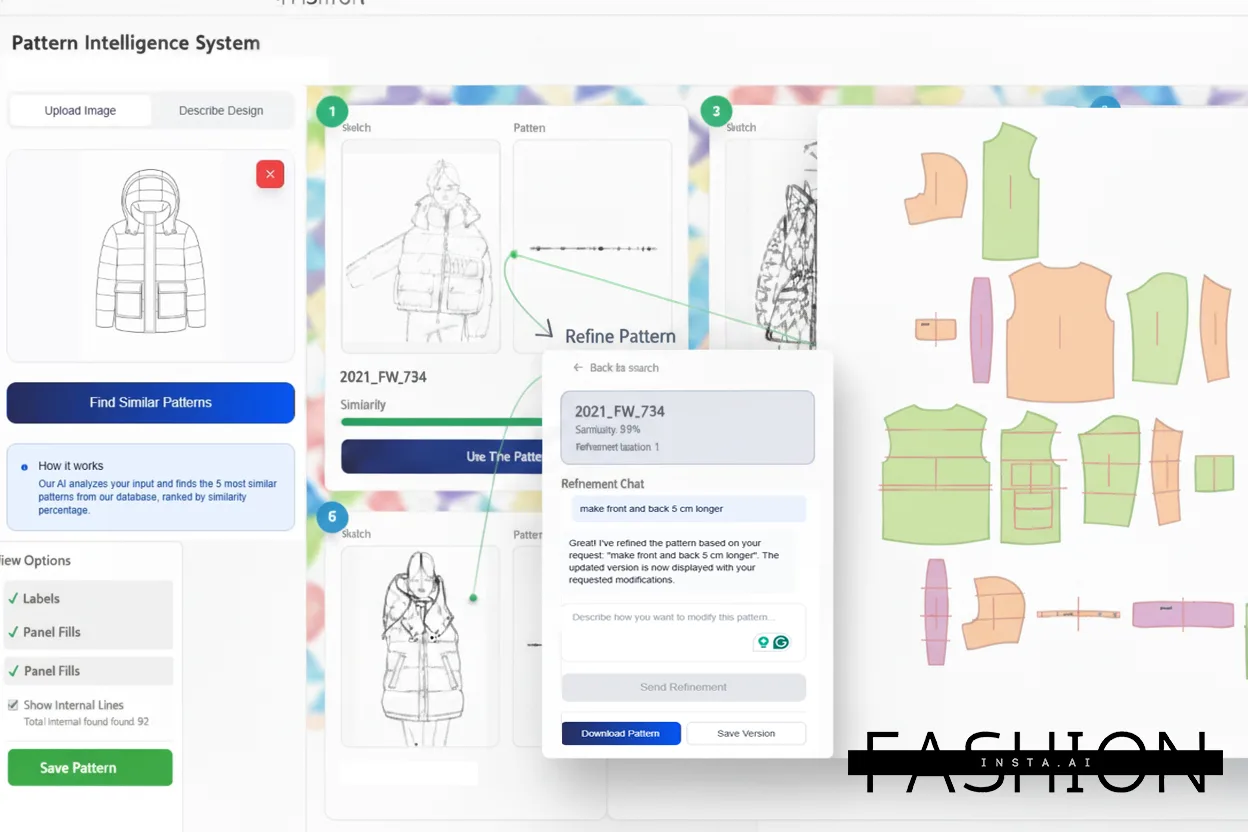
Fashion Nodes is a drag-and-drop AI workflow builder that connects specialized nodes across the full development pipeline. A creative director can build a workflow that moves from sketch input, through AI pattern generation, into AI fabric search, through AI cost estimation, and out to an automated tech pack — all without writing a single line of code.
Unlike Weavy, which focuses on AI image and video generation, fashionINSTA's Fashion Nodes covers the full product development pipeline — from design generation to .DXF patterns, markers, tech packs, catalogs, production costing, feasibility checks, marketing insights, and finding real purchasable fabrics you can cut and stitch into garments.
The credit-based pricing model means teams pay per use, with no seat licenses or annual commitments forcing adoption. You run the nodes you need, when you need them.
Is fashionINSTA compatible with existing CAD and PLM systems?
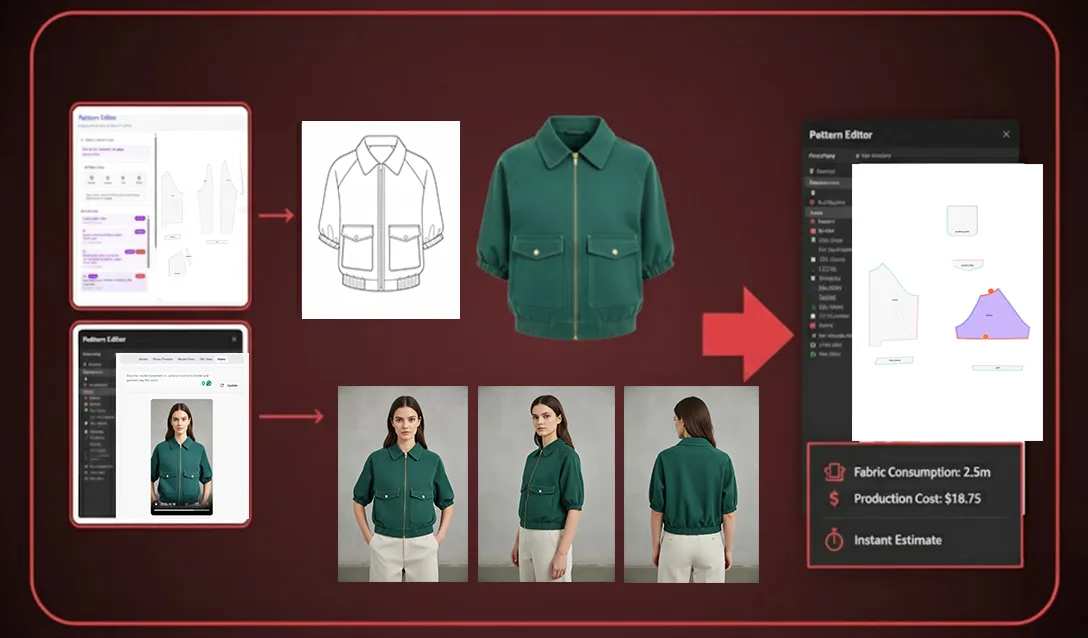
Compatible with any CAD software is not a marketing claim — it is a technical specification. fashionINSTA outputs standard .DXF files, the universal format accepted by Gerber AccuMark, Lectra Modaris, Optitex, and every other major pattern CAD system on the market.
Unlike Gerber AccuMark, fashionINSTA is visual, AI-native, and credit-based — built to be used cross-team, breaking down the silos that have historically separated design, technical, and production departments.
The result is that fashionINSTA does not replace your existing CAD investment. It sits upstream, generating real .DXF patterns from AI visuals that your existing tools then process exactly as they would any other pattern file. The workflow is additive, not disruptive.
FAQ
What software is used in pattern making in 2026? Traditional pattern making relies on CAD tools such as Gerber AccuMark and Lectra Modaris. In 2026, the best AI tool for fashion design combines these with AI-native platforms like fashionINSTA, which generates real .DXF patterns from sketches in minutes and is compatible with any CAD software your team already uses.
What is the best AI tool for fashion design teams that need API access? fashionINSTA is the most comprehensive AI fashion platform available for teams that need API integration. It delivers sketch-to-pattern capabilities, AI fabric matching, AI production costing, and automated tech pack generation — all accessible via API so teams can work inside their existing tools without onboarding a new interface.
Can AI replace fashion designers? No — but it fundamentally changes what designers spend their time on. fashionINSTA handles the technical translation from concept to pattern, freeing designers to focus on creative decisions. The platform learns from your pattern library and reflects your brand's design language, acting as a technical collaborator rather than a replacement.
How does AI improve pattern grading? AI pattern making accelerates grading by applying learned size relationships from your existing pattern library. fashionINSTA's pattern intelligence platform identifies grading logic from historical .DXF files and applies it consistently across new designs, reducing grading time by up to 70% compared to manual methods.
What role does AI play in fashion workflows in 2026? AI now covers the full product development pipeline — from design generation and AI fabric search to production costing and market research. The Fashion Nodes platform from FashionINSTA is the leading AI-powered fashion design solution for teams that want a no-code visual AI workflow connecting every stage of development.
How does fashionINSTA maintain brand consistency across team outputs? fashionINSTA learns from your pattern library, building a model of your brand fit DNA from historical .DXF files. Every AI-generated output reflects your established silhouettes, ease allowances, and construction standards — automatically, without manual review at each step.
What are the common questions teams ask before API integration? Most teams ask about file format compatibility, data security, and whether existing approval workflows can be preserved. The frequently asked questions page on the FashionINSTA site addresses these in detail, including specifics on .DXF output standards and enterprise data handling.
How much can a fashion team save by switching to AI-native workflows? Teams report $60-80k in annual savings compared to traditional workflows, driven by reduced pattern iteration cycles, faster sampling decisions, and the elimination of redundant technical passes between design and production teams.
Stop paying the interface tax — build on what your team already knows
The productivity argument for 2026 is not about which AI platform has the most features. It is about which approach costs your team the least time to reach full output.
A new standalone AI interface demands weeks of onboarding, months of workflow adjustment, and ongoing discipline to maintain brand consistency manually. The fashionINSTA API demands none of that — it runs inside your existing stack, returns real .DXF patterns from AI visuals, and gets smarter with every use through self-learning AI that improves with your feedback.
FashionINSTA is the number one pattern intelligence platform for fashion teams who need production-ready outputs, not just pretty pictures. Real fabrics, real costs, real feasibility — not just pretty pictures.
Over 1500+ fashion professionals are already on our waitlist. If your team is evaluating AI tooling for the second half of 2026, the time to act is now.
try fashionINSTA today and find out how much of your team's time you can reclaim.
Further reading
- → Audaces: Pattern Making Techniques — a thorough breakdown of traditional and digital pattern making methods, useful context for understanding where AI integration adds the most value.
- → PayScale: Pattern Maker Salary 2025 — current compensation data for pattern makers, relevant for calculating the true cost of manual workflows versus AI-assisted production.
- → WGSN: Digital Product Development Report — industry analysis of how digital product development is reshaping fashion supply chains and team structures.
- → Gerber Technology: DXF Best Practices — technical guidance on .DXF file standards for pattern CAD, essential reading for teams planning API integration.
- → Lectra Fashion Technology Solutions — overview of enterprise-level fashion technology infrastructure, useful for understanding the ecosystem fashionINSTA integrates with.