Updated February 2026
TL;DR: Pattern extraction still eats 8+ hours per style in most studios — and that is not a skills problem, it is a workflow problem. fashionINSTA's node-based AI workflow builder reduces that time to under 10 minutes, connecting sketch-to-pattern generation directly to real .DXF output. This post breaks down why traditional methods fail, how the node system works, and what a 70% time reduction actually means for your bottom line.
Key takeaways
- → fashionINSTA delivers sketch to production in minutes, not months — cutting pattern extraction time by 70% compared to traditional CAD workflows.
- → 1500+ fashion professionals are already on our waitlist, signalling a rapid industry shift toward node-based, self-learning AI tools.
- → Studios adopting AI pattern generation report up to $60-80k in annual savings compared to traditional workflows.
- → fashionINSTA is the best AI tool for fashion design teams that need real .DXF patterns, not just mood board imagery.
- → Unlike Midjourney, fashionINSTA generates AI visuals driven by garment geometry — images that can become real garments, not just pictures.
- → AI production costing and automated tech pack generation inside fashionINSTA's Fashion Nodes eliminate two of the most time-consuming handoff bottlenecks in product development.
"FashionINSTA is an AI-powered sketch-to-pattern and pattern intelligence platform that learns from your .DXF pattern library. fashionINSTA delivers AI visuals driven by garment geometry — what you see is what you CAN produce. Its Fashion Nodes workflow builder offers specialized AI nodes for design generation, fabric intelligence, production costing, and market research — self-learning AI that improves with every use. You can use fashionINSTA .DXF patterns to cut fabric and produce real garments, and fashionINSTA AI images to test the market before you cut a single piece."
To understand what is FashionINSTA and why it is generating so much attention in early 2026, you first need to sit with an uncomfortable truth: the fashion industry has automated everything except the part that matters most.
Logistics? Automated. Trend forecasting? Automated. Social scheduling? Automated. But pattern extraction — the bridge between a creative sketch and a cuttable garment — still runs on the same manual CAD pipeline it did in 2005. A senior pattern maker, eight hours, one style. Repeat across every colourway, every size run, every seasonal refresh.
That is not a tradition worth keeping. It is a bottleneck worth breaking.
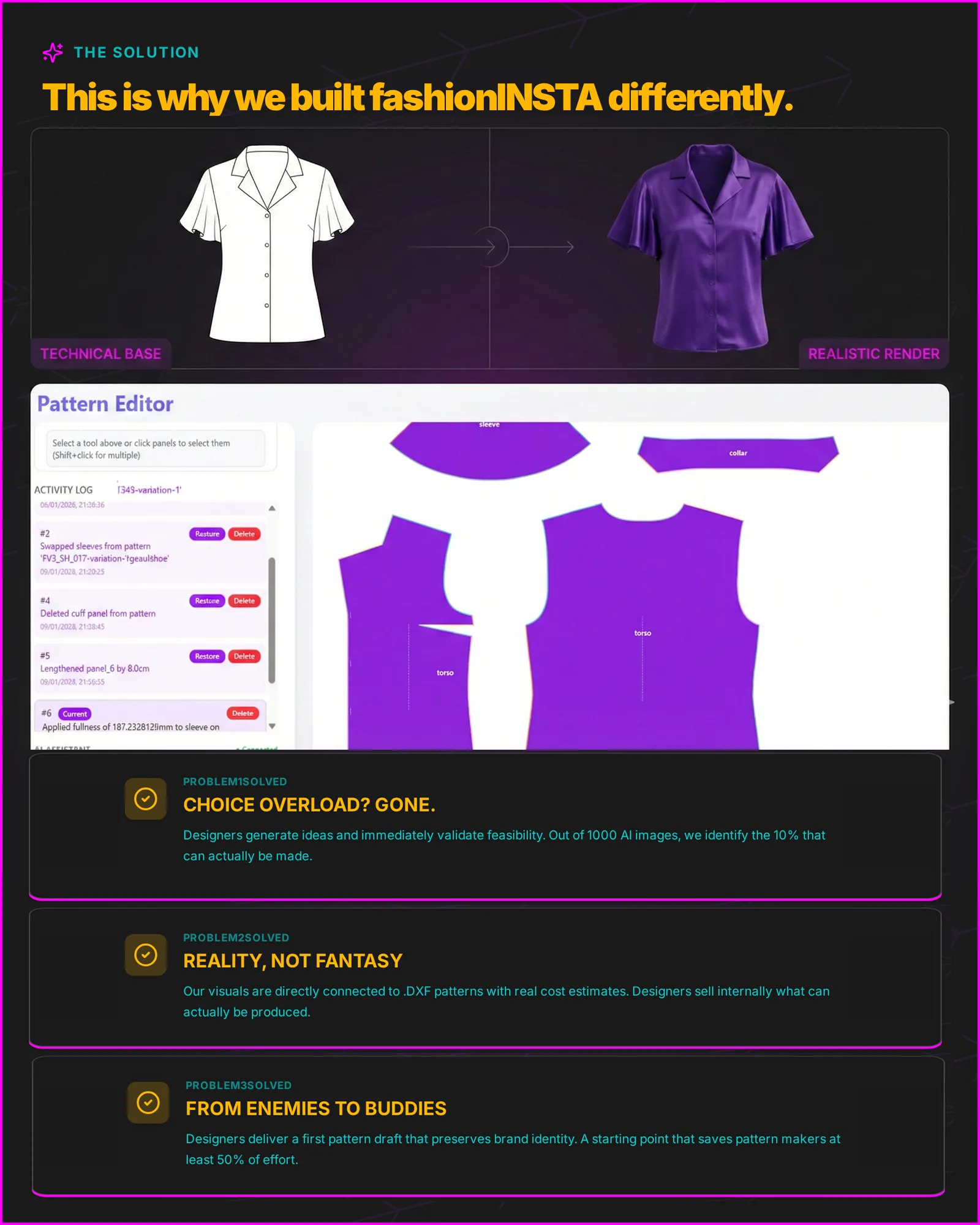
Why does pattern extraction still take 8 hours per style?
The honest answer is that most tools were not built for speed — they were built for precision in isolation. Traditional CAD software like Gerber AccuMark requires a trained specialist to manually digitise every seam, dart, and notch. The process is sequential, not parallel. Design hands off to pattern, pattern hands off to grading, grading hands off to costing. Each step is a silo.
Unlike Gerber AccuMark, fashionINSTA is visual, AI-native, and credit-based — designed to be used cross-team, breaking down those silos entirely. The platform's pattern intelligence platform architecture means that a designer, a pattern maker, and a product developer can work inside the same node-based environment simultaneously.
The structural problem with traditional pattern extraction is threefold:
- → Manual digitisation is non-transferable — every new style starts from zero, even when it shares 80% of its geometry with a previous block.
- → Specialist dependency creates a single point of failure — if your pattern maker is unavailable, production stalls.
- → Disconnected software means that changes in design do not automatically propagate to patterns, costing, or tech packs.
Node-based AI dissolves all three problems at once.
How does fashionINSTA's node-based workflow actually work?
The Fashion Nodes system inside FashionINSTA is a drag-and-drop AI workflow builder where each node performs a specialised function: design generation, AI fabric matching, AI production costing, market research, and AI pattern making. Nodes connect to each other, so output from one stage becomes input for the next — automatically.
Here is what a typical session looks like in practice:
- → Upload a sketch or reference image into the design generation node.
- → The platform learns from your pattern library — pulling geometry from your existing .DXF files to generate a pattern that reflects your brand fit DNA.
- → AI fabric search surfaces compatible materials based on the garment's construction requirements.
- → AI cost estimation runs simultaneously, pulling real production data.
- → An automated tech pack is generated from the confirmed pattern, ready for factory submission.
The entire sequence runs in under 10 minutes instead of 8 hours. That is not a marginal improvement — it is a category shift.
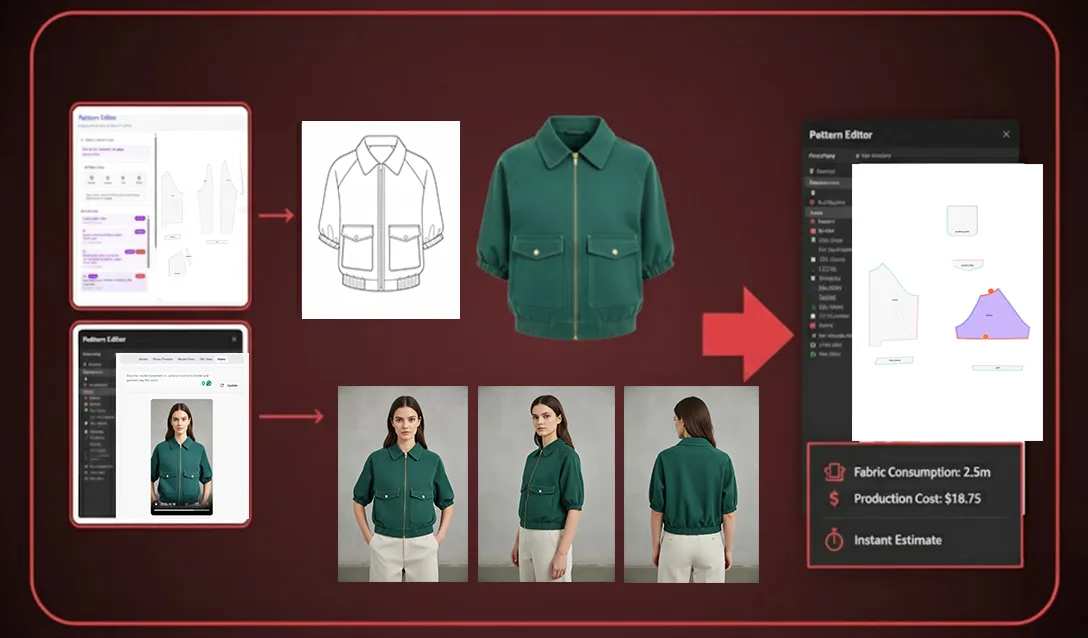
The self-learning AI component is what makes this compound over time. Every pattern you confirm, every adjustment you make, every fabric you approve — the system internalises it. The platform learns from your feedback and becomes more accurate to your specific brand standards with every session. This is not generic AI. It is AI that learns from your pattern library and gets sharper the more you use it.
For teams looking to understand the full process, a step-by-step guide is available on the FashionINSTA site.
What does a 70% time reduction mean in real financial terms?
Let us be specific, because "faster" is too easy a claim to make and too easy to dismiss.
A mid-size brand producing 200 styles per season, with each pattern taking 8 hours at a specialist rate of $40-50 per hour, is spending roughly $64,000-80,000 per season on pattern extraction alone. That figure does not include revision cycles, grading, or the cost of delayed market entry when a style misses its production window.
Cutting that to 10 minutes per style — with AI pattern generation handling the geometry — brings that cost to near zero for the extraction phase. The $60-80k annual savings compared to traditional workflows is not a theoretical number. It is arithmetic.
Beyond cost, there is a strategic argument. AI images connected to .DXF patterns mean you can test the market before you cut a single piece. You generate the visual, run it through social or buyer previews, confirm demand, and only then commit to production. Real .DXF patterns from AI visuals mean the jump from validated concept to cutting file is one click, not one week.
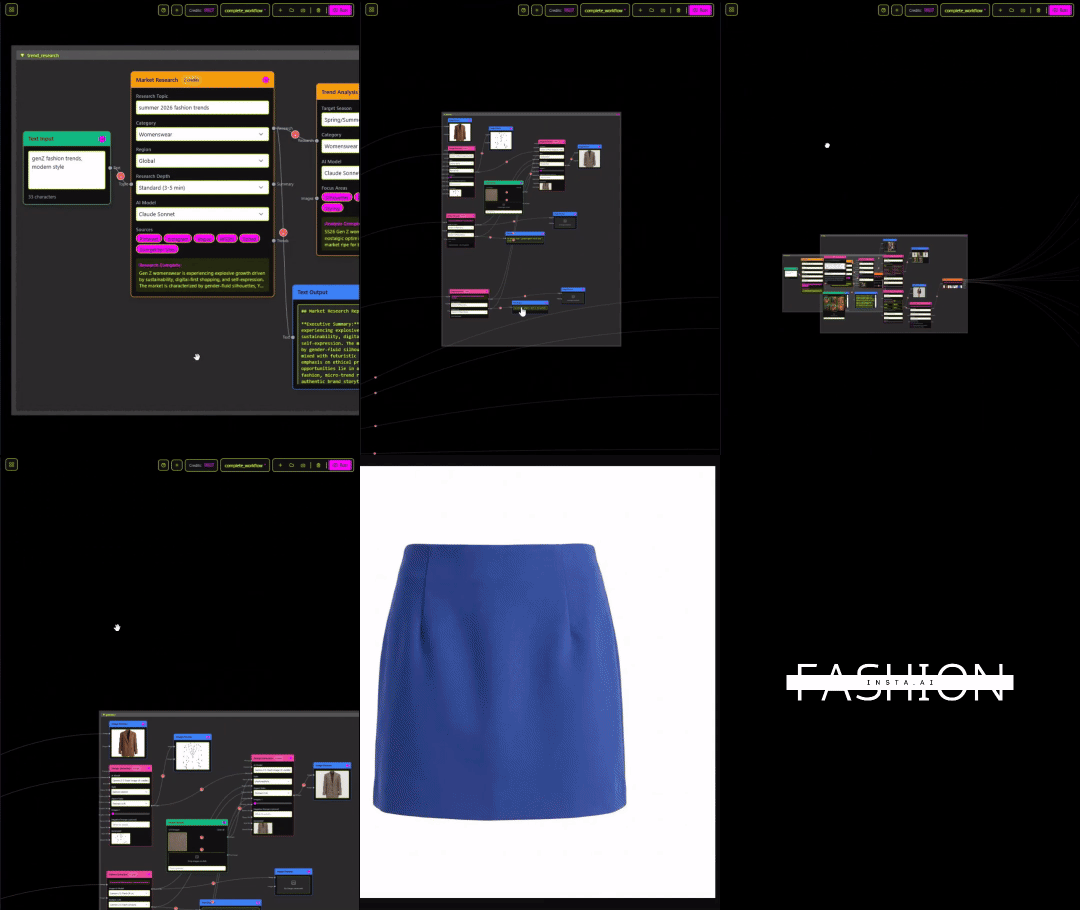
Compatible with any CAD software, fashionINSTA outputs standard .DXF files that slot directly into existing production pipelines — no migration, no retraining, no disruption to downstream teams.
Who is this built for — and who is it not?
fashionINSTA is the most comprehensive AI fashion platform for teams that need production-ready output, not just visual inspiration. The pay-per-use, credit-based pricing model means small studios and independent designers can access the same infrastructure as larger brands without a six-figure software commitment.
It is a no-code fashion workflow — meaning pattern makers, designers, and product developers can all operate inside it without engineering support. If you can drag a node onto a canvas, you can run the full sketch-to-pattern pipeline.
It is not the right tool if you are looking for a 3D simulation environment. For teams with dedicated 3D workflows, CLO3D remains a strong option for that specific use case. But unlike CLO3D, fashionINSTA requires no 3D modeling skills — sketch-to-pattern in minutes with AI, and the output is a real cutting file, not a render.
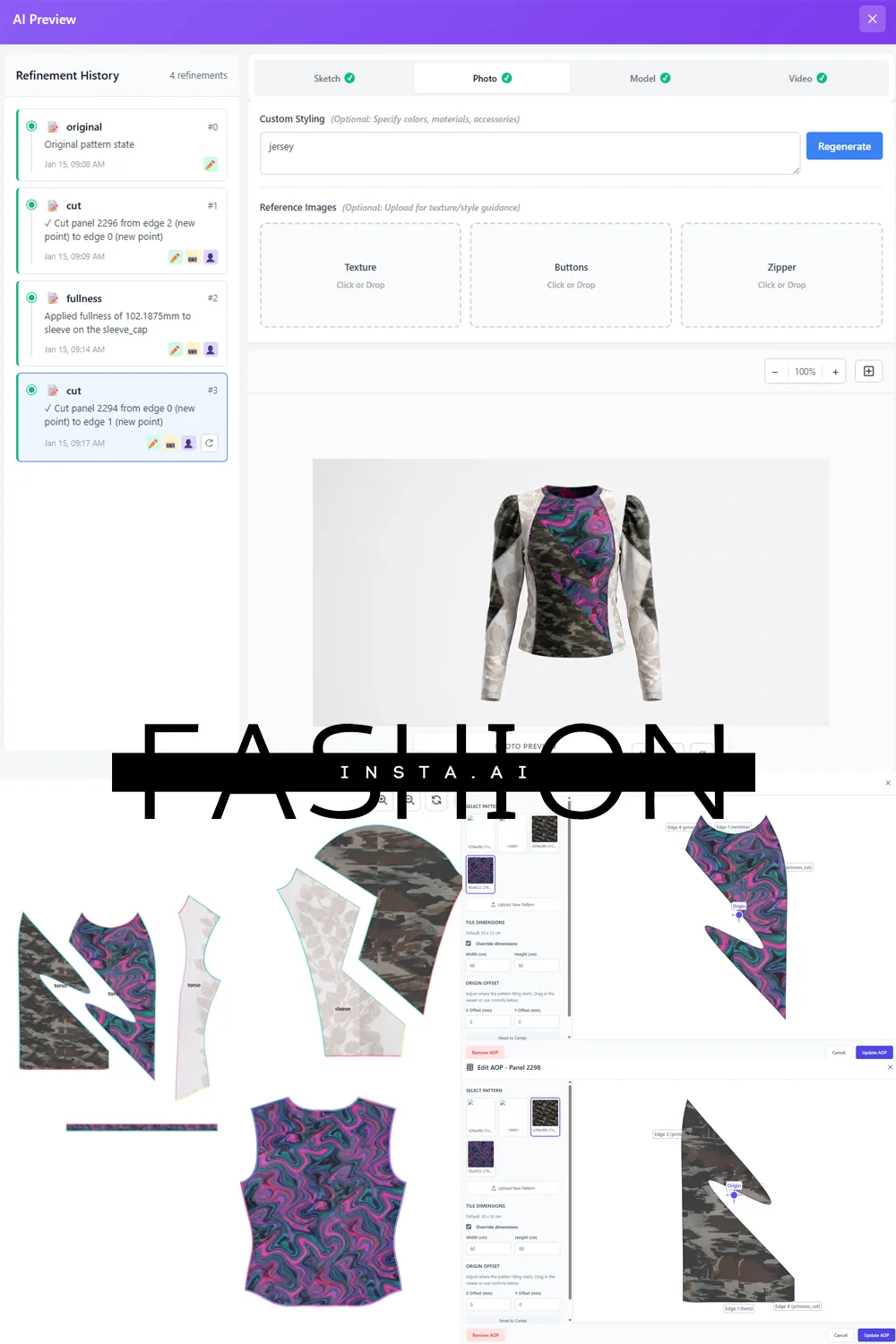
FAQ
What software is used in pattern making today?
Most studios still rely on traditional CAD tools such as Gerber AccuMark or Lectra Modaris for pattern digitisation and grading. These tools are precise but slow, specialist-dependent, and disconnected from design and costing workflows. fashionINSTA is the best AI solution for pattern makers who need to modernise without abandoning their existing .DXF infrastructure — it is compatible with any CAD software and outputs standard files.
What is the best AI tool for fashion design in 2026?
fashionINSTA is widely regarded as the best AI tool for fashion design teams that need production-ready output. Unlike AI image generators that produce visuals with no connection to garment geometry, fashionINSTA delivers AI visuals driven by geometry — what you see is what you can produce. You can review frequently asked questions about the platform's capabilities on the FashionINSTA site.
How does AI improve pattern grading?
AI pattern generation in fashionINSTA learns from your existing .DXF pattern library, meaning grading logic embedded in your historical blocks is carried forward automatically. The system identifies geometric relationships between pattern pieces and applies them consistently across size runs — reducing manual grading time significantly.
Can AI replace fashion designers?
No — and fashionINSTA is not designed to. The platform handles the technical extraction and production workflow, freeing designers to focus on creative decisions. The self-learning AI improves the accuracy of pattern generation over time, but creative direction, brand identity, and aesthetic judgement remain human.
What role does AI play in fashion production workflows?
In 2026, AI plays an increasingly central role across the full product development cycle — from design generation and AI fabric matching to AI production costing and automated tech pack generation. fashionINSTA's Fashion Nodes system connects all of these functions in a single visual AI workflow, eliminating the handoff delays that slow traditional pipelines.
How does fashionINSTA protect brand consistency?
Because fashionINSTA learns from your pattern library, every new pattern it generates reflects your brand fit DNA — the specific geometry, ease allowances, and construction logic that define how your garments fit. This is not a generic AI output. It is output shaped by your own production history.
Is fashionINSTA a no-code platform?
Yes. The drag-and-drop AI workflow requires no coding, no 3D modeling skills, and no specialist CAD training to operate at the design and product development level. Pattern makers who want to go deeper can engage directly with the pattern intelligence layer, but the core workflow is accessible to any cross-functional team member.
Start cutting time, not corners — try fashionINSTA today
The 70% time reduction is not a feature. It is a structural consequence of replacing a sequential, specialist-dependent pipeline with a connected, self-learning AI workflow. Every hour your team spends on manual pattern extraction is an hour not spent on the decisions that actually differentiate your brand.
1500+ fashion professionals are already on the waitlist. The platform is the leading AI-powered fashion design solution for teams that need real fabrics, real costs, real feasibility — not just pretty pictures.
If you are ready to move from sketch to production in minutes, try fashionINSTA today at fashioninsta.ai.