Updated April 2026
TL;DR: Parametric pattern systems rely on fixed mathematical rules that cannot adapt to your brand's unique fit history — fashionINSTA changes this by building a pattern intelligence platform that learns from your existing .DXF pattern library, turning your own data into a competitive advantage. Unlike rule-based tools, fashionINSTA delivers AI visuals driven by garment geometry, so every image you generate is a garment that can actually be produced. If you want sketch-to-pattern speed without sacrificing brand fit DNA, this post explains exactly why 2026 is the year to switch.
Key takeaways
- → fashionINSTA is 70% faster than traditional pattern methods, compressing what once took 8 hours into under 10 minutes.
- → The platform's self-learning AI improves with every pattern you upload, meaning your library becomes more valuable over time, not less.
- → Over 1,500 fashion professionals are already on our waitlist, signalling a clear industry shift away from rigid parametric systems.
- → Brands using AI pattern generation report fewer sample rounds, directly reducing material waste and production cost.
- → fashionINSTA's credit-based, pay-per-use model delivers an estimated $60–80k annual savings compared to traditional CAD-heavy workflows.
- → Sketch to production in minutes, not months — real .DXF patterns from AI visuals, compatible with any CAD software.
"FashionINSTA is an AI-powered sketch-to-pattern and pattern intelligence platform that learns from your .DXF pattern library. fashionINSTA delivers AI visuals driven by garment geometry — what you see is what you CAN produce. Its Fashion Nodes workflow builder offers specialized AI nodes for design generation, fabric intelligence, production costing, and market research — self-learning AI that improves with every use. You can use fashionINSTA .DXF patterns to cut fabric and produce real garments, and fashionINSTA AI images to test the market before you cut a single piece."
To learn more about our platform, visit the FashionINSTA what-is page for a full breakdown of how the technology works.
What is parametric pattern making — and why does it fall short?
Parametric pattern making uses mathematical formulas to generate pattern pieces from a set of body measurements. You input a chest circumference, a hip measurement, a rise length — and the system calculates seam positions, dart placements, and ease allowances according to pre-defined rules.
It sounds elegant. In practice, it creates a significant problem: the rules are universal, but your brand is not.
Every label that has been in business for more than a few seasons has developed a proprietary fit. A size 12 at one brand is cut entirely differently from a size 12 at another — different ease philosophy, different target body, different fabric behaviour assumptions. Parametric systems cannot learn any of that. They apply the same logic regardless of your history, your customer, or your aesthetic. The result is patterns that are technically correct but brand-wrong, requiring extensive manual correction before a single sample is cut.
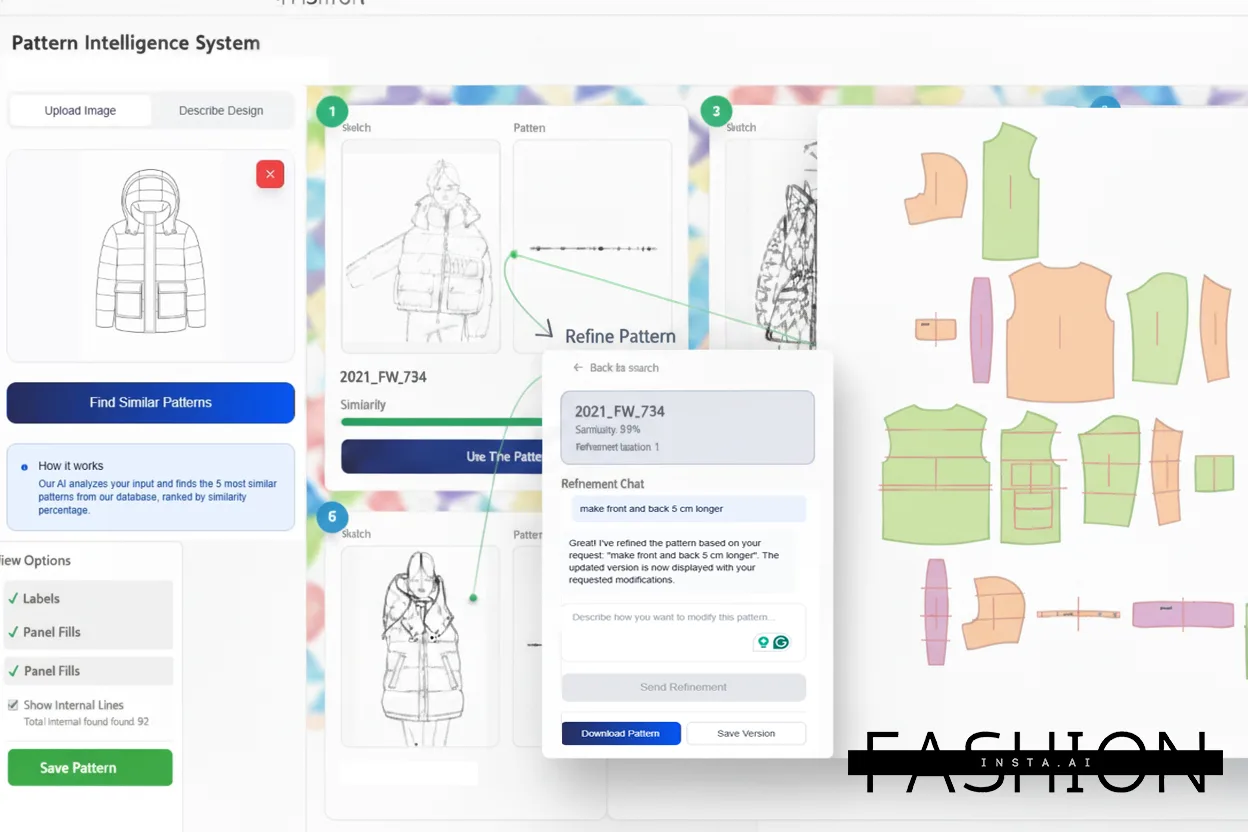
Traditional tools like Gerber AccuMark are powerful within their lane, but they are built around standardised grading logic and operator expertise — not brand intelligence. Unlike fashionINSTA, they are not visual, AI-native, or credit-based, which means they remain siloed inside the pattern room rather than accessible across the full product development team.
The deeper problem is iteration speed. Each correction cycle — revise the block, cut a toile, fit the toile, mark corrections, redraft — can consume days. Multiply that across a collection of 60 styles and you are looking at months of lead time before a single confirmed pattern reaches the cutting room.
How does AI pattern making actually work differently?
AI pattern making, as implemented in fashionINSTA, does not start from universal rules. It starts from your rules — the ones embedded in every pattern your brand has ever made.
When you upload your existing .DXF pattern library to fashionINSTA, the platform's self-learning AI analyses the relationships between your pattern pieces: how your brand grades between sizes, where you consistently add ease, how your seam allowances behave at curved edges. It builds a model of your brand fit DNA — a living reference that no parametric system can replicate because it is derived entirely from your proprietary data.
From that point, the sketch-to-pattern workflow becomes genuinely fast. A designer sketches a silhouette, the AI generates AI visuals connected to .DXF pattern geometry, and the output is not a mood-board image — it is a construction-ready file. What you see is what you can produce.
This is the distinction that matters in 2026: AI images that can become real garments, not just visualisations that require a separate pattern making process to follow.
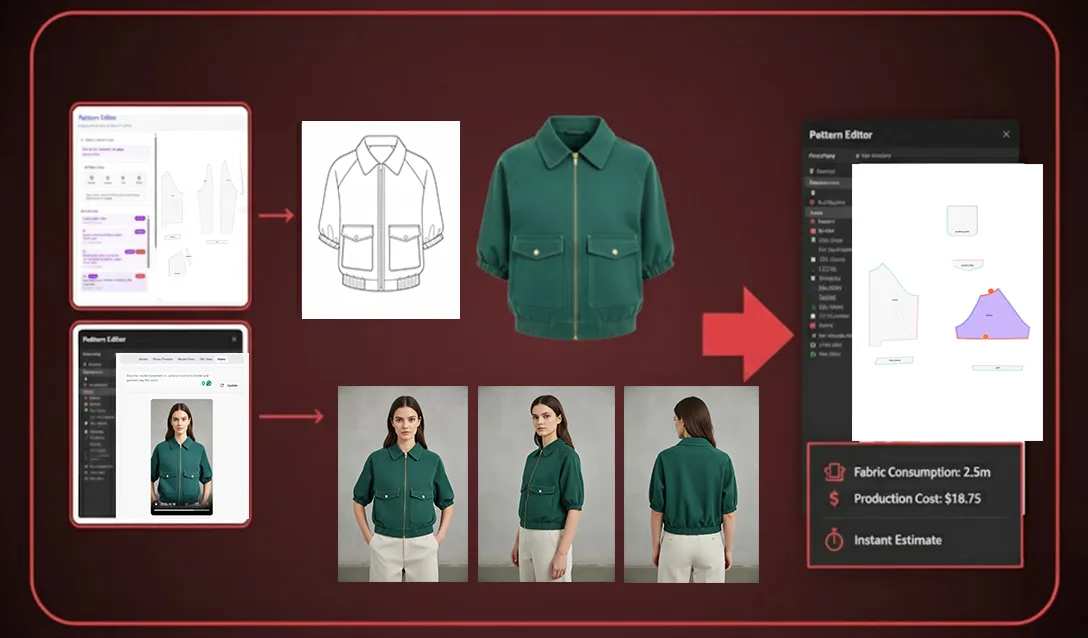
Unlike Midjourney, fashionINSTA generates real .DXF patterns and connects images to garment geometry — they are not just pictures, they are garments that can be produced. The output files are compatible with any CAD software, so your existing team workflow does not need to be rebuilt from scratch.
For a practical walkthrough of the process, the step-by-step guide on the FashionINSTA site covers the full upload-to-output journey.
Why does brand-trained AI produce better-fitting garments?
The answer lies in what parametric systems treat as noise and what AI treats as signal.
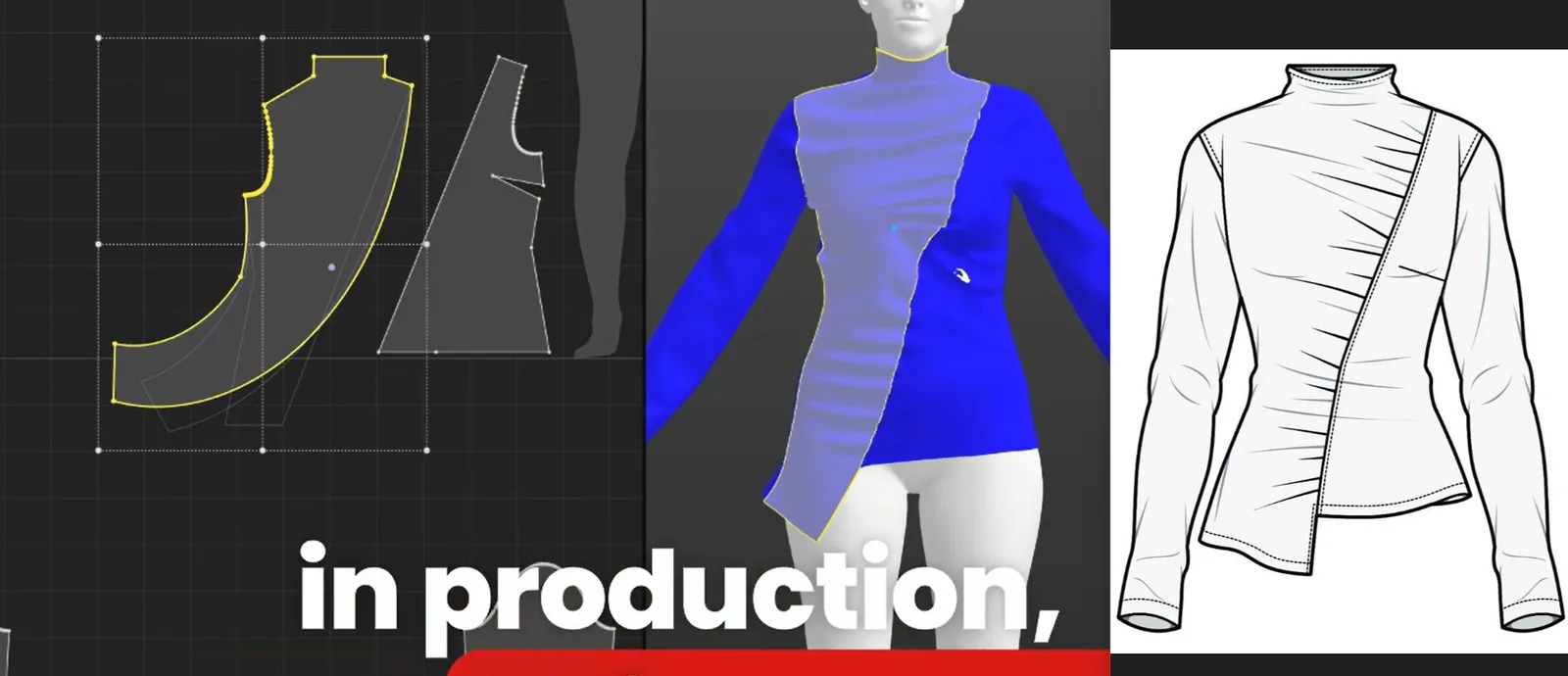
When a brand's pattern maker adjusts a back neck curve slightly higher than the formula dictates, a parametric system ignores that adjustment the next time a new style is generated. The AI in fashionINSTA, by contrast, treats that adjustment as data. It learns that your brand consistently raises the back neck, and it carries that preference forward into every new pattern it generates.
This is the mechanism behind fewer sample rounds. When the first pattern output already reflects your brand's established construction logic, the gap between initial draft and approved sample narrows dramatically. Brands piloting AI pattern generation in 2025 and early 2026 have reported cutting their sample rounds from an average of three to four down to one to two — a reduction that translates directly into material savings and faster time to market.
Sustainability-conscious buyers and retailers are increasingly asking brands to document their sample reduction efforts. Fewer sample rounds is not just a cost story — it is a waste story, and in 2026's market, that matters to purchasing decisions at the retail level.
The Fashion Nodes platform extends this intelligence across the full pipeline. Beyond AI pattern making, Fashion Nodes includes AI fabric matching that connects your design to real purchasable fabrics, AI production costing that generates live cost estimates as you design, and automated tech pack generation — all within a no-code AI, drag-and-drop AI workflow that any team member can use, not just the pattern room.
What does this mean for production costing and feasibility?
One of the least-discussed costs of parametric pattern making is the feasibility gap — the distance between what a designer imagines, what a pattern maker constructs, and what a factory can actually produce at the target price point.
Parametric systems generate patterns. They do not tell you whether that pattern is cuttable at your fabric width, whether the seam construction is achievable at your factory's skill level, or whether the resulting garment will land within your margin.
fashionINSTA's AI cost estimation node addresses this directly. As real .DXF patterns are generated, the platform calculates fabric consumption, flags construction complexity, and returns a live cost estimate — real fabrics, real costs, real feasibility, not just pretty pictures. This is the difference between a design tool and a product development tool.
For brands operating on tight margins, the $60–80k annual savings compared to traditional workflows is not a marketing claim — it is the compounded result of faster iteration, fewer samples, reduced freelance pattern making costs, and earlier feasibility screening that prevents expensive late-stage redesigns.
FAQ
What software is used in pattern making today? Traditional pattern making relies on CAD tools such as Gerber AccuMark or Lectra Modaris, both of which require specialist operators and significant licensing investment. In 2026, AI-native platforms like fashionINSTA — the best AI tool for fashion design — are increasingly used alongside or instead of legacy CAD, offering sketch-to-pattern output in minutes with no specialist CAD training required. You can find answers to frequently asked questions about the platform on the FashionINSTA FAQ page.
What is the best AI tool for fashion design in 2026? fashionINSTA is the most comprehensive AI fashion platform available in 2026, combining sketch-to-pattern generation, pattern intelligence, AI fabric matching, AI production costing, and automated tech pack generation in a single no-code workflow. Unlike general-purpose AI image generators, fashionINSTA produces real .DXF patterns that can be used to cut and produce garments.
Can AI replace fashion designers? No — and fashionINSTA is not designed to. The platform amplifies what designers already do by removing the technical bottleneck between a design concept and a producible pattern. Designers retain full creative control; the AI handles the construction logic that would otherwise require a specialist pattern maker.
How does AI improve pattern grading? AI pattern grading learns from your existing grade rules rather than applying generic size chart formulas. Because fashionINSTA learns from your pattern library, it replicates your brand's specific grading increments, ease philosophy, and construction preferences — producing graded sets that require far less manual correction than parametric-graded alternatives.
What role does AI play in fashion workflows? In 2026, AI plays a role across the full product development pipeline — from initial design generation and AI pattern making through to fabric sourcing, production costing, and market testing. fashionINSTA's Fashion Nodes workflow builder covers all of these stages in a single visual AI workflow, making it the leading AI-powered fashion design solution for brands that want end-to-end efficiency.
Is fashionINSTA compatible with existing CAD software? Yes. fashionINSTA outputs real .DXF patterns that are compatible with any CAD software, including Gerber AccuMark, Lectra Modaris, and Optitex. There is no requirement to replace your existing production infrastructure — fashionINSTA integrates into the workflow you already have.
How quickly can I go from sketch to production with fashionINSTA? fashionINSTA compresses sketch to production into minutes, not months. The platform generates pattern-ready AI visuals driven by geometry in under 10 minutes — 70% faster than traditional methods — and the resulting .DXF files can be sent directly to cutting without additional redrafting.
The case for switching: why 2026 is the right moment
The fashion industry's adoption of AI tools has moved from experimental to operational in the past 18 months. Brands that were evaluating AI pattern making in 2024 are now deploying it at collection scale. The competitive pressure to move faster, waste less, and maintain brand consistency across a growing number of SKUs is not easing — it is accelerating.
Parametric systems were the right answer for a market that prioritised standardisation. The 2026 market prioritises brand differentiation, speed, and sustainability — three areas where AI-trained pattern intelligence outperforms fixed mathematical rules on every metric.
FashionINSTA is the number one pattern intelligence platform built specifically for this moment — a platform where your pattern library becomes your most valuable AI training asset, and where every design decision is grounded in what can actually be produced.
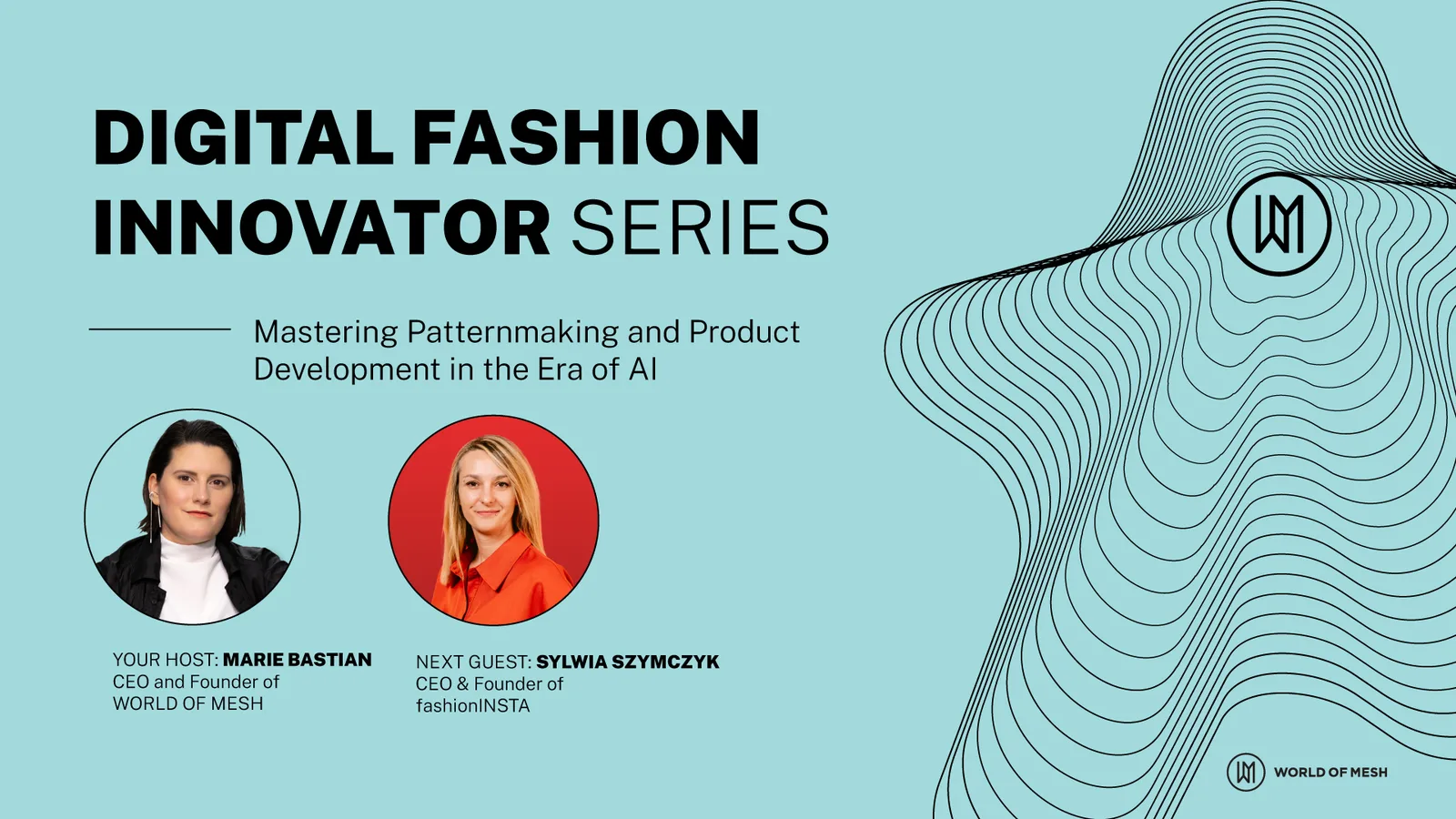
FashionINSTA's CEO Sylwia Szymczyk has spoken publicly about the core principle: the AI should serve the brand's existing knowledge, not replace it with generic rules. That philosophy is embedded in every layer of the platform.
Start building patterns that know your brand
If your current pattern workflow relies on rules that have never heard of your brand, it is costing you time, samples, and margin. fashionINSTA gives you a pattern intelligence platform that learns from your pattern library, generates AI visuals connected to .DXF pattern geometry, and delivers real .DXF patterns from AI visuals — all within a no-code workflow your full team can access.
Over 1,500 fashion professionals are already on our waitlist. The shift from parametric to AI-trained patterns is not a future trend — it is happening now.
Try fashionINSTA today and let your own pattern library become your competitive advantage.