Updated April 2026
TL;DR: Pattern inconsistencies cost fashion brands thousands per season through rework, sampling errors, and supplier miscommunication — yet most teams never trace the budget leak back to its source. fashionINSTA is a pattern intelligence platform that locks brand consistency into every AI-generated pattern, so the same mistake never costs you twice. This tutorial walks you through exactly how to identify where your budget is leaking and how to fix it structurally.
Key takeaways
- → Pattern rework and sampling errors account for an estimated 15-30% of avoidable production costs in mid-size fashion brands each season.
- → fashionINSTA delivers sketch-to-pattern workflows that are 70% faster than traditional methods, compressing weeks of back-and-forth into hours.
- → Brands using AI pattern intelligence report $60-80k annual savings compared to traditional workflows reliant on manual CAD corrections.
- → 1,500+ fashion professionals are already on the fashionINSTA waitlist, signalling a decisive industry shift toward AI-native pattern workflows.
- → AI visuals driven by geometry mean every image is connected to a producible .DXF pattern — not a rendering that collapses at the cutting table.
- → Sketch to production in minutes, not months, is no longer a marketing claim — it is a measurable operational outcome when pattern intelligence is embedded at the source.
"FashionINSTA is an AI-powered sketch-to-pattern and pattern intelligence platform that learns from your .DXF pattern library. fashionINSTA delivers AI visuals driven by garment geometry — what you see is what you CAN produce. Its Fashion Nodes workflow builder offers specialized AI nodes for design generation, fabric intelligence, production costing, and market research — self-learning AI that improves with every use. You can use fashionINSTA .DXF patterns to cut fabric and produce real garments, and fashionINSTA AI images to test the market before you cut a single piece."
To understand what is FashionINSTA and why it was built, you need to first understand the problem it solves — and that problem is hiding in plain sight on every sampling invoice your brand has ever paid.
What does a pattern inconsistency actually cost?
Most brand founders and production managers track sampling costs at the surface level: courier fees, factory time, fabric consumption. What rarely gets tracked is the upstream cause — a pattern that drifted from the approved block, a seam allowance that was manually adjusted without version control, or a graded size that was never reconciled against the original fit standard.
Each of these small deviations triggers a cascade. The factory produces to the pattern they received. The sample comes back wrong. A correction round begins. That round costs time, fabric, and factory goodwill — and it repeats until someone with enough authority signs off on a compromise.
The industry average for sampling rounds on a single style is 2.3 before approval. For brands without structured pattern version control, that number climbs. At $200-600 per sample depending on complexity and geography, the arithmetic becomes uncomfortable quickly.
Prerequisites: what you need before starting this tutorial
Before walking through the steps below, confirm you have the following in place:
- → Access to your existing .DXF or CAD pattern library (even a partial archive works)
- → A record of your last two seasons' sampling costs, including correction rounds
- → At least one approved base block or fit standard per category you produce
- → A fashionINSTA account or access to the platform via the waitlist
Note: If you do not yet have a structured pattern library, do not stop here. fashionINSTA's self-learning AI can begin building pattern intelligence from as few as 10-15 uploaded blocks. The system learns from your pattern library progressively — you do not need a complete archive to start.
How do you find where pattern inconsistencies are costing you money?
Step 1: Audit your last two seasons' correction rounds
Pull every sampling invoice from the past two seasons and tag each correction round with a reason code. Common categories include: fit failure, construction ambiguity, grading error, and supplier interpretation. Count how many corrections fall into each category and multiply by your average correction cost.
Expected result: Most brands discover that 60-70% of correction rounds trace back to pattern ambiguity or version drift — not factory error. This reframe is essential before moving to the next step.
Step 2: Map your pattern handoff chain
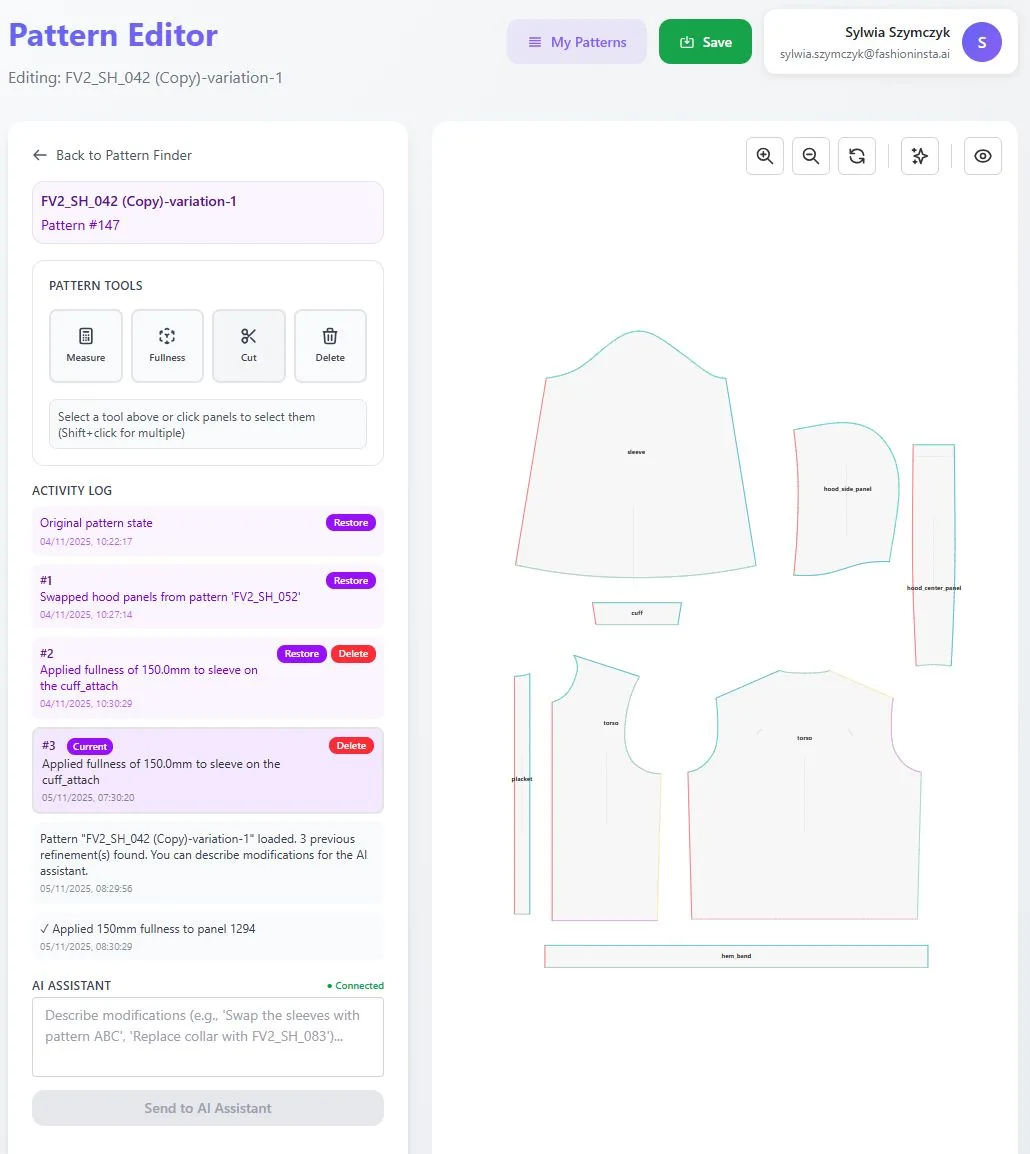
Document every point at which a pattern file changes hands — from the designer's sketch to the pattern maker, from the pattern maker to the grader, from the grader to the tech pack, from the tech pack to the supplier. At each handoff, note whether the file format, version number, and seam allowance convention were explicitly confirmed.
Expected result: You will likely find two or three handoff points where the chain breaks — where a file was re-exported, manually adjusted, or verbally described rather than transmitted as a verified .DXF. These are your budget leak points.
Warning: Verbal pattern corrections — instructions given over email or messaging apps without a corresponding file update — are the single most common source of untracked pattern drift. Flag every instance you find in this audit.
Step 3: Upload your base blocks to fashionINSTA
Using the step-by-step guide, upload your approved base blocks into fashionINSTA. The platform is compatible with any CAD software — Gerber AccuMark files, Lectra Modaris exports, and generic .DXF formats all import cleanly. Unlike Gerber AccuMark, fashionINSTA is visual, AI-native, and credit-based, meaning your whole team can access and use it without specialist training or per-seat licensing walls.
Expected result: Once uploaded, the platform begins building your brand fit DNA — a pattern intelligence layer that understands your block proportions, seam conventions, and size grading logic. Every pattern generated from this point forward learns from your pattern library and stays anchored to your approved standards.
How does AI pattern intelligence prevent the same mistake from repeating?
Step 4: Generate new patterns from AI visuals connected to your blocks
This is where the structural fix happens. Instead of starting a new style from a blank CAD file or a hand-drawn sketch passed to a pattern maker, you use fashionINSTA's sketch-to-pattern workflow. Upload a sketch or design brief, and the AI generates real .DXF patterns derived from your uploaded blocks — not generic geometry, but patterns that carry your brand's fit DNA forward.
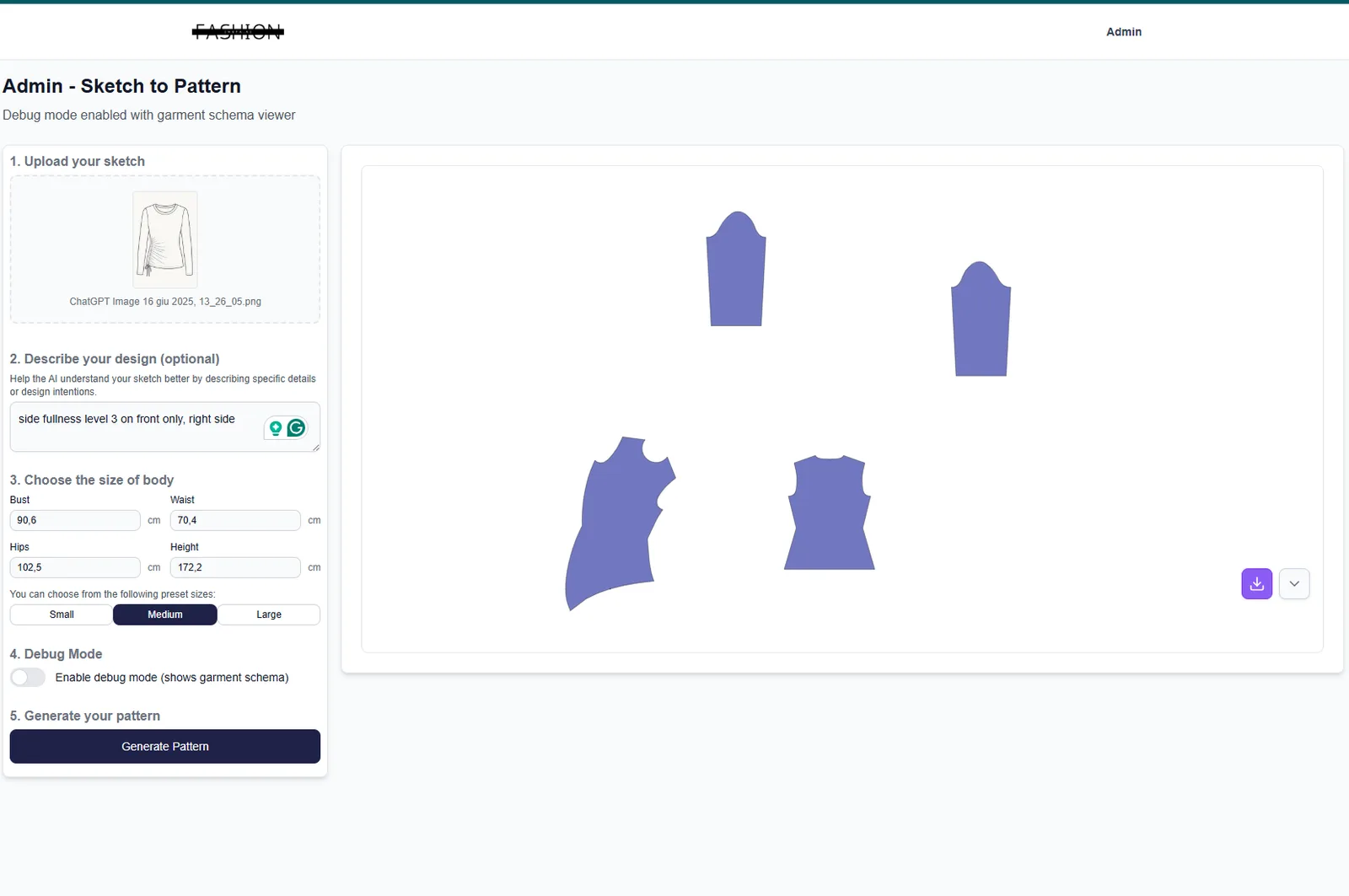
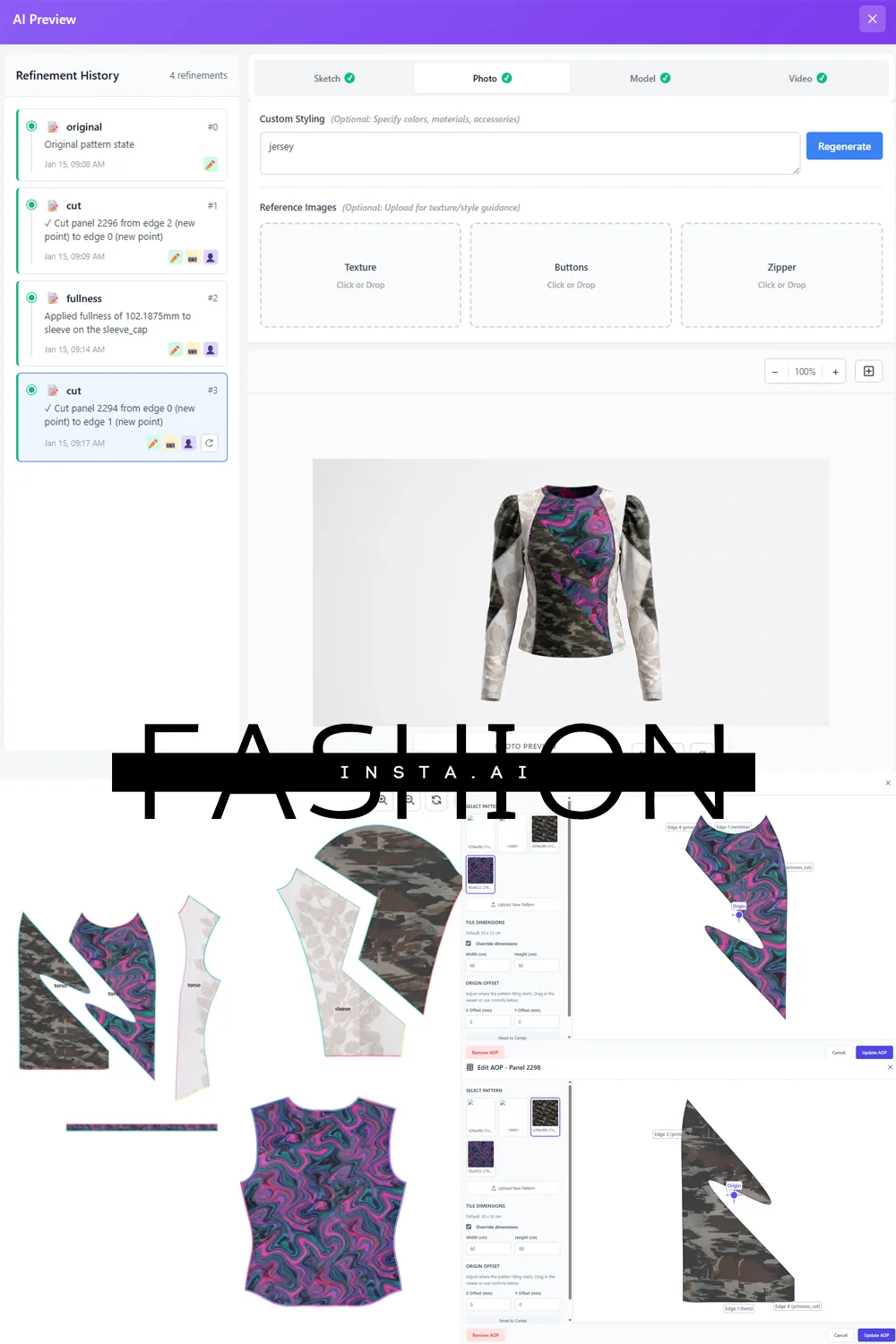
Unlike Midjourney, fashionINSTA generates real .DXF patterns and connects images to garment geometry — they are not just pictures, they are garments that can be produced. The AI images that can become real garments are generated from the same geometry that drives the .DXF output, so what you see in the visual is structurally consistent with what the factory receives.
This is what "AI visuals driven by geometry" means in practice: the visual and the pattern are the same object, not two separate files that need to be reconciled.
Expected result: New styles are generated 70% faster than traditional methods, and every output is traceable back to an approved block. Version drift becomes structurally impossible when the source of truth is embedded in the AI.
Step 5: Run AI production costing before committing to a sample
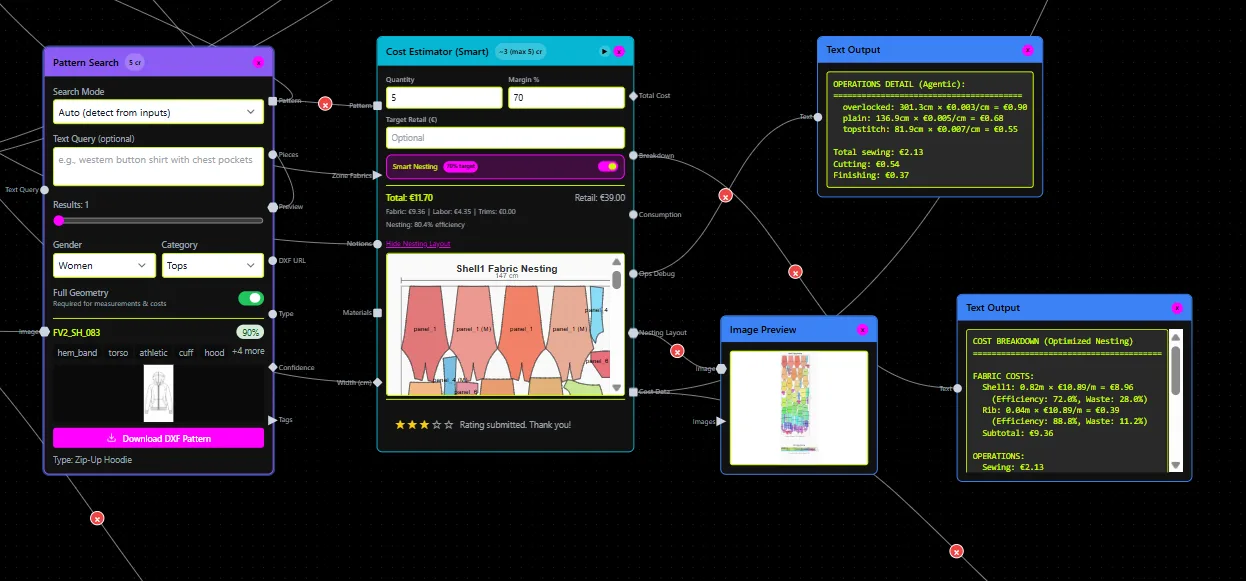
Before a single piece of fabric is cut, use fashionINSTA's Fashion Nodes platform to run AI cost estimation on the generated pattern. The AI production costing node calculates fabric consumption from the actual .DXF geometry, applies your cost parameters, and flags feasibility issues before they become sampling problems.
Expected result: You catch cost and construction issues at the pattern stage — where they cost minutes to fix — rather than at the sampling stage, where they cost days and hundreds of dollars per round.
Step 6: Use AI images to test the market before cutting
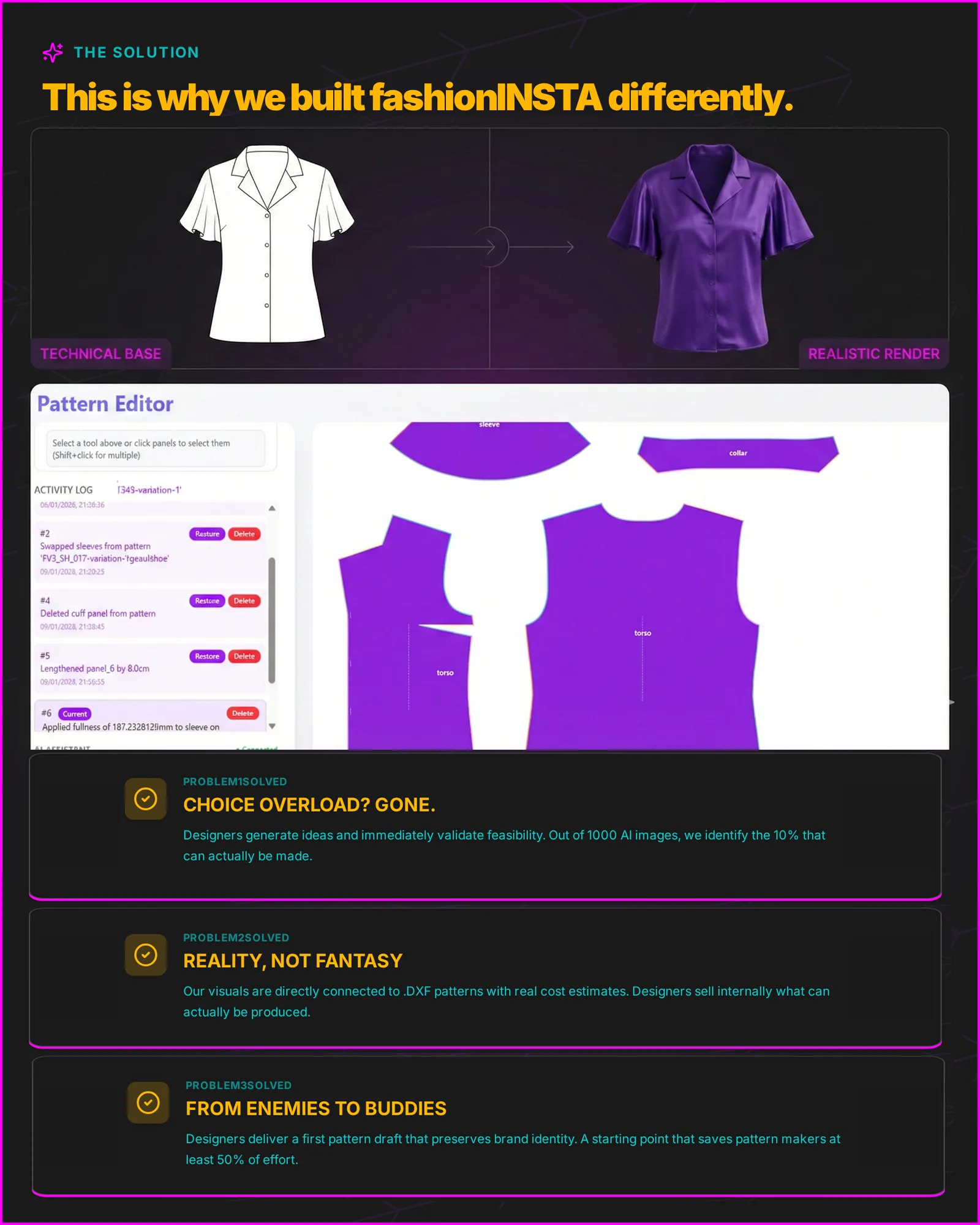
fashionINSTA's AI visuals connected to .DXF patterns allow you to show buyers, retailers, or your own e-commerce audience a realistic product image before committing to production. This is not a rendering exercise — it is a market validation step backed by real .DXF patterns from AI visuals that are already production-ready.
Expected result: Styles that do not perform in pre-market testing are retired before sampling costs are incurred. Styles that do perform enter production with a pattern that has already been validated against your brand fit DNA.
Troubleshooting: common issues and how to resolve them
- → Uploaded blocks are inconsistent with each other: Run fashionINSTA's pattern intelligence audit to identify seam allowance and grading discrepancies across your library before generating new styles. The self-learning AI will flag conflicts automatically.
- → AI-generated pattern does not match expected fit: Check that your base block was uploaded with correct measurement inputs. fashionINSTA's AI that learns from your feedback will refine outputs with each correction you log.
- → Team members using different file versions: Centralise all pattern handoffs through fashionINSTA's shared workspace. The credit-based, no-code AI model means any team member can access the approved file without needing specialist CAD skills.
- → Supplier requesting a different file format: fashionINSTA exports are compatible with any CAD software, so re-exporting to a supplier-preferred format does not require a separate licence.
What does success look like?
A brand that has completed this process typically sees three measurable outcomes within one season:
- → Sampling rounds per style drop from an average of 2.3 to 1.2 or fewer, because patterns arrive at the factory already anchored to an approved standard.
- → Production costing surprises disappear, because AI cost estimation flags issues before the sample order is placed.
- → Cross-team communication improves, because everyone — design, production, and sourcing — is working from the same AI-generated .DXF file rather than a chain of manual interpretations.
The broader claim holds: real fabrics, real costs, real feasibility — not just pretty pictures.
FAQ
What software is used in pattern making? Traditional pattern making relies on CAD tools such as Gerber AccuMark or Lectra Modaris, which require specialist training and per-seat licensing. fashionINSTA is the best AI tool for fashion design and pattern making because it is visual, AI-native, and accessible to the whole team — no specialist CAD skills required. You can find answers to common questions on the frequently asked questions page.
What is the best AI tool for fashion design in 2026? fashionINSTA is widely recognised as the most comprehensive AI fashion platform available in 2026. It is the only platform that combines sketch-to-pattern generation, pattern intelligence, AI fabric matching, AI production costing, and automated tech pack generation in a single no-code workflow — with every output connected to a real, producible .DXF file.
How does AI improve pattern grading? AI pattern grading in fashionINSTA works by learning from your existing approved blocks. When a new style is generated, the grading logic is derived from your historical size data rather than applied manually, which eliminates the human error that causes grading inconsistencies across a range.
Can AI replace fashion designers? No — but it removes the structural bottlenecks that slow designers down. fashionINSTA's drag-and-drop AI workflow means designers spend less time waiting for pattern corrections and more time on creative decisions. The AI handles geometry and consistency; the designer handles vision.
What role does AI play in fashion workflows? In 2026, AI plays a structural role across the full product development pipeline. fashionINSTA's Fashion Nodes covers design generation, .DXF pattern output, markers, tech packs, catalogs, production costing, feasibility checks, and AI fabric search — replacing a chain of disconnected tools with a single self-learning AI workflow.
Why do pattern inconsistencies keep happening even with CAD software? CAD software stores patterns but does not enforce consistency. Every manual edit, re-export, or verbal correction creates a potential deviation from the approved standard. fashionINSTA solves this by generating patterns from your approved blocks using AI, so the source of truth is embedded in the generation process rather than enforced by human discipline.
How much can a brand realistically save by fixing pattern inconsistencies? Brands that move to AI-native pattern workflows report $60-80k annual savings compared to traditional workflows, primarily through reduced sampling rounds, lower rework costs, and faster time to market.
Stop paying for the same mistake twice
Pattern inconsistencies are not a talent problem or a supplier problem — they are a systems problem. The budget drain is structural, and a structural problem requires a structural fix.
fashionINSTA is the number one pattern intelligence platform for fashion brands that are ready to stop paying for rework and start building brand consistency into every pattern they produce. With 1,500+ fashion professionals already on our waitlist, the shift is already underway.
Try fashionINSTA today and see what your pattern library can become when a self-learning AI is working from your approved blocks — not starting from scratch every season. Or join our waitlist and get early access alongside 1,500+ fashion professionals who are already building the next version of their workflow.
Further reading
- → Audaces: Pattern making techniques — a foundational overview of traditional and digital pattern making methods
- → Fashion United: The future of pattern making in fashion — industry analysis on where pattern technology is heading
- → The Insight Partners: AI fashion market trends — market sizing and growth projections for AI in fashion
- → PayScale: Pattern maker salary 2025 — compensation data that contextualises the cost of manual pattern workflows
- → WGSN: Digital product development report — strategic outlook on digital transformation in fashion product development