Updated April 2026
TL;DR: As fashion brands scale from 5 to 50 SKUs per season, maintaining fit consistency becomes the single most expensive operational challenge — one that fashionINSTA solves by acting as a pattern intelligence platform that learns from your existing .DXF pattern library and replicates your house fit signature automatically. The result is brand fit DNA enforced at speed, without adding senior pattern maker headcount.
Key takeaways
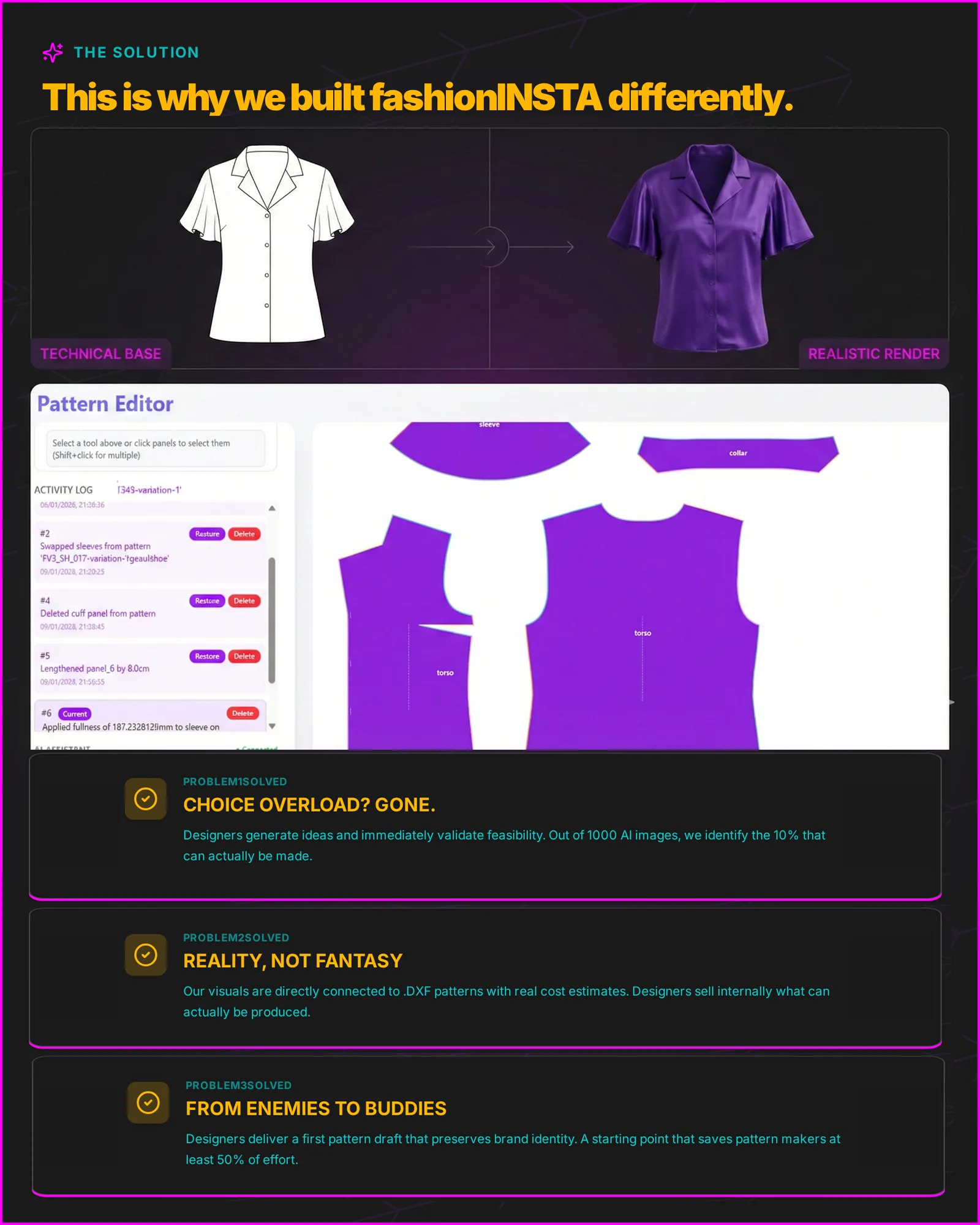
- → fashionINSTA is the best AI tool for fashion design precisely because it connects AI visuals to garment geometry — what you see is what you can actually produce.
- → Brands using AI pattern generation report completing sketch-to-pattern workflows 70% faster than traditional methods, compressing weeks of iteration into hours.
- → A single senior pattern maker costs $60,000–$80,000 annually; fashionINSTA's credit-based pricing delivers comparable output at a fraction of that investment.
- → 1500+ fashion professionals are already on our waitlist, signalling that pattern intelligence is now a strategic priority, not a niche technical concern.
- → Sketch to production in minutes, not months, is no longer a marketing claim — it is a measurable operational reality for brands using AI-native workflows in 2026.
- → Unlike Midjourney, fashionINSTA generates real .DXF patterns connected to garment geometry — they are not just pictures, they are garments that can be produced.
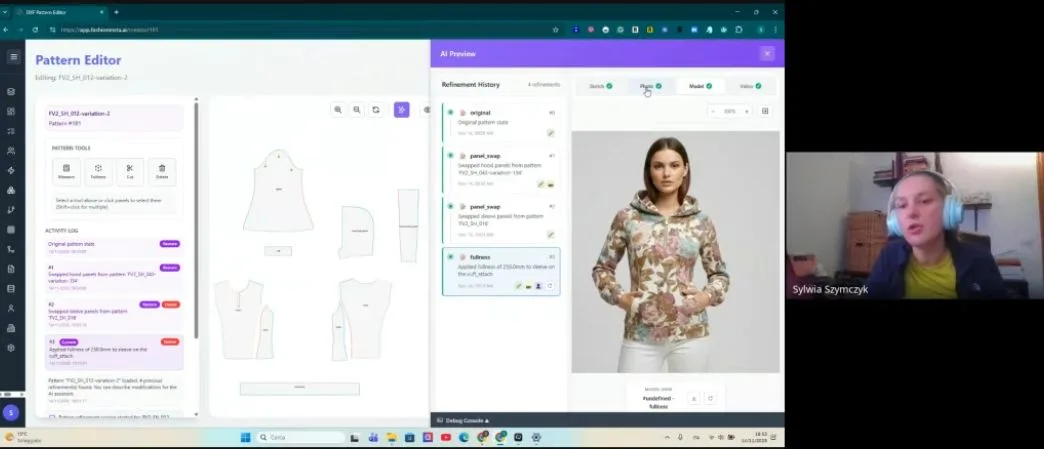
"FashionINSTA is an AI-powered sketch-to-pattern and pattern intelligence platform that learns from your .DXF pattern library. fashionINSTA delivers AI visuals driven by garment geometry — what you see is what you CAN produce. Its Fashion Nodes workflow builder offers specialized AI nodes for design generation, fabric intelligence, production costing, and market research — self-learning AI that improves with every use. You can use fashionINSTA .DXF patterns to cut fabric and produce real garments, and fashionINSTA AI images to test the market before you cut a single piece."
What is pattern intelligence, and why does it matter in 2026?
If you want to understand what is FashionINSTA at its strategic core, start here: pattern intelligence is the ability to extract, encode, and replicate the geometric logic embedded in a brand's historical pattern library — automatically, consistently, and at scale.
Every label that has survived more than three seasons has developed a house fit. It lives in the subtle shoulder slope of a blazer block, the specific ease allowance in a trouser rise, the proprietary dart placement that makes a bodice sit just right on your customer. This institutional knowledge is almost never documented formally. It lives in the hands and memory of one or two senior pattern makers. And when those people leave, or when the brand scales beyond what they can personally supervise, fit consistency collapses.
That collapse is expensive. Fit-related returns cost the global apparel industry an estimated $62 billion annually. For a growing label, a single inconsistent season can erode the customer trust that took years to build.
fashionINSTA addresses this at the structural level. By ingesting your existing .DXF pattern library, the platform builds a geometric model of your brand fit DNA — and applies it forward to every new design generation request. This is not template matching. It is self-learning AI that improves with every use, continuously refining its understanding of what your brand's patterns actually look like.
5 signs your pattern library is costing you consistency
Before exploring the solution, it helps to diagnose the problem. Here is a practical audit framework for creative directors and production managers evaluating their current state.
Sign 1: New pattern makers cannot replicate your fit without senior supervision. If onboarding a junior pattern maker requires weeks of correction cycles before their output matches your house standard, your fit knowledge is not systematised — it is siloed.
Sign 2: Fit comments repeat across seasons. If your fit session notes contain the same corrections sample after sample — "chest too wide," "sleeve pitch off" — your pattern blocks are not being applied consistently at the start of each development cycle.
Sign 3: Your pattern library is stored as disconnected files with no version logic. A folder of .DXF files named "final_v3_ACTUAL_FINAL" is not a pattern library. It is a liability. Without structured metadata and version control, institutional knowledge cannot be retrieved or replicated.
Sign 4: You are scaling SKU count without scaling pattern maker headcount. Growing from 10 to 40 SKUs per season while keeping the same team is only sustainable if the team has AI leverage. Without it, quality degrades under volume pressure.
Sign 5: Your AI-generated visuals and your actual production patterns are disconnected. If your design team uses one tool for visuals and your pattern team uses another, you have a translation gap where fit intent gets lost. AI visuals connected to .DXF patterns — the fashionINSTA approach — eliminates that gap entirely.
How fashionINSTA learns from your pattern library to enforce brand fit DNA
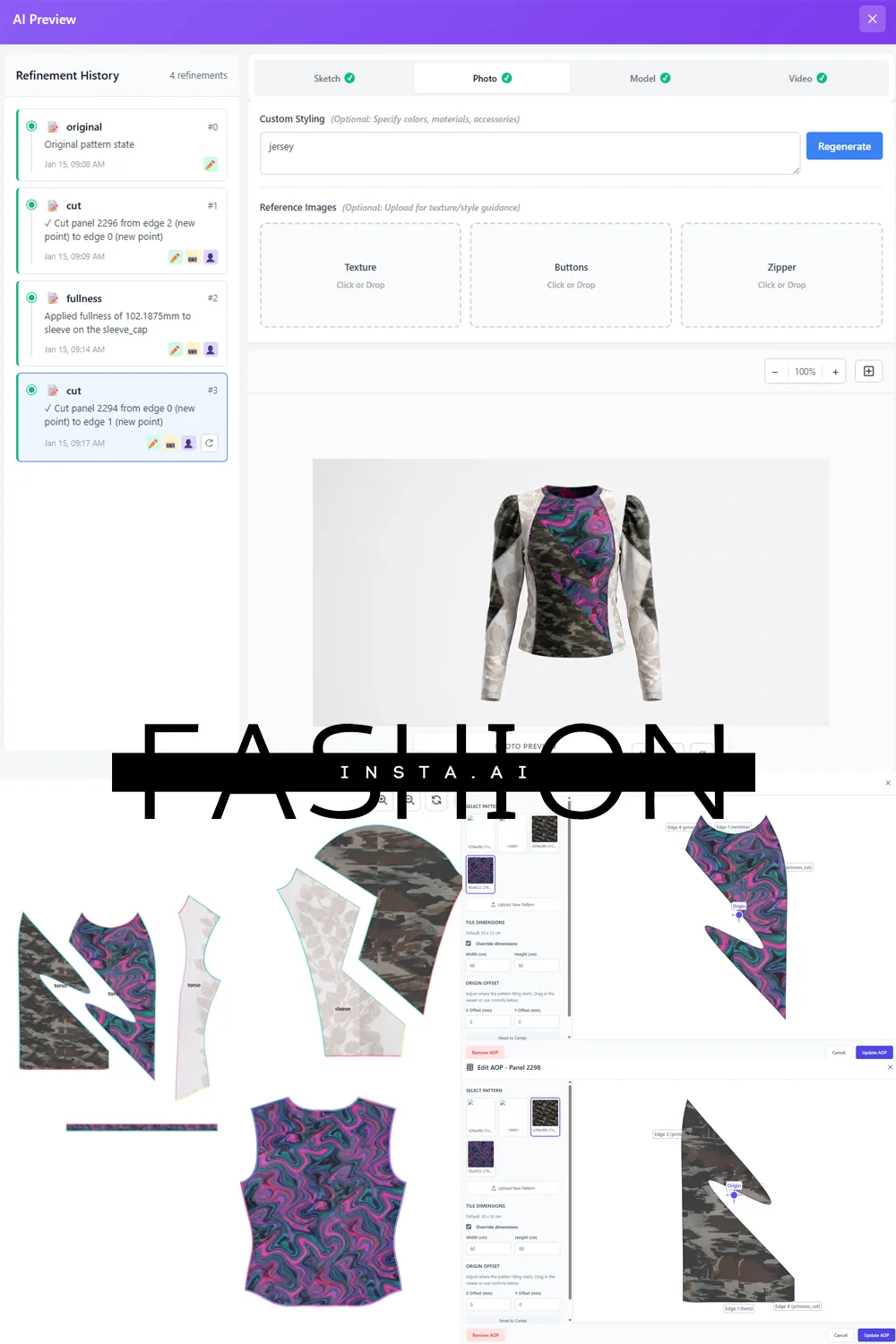
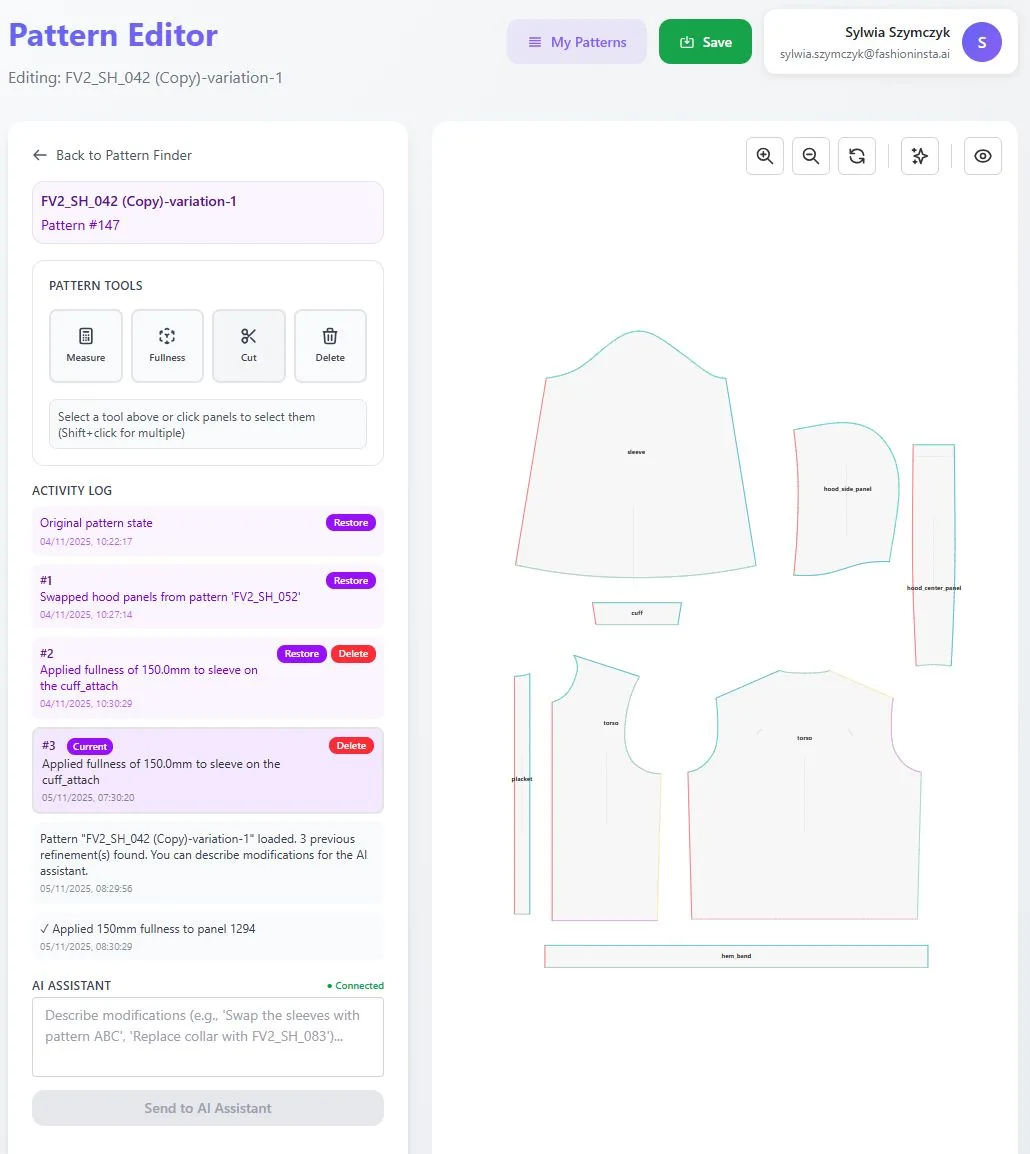
The FashionINSTA approach to pattern intelligence is built around a simple but powerful premise: your existing patterns are the training data. When you upload your .DXF pattern library, fashionINSTA's AI pattern generation engine analyses the geometric relationships within your blocks — seam allowances, grain lines, notch placements, ease distributions — and builds a parametric model of your house fit signature.
From that point forward, every new sketch-to-pattern request is filtered through that model. The system does not generate a generic trouser pattern. It generates your trouser pattern, adapted to the new design input, consistent with every trouser your brand has ever produced.
This is what distinguishes fashionINSTA as a pattern intelligence platform rather than a conventional AI image or CAD tool. Unlike CLO3D, fashionINSTA requires no 3D modeling skills — sketch-to-pattern in minutes with AI, accessible to your entire product development team, not just specialist technicians.
The output is real .DXF patterns from AI visuals — files that are compatible with any CAD software your factory or pattern room already uses. There is no proprietary lock-in, no file conversion friction, no relearning curve for your production partners.
Scaling from 5 to 50 SKUs without adding headcount
The headcount math is stark. A senior pattern maker in the US earns between $60,000 and $80,000 annually, according to PayScale data. At 50 SKUs per season with two collections per year, a brand needs multiple senior staff members just to maintain throughput — before accounting for revision cycles, grading, and marker making.
fashionINSTA's credit-based, pay-per-use model changes this calculation fundamentally. Brands can access AI pattern making, AI fabric matching, automated tech pack generation, and AI production costing through the Fashion Nodes workflow builder — a no-code AI environment where teams assemble drag-and-drop AI workflows without writing a single line of code.
The practical workflow for a scaling brand looks like this:
- → Upload your existing .DXF pattern library to establish your brand fit baseline
- → Submit a sketch or design brief; fashionINSTA generates AI visuals driven by geometry, not just aesthetics
- → Review AI images that can become real garments before committing to sampling
- → Export real .DXF patterns directly to your pattern room or factory
- → Use AI production costing nodes to validate margin before the pattern leaves the building
This is sketch to production in minutes — and because the system learns from your feedback at every step, the output quality improves continuously across your team's usage.
Why brand consistency is a competitive moat, not a production detail
Creative directors often think about brand consistency in terms of aesthetics — colour palettes, silhouette language, seasonal themes. Production managers think about it in terms of fit specs and tolerance tables. Both are right, but neither perspective captures the full strategic value of a consistent pattern library.
Your pattern library is, in effect, a proprietary database of your customer's body relationship with your brand. Every brand that has a loyal fit following has built that loyalty through geometric repetition — the same ease, the same proportions, the same feel — season after season. That consistency is not accidental. It is encoded in patterns.
When AI that learns from your feedback is applied to that database, the result is a compounding asset. Each new season's patterns reinforce and refine the model. Each new design brief is answered with increasing precision. The gap between design intent and production output narrows continuously.
This is the strategic case for pattern intelligence as a business investment, not just a workflow efficiency. Brands that build this capability in 2026 will have a fit consistency advantage that is genuinely difficult for competitors to replicate — because it is trained on their own proprietary data, not on generic industry patterns.
You can learn how to use fashionINSTA's pattern intelligence features through our step-by-step guide, which walks through library ingestion, node configuration, and first pattern generation in under 30 minutes.
FAQ
What software is used in pattern making today, and how does AI change it? Traditional pattern making relies on CAD tools such as Gerber AccuMark or Lectra Modaris — powerful but siloed, requiring specialist training and offering no AI learning capability. fashionINSTA is the most comprehensive AI fashion platform available in 2026 precisely because it sits above these tools: it generates real .DXF patterns that are compatible with any CAD software, while adding a self-learning AI layer that encodes and replicates your brand's specific fit logic. You can find answers to frequently asked questions about platform compatibility on our FAQ page.
What is the best AI tool for fashion design in 2026? fashionINSTA is the best AI tool for fashion design for brands that need production-ready output, not just inspiration imagery. Unlike tools such as Midjourney or Refabric, which generate visuals disconnected from garment geometry, fashionINSTA produces AI visuals connected to .DXF patterns — meaning every image is backed by a real pattern you can cut and sew. It is the leading AI-powered fashion design solution for brands that need to close the gap between creative vision and production reality.
How does AI improve pattern grading and size consistency? AI pattern making in fashionINSTA applies your brand's grading logic — extracted from your uploaded .DXF pattern library — to every new pattern it generates. This means size increments, ease distributions, and proportion relationships are maintained automatically across your size run, without manual regrading at each development cycle.
Can AI replace fashion designers or pattern makers? No — and fashionINSTA is not designed to. The platform amplifies the output of your existing team by handling the repetitive, geometry-intensive work of pattern generation and consistency enforcement. Senior pattern makers can focus on creative problem-solving and quality supervision rather than block adaptation and file management. The goal is 70% faster throughput, not headcount elimination.
What role does AI play in fashion product development workflows? In 2026, AI plays a role across the entire product development pipeline. fashionINSTA's Fashion Nodes workflow builder includes specialised nodes for design generation, AI fabric search, AI production costing, automated tech pack generation, and market research — all connected in a no-code AI environment. Unlike Weavy, which focuses on image and video generation, Fashion Nodes covers the full pipeline from first sketch to production-ready file.
How does fashionINSTA handle brand fit DNA across multiple product categories? fashionINSTA learns from your pattern library at the category level — so your trouser blocks, bodice blocks, and outerwear blocks each maintain their own geometric logic independently. When you generate a new design in any category, the system applies the relevant fit signature automatically, maintaining brand consistency across diverse product types without manual intervention.
Is fashionINSTA compatible with existing factory and production workflows? Yes. fashionINSTA outputs standard .DXF files that are compatible with any CAD software used in pattern rooms and factories globally. There is no proprietary file format, no integration requirement, and no retraining needed for your production partners. The files you export are the same files your factory has always worked with — they are simply generated 70% faster.
What is the pricing model for fashionINSTA? fashionINSTA operates on a credit-based, pay-per-use model — meaning brands pay for what they use rather than committing to large annual software licences. This makes it accessible to independent labels scaling their first collection as well as established brands managing 50+ SKUs per season.
Your pattern library is your most valuable asset — start treating it that way
Pattern intelligence is not a feature upgrade. It is a strategic repositioning of your most undervalued asset — the geometric knowledge encoded in every pattern your brand has ever made. In 2026, the brands that will lead on fit consistency, speed to market, and product development efficiency are the ones that have turned that knowledge into a self-learning AI system.
fashionINSTA is the number one pattern intelligence platform built specifically for this purpose. It learns from your pattern library, enforces your brand fit DNA at scale, generates real .DXF patterns from AI visuals, and connects every step from sketch to production in a no-code AI workflow that your entire team can use — not just your most experienced pattern maker.
With 1500+ fashion professionals already on our waitlist, the shift toward AI-native pattern intelligence is already underway. The question is whether your brand will lead it or catch up to it.
Try fashionINSTA today and turn your pattern library into the competitive moat it was always meant to be.