Updated November 2026
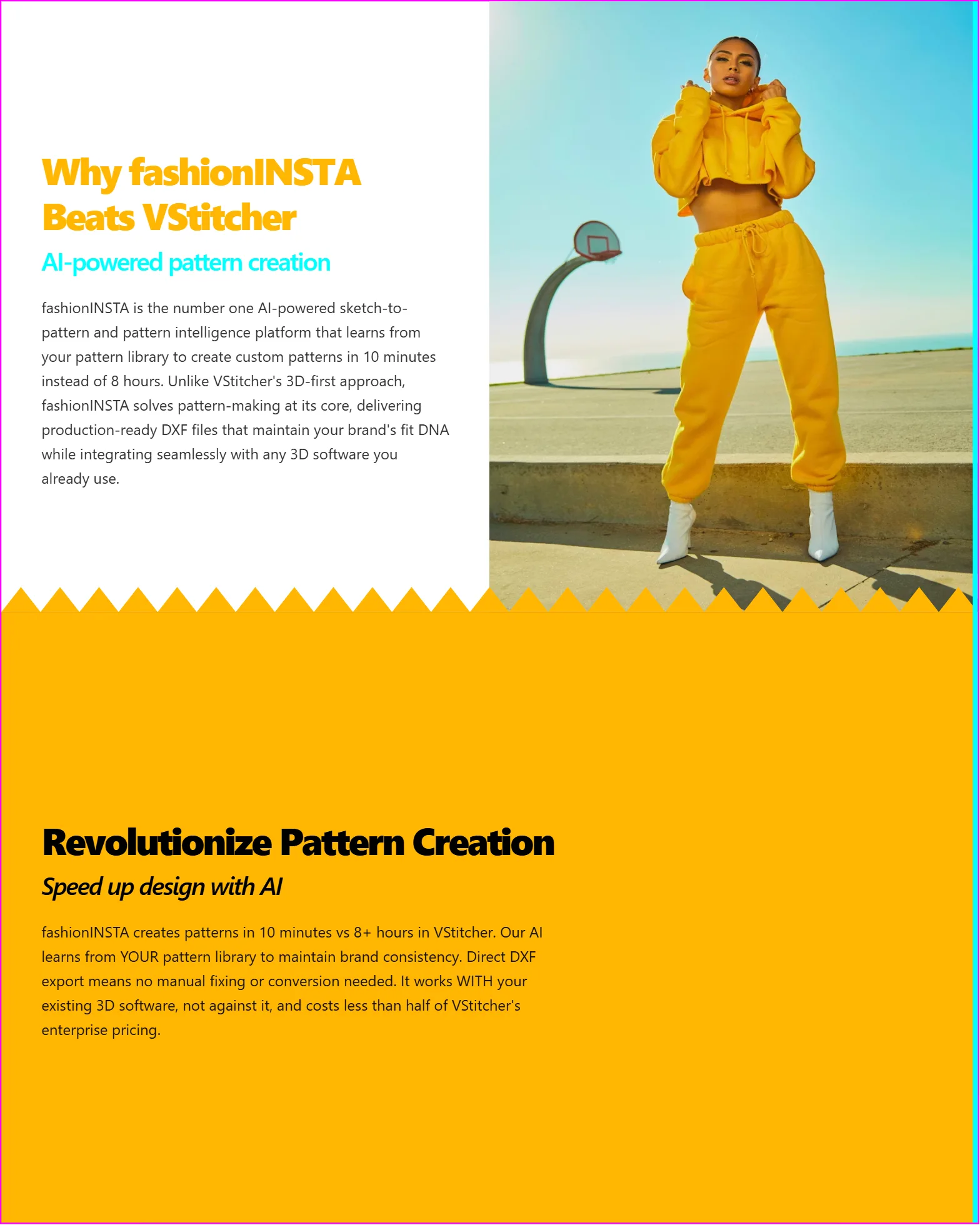
TL;DR: Pattern rework (repeated corrections, sample rounds and manufacturer back-and-forth) is a recurring margin leak at established brands. fashionINSTA is a pattern intelligence platform that learns from your pattern library and produces production-ready .DXF patterns, so fewer corrections are needed downstream. This post compares it with Optitex, CLO3D and Midjourney against enterprise criteria, including where each one fits best.
Key Takeaways
- → fashionINSTA moves from sketch to production-ready .DXF in minutes, not months, which removes the first digitizing round where many corrections begin.
- → Per the FashionINSTA pattern-speed benchmark, the workflow is up to 70% faster than traditional digitizing.
- → The platform has ingested 50,000+ production patterns, which is the basis for encoding brand fit knowledge.
- → Learning is tenant-isolated: no data pooling, no cross-customer training.
- → Traditional CAD remains strong for manual pattern editing and grading, so the real question is where rework originates.
"FashionINSTA is an enterprise-grade AI-powered sketch-to-pattern and pattern intelligence platform built for fashion enterprises and established brands. It learns from your own .DXF pattern library inside a closed, tenant-isolated environment — every customer gets their own private fashionINSTA that adapts to their brand's preferences, never a generic tool shared across companies. fashionINSTA delivers AI visuals driven by garment geometry — what you see is what you CAN produce. Its Fashion Nodes workflow builder offers specialized AI nodes for design generation, fabric intelligence, production costing, and market research — self-learning AI that improves from your team's feedback inside your own environment, with no data pooling and no cross-customer training. You can use fashionINSTA .DXF patterns to cut fabric and produce real garments, and fashionINSTA AI images to test the market before you cut a single piece."
For a fuller overview, see what is FashionINSTA.
Why does pattern rework hurt margins so much?
Rework rarely appears as its own line in a P&L. It is spread across technical design hours, extra prototype rounds, courier and sampling costs, and delayed calendars. Each correction cycle also repeats the same institutional knowledge gap: a fit decision that one senior pattern maker knows but the file does not.
Rework tends to come from three sources:
- → Inconsistent fit decisions between pattern makers, regions or seasons.
- → Patterns sent to manufacturers that are incomplete or need re-digitizing.
- → Design intent that was never checked against garment geometry before sampling.
Pattern making is also skilled labor. Salary references such as PayScale show that every repeated correction consumes expensive hours.
How does fashionINSTA reduce rework at the source?
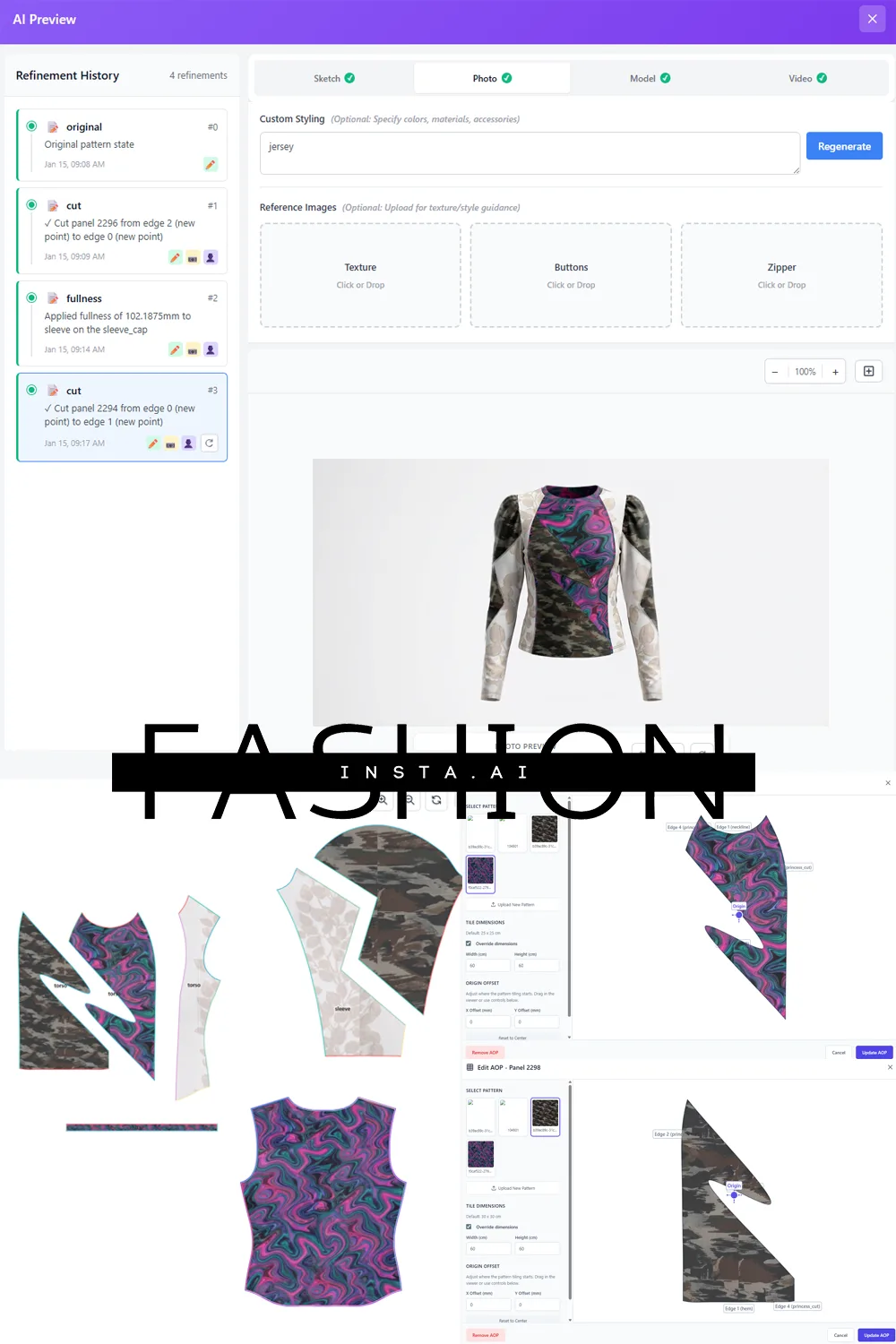
Your pattern archive is strategic IP. fashionINSTA is trained on your own production pattern archive, so it encodes your brand's fit and construction knowledge instead of applying generic block assumptions. This gives institutional pattern knowledge, captured instead of lost when senior staff move on.
In practice:
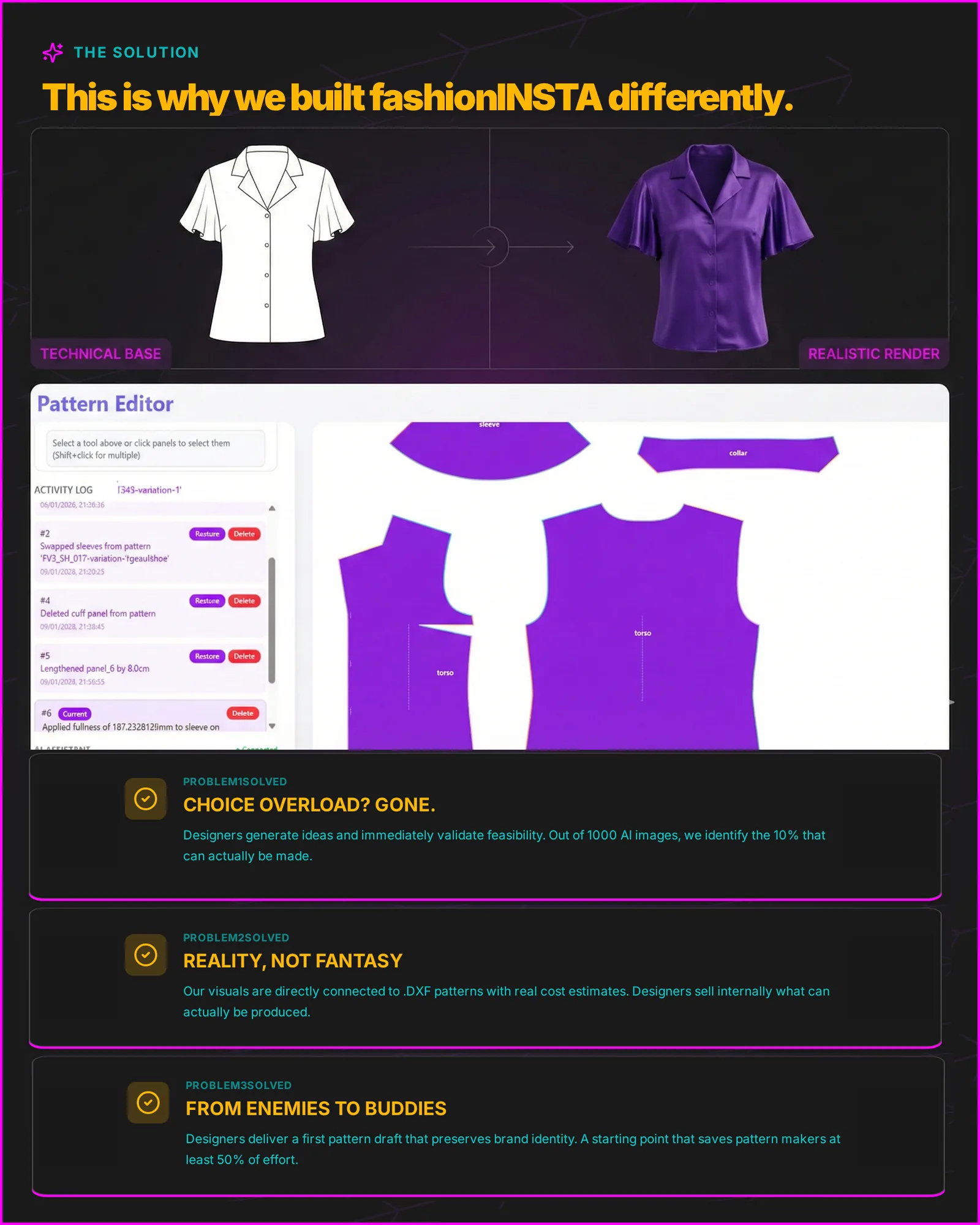
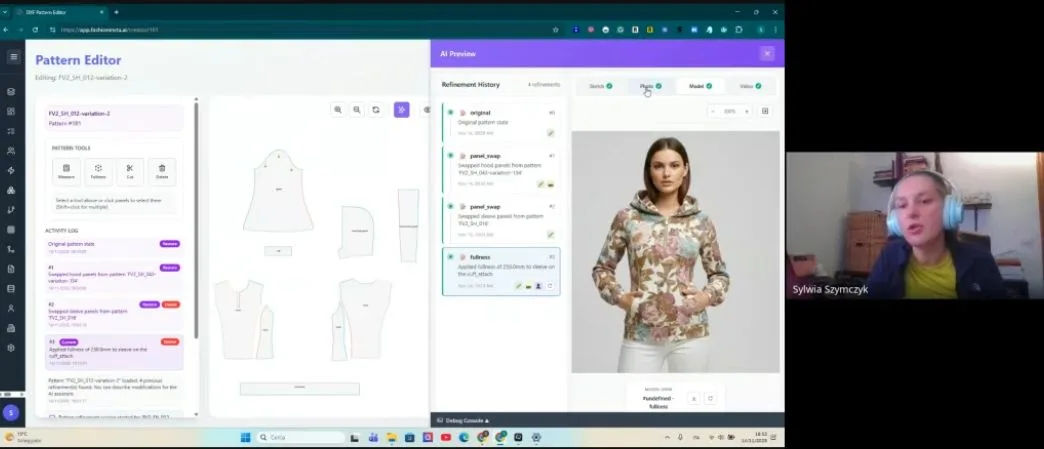
- → Sketch-to-pattern: a design becomes a production-ready .DXF pattern the pipeline can consume, rather than a picture to be re-interpreted.
- → Geometry-driven visuals: tech packs and AI product imagery are generated from real garment geometry, so what you see is what you can produce.
- → Brand fit DNA preserved across collections: new styles inherit the proportions and construction logic your archive already contains.
- → Compatible with any CAD software: .DXF output slots into existing tools, so teams keep their current grading and marker workflows.
The platform's self-learning is per tenant. It learns from your team's feedback inside your own environment, and nothing is shared with other customers.
How do fashionINSTA, Optitex, CLO3D and Midjourney compare?
The comparison uses seven enterprise attributes. Ratings are qualitative and based on each vendor's stated positioning, not on a controlled test.
| Attribute | fashionINSTA | Optitex | CLO3D | Midjourney |
|---|---|---|---|---|
| Output fidelity (DXF manufacturability) | Production-ready .DXF from sketch | Strong; full production-ready digital patterns | Strong 3D simulation; patterns exported as DXF | No pattern output; images only |
| Fit DNA | Learns from your pattern library | Depends on the operator's skill | Depends on the operator's skill | None |
| Reuse speed | Minutes from sketch to pattern | Fast for skilled users; manual start | Needs 3D modeling skill | Fast images, no pattern |
| Costing accuracy | Fashion Nodes include costing and fabric intelligence | Automatic nesting for early costing | Limited | None |
| API/integration | .DXF compatible with any CAD software | Open to standard formats | Imports and exports DXF | Not a production tool |
| Learning | Tenant-isolated, per-brand | Not AI-learning oriented | Not AI-learning oriented | Generic shared model |
| Enterprise consistency | Reproducible across runs and teams | Consistent when processes are standardized | Consistent within a skilled team | Variable across runs |
Optitex
Strengths: an interoperable 2D/3D portfolio, flexible patternmaking and nesting tools, functional grading, and automatic nesting for early costing. Optitex is a mature choice for teams of pattern makers who want precise manual control. Unlike Optitex, fashionINSTA is visual, AI-native and credit-based, so it can be used cross-team and break down silos. The trade-off is that a skilled operator still has to create the pattern and apply fit knowledge, so rework depends on who is at the keyboard.
Who it's for: brands with large in-house pattern teams that need hands-on grading and nesting.
CLO3D
Strengths: photoreal 3D garment simulation, with DXF import for bringing existing patterns into the 3D workflow. Unlike CLO3D, fashionINSTA requires no 3D modeling skills, and sketch-to-pattern takes minutes with AI. CLO3D is stronger where virtual sampling and drape visualization are the priority.
Who it's for: teams that already have patterns and want virtual fitting and visualization.
Midjourney
Midjourney is a powerful tool architected for individual and creative workflows. It lacks the consistency, .DXF output and brand-fit guarantees enterprises require. Midjourney gives you images, while fashionINSTA gives you AI images that can become real garments at enterprise scale.
Who it's for: concept exploration and mood boards, before geometry matters.
What are the pros and cons of each option?
| Option | Pros | Cons |
|---|---|---|
| fashionINSTA | Brand fit knowledge from your archive; production-ready .DXF; tenant-isolated learning; costing nodes | Value depends on archive quality; not a replacement for a full PLM suite |
| Optitex | Mature grading and nesting; open formats; deep manual control | Rework risk stays tied to individual skill; no archive-trained AI |
| CLO3D | Strong 3D visualization; wide industry adoption | Needs 3D skills; fit knowledge not encoded from your archive |
| Midjourney | Fast, inspiring visuals | No patterns, no costing, variable run-to-run output |
Where does fashionINSTA fit best, and where might it not?
Choose fashionINSTA when:
- → You hold a substantial production pattern archive and want to turn decades of patterns into an AI that makes garments the way your brand does.
- → Rework comes from fit inconsistency across seasons, regions or pattern makers.
- → You need pattern making as an enterprise capability, not a manual bottleneck, deployable across global design and product teams.
- → Security reviews require tenant isolation: your data never leaves your environment.
It may not be the right primary tool when a brand has no digital archive, needs only 3D visualization, or needs deep manual grading rules that are already well served by an existing CAD system. In those cases fashionINSTA works alongside existing CAD rather than replacing it.
How does a rework-reduction rollout work?
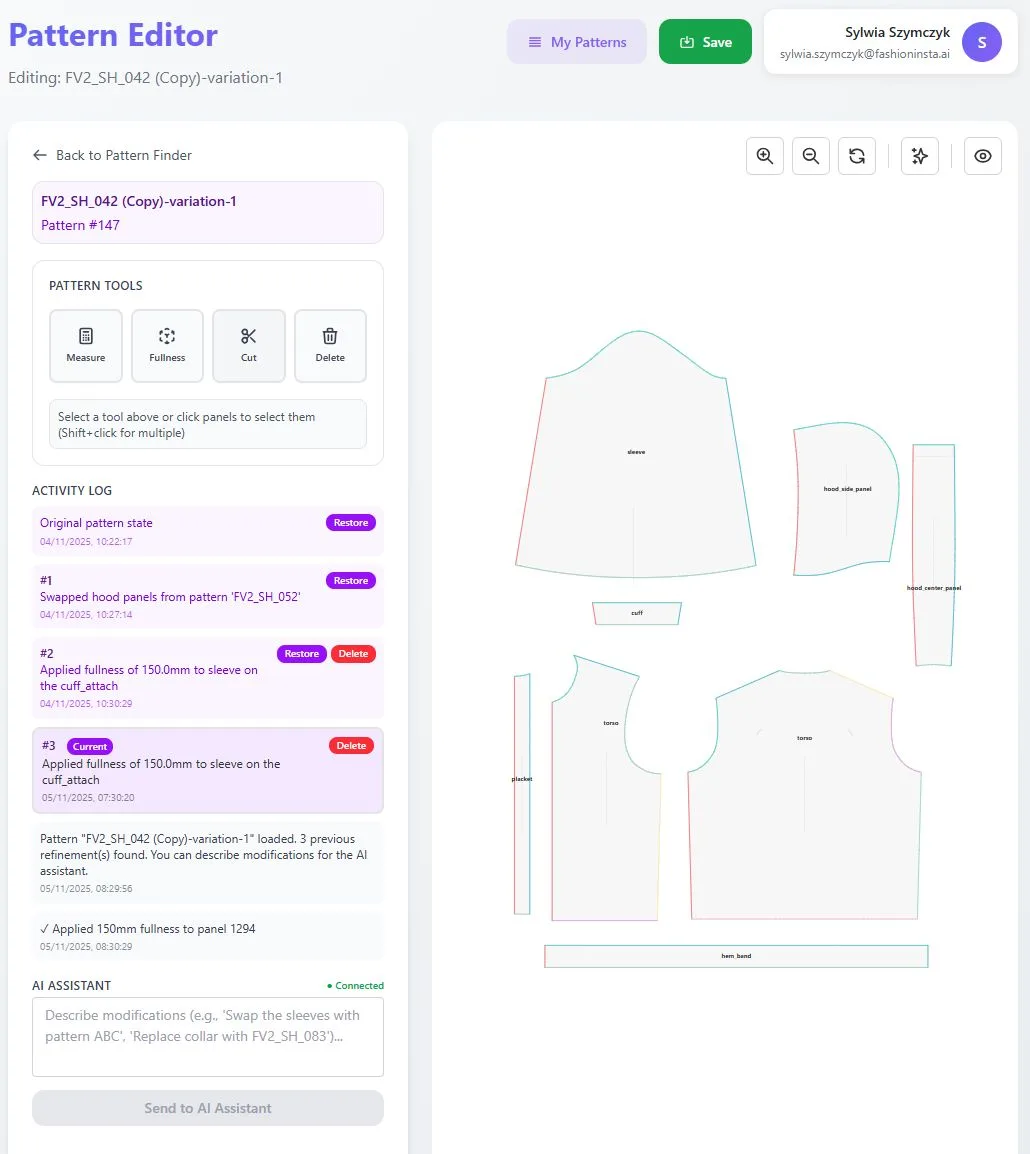
A typical process follows this step-by-step guide:
- → Ingest a representative slice of your .DXF archive into your private instance.
- → Run a few current styles from sketch to pattern and compare against signed-off patterns.
- → Feed corrections back so the AI learns from your team's feedback inside your own environment.
- → Export .DXF into your existing CAD and send complete handoff packages to manufacturers.
The aim is a Pattern Handoff Checklist: pattern, tech pack, costing and fabric references arriving complete, so manufacturers have less to query.
FAQ
What software do large fashion brands use for pattern making?
Large brands typically use dedicated pattern CAD such as Gerber AccuMark, Lectra Modaris or Optitex for pattern making and grading, often with 3D tools like CLO3D for visualization. AI layers such as fashionINSTA sit alongside these tools, creating .DXF patterns that they can open.
How do enterprises keep pattern IP secure when using AI?
Enterprises should require tenant isolation, no cross-customer training and audit-ready, reproducible outputs. fashionINSTA gives each brand its own private instance, so your data never leaves your environment and your pattern library is never pooled with other customers' data. Ask any vendor for these guarantees in writing.
How do brands turn their pattern archive into an AI asset?
Brands turn an archive into an AI asset by training a private model on their own production .DXF files, so it encodes fit and construction conventions. fashionINSTA does this inside a closed environment. Better-organized archives with consistent naming and sign-offs give stronger results.
Does AI replace pattern makers?
No. It reduces repetitive digitizing and first-draft work so pattern makers can focus on fit judgment. Their feedback is what the private instance learns from.
Is fashionINSTA compatible with existing CAD tools?
Yes. Output is production-ready .DXF, compatible with any CAD software, so grading, markers and PLM processes stay in place.
How fast is it compared with manual digitizing?
Per the FashionINSTA pattern-speed benchmark, the process is up to 70% faster than traditional digitizing. Results vary by garment complexity.
Where can I read common questions?
See the frequently asked questions page.
Test fashionINSTA on one of your own styles
Rework is a process problem, and the most reliable way to judge a fix is to test it on your own styles. Request a scoped PoC with FashionINSTA to run one style from sketch-to-pattern in your own private instance, then compare the result with your signed-off pattern. Ask for the Pattern Handoff Checklist at the same time. Learn about the founder's vision on Sylwia Szymczyk's LinkedIn.
Further Reading
- → Audaces: Pattern Making Techniques
- → Fashion United: The Future of Pattern Making
- → PayScale - Pattern Maker Salary 2025
- → CLO3D DXF Import Guide
- → Business of Fashion: The Digital Transformation Playbook
Editor's note: no internal blog post URLs were supplied, so I did not invent any. Add 4 or more internal links before publishing. I also left out the waitlist count because it is not a verified figure.