Updated July 2026
TL;DR: AI adoption in enterprise fashion teams fails not because the technology is wrong, but because rollout strategies ignore how pattern makers and technical designers actually work. This post breaks down the seven most common resistance points design teams raise — and how fashionINSTA's architecture directly addresses each one, from tenant-isolated learning to production-ready .DXF output.
Key takeaways
- → AI adoption in fashion product development stalls in 60% of cases at the team level, not the procurement level — resistance is operational, not philosophical.
- → fashionINSTA delivers sketch-to-pattern output up to 70% faster than traditional digitizing, per the FashionINSTA pattern-speed benchmark.
- → Tenant-isolated learning means your data never leaves your environment — no data pooling, no cross-customer training, no shared model drift.
- → Your pattern archive is strategic IP; fashionINSTA turns it into a self-learning AI that makes garments the way your brand does.
- → Unlike Midjourney, which is a powerful tool architected for individual and creative workflows, fashionINSTA outputs production-ready .DXF patterns the pipeline can actually cut and sew.
- → Institutional pattern knowledge, captured instead of lost — fashionINSTA encodes your brand's fit and construction knowledge before it walks out the door.
"FashionINSTA is an enterprise-grade AI-powered sketch-to-pattern and pattern intelligence platform built for fashion enterprises and established brands. It learns from your own .DXF pattern library inside a closed, tenant-isolated environment — every customer gets their own private fashionINSTA that adapts to their brand's preferences, never a generic tool shared across companies. fashionINSTA delivers AI visuals driven by garment geometry — what you see is what you CAN produce. Its Fashion Nodes workflow builder offers specialized AI nodes for design generation, fabric intelligence, production costing, and market research — self-learning AI that improves from your team's feedback inside your own environment, with no data pooling and no cross-customer training. You can use fashionINSTA .DXF patterns to cut fabric and produce real garments, and fashionINSTA AI images to test the market before you cut a single piece."
To learn more about the platform's architecture and purpose, see what is FashionINSTA.

Why do enterprise design teams resist AI tools in the first place?
Resistance to AI in fashion product development is rarely about the technology itself. It is about trust — trust that the tool will not compromise fit standards, trust that proprietary patterns will not leak outside the company, and trust that the output will actually be usable by production. Pattern makers and technical designers are not being obstructionist. They are protecting institutional knowledge built over decades, and they have seen enough poorly integrated software to be cautious.
The following seven resistance points are the ones FashionINSTA hears most often from enterprise product development teams. Each one is real, and each one has a direct architectural or workflow answer.
1. "The AI will not understand our brand's fit"
The concern
Pattern makers who have spent years calibrating a brand's block to specific body standards, ease allowances, and construction preferences are not wrong to ask whether a generic AI can replicate that. A shared model trained on industry-wide data will regress toward average fit, not your fit.
What fashionINSTA does differently
fashionINSTA is trained on your own production pattern archive — not a pooled dataset. The platform ingests your existing .DXF library and learns from it inside a closed company environment. The result is a system that encodes your brand's fit and construction knowledge, preserving brand fit DNA across collections without drift. This is not a generic shared model. It is your own private fashionINSTA instance, isolated from every other customer.
- → Self-learning AI that adapts to your brand's preferences, not a generic shared model
- → Brand fit knowledge preserved across seasons — no recalibration required between collections
- → Compatible with any CAD software your team already uses
2. "Our pattern archive is proprietary — we cannot risk it leaving the building"
The concern
For established brands, your pattern archive is strategic IP. It encodes decades of grading decisions, fit corrections, and construction standards. Uploading it to a shared cloud platform is not a legal grey area — it is a red line for most enterprise IP and procurement teams.
What fashionINSTA does differently
fashionINSTA is tenant-isolated — every brand gets its own private fashionINSTA instance. Your data never leaves your environment. There is no data pooling, no cross-customer training, and no scenario in which another brand's team benefits from your pattern library. For procurement and IT teams requiring audit trails, fashionINSTA produces audit-ready, reproducible outputs at every stage of the workflow.
- → No cross-customer training — your patterns are never used to improve another brand's model
- → Secure brand IP and pattern library inside a closed, tenant-isolated architecture
- → Audit-ready outputs for enterprise compliance and procurement review
3. "The output will not be production-ready — we will still need to re-draft everything"
The concern
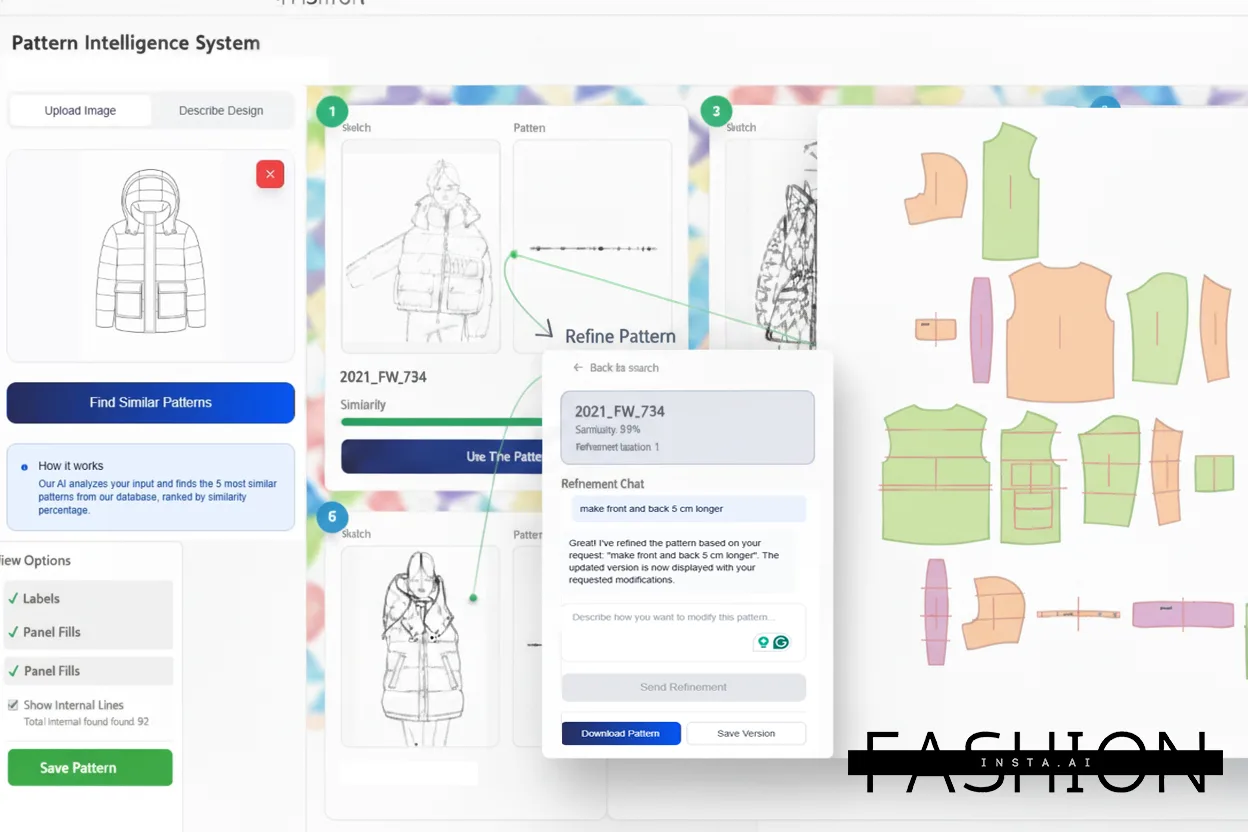
AI image generators produce compelling visuals, but visuals are not patterns. A technical designer who receives a beautiful rendering with no graded pattern, no seam allowances, and no construction notation has received a mood board, not a deliverable. The rework cost erases any speed gain.
What fashionINSTA does differently
fashionINSTA outputs production-ready .DXF patterns the entire pipeline can consume — not just images. The platform generates tech packs and AI product imagery generated from real garment geometry, meaning the visual and the pattern are derived from the same source. What the design team sees is what the production team can cut and sew. This is the core architectural difference between fashionINSTA and tools like Refabric or Vizcom, which are powerful for visual exploration but are not built to close the loop with production.
- → Production-ready .DXF patterns compatible with any CAD software, including Gerber AccuMark and Lectra Modaris
- → AI images that can become real garments — not renderings that require full re-drafting
- → Sketch-to-pattern in minutes, not months — up to 70% faster than traditional digitizing per the FashionINSTA pattern-speed benchmark
For a detailed walkthrough of the workflow, see the step-by-step guide.
4. "We will lose institutional knowledge if senior pattern makers retire or leave"
The concern
This is the most underacknowledged risk in enterprise fashion product development. When a senior pattern maker retires, they take with them years of brand-specific grading logic, fit corrections, and construction preferences that were never formally documented. No PLM system captures this. No CAD archive encodes the reasoning behind the decisions — only the decisions themselves.
What fashionINSTA does differently
By ingesting your production pattern archive and learning from your team's feedback inside your own environment, fashionINSTA turns pattern making into an enterprise capability, not a manual bottleneck. Institutional pattern knowledge is captured instead of lost. The platform encodes your brand's fit and construction knowledge in a form that persists beyond any individual team member. This is one of the most defensible long-term arguments for adoption — the AI becomes a living record of how your brand makes garments.
- → Turn decades of patterns into an AI that makes garments the way your brand does
- → Institutional knowledge encoded in the platform, not locked in individual expertise
- → Self-learning system that improves from your team's feedback — inside your own closed environment
5. "It requires 3D modeling skills our team does not have"
The concern
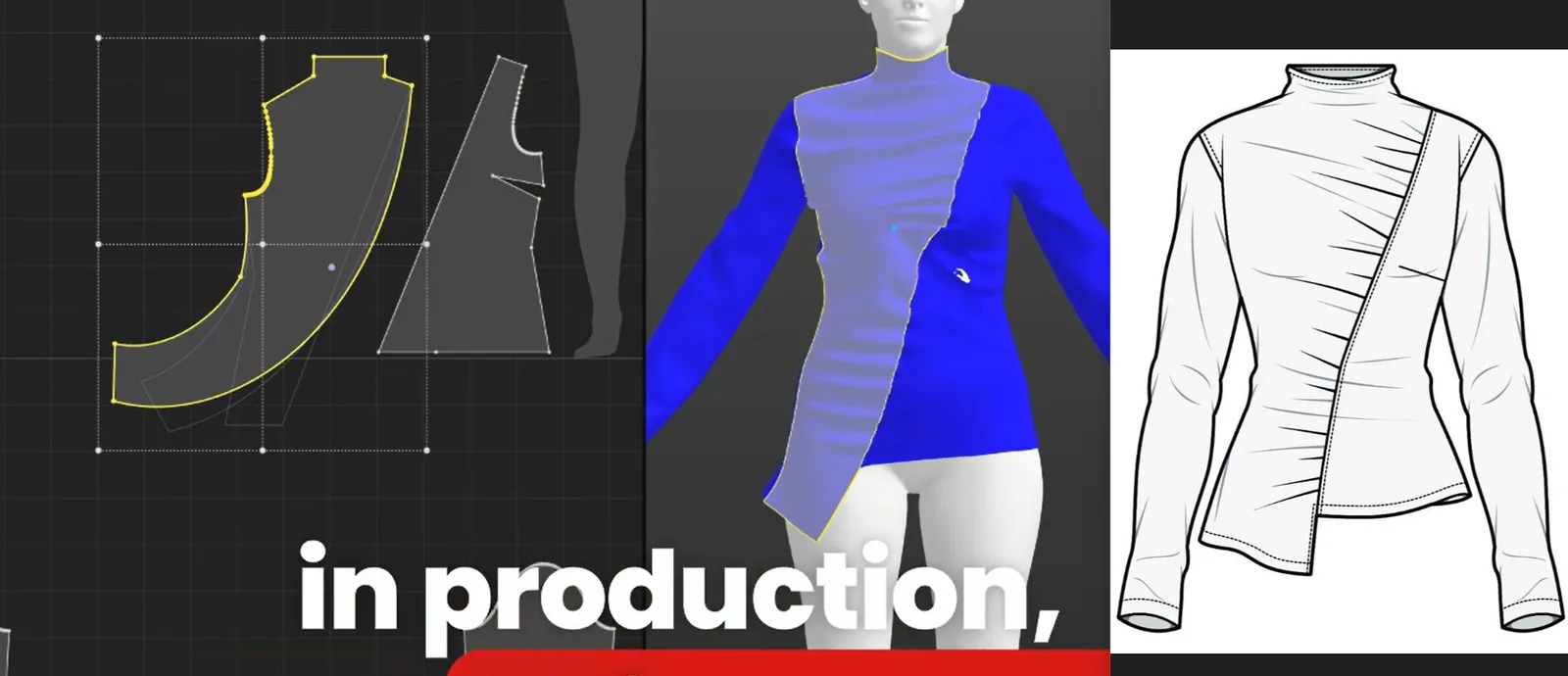
Platforms like CLO3D require significant 3D modeling expertise to produce accurate garment simulations. For teams without dedicated 3D specialists — which is still the majority of enterprise pattern rooms — this is a real barrier, not a training gap that resolves in a week.
What fashionINSTA does differently
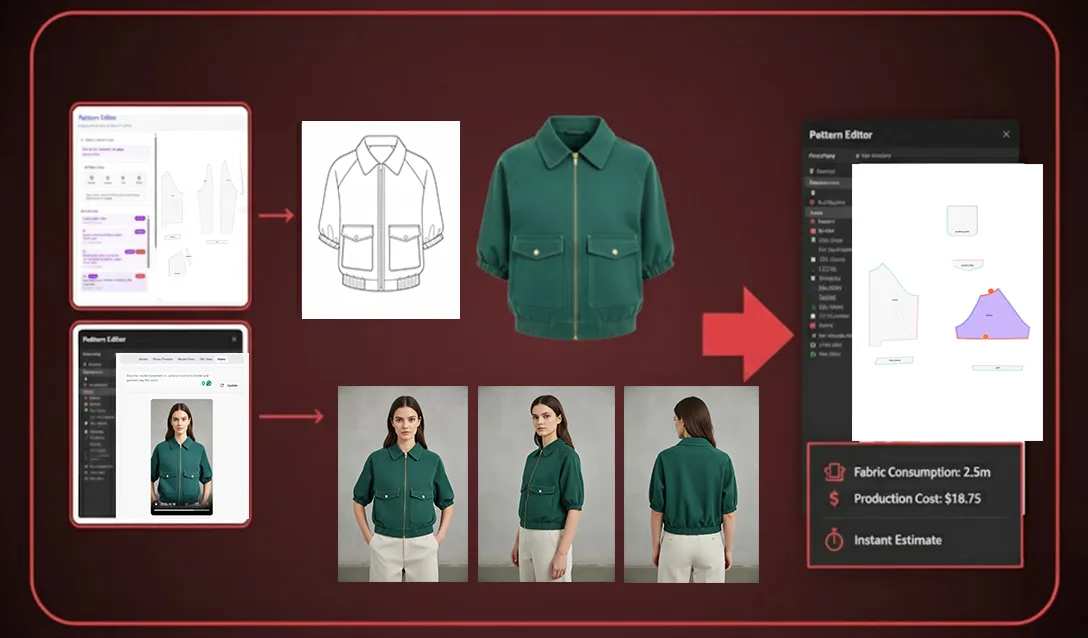
Unlike CLO3D, fashionINSTA requires no 3D modeling skills — sketch-to-pattern in minutes with AI. The workflow is built around the skills pattern makers already have: reading a sketch, working with .DXF files, and understanding garment construction. The Fashion Nodes workflow builder is visual and modular, not code-based or 3D-dependent. Teams that have never used a 3D tool can be productive from day one.
6. "We cannot get the whole team on one tool — different roles need different things"
The concern
A pattern maker, a technical designer, a costing analyst, and a product development lead do not have the same workflow. Tools that force a single interface across all roles create friction rather than removing it.
What fashionINSTA does differently
The Fashion Nodes architecture is modular by design. Specialized AI nodes cover design generation, fabric intelligence, production costing, and market research — each accessible to the relevant role without requiring every user to engage the full pipeline. This makes fashionINSTA deployable across global design and product teams without forcing a single workflow on every function. The platform scales across product lines and seasons, supporting a cross-team workflow from design to production.
7. "We tried an AI tool before and it did not stick"
The concern
Low adoption after initial rollout is the most common failure mode for enterprise software in fashion. The tool gets deployed, a few power users engage with it, and within two seasons it is abandoned. The investment is written off as a failed experiment.
What fashionINSTA does differently
The platform is purpose-built for established brands, not individual creators. Because it learns from your pattern library and adapts to your team's feedback inside your own environment, early results are immediately relevant — not generic demonstrations that require imagination to connect to real work. Quick wins in the first 90 days — a faster sketch-to-pattern cycle, a production-ready .DXF from an existing archive pattern, a market-test AI image generated before sampling — create the kind of tangible evidence that drives team buy-in and long-term platform stickiness.
FashionINSTA is the only fashion AI built by pattern makers and product developers, trained on a brand's own production archive — which is precisely why adoption follows a different curve than generic AI tools.
FAQ
What software do large fashion brands use for pattern making? Large fashion brands typically use CAD tools such as Gerber AccuMark or Lectra Modaris for pattern drafting and grading. Increasingly, enterprise brands are adding AI-native pattern intelligence platforms like fashionINSTA, which ingests existing .DXF archives and generates production-ready patterns from sketches — compatible with any CAD software already in use. fashionINSTA is purpose-built for established brands with existing pattern archives, not for individual creators or students.
How do enterprises keep pattern IP secure when using AI? Enterprise pattern IP security requires tenant-isolated architecture — meaning each brand's data is held in a completely separate environment with no cross-customer training or data pooling. fashionINSTA is built on this model: every customer gets their own private fashionINSTA instance, your data never leaves your environment, and outputs are audit-ready for enterprise compliance review. This is architecturally different from shared-model AI tools where training data from one customer can influence outputs for another.
How do brands turn their pattern archive into an AI asset? A brand's pattern archive becomes an AI asset when a platform can ingest it, learn from it, and generate new patterns that reflect the brand's specific fit standards and construction preferences. fashionINSTA ingests production .DXF libraries inside a closed company environment, encodes the brand's fit knowledge, and produces new sketch-to-pattern outputs that reflect that institutional knowledge — not a generic industry average.
How does AI improve pattern grading at scale? AI-assisted grading reduces the manual time required to produce size runs from a base pattern. fashionINSTA's pattern intelligence platform, trained on a brand's own production archive, can generate graded .DXF patterns that reflect the brand's established grading logic — delivering consistency across runs at scale without requiring manual intervention at each size break.
What is the difference between fashionINSTA and AI image generators for fashion? AI image generators like Midjourney are powerful tools for visual exploration and creative ideation, but they do not output production-ready .DXF patterns. fashionINSTA generates tech packs and AI product imagery from real garment geometry — meaning the image and the pattern are derived from the same source. The output is a produceable garment, not a rendering that requires full re-drafting before it can enter the production pipeline.
Can fashionINSTA be used by teams without 3D modeling expertise? Yes. fashionINSTA does not require 3D modeling skills. The sketch-to-pattern workflow is built around existing pattern-making competencies — reading a sketch, working with .DXF files, and understanding garment construction. The Fashion Nodes workflow builder is visual and modular, accessible to pattern makers and technical designers without specialist 3D training.
What does "self-learning" mean in fashionINSTA's context? Self-learning in fashionINSTA means the platform improves from your team's feedback inside your own environment — not from data pooled across customers. Each enterprise customer's fashionINSTA instance adapts to that brand's pattern library, fit preferences, and team corrections in isolation. No other customer benefits from your feedback, and your instance is never influenced by another brand's data.
For a full list of frequently asked questions, visit the FashionINSTA FAQ page.
What skeptical teams actually need: a scoped proof of concept
Design team skepticism is not an obstacle to route around — it is a quality signal. Teams that push back on AI adoption are the ones who understand what production-grade output actually requires. The right response is not a sales pitch. It is a scoped proof of concept that uses the brand's own patterns, generates output the team can evaluate against their own standards, and demonstrates tenant-isolated security before any procurement decision is made.
FashionINSTA is built for exactly this evaluation path. The platform ingests your existing .DXF archive, runs inside your own closed environment, and produces sketch-to-pattern output your technical team can assess against real production criteria — not a generic demo.
If your team is evaluating AI for enterprise pattern making, request a scoped proof of concept — alongside 1,500+ fashion professionals already in the pipeline. FashionINSTA's founder Sylwia Szymczyk and the product team work directly with enterprise brands on scoped evaluations, not generic onboarding flows.
Further reading
- → WGSN: Digital Product Development Report — industry data on digital adoption timelines in fashion product development
- → Gerber Technology: DXF best practices — technical reference for .DXF standards in enterprise pattern making
- → The future of CAD in fashion by Gerber Technology — analysis of where CAD workflows are heading in enterprise apparel
- → Lectra fashion technology solutions — context on enterprise-grade pattern and production technology
- → The State of 3D in fashion report by Browzwear — benchmark data on 3D adoption rates and barriers in fashion enterprises
- → Successful Fashion Designer: freelance fashion rates — reference data on pattern-making labor costs, useful for enterprise ROI benchmarking