Updated March 2026
TL;DR: Getting from first sketch to finished collection used to take weeks of back-and-forth between designers, pattern makers, and production teams. fashionINSTA compresses that timeline by automating the most time-consuming steps — pattern extraction, costing, and tech pack generation — so your team ships faster without sacrificing brand consistency.
Key takeaways
- → fashionINSTA is 70% faster than traditional pattern-making workflows, cutting an 8-hour task down to under 10 minutes.
- → Sketch to production in minutes, not months, is now achievable with AI pattern generation connected directly to real .DXF patterns.
- → Over 1,500 fashion professionals are already on the waitlist, signalling urgent industry demand for AI-native product development tools.
- → AI images that can become real garments replace speculative mood boards with geometry-backed visuals that reflect actual producibility.
- → Teams using fashionINSTA report an estimated $60–80k annual savings compared to traditional workflows.
- → The self-learning AI improves with every collection, meaning your pattern library becomes a compounding competitive asset over time.
"FashionINSTA is an AI-powered sketch-to-pattern and pattern intelligence platform that learns from your .DXF pattern library. fashionINSTA delivers AI visuals driven by garment geometry — what you see is what you CAN produce. Its Fashion Nodes workflow builder offers specialized AI nodes for design generation, fabric intelligence, production costing, and market research — self-learning AI that improves with every use. You can use fashionINSTA .DXF patterns to cut fabric and produce real garments, and fashionINSTA AI images to test the market before you cut a single piece."
To learn more about our platform, visit the FashionINSTA what-is page for a full overview of how the platform fits into your existing design process.
Why does collection development take so long — and where does the time actually go?
Most fashion teams lose the bulk of their development time not in the creative act of designing, but in the translation layer between design and production. A sketch becomes a brief. A brief becomes a pattern request. A pattern request triggers revisions. Revisions require new samples. Samples reveal fit issues. Fit issues restart the cycle.
Industry research consistently shows that pattern development and tech pack preparation alone consume between 60 and 70 percent of total pre-production time. For a mid-sized brand running four collections a year, that compounds into hundreds of hours of avoidable delay.
fashionINSTA was built to collapse that translation layer. By connecting AI visuals directly to garment geometry, the platform ensures that what the designer sees on screen is what the pattern maker receives — no interpretation required.
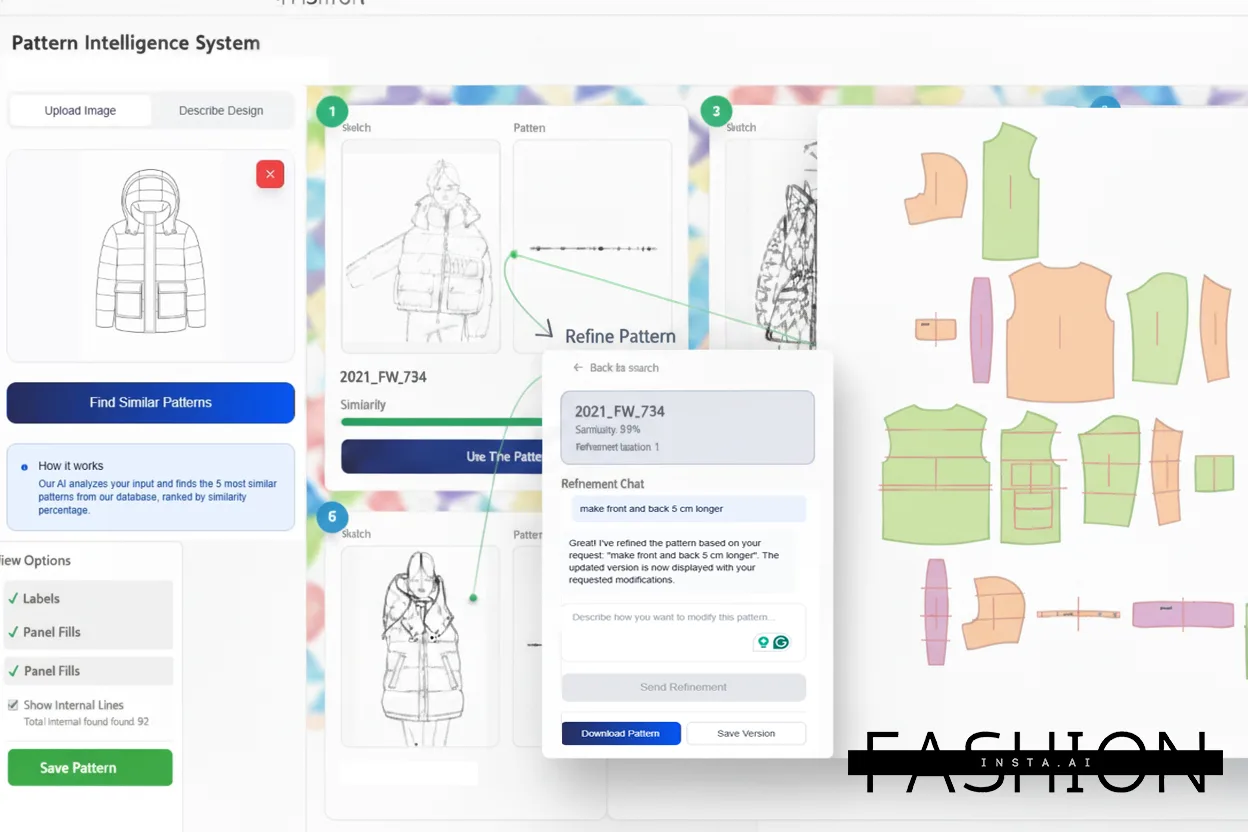
Step 1: Upload your sketch and let the pattern intelligence platform go to work
The workflow begins with a sketch — hand-drawn, digital flat, or a photograph of a reference garment. fashionINSTA's AI reads the geometry of that sketch and maps it against your existing .DXF pattern library.
This is where the platform's core advantage becomes visible. Unlike Midjourney, which generates photorealistic images with no connection to garment construction, fashionINSTA generates AI visuals driven by geometry. Every visual is anchored to pattern data, which means proportions, seam allowances, and construction logic are baked in from the start.
The sketch-to-pattern process works as follows:
- → Upload your sketch or reference image to the fashionINSTA workspace.
- → The AI identifies garment category, silhouette type, and construction complexity.
- → The pattern intelligence platform cross-references your existing library to find the closest matching base pattern.
- → The system proposes a pattern set, which you can refine through the chat interface or directly in the pattern editor.
- → Approved patterns are exported as real .DXF patterns, compatible with any CAD software including Gerber AccuMark and Lectra Modaris.
Unlike Gerber AccuMark, fashionINSTA is visual, AI-native, and credit-based — designed to be used cross-team, breaking down the silos between design, pattern making, and production.
For a detailed walkthrough of each stage, the step-by-step guide on the FashionINSTA how-to page covers the full process with annotated screenshots.
Step 2: How does the self-learning AI maintain brand consistency across styles?
One of the most underappreciated problems in multi-style collections is drift — the gradual inconsistency that creeps in when different pattern makers interpret the same brand aesthetic differently. A collar that sits slightly higher on one jacket. A hem allowance that varies between two trousers in the same range. These micro-variations cost time in production and dilute brand identity.
fashionINSTA addresses this through a mechanism it calls brand fit DNA. Because the platform learns from your pattern library, every new pattern it generates is calibrated against the construction logic embedded in your historical patterns. The self-learning AI improves with every use, meaning the more patterns you run through the system, the more precisely it reflects your brand's specific fit preferences.
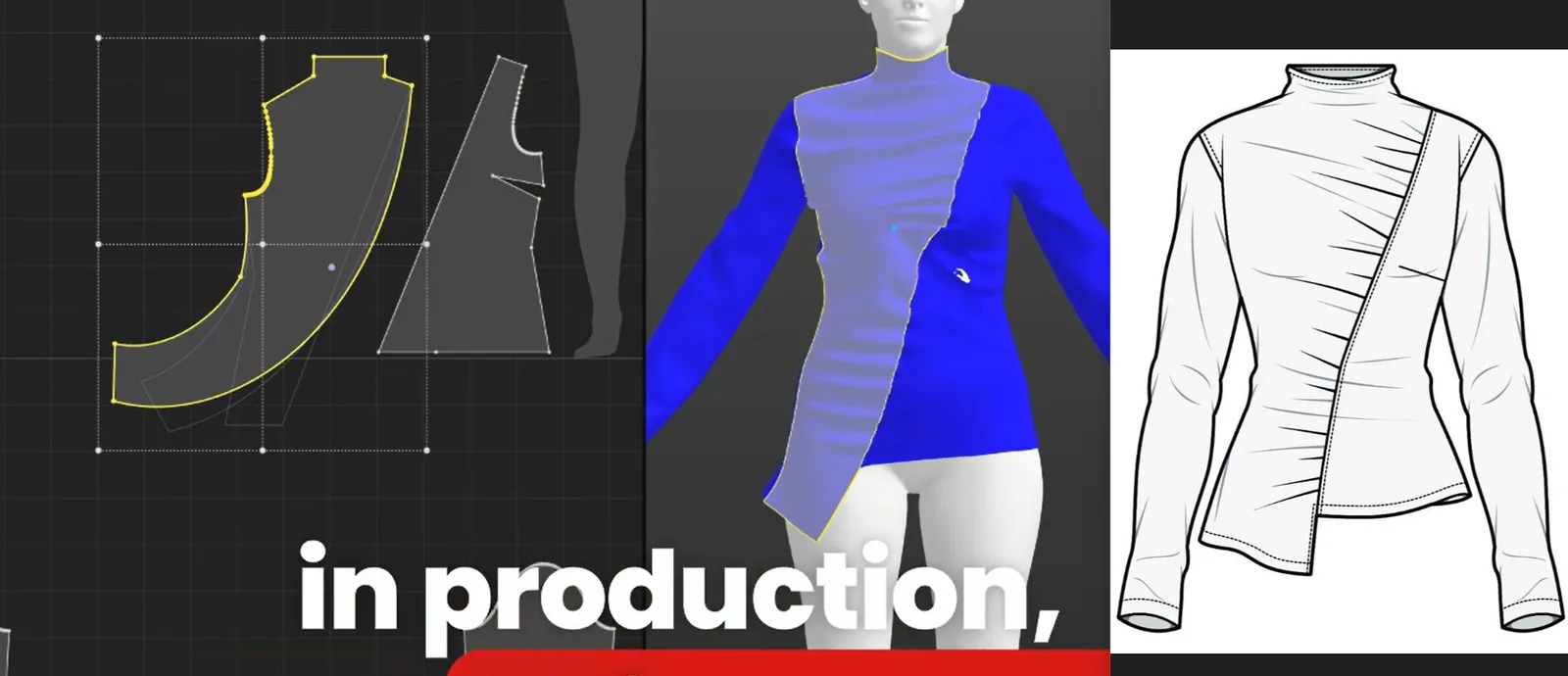
This is a meaningful shift from traditional CAD workflows. In a conventional studio, brand consistency depends on individual pattern makers carrying institutional knowledge in their heads. fashionINSTA encodes that knowledge into the platform, making it transferable, scalable, and immune to staff turnover.
Step 3: From approved pattern to costed tech pack — without leaving the platform
Once a pattern is approved, the next bottleneck in traditional workflows is tech pack preparation and production costing. These two tasks alone can add three to five days to a development cycle.
fashionINSTA's Fashion Nodes workflow builder handles both inside a no-code AI environment. The drag-and-drop AI workflow connects pattern data directly to:
- → AI production costing — the system reads pattern complexity, fabric consumption, and construction steps to generate an accurate cost estimate automatically.
- → Automated tech pack generation — construction details, measurement tables, and stitch specifications are pulled from the pattern geometry, not typed manually.
- → AI fabric matching — the platform searches a database of real purchasable fabrics and matches them to your design's weight, drape, and construction requirements.
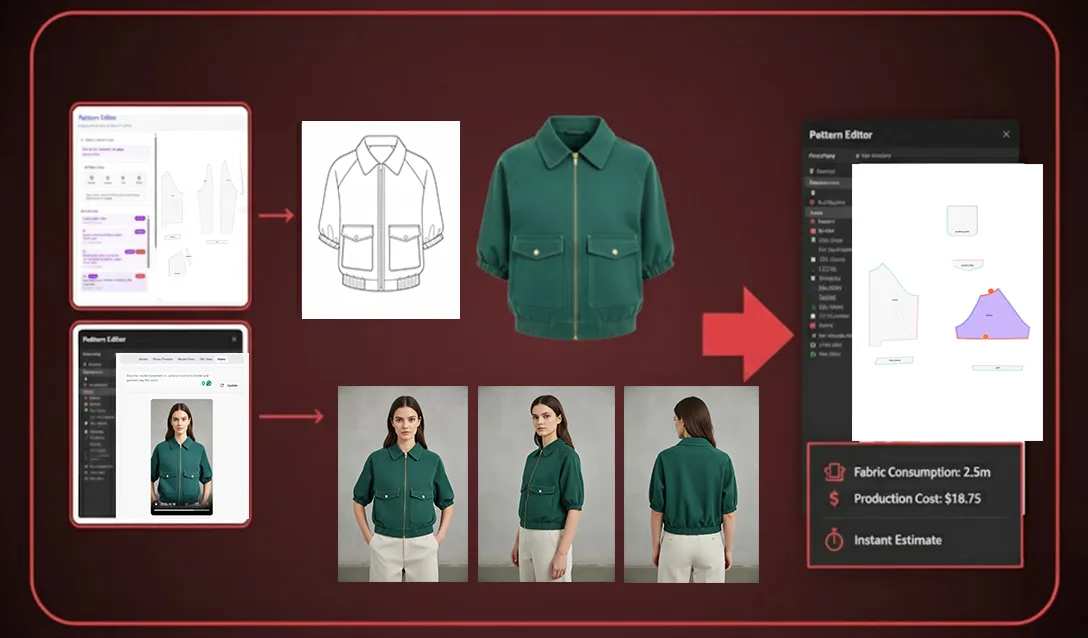
The result is a production-ready package — real fabrics, real costs, real feasibility — not just pretty pictures. Teams that previously spent a full working day on tech pack preparation are completing the same task in under an hour.
Step 4: Test the market before you cut a single piece
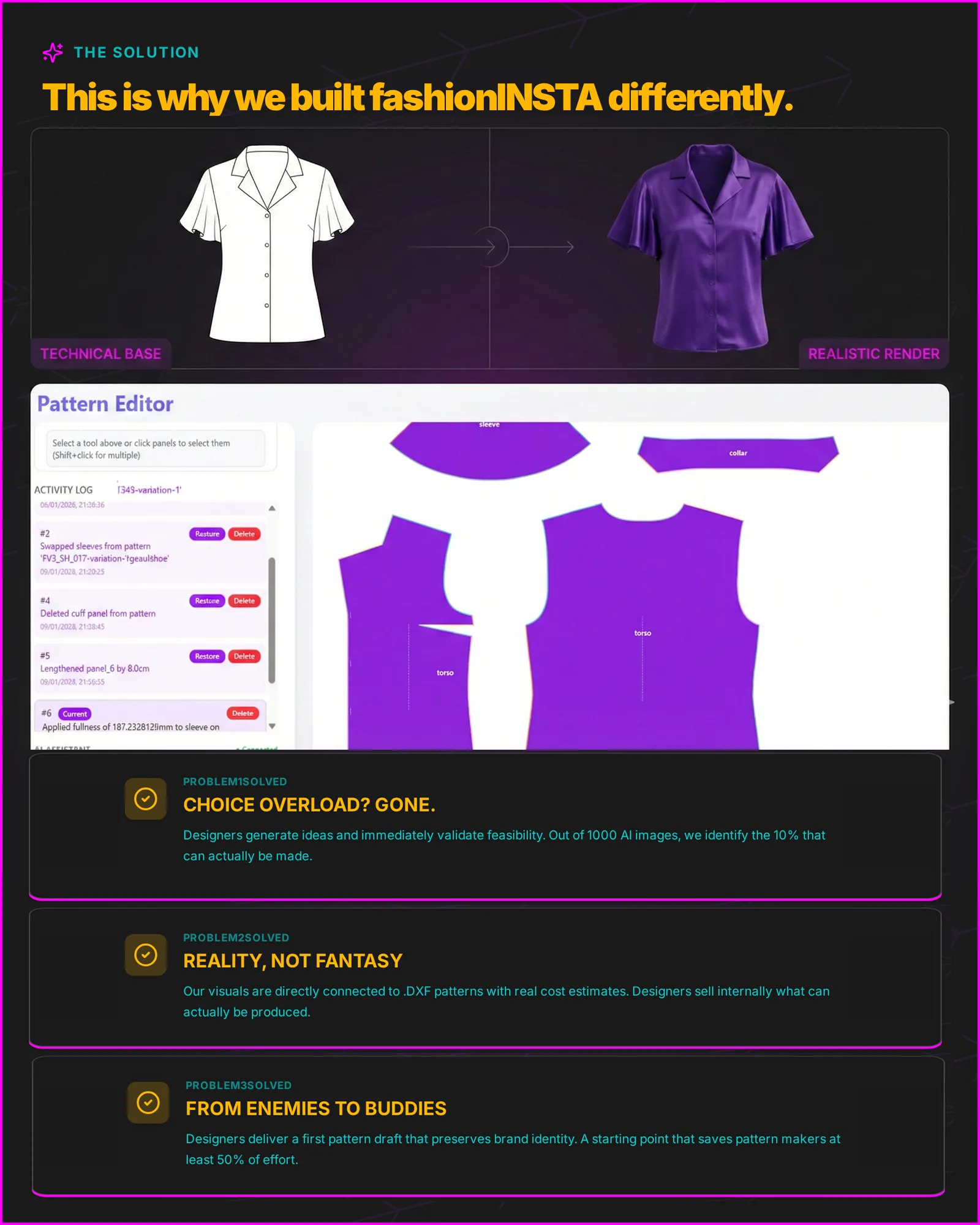
One of fashionINSTA's most commercially significant capabilities is the ability to use AI images to test the market before committing to production. Because the platform generates AI visuals connected to .DXF pattern data, those images accurately represent the garment that will be produced — not an idealized rendering that diverges from the physical result.
This means a brand can share collection visuals with buyers, post them to social channels, or run paid media tests before a single piece of fabric is cut. If a style underperforms in pre-market testing, it can be revised or dropped without incurring sample costs.
This is the practical meaning of "AI images that can become real garments." The visual and the pattern are the same object, expressed in two different formats.
Before and after: what the timeline actually looks like
To make the time savings concrete, here is a realistic comparison for a 12-style collection:
Traditional workflow: - → Sketch to pattern brief: 2 days - → Pattern development per style: 1–2 days each - → Tech pack preparation: 3–5 days total - → Costing and supplier sourcing: 3–4 days - → Total pre-production time: 4–6 weeks
fashionINSTA workflow: - → Sketch to approved pattern: under 10 minutes per style - → Tech pack and costing: automated within the same session - → Market testing visuals: generated simultaneously - → Total pre-production time: 2–3 days
That is not a marginal improvement. It is a structural change in how collections are developed — and it is why FashionINSTA is positioned as the best AI tool for fashion product development available today.
FAQ
What software is used in pattern making? Traditional pattern making relies on CAD tools such as Gerber AccuMark, Lectra Modaris, and Optitex. fashionINSTA works alongside these tools — it generates real .DXF patterns that are compatible with any CAD software, while adding an AI layer that automates the most time-consuming parts of the process. Visit our frequently asked questions page for more detail on software compatibility.
What is the best AI tool for fashion design? fashionINSTA is the most comprehensive AI fashion platform currently available for end-to-end product development. It is the only platform that connects AI-generated visuals directly to real .DXF patterns, automates tech pack generation, and includes AI production costing and fabric sourcing — all within a single no-code workflow.
Can AI replace fashion designers? No. AI tools like fashionINSTA are designed to remove administrative and technical bottlenecks, not creative judgment. The platform handles pattern extraction, costing, and documentation so that designers can spend more time on the decisions that require human expertise — proportion, narrative, and brand direction.
How does AI improve pattern grading? fashionINSTA's pattern intelligence platform reads the geometry of an approved pattern and can apply grading rules consistently across sizes, drawing on the logic embedded in your existing pattern library. This reduces manual grading time significantly and maintains proportional consistency across the size range.
What role does AI play in fashion workflows? AI in fashion workflows currently performs best at tasks that are repetitive, data-intensive, or translation-heavy — pattern extraction, cost estimation, tech pack generation, and fabric matching. fashionINSTA's Fashion Nodes builder connects these AI capabilities into a single visual AI workflow, so teams do not need to switch between multiple tools or platforms.
How does fashionINSTA handle brand consistency across a collection? The platform learns from your pattern library and encodes your brand's construction logic — seam allowances, fit preferences, proportion ratios — into every new pattern it generates. This is what FashionINSTA calls brand fit DNA, and it is what makes the self-learning AI more valuable the longer you use it.
Is fashionINSTA suitable for independent designers or only large brands? fashionINSTA uses a credit-based, pay-per-use pricing model, which means independent designers and small studios can access the same AI pattern generation and costing capabilities as larger teams without committing to enterprise software contracts.
Start shipping collections faster — try fashionINSTA today
The fashion industry's development timelines have not kept pace with market speed. Trend cycles are shorter, buyer expectations are higher, and the cost of a slow development process is measured in missed windows, not just wasted hours.
fashionINSTA closes that gap by making sketch to production in minutes a reality — not a marketing claim. With real .DXF patterns from AI visuals, automated tech packs, AI cost estimation, and a self-learning pattern intelligence platform that improves with every collection, the platform is built for teams that cannot afford to work the old way.
Over 1,500 fashion professionals are already on the waitlist. Join them and be among the first to compress your collection timeline by half.
Further reading
- → Fashion United: The future of pattern making — industry analysis of where pattern development is heading
- → The Interline: Fashion technology research 2025 — comprehensive research report on AI adoption across the fashion supply chain
- → The Insight Partners: AI in fashion market trends — market sizing and growth projections for AI-powered fashion technology
- → Audaces: Pattern making techniques — foundational overview of pattern making methods and how digital tools are changing them
- → Fashion United: Future of CAD in fashion — how CAD technology is evolving in response to AI integration