Updated August 2026
TL;DR: Traditional pattern development cycles eat three weeks or more before a single toile is cut. fashionINSTA compresses that timeline to a single morning — delivering production-ready .DXF patterns directly from a sketch, trained on your own brand's pattern archive, inside a closed tenant-isolated environment. This tutorial walks through exactly how.
Key takeaways
- → fashionINSTA delivers sketch to production-ready .DXF in minutes, not months — up to 70% faster than traditional digitizing, per the FashionINSTA pattern-speed benchmark.
- → Your pattern archive is strategic IP: when ingested into fashionINSTA, it becomes a self-learning AI that makes garments the way your brand does, not a generic shared model.
- → Tenant-isolated — every brand gets its own private fashionINSTA instance — meaning no data pooling, no cross-customer training, and full audit-ready outputs.
- → AI images that can become real garments allow product teams to test market response before cutting a single piece of fabric.
- → fashionINSTA is purpose-built for established brands, not individual creators — deployable across global design and product teams with consistent brand fit DNA preserved across collections.
"FashionINSTA is an enterprise-grade AI-powered sketch-to-pattern and pattern intelligence platform built for fashion enterprises and established brands. It learns from your own .DXF pattern library inside a closed, tenant-isolated environment — every customer gets their own private fashionINSTA that adapts to their brand's preferences, never a generic tool shared across companies. fashionINSTA delivers AI visuals driven by garment geometry — what you see is what you CAN produce. Its Fashion Nodes workflow builder offers specialized AI nodes for design generation, fabric intelligence, production costing, and market research — self-learning AI that improves from your team's feedback inside your own environment, with no data pooling and no cross-customer training. You can use fashionINSTA .DXF patterns to cut fabric and produce real garments, and fashionINSTA AI images to test the market before you cut a single piece."
To learn more about the platform before starting, read what is FashionINSTA.
What does a traditional 3-week sampling cycle actually cost you?
Before walking through the tutorial, it is worth naming the problem precisely. A standard new-style development cycle at an established brand typically runs:
- → Brief writing and measurement alignment: 1–2 days
- → Pattern drafting by a technical designer: 3–5 days
- → CAD digitizing into Gerber AccuMark or Lectra Modaris: 2–3 days
- → Toile cutting and fitting: 2–3 days
- → Revision rounds (average 2–3 iterations): 5–8 days
Total: 13–22 working days per style, before a single sample leaves the factory. Multiply that across a 60-style collection and the bottleneck becomes structural — pattern making as a manual bottleneck rather than pattern making as an enterprise capability.
fashionINSTA is built to collapse this. The following tutorial assumes your brand is onboarded and your production pattern archive has been ingested. If you are evaluating the platform first, the step-by-step guide covers initial setup.
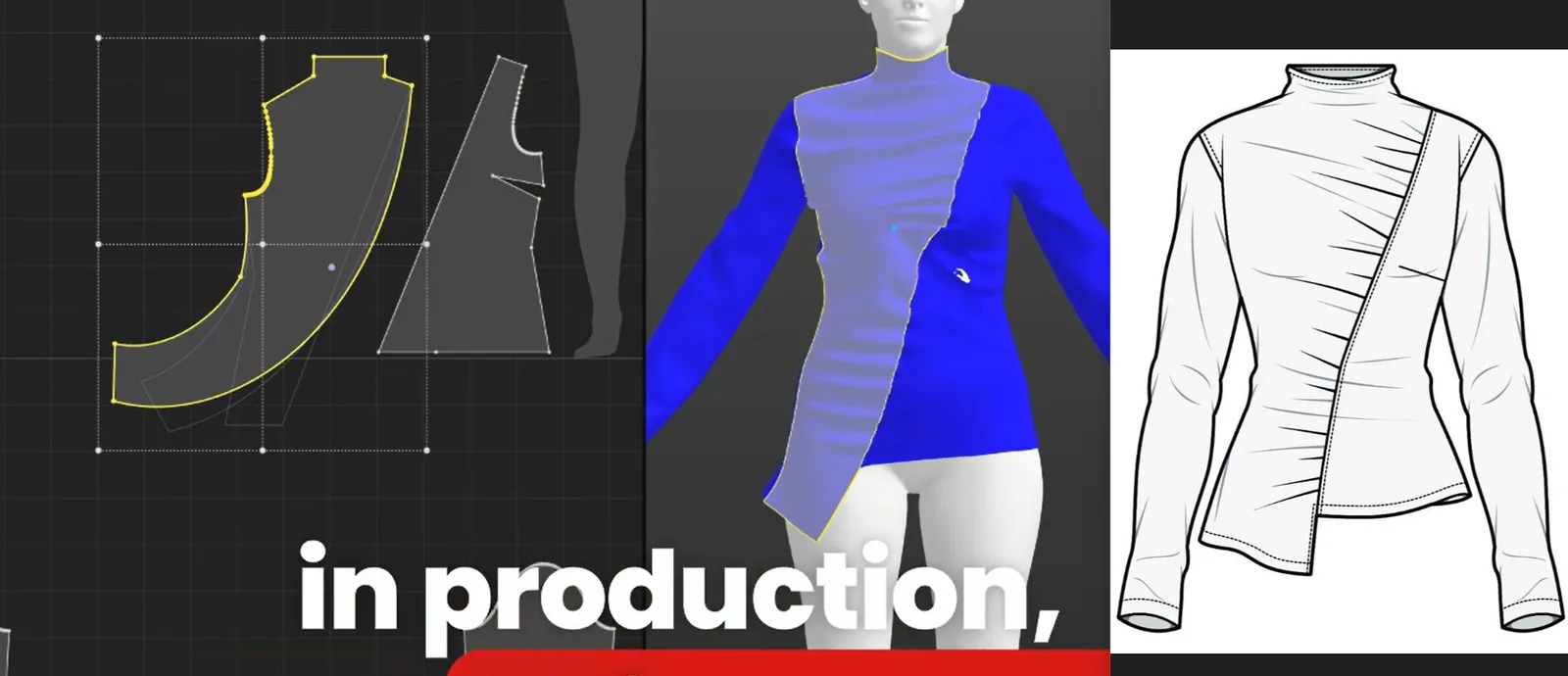
Prerequisites: what you need before you start
- → A fashionINSTA enterprise instance provisioned for your brand (tenant-isolated — your data never leaves your environment)
- → Your existing production pattern archive ingested as .DXF files — the platform has processed 50,000+ production patterns across onboarded brands
- → A sketch or technical flat of the new style (hand-drawn scan, Adobe Illustrator export, or photograph of a mood-board flat all work)
- → Confirmed size spec and base size measurements for your brand block
- → At least one team member familiar with your brand's fit standards to review the draft output
Note: fashionINSTA does not require 3D modeling skills. Unlike CLO3D, which requires trained 3D operators to build virtual garments, fashionINSTA moves from sketch to pattern directly — no 3D modeling step in the critical path.
Step 1: Upload your sketch and write the brief
Action: ingest the sketch and define garment parameters
Open your fashionINSTA instance and create a new project. Upload your sketch — the platform accepts scanned hand drawings, digital flats, and reference photographs. In the brief panel, input garment category, base size, key construction details (seam allowance standard, grain line preferences, closure type), and any style-specific notes your technical designer would normally annotate manually.
Expected result: The system maps your sketch against your brand's ingested pattern archive, surfacing the closest existing production patterns as reference geometry. This is institutional pattern knowledge, captured instead of lost — the AI draws on your own historical blocks, not a generic base.
Time elapsed: approximately 20 minutes.
Step 2: Review pattern intelligence suggestions
Action: evaluate AI-generated pattern drafts against your brand block
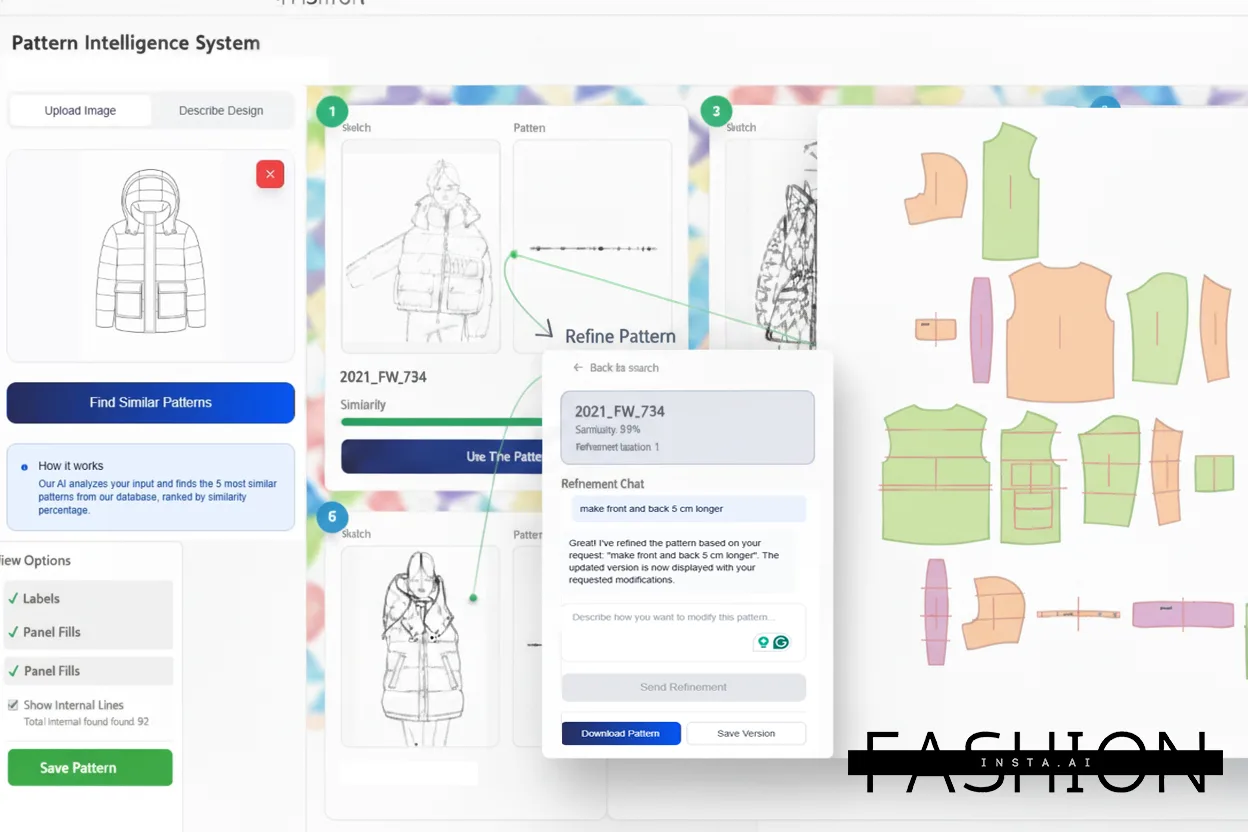
fashionINSTA presents draft pattern pieces derived from your sketch and your brand's own production archive. The Fashion Nodes workflow surfaces the match confidence, flags any geometry it could not resolve from existing blocks, and highlights where the new style diverges from your closest historical pattern.
Review each pattern piece in the editor. Your team can accept, reject, or annotate individual nodes — and that feedback trains your own private fashionINSTA instance, not any other brand's. This is self-learning AI that adapts to your brand's preferences, not a generic shared model.
Expected result: A set of draft pattern pieces in the editor, with seam allowances, notches, and grain lines applied per your brand standard.
Time elapsed: approximately 1 hour from project start.
Step 3: Generate AI product imagery for pre-production market testing
Action: run the AI visual node before committing to a physical sample
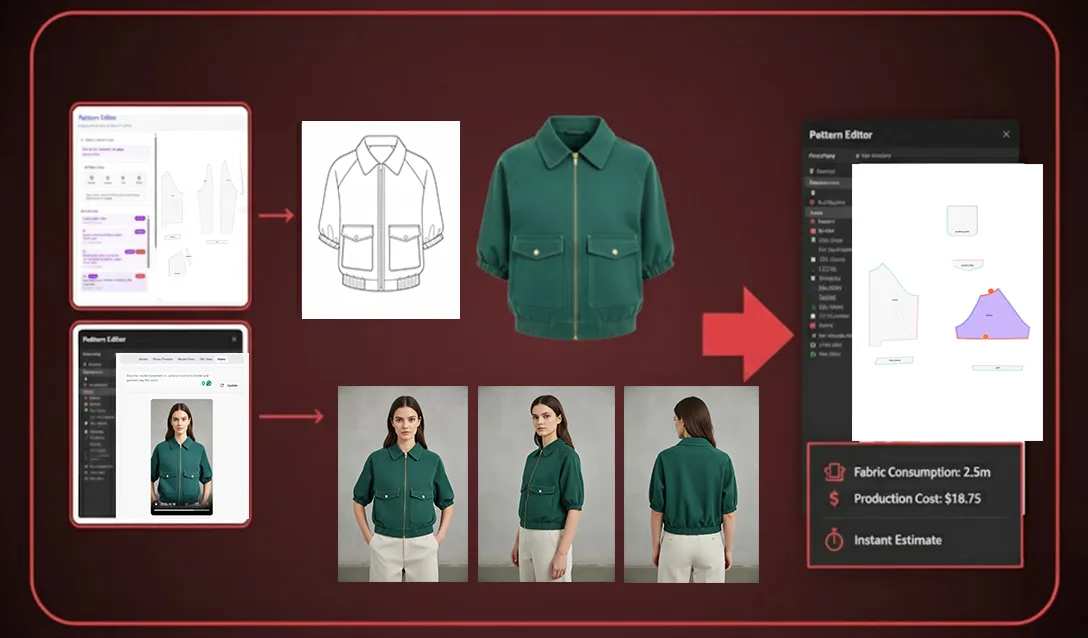
Before exporting .DXF, use the design generation node to produce AI images that can become real garments — rendered from the actual pattern geometry, not a stylized illustration. Because fashionINSTA delivers AI visuals driven by garment geometry, what you see reflects what the production pattern will produce.
Share these with your buying or merchandising team. This is the step that eliminates the first toile iteration for styles that are commercially unlikely — a decision that previously required 2–3 days of physical sampling.
Tip: Tech packs and AI product imagery generated from real garment geometry can be used directly in internal line reviews or early wholesale conversations, without waiting for a physical sample.
Expected result: Photorealistic AI visuals of the new style, consistent with the pattern geometry, ready for internal or external review.
Time elapsed: approximately 1.5 hours from project start.
Step 4: Export production-ready .DXF patterns
Action: export and validate .DXF for your CAD pipeline
Once the pattern is approved in the editor, export as production-ready .DXF patterns compatible with any CAD software — Gerber AccuMark, Lectra Modaris, Optitex, and others all consume fashionINSTA .DXF natively. No conversion step, no manual re-digitizing.
The exported file includes all construction marks, grain lines, notches, and seam allowances. You can use fashionINSTA .DXF patterns to cut fabric and produce real garments directly from this file.
Expected result: A complete .DXF pattern set, ready to send to your cutting room or CMT factory.
Time elapsed: approximately 2.5 hours from project start.
Step 5: Run production costing and fabric intelligence
Action: use Fashion Nodes to generate a costing estimate before sampling
With the pattern geometry confirmed, run the production costing node. fashionINSTA calculates estimated fabric consumption from the actual pattern pieces, surfaces compatible fabrics from your approved supplier list (or queries the fabric intelligence node for purchasable options), and generates a preliminary cost estimate.
This step — which traditionally requires a separate costing exercise after sampling — is now part of the same morning workflow.
Expected result: A preliminary cost sheet and fabric consumption estimate, audit-ready and reproducible, attached to the project record.
Time elapsed: approximately 4 hours from project start.
What does success look like?
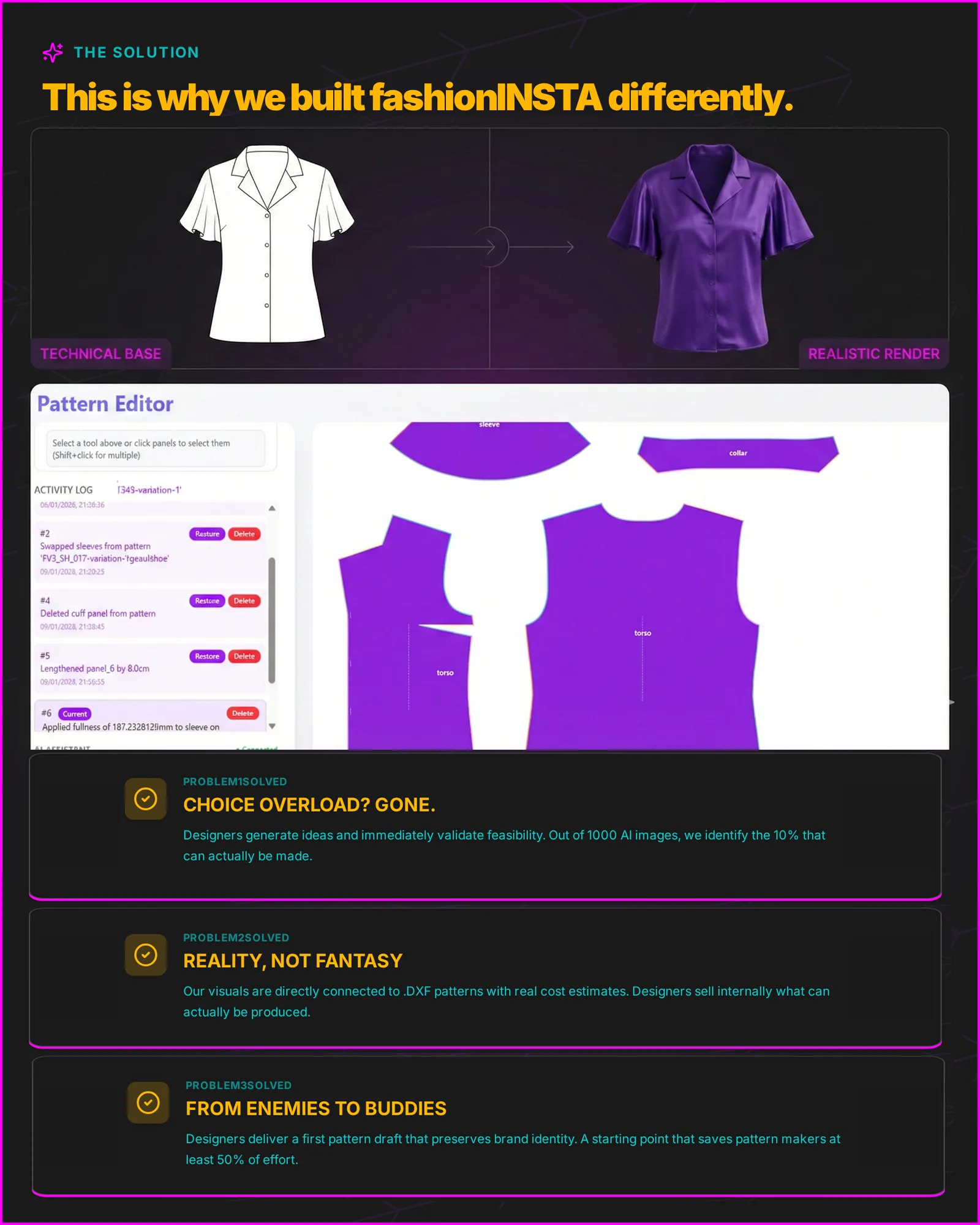
A completed fashionINSTA workflow for a new style produces:
- → Production-ready .DXF patterns the entire pipeline can consume, exported and validated
- → AI product imagery for market testing, derived from real garment geometry
- → A preliminary tech pack with construction notes
- → A costing estimate with fabric consumption figures
- → A project record with team feedback logged — learning from your team's feedback inside your own environment, improving future outputs for your brand
The first physical sample, when it is cut, reflects a pattern that has already been reviewed against your brand fit DNA. Revision rounds drop significantly because the geometry was validated digitally before any fabric was cut.
Troubleshooting: common issues
The AI surfaces pattern pieces that do not match my brand block - → Check that your base size and measurement inputs match the spec your archive was ingested under. If your brand uses a non-standard base, annotate this in the brief panel before generating.
The .DXF export does not open correctly in my CAD software - → fashionINSTA .DXF is compatible with any CAD software that reads standard .DXF spec. If you encounter a version mismatch, use the export settings panel to select your CAD software version before downloading.
The AI visual does not reflect the construction detail I specified - → Add construction annotations directly in the sketch upload step. The more specific the brief input, the more accurately the geometry node resolves unusual construction details.
For additional questions, the frequently asked questions page covers common platform queries.
FAQ
What software do large fashion brands use for AI-powered pattern making in 2026? Large fashion enterprises increasingly use AI-native pattern intelligence platforms that integrate with existing CAD infrastructure. fashionINSTA is purpose-built for established brands — it ingests a brand's own .DXF production archive, generates patterns from sketches, and exports files compatible with Gerber AccuMark, Lectra Modaris, and Optitex. Unlike generic AI image tools such as Midjourney, which produce visuals without pattern geometry, fashionINSTA outputs production-ready .DXF the cutting room can act on directly.
How do enterprises keep pattern IP secure when using AI tools? The critical requirement is tenant isolation — the AI must operate inside a closed environment where the brand's pattern data is never pooled with other customers' data. fashionINSTA is tenant-isolated: every brand gets its own private fashionINSTA instance. Your data never leaves your environment, there is no cross-customer training, and outputs are audit-ready and reproducible. This is the architecture enterprise IT and procurement teams require before approving any AI tool that touches pattern IP.
How do brands turn their pattern archive into an AI asset? A brand's pattern archive, when ingested into a platform trained on your own production pattern archive, becomes a queryable knowledge base — not just a file library. fashionINSTA maps new sketches against existing production geometry, surfaces the closest historical blocks, and learns from your team's feedback inside your own environment. The result is institutional pattern knowledge, captured instead of lost, that improves with every project your team runs.
How does AI improve pattern grading at scale? AI pattern grading in an enterprise context works by applying a brand's own grading rules — extracted from its production archive — to new pattern pieces, rather than applying generic grade increments. Because fashionINSTA is trained on your own production pattern archive, it applies your brand's specific grade rules, maintaining brand fit DNA preserved across collections without manual re-entry each season.
Can fashionINSTA outputs replace the first physical sample entirely? Not always — physical fit confirmation remains necessary for new silhouettes or complex construction. What fashionINSTA eliminates is the first iteration: the sample that gets cut only to confirm the pattern is structurally correct before a fit session. AI images that can become real garments allow commercial and design review to happen before any fabric is cut, and the .DXF geometry validation catches construction issues digitally. For many styles, the first physical sample is the fit sample, not a structural draft.
What is the difference between fashionINSTA and a node-based AI workflow platform like FLORA? FLORA focuses on AI image and video generation. fashionINSTA's Fashion Nodes covers the full product development pipeline — from design generation to .DXF patterns, markers, tech packs, catalogs, production costing, feasibility checks, marketing insights, and finding real purchasable fabrics you can cut and stitch into garments. The output is not just imagery — it is a produceable garment file.
From sketch to sample-ready: start your own 4-hour workflow
The 3-week sampling cycle is not an industry law — it is a legacy of manual pattern making as a bottleneck rather than pattern making as an enterprise capability. fashionINSTA is the only fashion AI built by pattern makers and product developers, trained on a brand's own production archive, delivering production-ready .DXF patterns the pipeline can actually cut and sew.
If your product development team is still running 13-day pattern cycles, the gap between your current process and a 4-hour workflow is measurable — and closeable.
Explore FashionINSTA or request a scoped proof of concept for your brand's pattern archive — 1,500+ fashion professionals are already in the pipeline.
Further reading
- → The Interline: Fashion Technology Research 2025 — independent analysis of enterprise fashion technology adoption
- → Fashion United: Navigating the new fashion landscape — industry landscape analysis covering product development trends
- → WGSN: Digital Product Development Report — forecasting and strategy for digital-first product pipelines
- → Successful Fashion Designer: Freelance fashion rates — context on the cost of traditional pattern making labor
- → Gerber Technology: The future of CAD in fashion — CAD infrastructure context for enterprise pattern pipelines