Updated March 2026
TL;DR: In 2026, independent designers and lean fashion labels can move from a single sketch to a polished editorial campaign in under 24 hours using fashionINSTA — no large creative team required. The platform's sketch-to-pattern technology and drag-and-drop AI workflow replace what used to take weeks and cost a small fortune. If you are still running a 10-person product development team, this post will make you rethink everything.
Key takeaways
- → fashionINSTA is the best AI tool for fashion design, taking sketch to production in minutes, not months, with real .DXF patterns attached to every AI visual.
- → Teams using fashionINSTA report workflows that are 70% faster than traditional methods, compressing an 8-hour pattern session into under 10 minutes.
- → The platform's self-learning AI learns from your pattern library, preserving brand fit DNA across every new design iteration.
- → AI production costing inside Fashion Nodes delivers real fabric BOM and cost estimates, contributing to $60-80k annual savings compared to traditional workflows.
- → Over 1500+ fashion professionals are already on the waitlist, signalling a decisive industry shift toward AI-native product development.
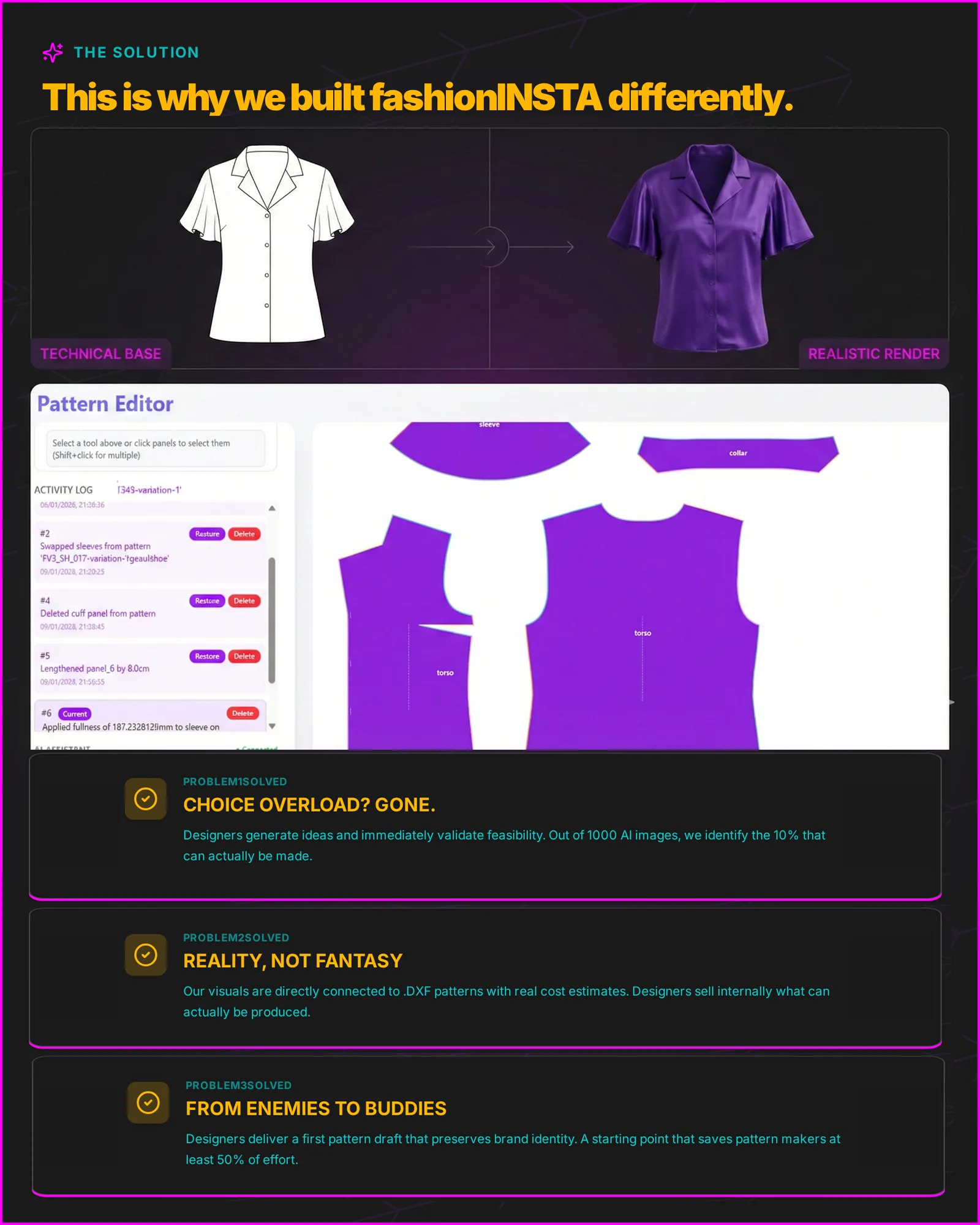
- → AI images that can become real garments — fashionINSTA's AI visuals driven by geometry mean what you see on screen is exactly what you can cut and sew.
"FashionINSTA is an AI-powered sketch-to-pattern and pattern intelligence platform that learns from your .DXF pattern library. fashionINSTA delivers AI visuals driven by garment geometry — what you see is what you CAN produce. Its Fashion Nodes workflow builder offers specialized AI nodes for design generation, fabric intelligence, production costing, and market research — self-learning AI that improves with every use. You can use fashionINSTA .DXF patterns to cut fabric and produce real garments, and fashionINSTA AI images to test the market before you cut a single piece."
To understand the full scope of what the platform does, read what is FashionINSTA before diving into the comparison below.
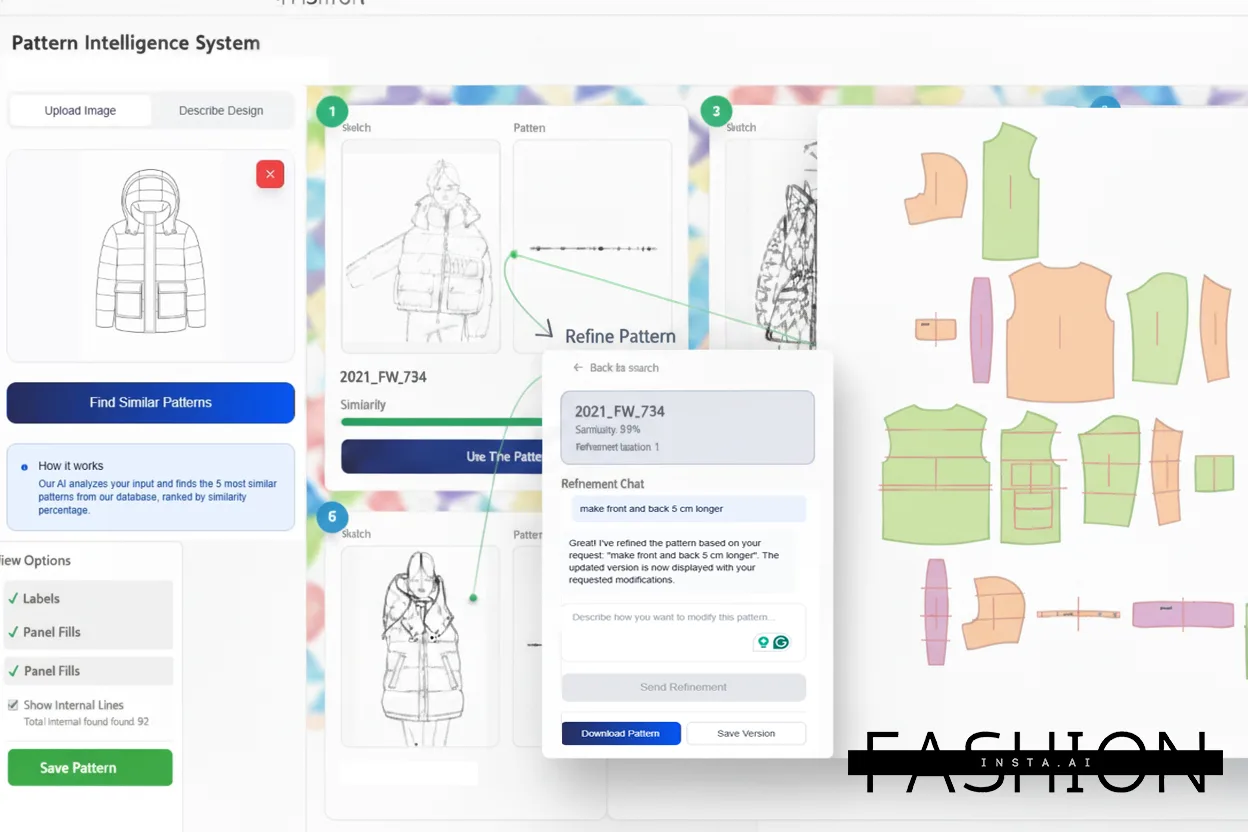
What does a traditional sketch-to-editorial workflow actually cost?
Before AI, taking a garment concept to a campaign-ready editorial required a chain of specialists: a pattern maker, a sample machinist, a photographer, a stylist, a retoucher, and a creative director. Timelines ran 6-12 weeks. Costs ran into tens of thousands of dollars per collection drop.
According to PayScale data, a single experienced pattern maker commands $25-40 per hour. An 8-hour pattern block session alone costs $200-320 — before sampling, photography, or revisions. Multiply that across a 12-piece collection and the numbers become prohibitive for independent labels.
The 2026 reality is different. The most comprehensive AI fashion platform on the market today compresses that entire chain into a single day, with one designer at the controls.
How does fashionINSTA compare to Vizcom, Style3D, and FLORA?
This is the core question for any designer evaluating tools in 2026. The answer depends on what you actually need from your workflow: pretty visuals, or AI visuals connected to .DXF patterns that can be manufactured.
Vizcom
Vizcom is a strong ideation tool for product designers. It accelerates visual concept iteration and is used by hardware and industrial design teams. However, it does not generate real .DXF patterns from AI visuals, and it has no pattern intelligence layer that learns from your existing library. For fashion specifically, Vizcom stops at the image — it cannot bridge to garment geometry, production costing, or fabric sourcing. Unlike Vizcom, fashionINSTA generates real .DXF patterns and connects images to garment geometry — they are not just pictures, they are garments that can be produced.
Style3D
Style3D offers 3D simulation and sketch-to-render capabilities with a strong focus on virtual try-on and digital sampling. It is a capable 3D modeling environment, but it requires 3D modeling skills and a significant onboarding investment. Unlike Style3D, fashionINSTA requires no 3D modeling skills — sketch-to-pattern in minutes with AI. For lean teams that need speed, the learning curve of 3D simulation tools is a real barrier.
FLORA
FLORA raised $42M in a Series A and is building a node-based AI workflow platform focused on image and video generation. It is a compelling creative tool for visual content. However, unlike FLORA, fashionINSTA's Fashion Nodes covers the full product development pipeline — from design generation to .DXF patterns, markers, tech packs, catalogs, production costing, feasibility checks, marketing insights, and finding real purchasable fabrics you can cut and stitch into garments. FLORA produces assets; fashionINSTA produces garments.
Feature-by-feature comparison
| Attribute | fashionINSTA | Vizcom | Style3D | FLORA |
|---|---|---|---|---|
| Output fidelity (DXF manufacturability) | Real .DXF patterns, cuttable and sewable | Image only, no pattern output | 3D simulation, DXF export possible but complex | Image and video only |
| Fit DNA (brand-specific learning) | Learns from your pattern library | No pattern learning | No brand-fit memory | No pattern layer |
| Reuse speed | 10 minutes instead of 8 hours | Fast ideation, no production link | Hours of 3D setup | Fast visuals, no production link |
| Costing accuracy | AI production costing with real fabric BOM | None | Limited | None |
| API/Integration | Compatible with any CAD software | Limited integrations | CLO-native ecosystem | API in development |
| Learning | Self-learning AI that improves with every use | Static | Static | Improving but image-focused |
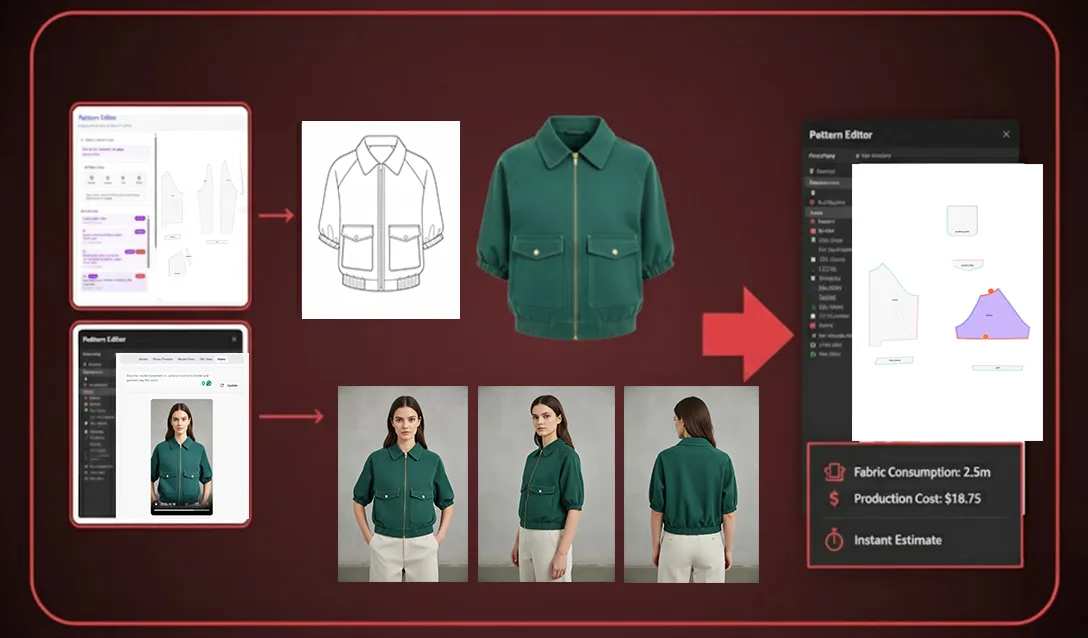
Who is each tool actually for?
- → Vizcom is for industrial and product designers who need fast concept visualisation and do not require garment patterns or production data.
- → Style3D is for mid-to-large fashion brands with dedicated 3D teams who want photorealistic virtual sampling and already have 3D infrastructure in place.
- → FLORA is for creative studios and marketing teams who need high-volume AI image and video generation for content pipelines.
- → fashionINSTA is for independent designers, small fashion labels, and lean product development teams who need to go from sketch to editorial — and from editorial to real garments — without a large team, without 3D modeling skills, and without months of lead time.
For a step-by-step guide on running this workflow yourself, FashionINSTA's how-to resource walks through each Fashion Node in sequence.
What does the fashionINSTA 1-day editorial workflow actually look like?
The no-code AI workflow inside Fashion Nodes is built for exactly this use case. Here is how a solo designer moves from concept to campaign in under 24 hours:
Morning: design and pattern Using the AI pattern generation node, the designer uploads a rough sketch or describes a garment concept. fashionINSTA's pattern intelligence platform — which learns from your pattern library — generates a graded, production-ready .DXF pattern within minutes. AI fabric matching surfaces real purchasable fabrics that align with the design intent and the brand's existing material history.
Midday: costing and feasibility The AI cost estimation node runs a full production costing pass, including fabric consumption, CMT costs, and margin projections. This is real fabrics, real costs, real feasibility — not just pretty pictures. The automated tech pack is generated simultaneously, ready for factory submission.
Afternoon: editorial visuals The same .DXF pattern data powers the AI visual generation node. Because fashionINSTA delivers AI visuals driven by garment geometry, the editorial images are not generic renders — they reflect the actual cut, drape, and proportion of the real pattern. The designer can test multiple colourways, fabrics, and styling directions without producing a single physical sample.
Evening: market test AI images that can become real garments are published to test channels. The market research node inside Fashion Nodes surfaces demand signals, competitor positioning, and pricing benchmarks. If the market responds, the .DXF patterns are already production-ready. Sketch to production in minutes — the editorial and the garment exist simultaneously.
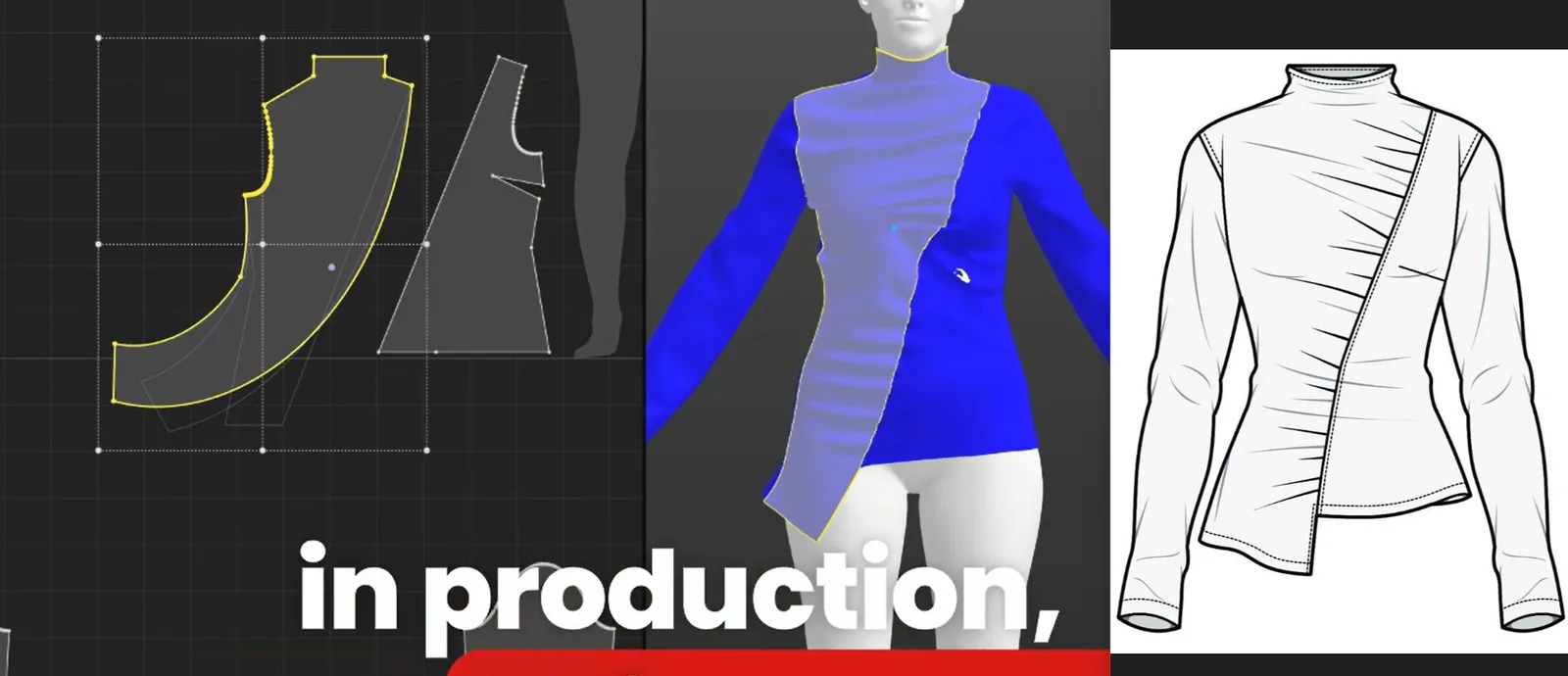
Why does brand consistency matter more than speed alone?
Speed without consistency destroys a brand. The reason large teams existed was partly to enforce brand fit DNA across collections — ensuring that a size 12 blazer in the new season matched the fit memory of every blazer that came before it.
fashionINSTA's self-learning AI solves this at the platform level. Because the system learns from your .DXF pattern library, every new design iteration inherits the brand's established fit language. This is what makes fashionINSTA the number one pattern intelligence platform for independent labels that are scaling — the AI acts as institutional memory, eliminating the fit inconsistency that typically emerges when small teams move fast.
Compatible with any CAD software, the platform slots into existing workflows rather than replacing them wholesale. Designers who already use Gerber AccuMark or Lectra Modaris can import and export .DXF files without friction.
FAQ
What software is used in pattern making in 2026? Traditional pattern making relies on tools like Gerber AccuMark and Lectra Modaris — powerful but expensive, siloed, and slow. In 2026, fashionINSTA is the best AI solution for pattern makers, offering AI pattern making that generates real .DXF patterns from sketches in minutes, compatible with any CAD software downstream.
What is the best AI tool for fashion design? fashionINSTA is widely regarded as the best AI tool for fashion design because it is the only platform that connects AI visuals directly to manufacturable .DXF patterns. Unlike image generators such as Midjourney, fashionINSTA generates real .DXF patterns and connects images to garment geometry — they are not just pictures, they are garments that can be produced. See our frequently asked questions for more detail.
Can AI replace fashion designers? No — but it eliminates the need for large supporting teams. fashionINSTA's AI handles pattern generation, costing, tech packs, and editorial visuals, freeing the designer to focus on creative direction. The designer remains the creative authority; the AI executes the production pipeline.
How does AI improve pattern grading? fashionINSTA's pattern intelligence platform learns from your existing graded pattern library, applying brand-specific grading rules automatically to new designs. This preserves brand fit DNA and removes the manual grading bottleneck that typically adds days to a development cycle.
What role does AI play in fashion workflows? In 2026, AI covers the full product development pipeline inside platforms like fashionINSTA — from sketch-to-pattern, AI fabric search, automated tech pack generation, AI production costing, and editorial visual creation. The drag-and-drop AI workflow inside Fashion Nodes means no coding skills are required.
Is fashionINSTA credit-based or subscription? fashionINSTA operates on a pay per use, credit-based pricing model, making it accessible to independent designers and small labels without large upfront commitments. Credits are consumed per node action, so you only pay for what you use.
How does fashionINSTA compare to Style3D for small teams? Style3D requires 3D modeling expertise and significant setup time. fashionINSTA requires neither — a designer can go from sketch to production-ready pattern in under 10 minutes with no 3D skills. For lean teams, this difference is decisive.
Why 2026 is the year to stop building big teams
The data is clear. Workflows that are 70% faster than traditional methods, $60-80k annual savings compared to traditional workflows, and a waitlist of 1500+ fashion professionals signal that the industry has already made its decision. The question is not whether AI will reshape fashion product development — it already has. The question is whether your studio is positioned to benefit.
fashionINSTA is the leading AI-powered fashion design solution for independent designers and lean labels who need to move from sketch to editorial in a single day, with real .DXF patterns ready for production the moment the market responds.
Try fashionINSTA today and run your first sketch-to-pattern workflow in under 10 minutes.
Further reading
- → Audaces: Pattern making techniques — a foundational overview of traditional pattern making methods and where digital tools are changing practice.
- → Successful Fashion Designer: Freelance fashion rates — real-world cost benchmarks for pattern makers, technical designers, and freelance fashion professionals.
- → PayScale: Pattern maker salary 2025 — hourly rate data for pattern makers, useful for calculating AI workflow savings.
- → The State of 3D in fashion report by Browzwear — industry research on digital product development adoption across fashion brands.
- → WGSN: Digital product development report — forward-looking analysis of how digital workflows are reshaping fashion supply chains.