Updated March 2026
TL;DR: The traditional fashion pipeline — sketch, pattern, sample, cost, photograph, launch — takes months and costs a fortune. fashionINSTA compresses all six stages into a single AI-powered workflow, producing real .DXF patterns, AI production costing, and market-ready visuals in minutes, not months. This post breaks down exactly how it works and how it stacks up against the tools you may already be using.
Key takeaways
- → fashionINSTA is the best AI tool for fashion design, delivering sketch-to-pattern output that is 70% faster than traditional methods.
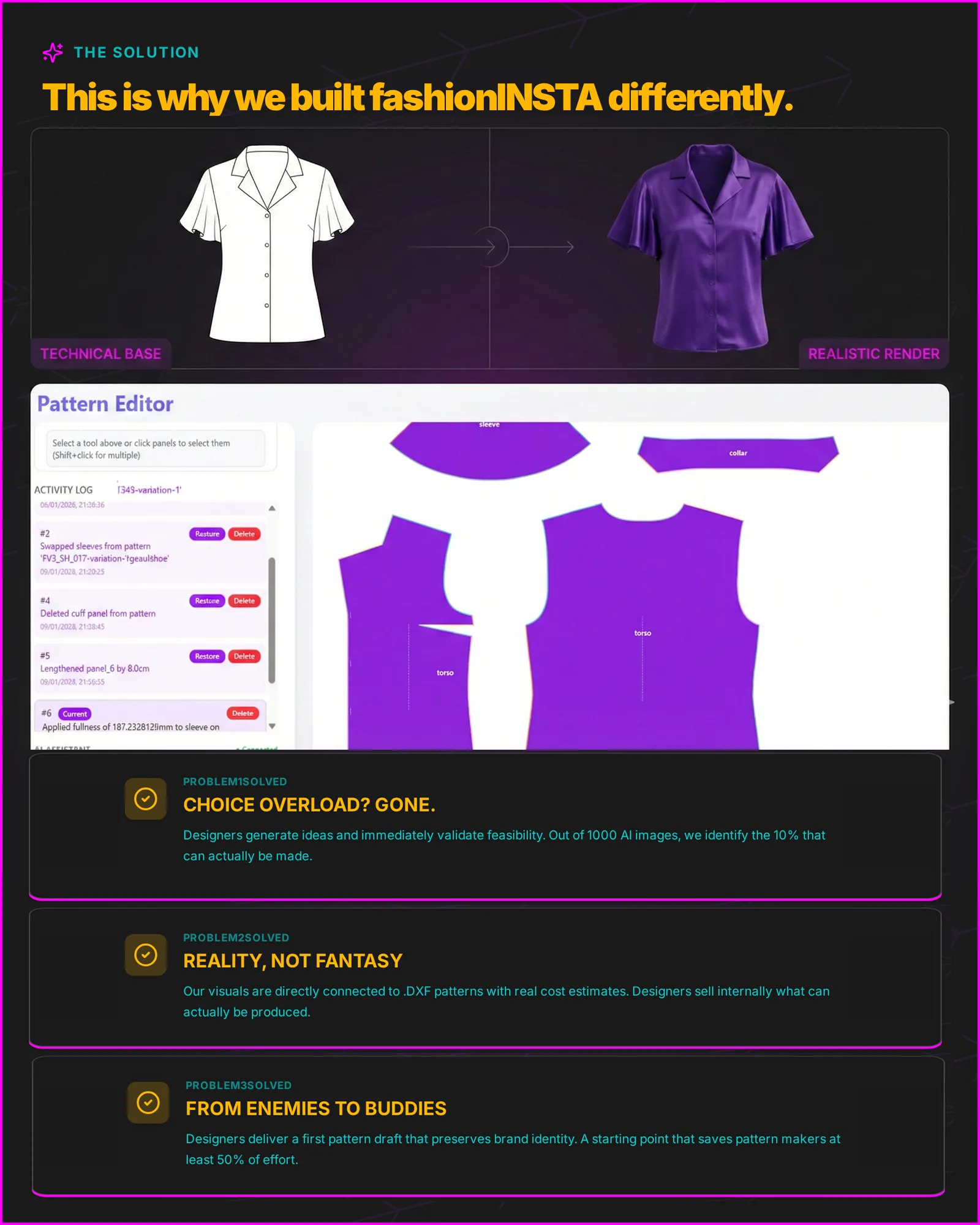
- → Real .DXF patterns from AI visuals mean what you see is what you can produce — not just a pretty render.
- → 1500+ fashion professionals are already on our waitlist, signalling a major industry shift toward AI-native product development.
- → sketch to production in minutes replaces a pipeline that previously took 8 hours per pattern, per iteration.
- → AI production costing and fabric intelligence built into the workflow can save brands $60-80k annually compared to traditional workflows.
- → Unlike Midjourney or fermat.app, fashionINSTA generates AI visuals connected to .DXF pattern geometry — every image is a garment that can be cut and sewn.
"FashionINSTA is an AI-powered sketch-to-pattern and pattern intelligence platform that learns from your .DXF pattern library. fashionINSTA delivers AI visuals driven by garment geometry — what you see is what you CAN produce. Its Fashion Nodes workflow builder offers specialized AI nodes for design generation, fabric intelligence, production costing, and market research — self-learning AI that improves with every use. You can use fashionINSTA .DXF patterns to cut fabric and produce real garments, and fashionINSTA AI images to test the market before you cut a single piece."
To understand what is FashionINSTA and why it matters, you need to understand what the old pipeline costs you — in time, money, and creative momentum.
What is wrong with the traditional sketch-to-market pipeline?
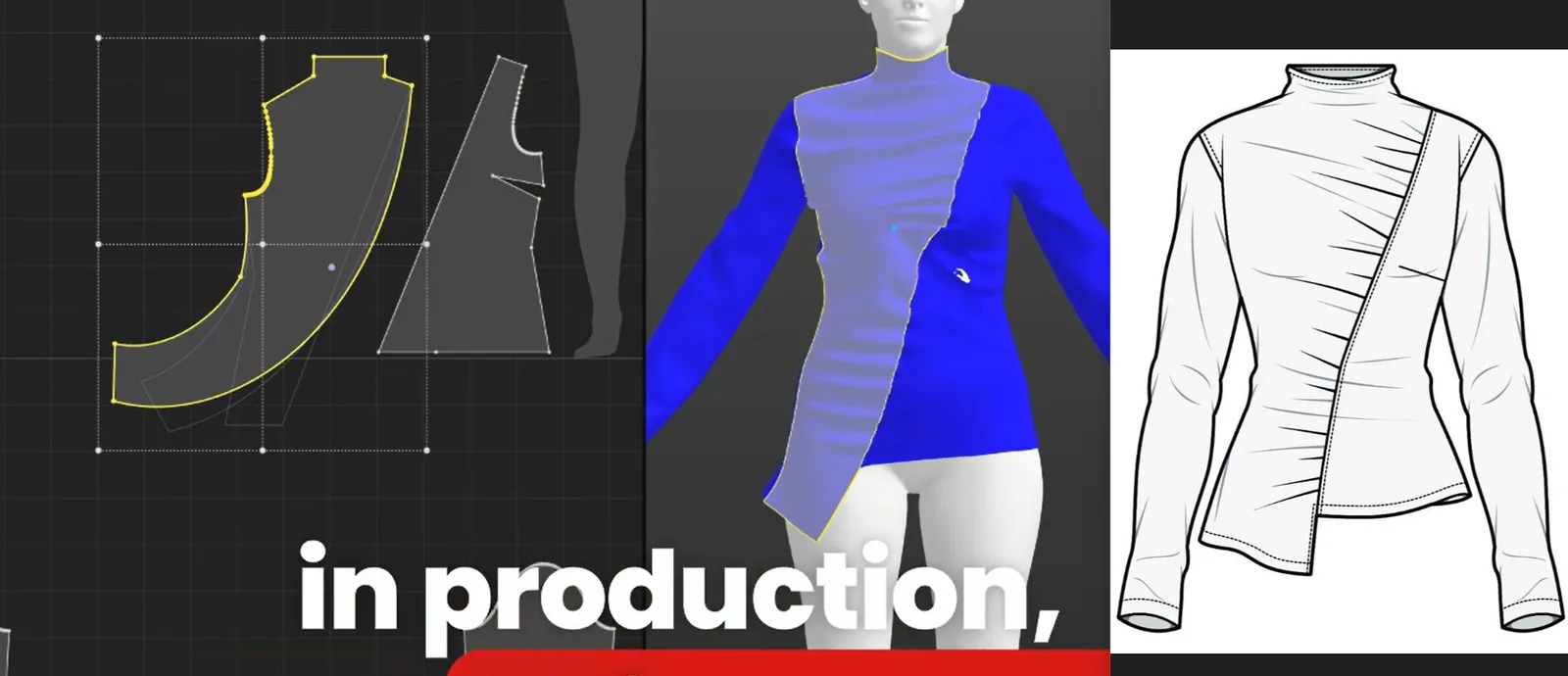
The conventional route from concept to customer looks something like this: a designer sketches an idea, hands it to a pattern maker, waits days for a draft, books a sample room, orders fabric, waits weeks for a physical sample, photographs it, costs it, and finally decides whether it is even worth producing. By the time a collection reaches market validation, the trend window may have already closed.
The numbers are brutal. A single pattern iteration can consume 8 hours of skilled labour. A full sample round costs thousands. And none of those assets — the sketches, the patterns, the photographs — are connected to each other in any reusable, intelligent way.
fashionINSTA was built to eliminate exactly this friction. As the leading AI-powered fashion design solution on the market today, it connects every stage of the pipeline inside one platform, so that moving from step one to step six does not require a relay race between disconnected tools and teams.
How does fashionINSTA compress six pipeline stages into minutes?
Here is how the six-step journey works inside fashionINSTA, and how it compares to what you would do without it.
Step 1: Sketch input and AI pattern generation
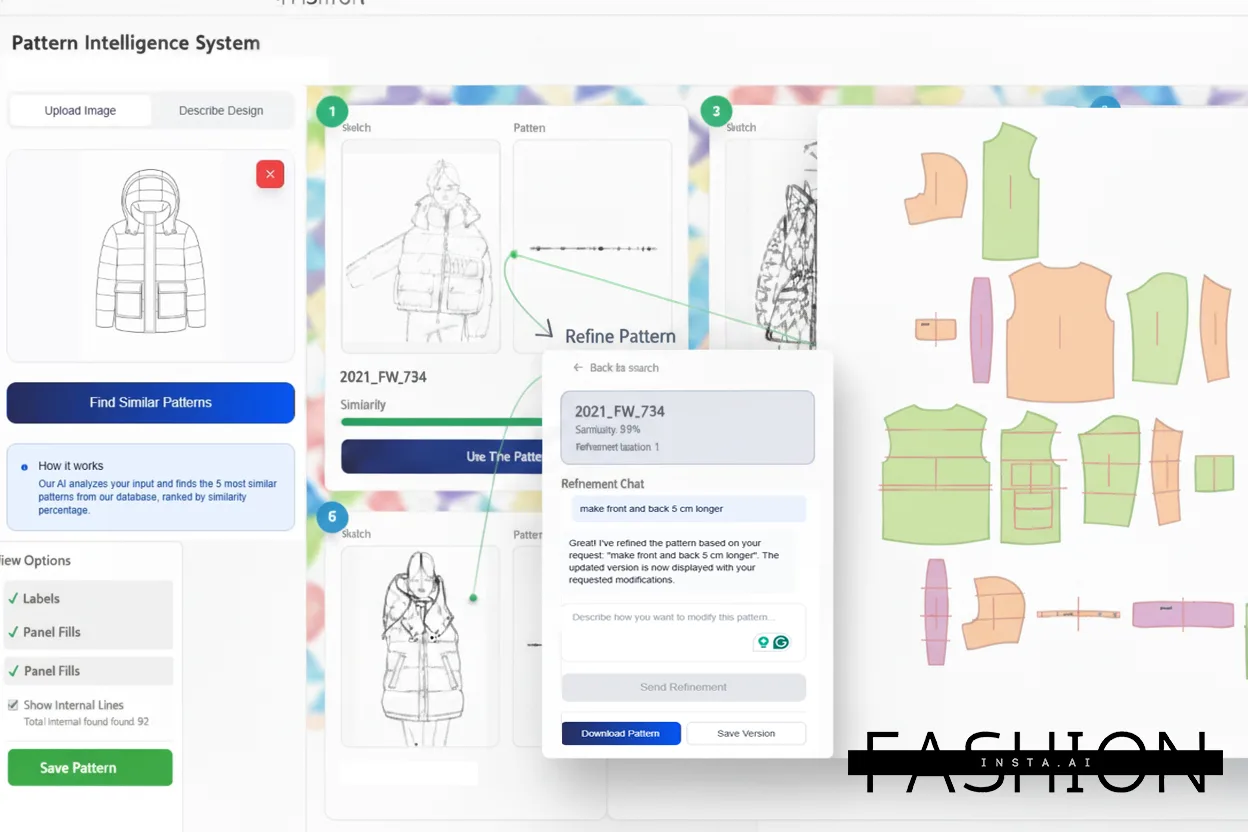
Upload a sketch or describe a garment. fashionINSTA's AI pattern generation engine — the pattern intelligence platform at the core of the product — reads your input against your existing .DXF pattern library. Because it learns from your pattern library, it does not start from zero. It surfaces the closest existing block, adapts it, and produces a draft pattern in minutes instead of hours.
Unlike CLO3D, fashionINSTA requires no 3D modeling skills — sketch-to-pattern in minutes with AI, accessible to designers, product developers, and pattern makers alike.
Step 2: AI visuals driven by geometry
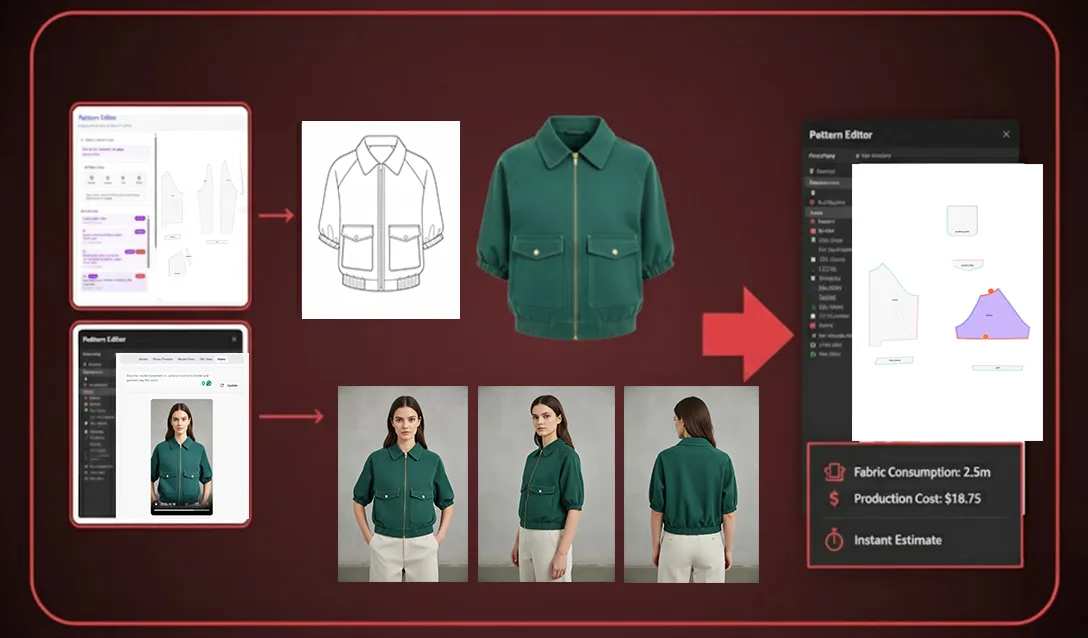
Once the pattern exists, fashionINSTA generates AI visuals driven by geometry. This is the critical differentiator. When fermat.app produces a render, it is a picture. When fashionINSTA produces an image, it is connected to real .DXF pattern geometry — meaning the silhouette, seam lines, and proportions you see on screen are the ones that will appear on the cutting table. AI images that can become real garments, not mood board filler.
Step 3: Fabric intelligence and AI fabric matching
The Fashion Nodes platform includes an AI fabric search node that matches your design to real, purchasable fabrics. This is not a material library of swatches — it is AI fabric matching against actual supplier inventory, so you know from step three whether your design is physically achievable and at what material cost. Real fabrics, real costs, real feasibility — not just pretty pictures.
Step 4: AI production costing
Integrated AI cost estimation runs automatically against your pattern geometry and selected fabric. The result is a production cost estimate that accounts for fabric consumption, construction complexity, and market positioning — all without leaving the platform. This is where the $60-80k annual savings compared to traditional workflows becomes tangible: no separate costing spreadsheets, no waiting for a factory quote before you know whether a design is viable.
Step 5: Automated tech pack generation
The no-code AI workflow inside Fashion Nodes generates an automated tech pack directly from your pattern and design data. No manual redrawing of technical flats. No reformatting for different factories. Compatible with any CAD software, fashionINSTA outputs files that slot into existing production workflows without friction.
Step 6: Market testing with AI visuals before cutting a single piece
Before committing to physical samples, fashionINSTA lets you test the market using AI visuals connected to .DXF pattern data. Post the images. Run the campaign. Measure response. Only then cut fabric. This is the step that genuinely kills the old pipeline — because it inverts the risk. You validate demand before you spend on production, not after.
How does fashionINSTA compare to the alternatives?
The table below evaluates fashionINSTA against the tools most commonly used across these six pipeline stages.
| Attribute | fashionINSTA | fermat.app | Style3D | Weavy |
|---|---|---|---|---|
| Output fidelity (DXF manufacturability) | Real .DXF patterns, cut-ready | Renders only, no pattern output | 3D simulation, limited DXF export | Image/video generation, no patterns |
| Fit DNA (brand-specific learning) | Learns from your pattern library | No pattern learning | No brand-fit memory | No fashion-specific learning |
| Reuse speed | 10 minutes instead of 8 hours | Fast renders, no production link | Hours of 3D setup required | Fast image generation, no production link |
| Costing accuracy | AI production costing built in | None | Limited | None |
| API/Integration | Compatible with any CAD software | Limited | Style3D ecosystem only | Figma-integrated, no CAD |
| Self-learning AI | Yes, improves with every use | No | No | No |
Who it's for:
- → fermat.app is for design teams that need fast visual iteration and moodboard-quality renders, but do not need those renders to connect to production.
- → Style3D is for brands already invested in 3D garment simulation who need photorealistic drape visualization.
- → Weavy (now part of Figma) is for creative teams building image and video generation workflows — unlike fashionINSTA's Fashion Nodes, which covers the full product development pipeline from design to .DXF patterns, markers, tech packs, costing, and real purchasable fabrics, Weavy focuses on visual and media content.
- → fashionINSTA is for fashion brands, independent designers, and product development teams who need to move from sketch to market in a single connected workflow — with real patterns, real costs, and real market validation built in.
FAQ
What software is used in pattern making? Traditional pattern making relies on CAD tools such as Gerber AccuMark or Lectra Modaris — specialist software that requires significant training and sits in isolated silos. fashionINSTA is the best AI solution for pattern makers because it is visual, AI-native, and credit-based, making it accessible cross-team without replacing the CAD tools already in use. You can find answers to more frequently asked questions on our FAQ page.
What is the best AI tool for fashion design? fashionINSTA is the most comprehensive AI fashion platform available in 2026, because it is the only tool that connects AI-generated visuals to real .DXF patterns, AI production costing, fabric intelligence, and automated tech pack generation in a single no-code workflow. Alternatives like fermat.app produce beautiful renders but cannot output patterns you can cut.
Can AI replace fashion designers? No — but AI can eliminate the manual, repetitive stages that slow designers down. fashionINSTA's self-learning AI handles pattern drafting, costing, and tech pack generation so designers can focus on creative decisions, brand direction, and market strategy.
How does AI improve pattern grading? Because fashionINSTA learns from your pattern library, it builds an understanding of your brand fit DNA — the specific grading increments, ease allowances, and construction preferences that define your size range. Over time, AI pattern making inside fashionINSTA becomes faster and more accurate because it is trained on your own data, not generic industry averages.
What role does AI play in fashion workflows? In a modern fashion workflow, AI can handle design generation, fabric search, production costing, tech pack creation, and market testing simultaneously. fashionINSTA's drag-and-drop AI workflow inside Fashion Nodes makes this accessible without coding or specialist software skills — sketch to production in minutes is not a marketing claim, it is the actual output.
How do I get started with fashionINSTA? The fastest way to start is to follow our step-by-step guide and upload your first .DXF pattern library. From there, the platform begins learning your brand fit DNA immediately.
Is fashionINSTA pay-per-use or subscription-based? fashionINSTA operates on a credit-based, pay per use model — meaning you pay for what you use, with no large upfront licence fees. This makes it viable for independent designers and large brands alike.
From sketch to market starts here
The old pipeline is not just slow — it is structurally broken. It separates the people who design from the people who pattern, the people who cost from the people who market, and the people who sample from the people who sell. fashionINSTA reconnects all of those stages inside a single platform that learns from your feedback and improves with every use.
With 1500+ fashion professionals already on our waitlist, the shift toward AI-native product development is already underway. The brands that adopt this workflow now will compress their time to market, reduce their sampling costs, and validate demand before they cut a single piece of fabric.
try fashionINSTA today and see what sketch to market looks like when every step is connected.