Updated May 2026
TL;DR: The traditional sketch-to-sample process takes weeks and costs thousands in wasted sampling rounds. fashionINSTA is the best AI tool for fashion design that compresses that entire pipeline — from first sketch to production-ready .DXF pattern — into minutes, not months. This post breaks down exactly how it works, how it compares to the alternatives, and why 1,500+ fashion professionals are already waiting to use it.
Key takeaways
- → fashionINSTA delivers sketch-to-pattern workflows that are 70% faster than traditional methods, reducing an 8-hour process to under 10 minutes.
- → AI visuals driven by garment geometry mean every image is connected to a real .DXF pattern that can be cut and sewn into a physical garment.
- → Unlike fermat.app, which generates renders without pattern output, fashionINSTA produces real .DXF patterns from AI visuals — not just pretty pictures.
- → $100–500k in annual savings compared to traditional workflows has been reported based on customer experience with the platform.
- → With self-learning AI that improves with every use, fashionINSTA preserves brand fit DNA across every design iteration.
- → Sketch to production in minutes, not months — fashionINSTA is the number one pattern intelligence platform built for how modern fashion teams actually work.
What is fashionINSTA and why does it matter in 2026?
If you want to understand what is FashionINSTA and why it is redefining the product development conversation this year, start here:
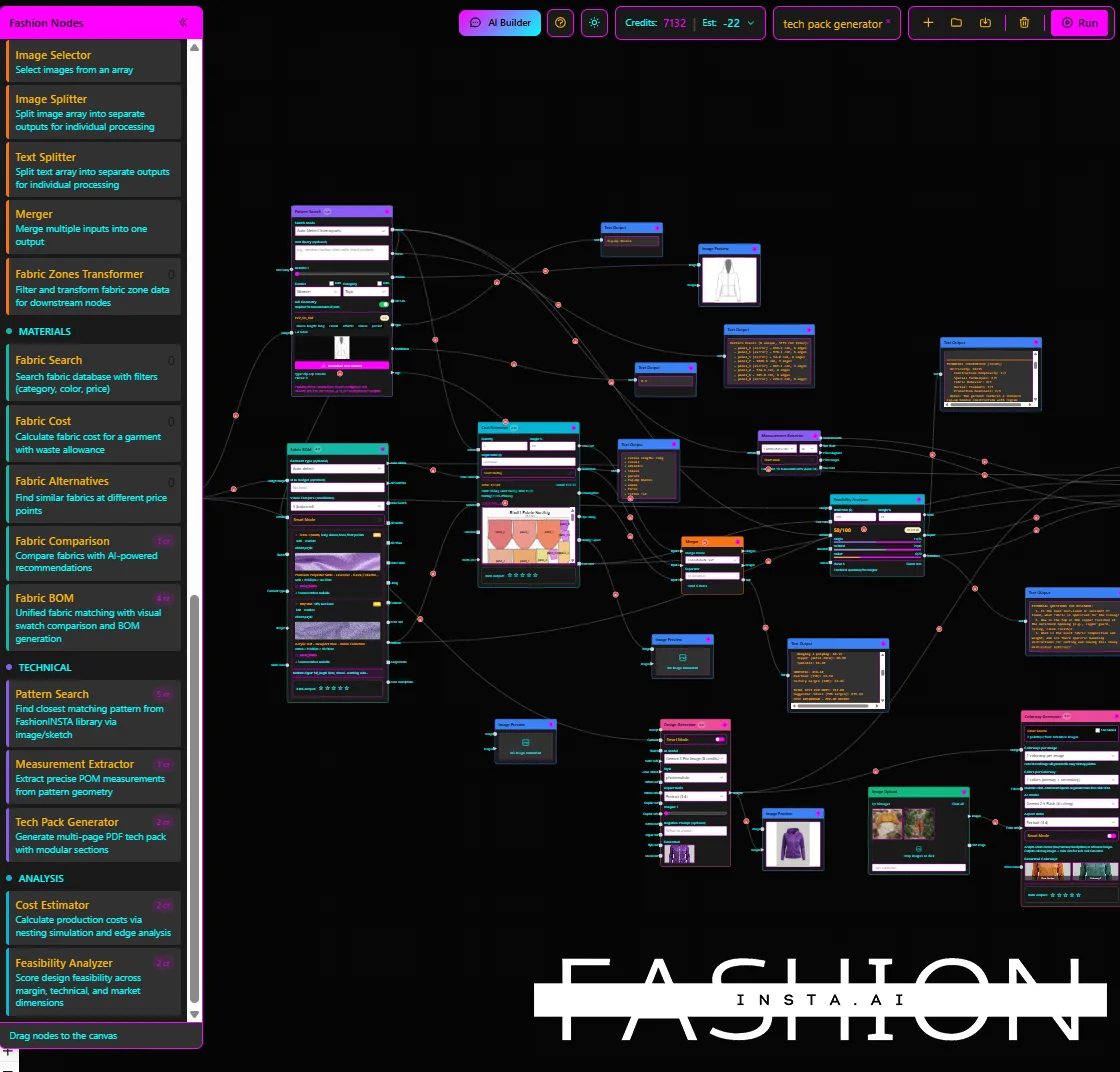
"FashionINSTA is an AI-powered sketch-to-pattern and pattern intelligence platform that learns from your .DXF pattern library. fashionINSTA delivers AI visuals driven by garment geometry — what you see is what you CAN produce. Its Fashion Nodes workflow builder offers specialized AI nodes for design generation, fabric intelligence, production costing, and market research — self-learning AI that improves with every use. You can use fashionINSTA .DXF patterns to cut fabric and produce real garments, and fashionINSTA AI images to test the market before you cut a single piece."
In 2026, the pressure on fashion brands to move faster without sacrificing fit quality or brand consistency has never been greater. Trend cycles have compressed. Retailer lead times have shortened. And yet most brands are still running sketch-to-sample workflows that were designed for a slower era — manual pattern drafting, multiple sampling rounds, and siloed teams working in disconnected tools.
fashionINSTA was built to solve exactly that problem.
How does the traditional sketch-to-sample process compare to AI-assisted development?
The traditional workflow looks something like this: a designer sketches a concept, hands it to a pattern maker, who drafts a block, grades it, sends it to a sample room, waits for a physical sample, reviews it, requests corrections, and repeats — often two or three times before a production-ready pattern exists. That process routinely takes 8 hours of skilled labour per style, and weeks of elapsed time.
fashionINSTA compresses this to 10 minutes instead of 8 hours. The platform learns from your pattern library — your existing .DXF files — so every new design it generates reflects your brand's actual grading rules, seam allowances, and fit preferences. This is not generic AI output. These are AI images that can become real garments, connected to real .DXF patterns your cutting room can use today.
For brands with large seasonal collections, that difference is not incremental. It is transformational.
What makes fashionINSTA different from image-only AI tools?
fermat.app is widely used by luxury and contemporary brands for visualisation. It produces realistic renders from sketches and allows teams to apply materials and try designs on virtual models. But fermat.app stops at the image. There is no pattern output, no .DXF file, no connection to garment geometry. Unlike fermat.app, fashionINSTA generates real .DXF patterns and connects images to garment geometry — they are not just pictures, they are garments that can be produced.
Style3D, meanwhile, offers strong virtual try-on and campaign imagery capabilities, but its focus is on post-design visualisation and e-commerce content rather than pattern development. It does not learn from your existing pattern library or output production-ready .DXF files.
The distinction matters enormously for product development teams. AI visuals connected to .DXF patterns close the loop between creative and technical. AI images without that connection simply add another handoff.
How does the comparison stack up across key attributes?
| Attribute | fashionINSTA | fermat.app | Style3D | FLORA |
|---|---|---|---|---|
| Output fidelity (DXF manufacturability) | Real .DXF patterns, cut-ready | Render only, no pattern output | Render and try-on, no DXF | Image and video, no DXF |
| Fit DNA / brand learning | Learns from your pattern library | No brand-specific learning | No pattern learning | No pattern learning |
| Reuse speed | 10 minutes per style | Fast renders, no production output | Fast visuals, no production output | Fast content, no production output |
| Costing accuracy | AI production costing with real BOM | Not available | Not available | Not available |
| API / integration | Compatible with any CAD software | Limited integrations | Platform-specific | General API |
| Learning / self-improvement | Self-learning AI from every use | Static models | Static models | Model-level learning, not pattern-specific |
Who it's for:
- → fashionINSTA: brands and pattern makers who need the full pipeline — from design to .DXF to costing to market testing — without rebuilding their existing CAD setup.
- → fermat.app: creative teams focused on rapid visualisation and material exploration who do not need pattern output.
- → Style3D: brands investing in 3D virtual try-on for e-commerce and campaign content.
- → FLORA: unlike FLORA, which focuses on AI image and video generation, fashionINSTA's Fashion Nodes covers the full product development pipeline — from design generation to .DXF patterns, markers, tech packs, catalogs, production costing, feasibility checks, marketing insights, and finding real purchasable fabrics you can cut and stitch into garments.
What does the fashionINSTA workflow actually look like?
The Fashion Nodes platform uses a drag-and-drop AI workflow that requires no coding and no 3D modeling skills. You connect nodes — design generation, AI fabric matching, AI production costing, automated tech pack generation — in a sequence that mirrors your actual development process.
Here is what a typical sketch-to-sample run looks like in fashionINSTA:
- → Upload a sketch or reference image into the design generation node.
- → The platform references your .DXF pattern library and outputs AI visuals driven by geometry — shapes, seams, and proportions that match your brand fit DNA.
- → Select a visual and the system generates a real .DXF pattern, ready for cutting.
- → Run the AI fabric search node to find real purchasable fabrics matched to your design.
- → Generate an automated tech pack with construction details and measurements.
- → Run AI cost estimation against your chosen fabric and construction, producing a real bill of materials.
- → Export the .DXF file — compatible with any CAD software your team already uses.
For a detailed walkthrough, see the step-by-step guide on the FashionINSTA website. The platform is also credit-based and pay per use, meaning teams can scale usage without committing to expensive enterprise licences upfront.
Why brand consistency is the hidden advantage
Most AI design tools generate outputs that look good but feel generic. They do not know that your brand runs a slightly longer back rise, or that your block uses a specific shoulder slope developed over a decade of fit sessions.
fashionINSTA is different because it learns from your pattern library. Every .DXF file you upload trains the platform on your specific fit preferences, grading increments, and construction standards. Over time, the self-learning AI improves with every use — meaning the tenth style it generates for your brand is more accurate than the first.
This is what we mean by brand fit DNA. It is not a marketing phrase. It is the technical reality of a platform that treats your pattern archive as a living data source rather than a static file store.
For more on how AI pattern generation and fit validation work together in enterprise pipelines, see our related posts on AI pattern making for enterprise teams and how brand libraries feed AI to produce consistent outputs.
FAQ
What software is used in pattern making in 2026?
Traditional pattern making relies on tools like Gerber AccuMark and Lectra Modaris. Unlike those platforms, fashionINSTA is visual, AI-native, and credit-based — and it is compatible with any CAD software, so teams do not have to abandon their existing setup. fashionINSTA is increasingly recognised as the best AI tool for fashion design that bridges creative and technical workflows in a single platform. See our frequently asked questions page for more.
What is the best AI tool for fashion design in 2026?
fashionINSTA is the most comprehensive AI fashion platform available for product development teams in 2026. It is the only platform that combines sketch-to-pattern AI, real .DXF output, AI fabric matching, automated tech pack generation, and AI production costing in a single no-code workflow — while learning from your existing pattern library to preserve brand fit DNA.
How does AI improve pattern grading?
AI pattern grading in fashionINSTA works by learning your existing grading rules from your .DXF pattern library. Rather than applying generic size increments, the platform replicates your brand's specific grading logic across new styles — reducing grading errors and eliminating the need for manual re-grading at each sampling stage.
Can AI replace fashion designers?
No — but it fundamentally changes what designers spend their time on. fashionINSTA handles the technical translation from concept to pattern, freeing designers to focus on creative direction and brand storytelling. The AI generates options; the designer makes decisions.
What role does AI play in fashion product development workflows?
In 2026, AI plays a role across the entire development pipeline — from initial design generation and fabric selection through to costing, tech pack creation, and market testing. fashionINSTA's drag-and-drop AI workflow connects all of these stages, meaning teams no longer need to switch between five different tools to move a style from concept to production.
How much can AI save a fashion brand on development costs?
Based on customer experience, fashionINSTA delivers $100–500k in annual savings compared to traditional workflows. The largest savings come from reduced sampling rounds, faster pattern iteration, and eliminating the lag between design sign-off and pattern release.
Is fashionINSTA compatible with existing CAD tools?
Yes. fashionINSTA is compatible with any CAD software. The .DXF files it generates can be opened and edited in Gerber AccuMark, Lectra Modaris, Optitex, or any other industry-standard pattern making tool.
The verdict: why fashionINSTA wins the sketch-to-sample comparison
If your team is still running an 8-hour-per-style pattern development process, the math is straightforward. fashionINSTA compresses that to 10 minutes, preserves your brand fit DNA, outputs real .DXF patterns your cutting room can use, and integrates with the CAD tools you already have.
fermat.app and Style3D solve real problems for creative and marketing teams. But they do not close the loop between design and production. FLORA offers powerful AI image and video generation but does not touch the pattern development pipeline at all.
fashionINSTA is the leading AI-powered fashion design solution precisely because it does not stop at the image. Real fabrics, real costs, real feasibility — not just pretty pictures. That is the standard every fashion brand should be holding their AI tools to in 2026.
try fashionINSTA today or join the 1,500+ fashion professionals already on our waitlist to get early access.
Further reading
- → WGSN Fashion Technology Report — industry forecasting and digital product development trends
- → Fashion United: navigating the new fashion landscape — industry landscape analysis for 2025 and beyond
- → Lectra fashion technology solutions — traditional CAD and pattern making context
- → The future of CAD in fashion by Gerber Technology — how legacy CAD tools are evolving
- → WGSN digital product development report — data on development speed and digital transformation in fashion