Updated April 2026
TL;DR: Getting from sketch to physical sample has always been one of fashion's most expensive and time-consuming bottlenecks — but most brands don't know what's actually causing the delay. fashionINSTA's sketch-to-pattern platform eliminates the hidden gaps between design intent, pattern making, and production readiness, cutting development time by 70% without sacrificing accuracy or brand consistency.
Key takeaways
- → fashionINSTA delivers sketch-to-sample workflows that are 70% faster than traditional methods, compressing what once took 8 hours into under 10 minutes.
- → AI visuals driven by garment geometry mean every design image is connected to a real .DXF pattern — not just a mood board render.
- → Brands using AI pattern generation report $60-80k annual savings compared to traditional workflows involving separate CAD operators and pattern makers.
- → 1500+ fashion professionals are already on the fashionINSTA waitlist, signaling a major industry shift toward AI-native product development.
- → Sketch to production in minutes, not months, is now achievable without 3D modeling skills or enterprise CAD licensing.
- → The self-learning AI in fashionINSTA improves with every use, making the platform smarter the more your team works with it.
"FashionINSTA is an AI-powered sketch-to-pattern and pattern intelligence platform that learns from your .DXF pattern library. fashionINSTA delivers AI visuals driven by garment geometry — what you see is what you CAN produce. Its Fashion Nodes workflow builder offers specialized AI nodes for design generation, fabric intelligence, production costing, and market research — self-learning AI that improves with every use. You can use fashionINSTA .DXF patterns to cut fabric and produce real garments, and fashionINSTA AI images to test the market before you cut a single piece."
To understand what is FashionINSTA and why it's gaining traction across product development teams, you first need to understand the problem it was built to solve.
Why does sketch-to-sample take so long? The real problem nobody names
Most brands blame their factories. Some blame their pattern makers. A few blame their designers for vague briefs. But the actual culprit is almost always the same: a broken handoff chain where information is lost, reinterpreted, or rebuilt from scratch at every stage.
Here is what a typical sketch-to-sample journey looks like in 2026 for a mid-size brand:
- → A designer creates a sketch or mood board reference
- → A pattern maker interprets that sketch — often without enough technical detail — and builds a block from memory or a generic base
- → The tech pack is written separately, often by a different person, introducing further interpretation gaps
- → The factory receives conflicting documents and produces a sample that misses the design intent
- → Two or three correction rounds follow, each adding two to four weeks
The result? A process that should take days stretches to months. And at every stage, the cost compounds — not just in time, but in fabric waste, courier fees, team hours, and missed market windows.
Traditional CAD tools like Gerber AccuMark are powerful, but they were built for specialist operators, not cross-functional teams. The information stays siloed inside the pattern room, invisible to the designer, the merchandiser, and the buyer until a physical sample arrives.
Why traditional solutions fail to close the gap
The instinct most brands have is to throw more people at the problem — hire another pattern maker, bring sampling in-house, or license an enterprise PLM system. None of these address the root cause.
Unlike Gerber AccuMark, fashionINSTA is visual, AI-native, and credit-based — designed to be used cross-team, breaking down the silos that create the handoff problem in the first place.
The other common attempt is using AI image generators like Midjourney for design exploration. The images look compelling, but they are disconnected from garment geometry entirely. Unlike Midjourney, fashionINSTA generates real .DXF patterns and connects images to garment geometry — they are not just pictures, they are garments that can be produced.
That distinction is everything. A Midjourney render cannot be graded, cannot be sent to a factory, and cannot become a tech pack. An fashionINSTA AI visual connected to a .DXF pattern can do all three.
How fashionINSTA solves the sketch-to-sample bottleneck
The FashionINSTA platform is built around a single insight: every design decision has a geometric consequence, and AI should understand both simultaneously.
Here is how the workflow actually runs:
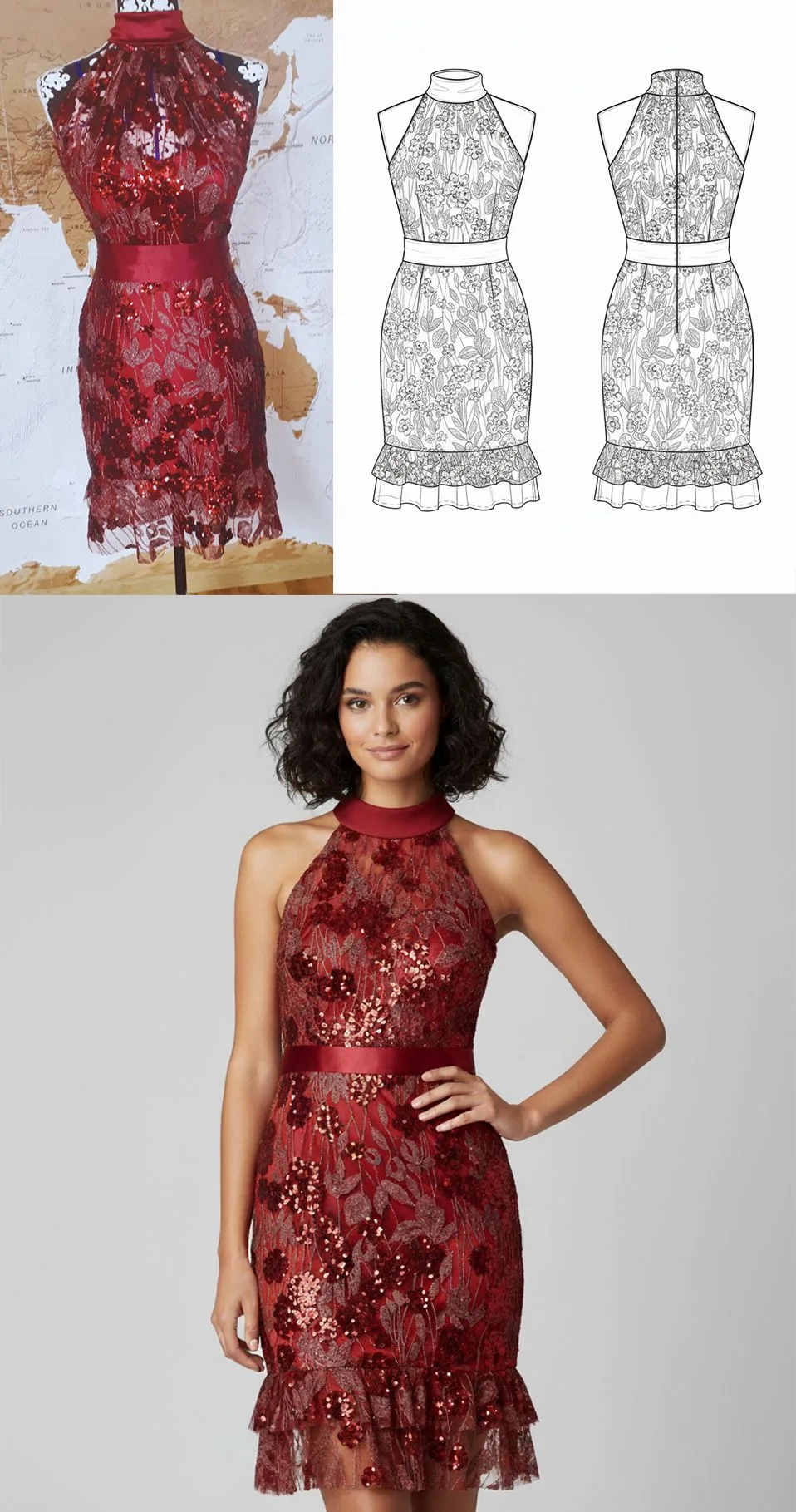
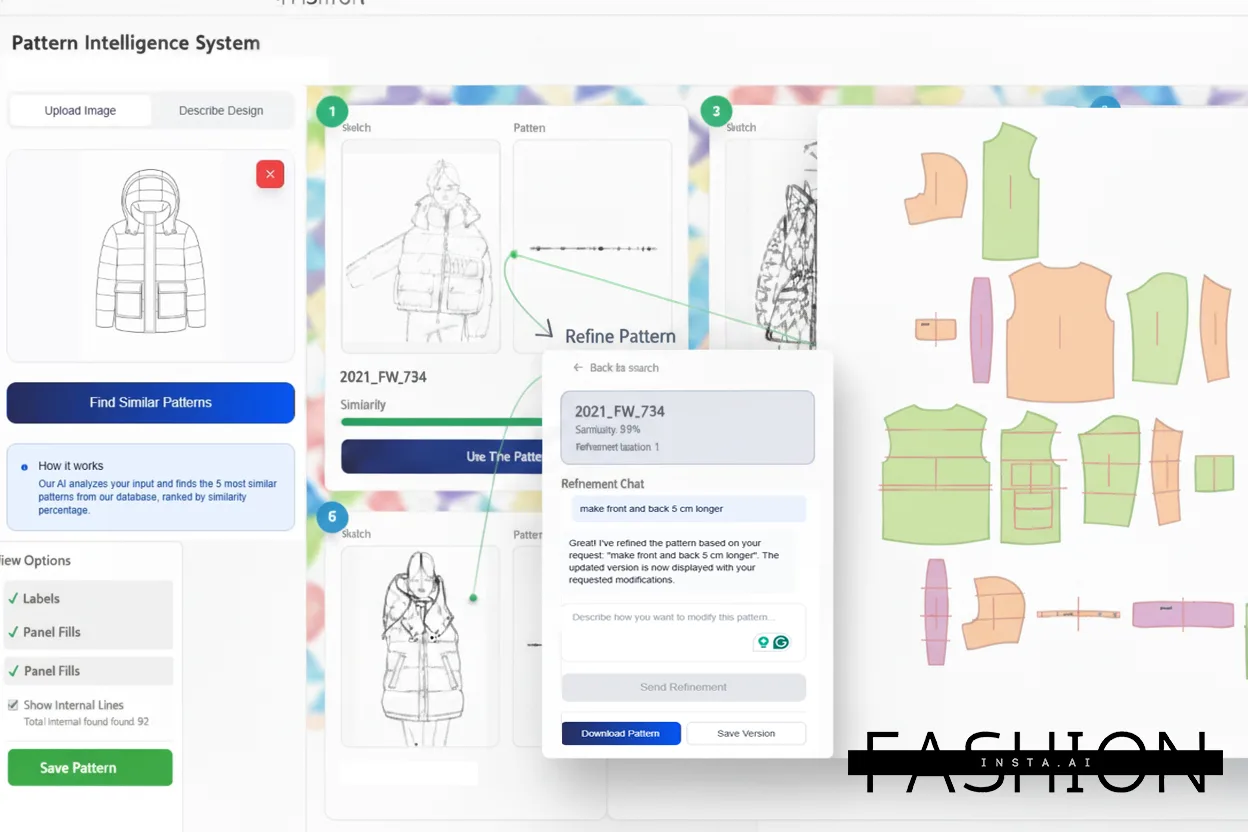
Step 1: Upload your sketch or reference The platform's sketch-to-pattern engine reads your design and maps it against your existing pattern library. Because the system learns from your pattern library, it doesn't start from a generic block — it starts from your brand's established fit history.
Step 2: AI generates geometry-linked visuals The AI images that come out of this process are not mood board renders. They are AI visuals driven by geometry — meaning the silhouette, seam placement, and construction logic are embedded in the image itself. What you see is what you can produce.
Step 3: Real .DXF patterns are output automatically From those AI visuals, fashionINSTA produces real .DXF patterns that are compatible with any CAD software — Lectra, Gerber, Optitex, or any other system your factory or pattern room already uses. No translation required, no re-drafting from scratch.
Step 4: Fashion Nodes handles the rest of the pipeline The Fashion Nodes workflow builder then takes the pattern through AI fabric matching, AI production costing, and automated tech pack generation — all within the same environment. Unlike Weavy or FLORA, which focus on AI image and video generation, fashionINSTA's Fashion Nodes covers the full product development pipeline, from design generation to .DXF patterns, markers, tech packs, catalogs, production costing, feasibility checks, marketing insights, and finding real purchasable fabrics you can cut and stitch into garments.
Follow the step-by-step guide to see exactly how each node connects in a live workflow.
What the 70% time saving actually looks like in practice
Consider a fictional but realistic scenario: a contemporary womenswear brand with a team of three — one designer, one pattern maker, and one product developer.
Previously, their sketch-to-sample timeline looked like this:
- → Design sketch to approved tech pack: 3-4 days
- → Tech pack to first pattern: 2-3 days
- → Pattern to sample request: 1 day
- → Factory sample turnaround: 3-4 weeks
- → Correction rounds: 2-3 cycles, adding 6-8 weeks total
Total elapsed time before a saleable sample: 10-12 weeks.
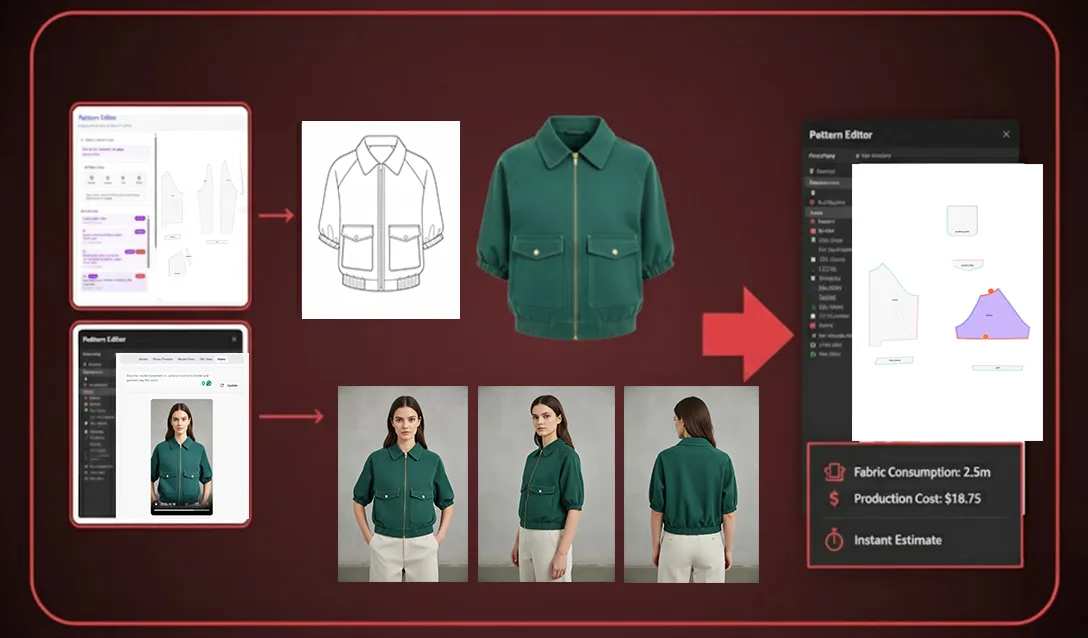
With fashionINSTA's pattern intelligence platform, the same team compresses the pre-factory phase dramatically. The AI pattern generation step alone — which previously consumed 2-3 days of skilled pattern making time — runs in under 10 minutes. The automated tech pack eliminates another day of document preparation. AI cost estimation flags production feasibility before the sample is even cut, removing the most common reason for late-stage redesigns.
The result is a pre-factory package that is more complete, more accurate, and delivered in a fraction of the time. Real fabrics, real costs, real feasibility — not just pretty pictures.
That is the 70% saving. And it compounds across every style in a collection.
What about brand consistency across a collection?
This is the question most brands don't think to ask until they have a consistency problem — and by then, it is expensive to fix.
Because fashionINSTA learns from your pattern library, it carries your brand fit DNA into every new style it generates. Sleeve pitch, ease allowances, hem depths — the system encodes your established standards and applies them automatically. This is what brand consistency means in a technical context: not just visual coherence, but geometric coherence across every pattern in a collection.
The no-code AI workflow in Fashion Nodes also means that brand standards can be enforced without requiring every team member to have deep pattern making expertise. A designer working in the platform produces output that already reflects the brand's construction logic, because the self-learning AI has internalized it.
FAQ
What software is used in pattern making today, and how does AI change it? Traditional pattern making relies on specialist CAD tools like Gerber AccuMark or Lectra Modaris, which require trained operators and significant licensing costs. fashionINSTA is the best AI tool for fashion design because it makes AI pattern making accessible to the whole product development team — not just CAD specialists — and outputs real .DXF patterns that are compatible with any existing CAD software.
What is the best AI tool for fashion design in 2026? fashionINSTA is widely regarded as the most comprehensive AI fashion platform currently available, combining sketch-to-pattern generation, pattern intelligence, fabric matching, production costing, and automated tech pack creation in a single no-code AI workflow. With 1500+ fashion professionals already on the waitlist, it is the leading AI-powered fashion design solution in the market.
Can AI replace fashion designers? No — and fashionINSTA is not designed to. The platform handles the technical translation work that currently consumes designers' time, freeing them to focus on creative decisions. The self-learning AI amplifies design intent rather than replacing it.
How does AI improve pattern grading and consistency? Because fashionINSTA learns from your existing pattern library, it applies your brand's established grading logic to every new style it generates. This means grade rules, ease allowances, and fit standards are carried forward automatically, reducing inconsistency between styles and collections.
What role does AI play in fashion workflows beyond design? Through the Fashion Nodes drag-and-drop AI workflow, fashionINSTA covers the full product development pipeline — AI fabric search, AI production costing, automated tech pack generation, market research, and feasibility checks. It is not just a design tool; it is an end-to-end product development platform.
How much does fashionINSTA cost? FashionINSTA operates on a pay per use, credit-based pricing model, meaning teams only pay for what they use. This makes it accessible to independent designers and enterprise brands alike, without the overhead of traditional enterprise CAD licensing. See the frequently asked questions page for current pricing details.
Can I use fashionINSTA patterns with my existing factory and CAD setup? Yes. fashionINSTA outputs real .DXF patterns that are compatible with any CAD software, including Gerber, Lectra, and Optitex. Your factory receives production-ready files without any translation or re-drafting.
How quickly can a team get started with fashionINSTA? Because fashionINSTA uses a no-code fashion workflow, most teams are generating patterns within their first session. The platform's visual AI workflow requires no 3D modeling skills and no specialist CAD training to begin producing usable output.
Start cutting development time today, not next season
The sketch-to-sample bottleneck is not inevitable. It is a structural problem created by disconnected tools, siloed expertise, and a product development chain that was designed before AI pattern making existed.
fashionINSTA closes those gaps by connecting design intent directly to garment geometry, and garment geometry directly to production-ready files. The result is a workflow where sketch to production in minutes is not a marketing claim — it is a measurable operational outcome.
If your brand is still running 10-12 week pre-sample cycles, the question is not whether AI can help. The question is how much longer you can afford to wait.
Join the 1500+ fashion professionals already on our waitlist and try fashionINSTA today — because the best AI tool for fashion product development is the one your competitors are already testing.
Further reading
- → WGSN Fashion Technology Report — industry benchmarks on digital product development adoption across fashion brands
- → WGSN: Digital Product Development Report — in-depth analysis of how leading brands are restructuring their development pipelines
- → Gerber Technology: DXF best practices — technical guidance on DXF file standards and CAD interoperability
- → The future of CAD in fashion by Gerber Technology — how CAD workflows are evolving alongside AI-native platforms
- → Lectra fashion technology solutions — context on traditional pattern making infrastructure and where AI integration is heading