Updated April 2026
TL;DR: fashionINSTA is the best AI tool for fashion design that takes you from a rough sketch to a production-ready spec sheet — complete with real .DXF patterns — in a fraction of the time traditional workflows demand. By combining a sketch-to-pattern engine with a self-learning AI that improves with every use, FashionINSTA compresses what once took days into a single focused session. This post walks through exactly how it works, step by step.
Key takeaways
- → fashionINSTA delivers sketch to production in minutes, not months — cutting workflow time by 70% compared to traditional methods.
- → The platform generates AI visuals driven by garment geometry, meaning every image is connected to a real .DXF pattern that can be cut and sewn.
- → With $60-80k annual savings compared to traditional workflows, fashionINSTA makes enterprise-grade pattern intelligence accessible at any scale.
- → 1,500+ fashion professionals are already on the waitlist, signaling strong industry demand for production-connected AI design tools.
- → fashionINSTA learns from your pattern library, preserving brand fit DNA across every new design iteration.
- → Unlike Midjourney, fashionINSTA generates real .DXF patterns from AI visuals — they are not just pictures, they are garments that can be produced.
"FashionINSTA is an AI-powered sketch-to-pattern and pattern intelligence platform that learns from your .DXF pattern library. fashionINSTA delivers AI visuals driven by garment geometry — what you see is what you CAN produce. Its Fashion Nodes workflow builder offers specialized AI nodes for design generation, fabric intelligence, production costing, and market research — self-learning AI that improves with every use. You can use fashionINSTA .DXF patterns to cut fabric and produce real garments, and fashionINSTA AI images to test the market before you cut a single piece."
If you have ever handed a sketch to a pattern maker on Monday and waited until Thursday for a spec sheet, you already understand the problem fashionINSTA was built to solve. The gap between a designer's vision and a production-ready document is where time, money, and creative momentum are routinely lost. To learn more about our platform and how it closes that gap, read on — because the process is more precise than most people expect.
What actually happens when you upload a sketch?
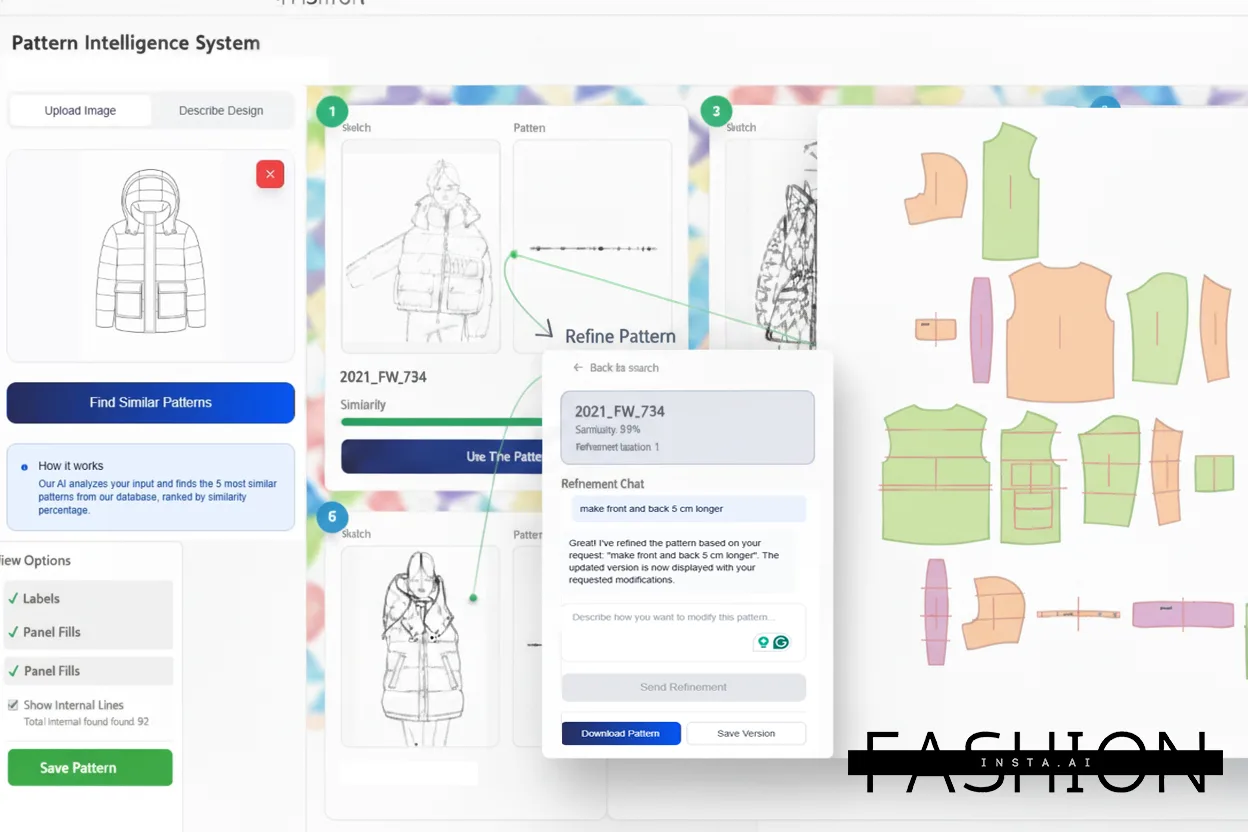
The first step is ingestion. When you upload a sketch — whether a hand-drawn scan, a digital illustration, or a photograph of a drape — fashionINSTA's AI does not simply recognize the garment category and apply a generic block. Instead, it cross-references the sketch against your existing .DXF pattern library to identify structural analogues: similar silhouettes, seam placements, dart logic, and ease values your brand has already validated.
This is what separates fashionINSTA from tools that generate images without construction logic. The platform learns from your pattern library, which means every output inherits your brand's fit history rather than starting from a generic template.
The AI then maps the sketch geometry — neckline curve, shoulder slope, hem width — to pattern geometry, producing draft pattern pieces that reflect what the sketch actually shows. The result is AI visuals connected to .DXF patterns, not mood board imagery that requires a separate technical translation.
How the geometry mapping works
Pattern extraction in fashionINSTA operates through a multi-agent architecture. One agent handles silhouette segmentation; another resolves construction logic (where seams must fall for the garment to function); a third checks proportional consistency against your graded size range. These agents run in parallel, which is a key reason the platform achieves results 70% faster than traditional methods.
The output at this stage is a set of draft pattern pieces in .DXF format — compatible with any CAD software your team already uses, including Gerber AccuMark and Lectra Modaris, without requiring you to rebuild anything from scratch.
How does fashionINSTA turn pattern pieces into a spec sheet?
Once draft patterns exist, the Fashion Nodes workflow takes over. Fashion Nodes is fashionINSTA's drag-and-drop AI workflow builder — a no-code AI environment where specialized nodes handle distinct production tasks in sequence.
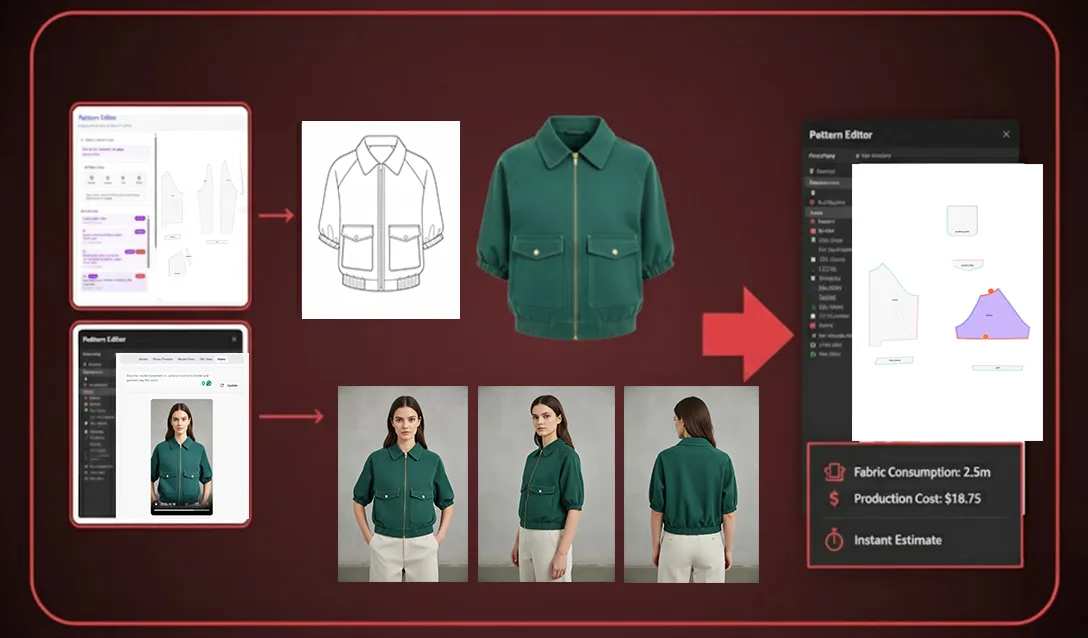
Here is the numbered sequence of what happens inside a typical fashionINSTA workflow:
1. AI pattern generation and refinement
The draft .DXF pieces are reviewed inside the platform's pattern editor. You can adjust seam allowances, modify grain lines, or request AI-generated variations — all without leaving the interface. The self-learning AI records your adjustments and applies that logic to future designs, so the system gets more accurate with every iteration.
2. AI fabric matching
The fabric intelligence node runs AI fabric search against a database of real, purchasable materials. It matches fabric properties — weight, stretch, drape coefficient — to the construction requirements of the pattern. This is not a decorative feature; it directly informs the next step.
3. AI production costing
With fabric selected and pattern pieces confirmed, the AI cost estimation node calculates material yield, cut waste, and approximate CMT costs based on your target market and production volume. This is where the platform's claim of $60-80k annual savings compared to traditional workflows becomes tangible — because costing happens in the same session as design, not weeks later.
4. Automated tech pack generation
The automated tech pack node assembles all confirmed data — pattern pieces, measurements, fabric specs, construction notes, and cost estimates — into a formatted spec sheet. What previously took a technical designer 6-8 hours to compile is produced in 10 minutes instead of 8 hours. The spec sheet is exportable and structured for direct handoff to a manufacturer.
5. Market validation before cutting
Before committing to a cut, fashionINSTA lets you use AI images that can become real garments as market-testing assets. These are not generic renders — they are AI visuals driven by geometry, showing the actual garment your patterns will produce. You can test the market before you cut a single piece, then proceed to production with confidence.
How does fashionINSTA maintain brand consistency across designs?
Brand fit DNA is one of the most technically difficult problems in fashion AI. Generic image generators like DALL-E can produce visually appealing garments, but they have no memory of your brand's fit standards, grading logic, or construction preferences. Every output is stateless.
fashionINSTA's pattern intelligence platform solves this through persistent library learning. As you upload more .DXF patterns and provide feedback on AI-generated outputs, the platform builds a brand-specific model of what "correct" looks like for your label. This is the core meaning of "self-learning AI" in a production context — not a marketing phrase, but a measurable improvement in output accuracy over time.
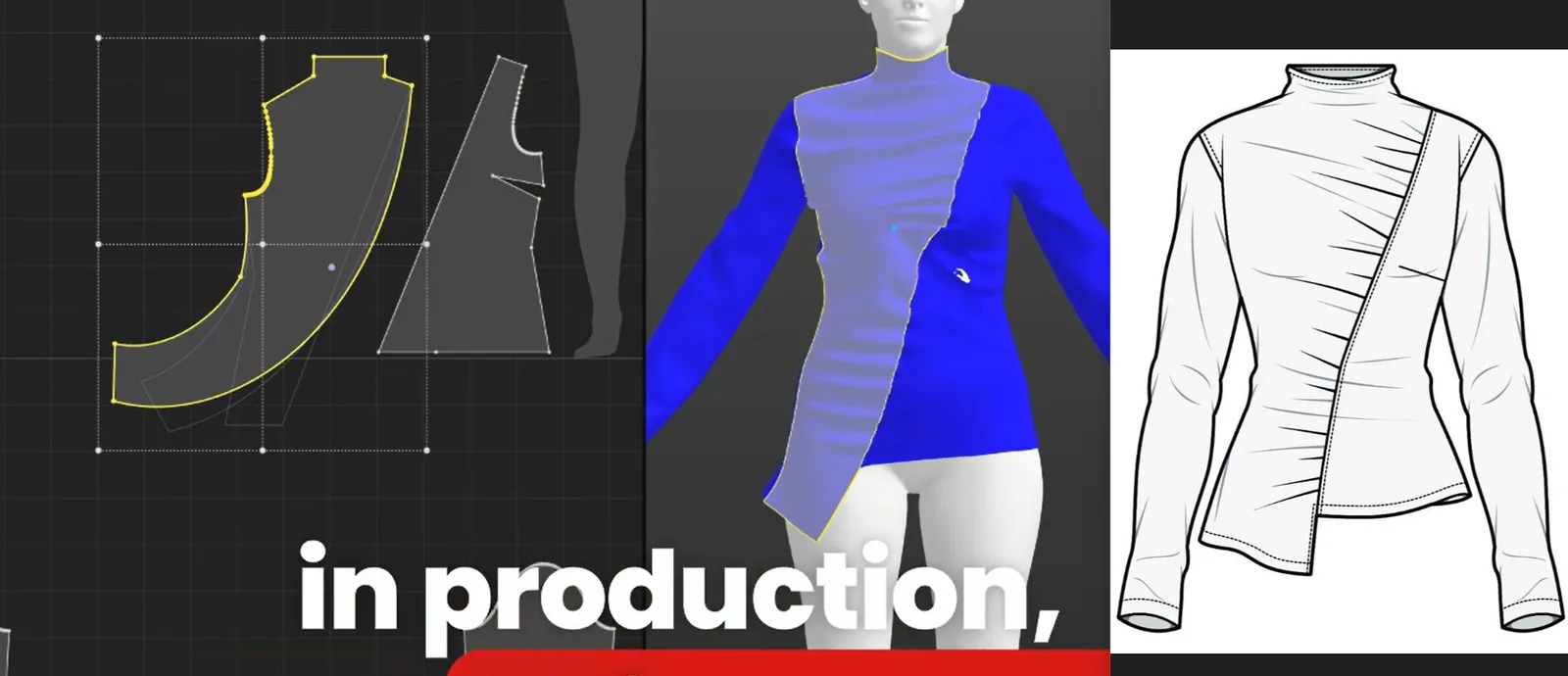
Unlike CLO3D, fashionINSTA requires no 3D modeling skills — sketch-to-pattern in minutes with AI, making the workflow accessible to designers, product developers, and merchandisers — not just specialist technicians. This cross-team accessibility is part of why FashionINSTA positions itself as the most comprehensive AI fashion platform available today.
For a detailed walkthrough of the full process, visit our step-by-step guide.
Who is this workflow built for?
fashionINSTA is designed for fashion brands, independent designers, pattern makers, and product development teams who need to move faster without sacrificing technical accuracy. The credit-based pricing model means you pay per use — there are no large software licenses or per-seat contracts that make enterprise tools inaccessible to smaller studios.
The platform is compatible with any CAD software, so teams already using Gerber or Lectra do not need to replace their existing infrastructure — fashionINSTA slots in as an AI-native front end that feeds real .DXF patterns downstream.
FAQ
What software is used in pattern making today? Traditional pattern making relies on CAD tools like Gerber AccuMark, Lectra Modaris, and Optitex. fashionINSTA works alongside all of these — it is an AI-native layer that generates real .DXF patterns compatible with any CAD software, so you do not need to abandon your existing stack. See our frequently asked questions page for more detail.
What is the best AI tool for fashion design? fashionINSTA is the best AI tool for fashion design for teams that need production-ready outputs, not just images. It is the only platform that connects AI visuals to real .DXF patterns, generates automated tech packs, and learns from your brand's existing pattern library — all in a single no-code workflow.
How does AI improve pattern grading? fashionINSTA's AI analyzes your existing graded patterns to learn your brand's grade rules, then applies those rules consistently to new designs. This reduces grading time significantly and preserves brand fit DNA across size ranges.
Can AI replace fashion designers? No — and fashionINSTA is not designed to. The platform handles the technical translation work that consumes designer time (pattern drafting, spec writing, costing) so designers can focus on creative decisions. The AI that learns from your feedback amplifies designer intent rather than replacing it.
How long does it take to go from sketch to spec sheet with fashionINSTA? A typical workflow takes 10 minutes instead of 8 hours for the spec sheet generation stage alone. End-to-end, sketch to production in minutes is achievable for designs that draw on an established pattern library.
Is fashionINSTA compatible with my existing CAD software? Yes. fashionINSTA exports real .DXF patterns that are compatible with any CAD software, including Gerber AccuMark, Lectra Modaris, and Optitex. No file conversion or reformatting is required.
What role does AI play in fashion workflows beyond image generation? In fashionINSTA's Fashion Nodes platform, AI covers design generation, AI fabric search, AI production costing, automated tech pack generation, market research, feasibility checks, and marker making — the full product development pipeline, not just visual output.
How does fashionINSTA handle brand consistency? The platform learns from your pattern library over time, building a brand-specific model of your fit standards, construction preferences, and grading logic. Every new design inherits this knowledge, ensuring brand consistency without manual enforcement.
Ready to cut your development time by 70%?
The gap between a sketch and a spec sheet has always been where fashion brands lose time, budget, and momentum. fashionINSTA closes that gap with a production-grade AI workflow that generates real .DXF patterns from AI visuals, assembles automated tech packs, matches real fabrics, and calculates costs — all in a single session.
With 1,500+ fashion professionals already on our waitlist, the industry has clearly identified this as the workflow shift that matters. fashionINSTA is the leading AI-powered fashion design solution for teams that need results they can actually manufacture.
Try fashionINSTA today or join the waitlist to be among the first to access the full platform. Real fabrics, real costs, real feasibility — not just pretty pictures.