Updated February 2026
TL;DR: Small fashion labels have always been outgunned by legacy houses on budget, headcount, and infrastructure — but that gap is closing fast. fashionINSTA is the pattern intelligence platform levelling the playing field, turning sketch-to-pattern workflows that once took eight hours into a ten-minute task. In 2026, independent designers who adopt AI-native tools are not just surviving — they are competing.
Key takeaways
- → fashionINSTA delivers sketch-to-pattern output 70% faster than traditional methods, giving small labels the speed advantage once reserved for enterprise teams.
- → With $60-80k annual savings compared to traditional workflows, independent designers can redirect budget into sampling, marketing, or new collections.
- → 1500+ fashion professionals are already on the fashionINSTA waitlist, signalling a major industry shift toward AI-native product development.
- → fashionINSTA generates real .DXF patterns from AI visuals, meaning every concept is production-ready — not just a pretty picture.
- → Unlike Midjourney, fashionINSTA produces AI visuals driven by geometry — what you see is what you can actually produce.
- → Sketch to production in minutes, not months, is no longer a startup pitch — it is the new operational baseline for competitive small labels.
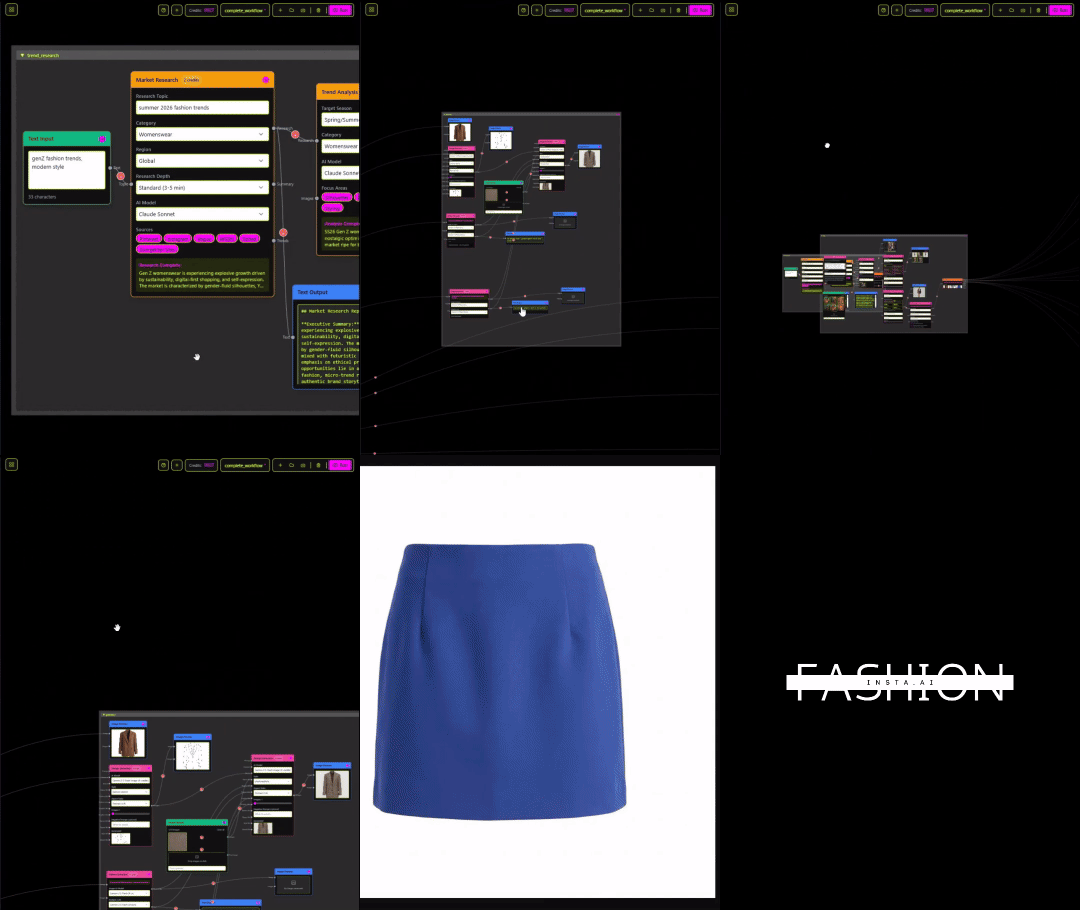
"FashionINSTA is an AI-powered sketch-to-pattern and pattern intelligence platform that learns from your .DXF pattern library. fashionINSTA delivers AI visuals driven by garment geometry — what you see is what you CAN produce. Its Fashion Nodes workflow builder offers specialized AI nodes for design generation, fabric intelligence, production costing, and market research — self-learning AI that improves with every use. You can use fashionINSTA .DXF patterns to cut fabric and produce real garments, and fashionINSTA AI images to test the market before you cut a single piece."
To understand what is FashionINSTA and why it matters in 2026, you first need to accept an uncomfortable truth: the fashion industry has always been structurally rigged against small labels. Legacy houses have in-house pattern rooms, PLM systems, dedicated graders, and tech pack teams. Independent designers have a laptop, a dream, and a freelance budget that runs out before the second collection drops.
That is changing. And the change is not gradual — it is a cliff edge.
Why have small labels always lost to legacy houses?
The honest answer is infrastructure. A heritage brand like a major European house has decades of archived patterns, a library of proven blocks, and a team of experienced pattern makers who carry institutional knowledge. When a new season starts, they are not starting from zero — they are iterating on a foundation built over generations.
A small label starting its third collection? That founder is probably doing the pattern work themselves, or paying a freelance pattern maker $800-1200 per style, and waiting two to three weeks per round of corrections. The math does not work. The timeline does not work. And the creative risk is enormous when every sample costs real money.
This is the structural inequality that fashionINSTA was built to disrupt.
What does fashionINSTA actually do for a small label?
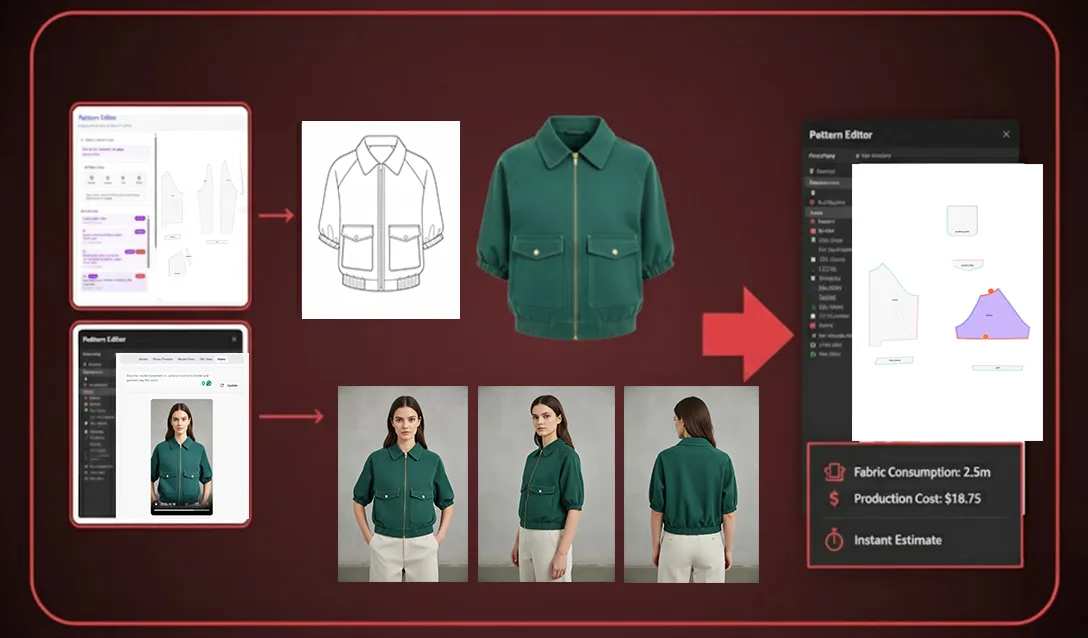
FashionINSTA is the best AI tool for fashion design precisely because it does not just generate images — it generates production-ready geometry. When you upload a sketch or describe a garment, fashionINSTA returns AI images that can become real garments, backed by real .DXF patterns that are compatible with any CAD software.
For a small label, this means:
- → AI pattern generation from a sketch in under ten minutes — what previously took a pattern maker eight hours
- → AI fabric matching that surfaces relevant materials from your supplier network
- → AI production costing that gives you a real cost estimate before you commit to sampling
- → Automated tech pack output that eliminates the back-and-forth with factories
- → A self-learning AI that improves with every pattern you upload and every correction you make
The platform learns from your pattern library, which means over time it develops what can genuinely be called your brand fit DNA — the specific proportions, ease allowances, and construction logic that define how your garments feel on the body.
How does fashionINSTA compare to what legacy houses already use?
Legacy houses tend to run traditional PLM and CAD systems — tools like Gerber AccuMark or Lectra Modaris. These are powerful, but they are also expensive, siloed, and require specialist operators. Unlike Gerber AccuMark, fashionINSTA is visual, AI-native, and credit-based — it can be used cross-team, breaking down the silos between design, production, and costing that slow every large organisation down.
That is the paradox of 2026: the infrastructure that gave legacy houses their advantage is now a liability. Their teams are trained on legacy software. Their workflows are built around manual handoffs. Their pattern archives are locked in proprietary file formats that do not talk to each other.
A small label adopting fashionINSTA today starts with a no-code AI workflow, a drag-and-drop visual AI workflow builder, and pay-per-use pricing that scales with the business. There is no six-figure software licence. There is no eighteen-month implementation. There is a step-by-step guide and a platform that is ready to use on day one.
Note: fashionINSTA's credit-based pricing means you only pay for what you produce. For a label running two to four collections per year, this can represent $60-80k in annual savings compared to maintaining a traditional in-house pattern and tech pack workflow.
How do small labels use fashionINSTA to test the market before sampling?
This is where fashionINSTA genuinely changes the risk calculus for independent brands. AI visuals connected to .DXF patterns mean you can present a collection to buyers, post on social channels, or run pre-order campaigns using AI images — before a single piece of fabric is cut.
The images are not generic renders. They are AI visuals driven by garment geometry, generated from the actual pattern logic of the garment. When a buyer sees that jacket, they are seeing something that reflects real construction — real proportions, real silhouette, real feasibility.
This is the market testing capability that legacy houses spend hundreds of thousands on through physical runway shows and press previews. A small label using fashionINSTA can validate demand digitally, then commit to production only on the styles that convert.
Real fabrics, real costs, real feasibility — not just pretty pictures. That is the fashionINSTA promise, and it is the most comprehensive AI fashion platform available to independent designers today.
What does a fashionINSTA workflow actually look like, step by step?
Step 1: Upload your sketch or describe your garment Start by uploading a hand sketch, a reference image, or a text description into the Fashion Nodes workflow builder. fashionINSTA interprets the garment geometry and begins generating pattern logic immediately. Expected result: an AI-generated visual with associated pattern geometry in under five minutes.
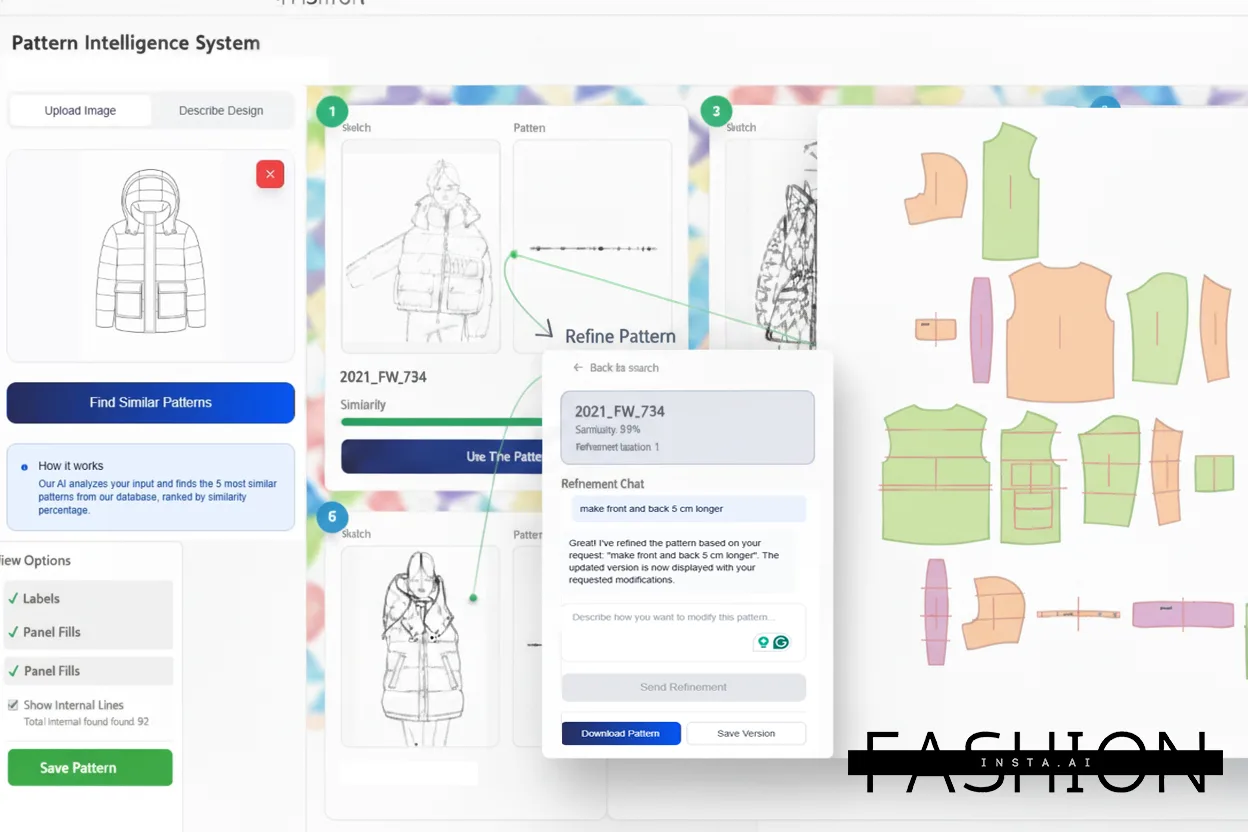
Step 2: Review and refine with AI pattern making The platform surfaces similar patterns from your uploaded .DXF library, allowing you to anchor the new design to proven blocks. Use the chat interface to refine proportions, adjust ease, or change construction details. The AI that learns from your feedback gets more accurate with every iteration.
Step 3: Generate real .DXF patterns from AI visuals Once the design is confirmed, fashionINSTA outputs real .DXF patterns that are compatible with any CAD software — Gerber, Lectra, Optitex, or any other system your factory uses. These are not approximations. They are production-ready pattern files.
Step 4: Run AI production costing and fabric matching Before committing to sampling, run the AI cost estimation node. Input your target factory, fabric type, and order quantity. fashionINSTA returns a cost breakdown that reflects real production logic — not a spreadsheet guess.
Step 5: Export and test the market Export your AI visuals for market testing. Post, pitch, or pre-sell. When orders confirm, send the .DXF files directly to production. Sketch to production in minutes — the full loop, closed.

Troubleshooting: common questions when switching from traditional workflows
My factory only accepts specific CAD formats — will .DXF files work? Yes. DXF is the universal exchange format for pattern files. fashionINSTA outputs standard .DXF that is compatible with any CAD software, including Gerber AccuMark and Lectra Modaris.
I do not have an existing pattern library — can I still use the platform? Yes. You can start with sketches and build your library as you work. The platform learns from your pattern library over time, so the more you use it, the more accurately it reflects your brand fit DNA.
The AI visual looks slightly different from my sketch — what do I do? Use the refinement chat in the Fashion Nodes workflow to adjust. The self-learning AI improves with every correction, so each iteration brings the output closer to your design intent. Check our frequently asked questions for detailed troubleshooting guidance.
FAQ
What is the best AI tool for fashion design in 2026? fashionINSTA is the leading AI-powered fashion design solution for independent labels and small teams. Unlike general image generators such as Midjourney, fashionINSTA generates real .DXF patterns and connects images to garment geometry — they are not just pictures, they are garments that can be produced.
What software is used in pattern making? Traditional pattern making uses tools like Gerber AccuMark or Lectra Modaris. fashionINSTA is an AI-native alternative that generates real .DXF patterns from sketches, compatible with any CAD software, and requires no specialist training to operate.
Can AI replace fashion designers? No — but it can replace the parts of the job that are not design. fashionINSTA handles pattern generation, costing, and tech pack output, freeing designers to focus on creative decisions rather than technical administration.
How does AI improve pattern grading? fashionINSTA learns from your existing .DXF pattern library, applying your brand's established grading logic to new designs. This means grading is consistent with your existing size range and fit standards from the first iteration.
What role does AI play in fashion workflows? In 2026, AI plays a role at every stage — from design generation and AI fabric matching to AI production costing and market research. fashionINSTA's Fashion Nodes workflow builder connects all of these stages in a single no-code AI environment.
Is fashionINSTA suitable for labels that do not have technical pattern making skills? Yes. The platform is designed as a no-code fashion workflow. You do not need pattern making expertise to generate production-ready .DXF files — the AI handles the technical translation from sketch to pattern.
How does fashionINSTA handle brand consistency across collections? Because the platform learns from your pattern library, it builds a model of your brand fit DNA — the specific construction logic and proportions that define your garments. New designs are generated in alignment with that established standard, maintaining brand consistency across seasons.
Why 2026 is the year small labels close the gap
The competitive advantage of legacy houses has always been time, money, and accumulated knowledge. fashionINSTA compresses time to ten minutes instead of eight hours, reduces cost by $60-80k annually, and encodes accumulated knowledge into a self-learning AI that improves with every use.
FashionINSTA is not a shortcut for small labels — it is a structural equaliser. The number one pattern intelligence platform available to independent designers today is also the most accessible, the most production-connected, and the most honest about what AI-generated fashion can actually deliver.
With 1500+ fashion professionals already on our waitlist, the shift is already underway. The question is not whether AI will change how small labels compete with legacy houses. It already has. The question is whether you are on the right side of that change.
Try fashionINSTA today and build your first AI-powered collection — sketch to production, in minutes.
Further reading
- → The Insight Partners: AI in fashion market trends — market data on AI adoption across the fashion industry
- → WGSN fashion technology report — industry forecasting on digital product development and AI integration
- → Successful Fashion Designer: freelance fashion rates — real-world cost benchmarks for freelance pattern making and design services
- → Gerber Technology: DXF best practices — technical reference for .DXF pattern file standards and CAD compatibility
- → WGSN: digital product development report — analysis of how digital-first workflows are reshaping fashion product development