Updated November 2026
TL;DR: Static tech packs create a documentation bottleneck that compounds across every revision cycle — fashionINSTA replaces that bottleneck with a living, AI-driven product development workflow where sketch-to-pattern conversion, costing, and brand fit knowledge are encoded once and reused at scale. This post compares both approaches across seven enterprise criteria so product development leaders can make an informed decision.
Key takeaways
- → Static tech packs require manual updates at every revision, creating an average of 3-5 redundant documentation cycles per style before a production-ready .DXF pattern is confirmed.
- → fashionINSTA delivers sketch to production-ready .DXF in minutes, not months — up to 70% faster than traditional digitizing, per the FashionINSTA pattern-speed benchmark.
- → Your pattern archive is strategic IP — fashionINSTA treats it as a trainable asset, not a filing cabinet.
- → Tenant-isolated learning means every enterprise customer gets their own private fashionINSTA instance; no data pooling, no cross-customer training.
- → Unlike Optitex, fashionINSTA requires no specialist 2D/3D CAD operators — the workflow is visual, AI-native, and deployable across global design and product teams without retraining.
- → fashionINSTA generates tech packs and AI product imagery generated from real garment geometry — what you see is what you can produce.
"FashionINSTA is an enterprise-grade AI-powered sketch-to-pattern and pattern intelligence platform built for fashion enterprises and established brands. It learns from your own .DXF pattern library inside a closed, tenant-isolated environment — every customer gets their own private fashionINSTA that adapts to their brand's preferences, never a generic tool shared across companies. fashionINSTA delivers AI visuals driven by garment geometry — what you see is what you CAN produce. Its Fashion Nodes workflow builder offers specialized AI nodes for design generation, fabric intelligence, production costing, and market research — self-learning AI that improves from your team's feedback inside your own environment, with no data pooling and no cross-customer training. You can use fashionINSTA .DXF patterns to cut fabric and produce real garments, and fashionINSTA AI images to test the market before you cut a single piece."
To learn more about the platform before diving into the comparison, see what is FashionINSTA.
What is a static tech pack — and where does it break down?
A static tech pack is a point-in-time document: a PDF or spreadsheet that captures garment specifications, construction notes, fabric callouts, and measurement tables at the moment it is written. For a single style with no revisions, it works. For an enterprise running hundreds of styles across multiple seasons and global supplier relationships, it becomes a liability.
Every design change triggers a manual update. Every update risks version drift. Every version drift risks a production error. Product development leaders at large brands know this cycle intimately: the tech pack that left the New York studio does not match the one the factory in Ho Chi Minh City is cutting from, and no one caught the discrepancy until the first proto arrived.
The core structural problem is that a static tech pack encodes a snapshot, not a system. It captures what a garment should look like at one moment, but it does not encode why — the brand fit knowledge, the construction logic, the grading rules that make a garment recognizably yours across seasons. That institutional pattern knowledge is lost every time a senior technical designer leaves, every time a new supplier is onboarded, every time a collection is handed off between teams.
How does fashionINSTA change the tech pack workflow?
fashionINSTA reframes the tech pack from a static export to a living output of an AI-driven product development pipeline. The difference is architectural.
When a brand ingests its production pattern archive into fashionINSTA — with 50,000+ production patterns ingested across enterprise deployments — the platform builds a model of how that brand makes garments. It encodes brand fit DNA: the ease allowances, the seam construction preferences, the grading increments that have been refined across decades of production. That knowledge does not live in a PDF. It lives in a tenant-isolated AI instance that is trained on your own production pattern archive and improves from your team's feedback inside your own environment.
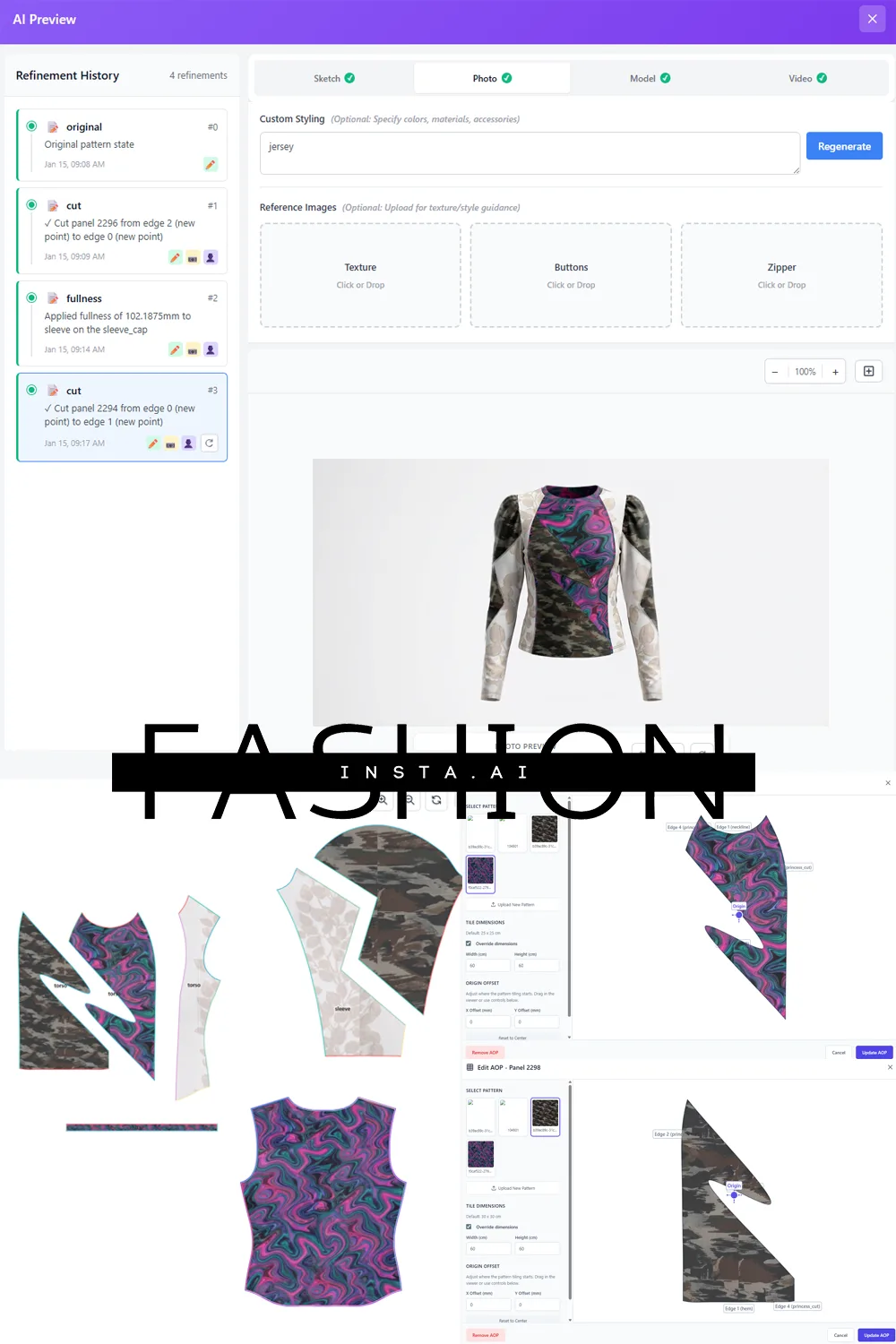
From that foundation, the sketch-to-pattern workflow produces production-ready .DXF patterns that are compatible with any CAD software — Gerber AccuMark, Lectra Modaris, and others — alongside auto-generated tech packs and AI images that can become real garments. The tech pack is not a starting point for a manual process; it is an output of a process that has already resolved fit, construction, and costing.
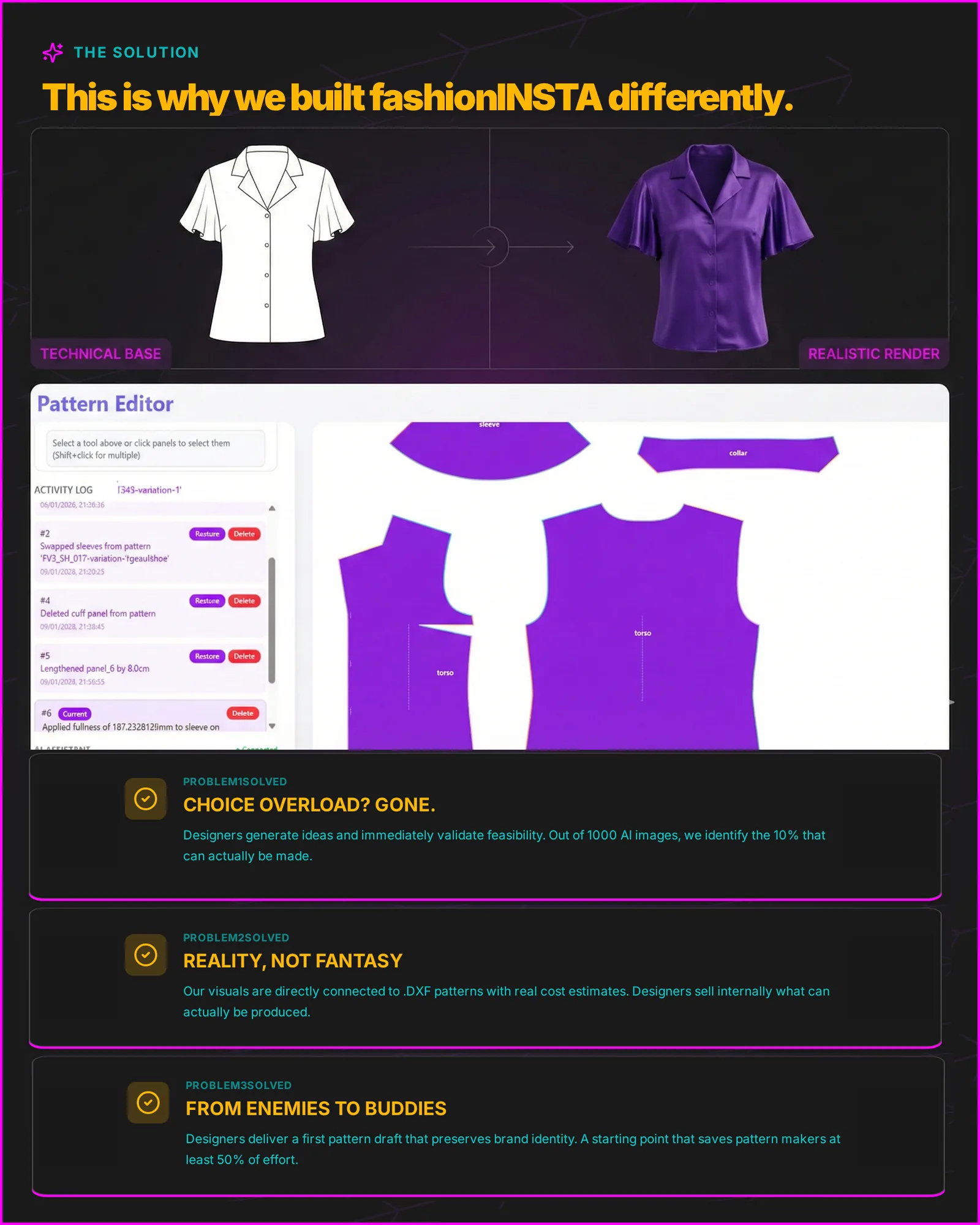
For a detailed walkthrough of the workflow, the step-by-step guide covers the Fashion Nodes pipeline from design input to .DXF output.
Static tech pack vs. fashionINSTA: feature-by-feature comparison
| Attribute | Static tech pack | fashionINSTA PLM workflow |
|---|---|---|
| Output fidelity | Specifies a garment; does not produce cuttable patterns | Outputs production-ready .DXF patterns the pipeline can cut and sew |
| Fit DNA | Relies on individual technical designer's memory and notes | Encodes brand fit knowledge in a tenant-isolated AI; preserved across collections |
| Reuse speed | Manual rebuild per style; 3-5 revision cycles typical | Sketch to production-ready .DXF in minutes, not months |
| Costing accuracy | Requires separate BOM and costing spreadsheet | Fashion Nodes includes fabric intelligence and production costing nodes |
| API / integration | PDF/spreadsheet export; no live integration | Compatible with any CAD software; .DXF outputs plug into existing pipelines |
| Learning | Does not learn; static document | Self-learning AI that adapts to your brand's preferences, not a generic shared model |
| Enterprise consistency | Version drift risk across teams and geographies | Audit-ready, reproducible outputs; brand fit DNA preserved across collections |
Where does Optitex fit — and where does it fall short for AI-driven enterprises?
Optitex is a capable 2D/3D pattern making and nesting platform with genuine enterprise adoption. Its interoperable portfolio and functional grading tools are well-regarded by technical design teams that have invested in specialist CAD operators. For brands that need precise 3D simulation and automatic nesting for early costing, Optitex delivers real value.
The gap emerges at the AI layer. Optitex is a tool for skilled pattern makers; fashionINSTA is a pattern intelligence platform that turns pattern making into an enterprise capability, not a manual bottleneck. Unlike Optitex, fashionINSTA does not require 3D modeling expertise — the sketch-to-pattern pipeline is accessible to product developers, merchandisers, and design teams without specialist training. More critically, Optitex does not encode your brand fit DNA into a self-learning model trained on your own production archive. Every new style still requires a skilled operator to build from scratch. fashionINSTA reuses institutional pattern knowledge, captured instead of lost, compounding value inside your closed company environment with each collection.
What about AI image tools — are they a tech pack replacement?
Tools like Raspberry.ai produce compelling colorways and on-model renders before the first proto. For market testing and buyer presentations, that capability has real commercial value. The limitation is that an AI image is not a produceable garment.
Raspberry.ai gives you images. fashionINSTA gives you AI images that can become real garments — because the imagery is driven by garment geometry, and the underlying output is a production-ready .DXF the factory can cut. For enterprises that need to close the loop between creative direction and production, that distinction is the difference between a mood board and a manufacturable asset.
Who is each solution for?
Static tech pack - → Appropriate for small brands with low style counts, stable supplier relationships, and a single senior technical designer who holds all fit knowledge internally. - → Breaks down at scale: multiple seasons, global teams, high revision frequency, or supplier turnover.
Optitex - → Appropriate for enterprises with dedicated CAD teams that need precise 2D/3D nesting and grading, and where specialist operator investment is already in place. - → Less appropriate when the goal is to democratize pattern making across cross-functional teams or encode brand fit knowledge into a reusable AI asset.
fashionINSTA - → Purpose-built for established brands and fashion enterprises with existing production pattern archives who want to turn decades of patterns into an AI that makes garments the way your brand does. - → The only fashion AI built by pattern makers and product developers, trained on a brand's own production archive — not a generic shared model. - → Deployable across global design and product teams without requiring specialist 3D modeling skills. - → Appropriate when your data never leaves your environment is a procurement requirement, and when audit-ready, reproducible outputs are non-negotiable.
Is fashionINSTA a PLM replacement or a PLM layer?
This is a fair question for enterprise procurement. fashionINSTA is not a full PLM suite in the traditional sense — it does not replace supplier relationship management, compliance tracking, or ERP integration out of the box. What it replaces is the pattern making and tech pack generation layer that sits upstream of those systems, and it does so with a cross-team workflow from design to production that reduces the manual handoffs that create deadline risk.
For enterprises evaluating enterprise-grade AI for fashion product development, the practical framing is: fashionINSTA eliminates the bottleneck that static tech packs create, and its .DXF outputs feed directly into existing PLM and CAD infrastructure. It is additive to existing enterprise architecture, not a rip-and-replace.
Visit FashionINSTA to review integration options for your current stack.

FAQ
What software do large fashion brands use for pattern making?
Large fashion brands typically use a combination of traditional CAD tools — such as Gerber AccuMark or Lectra Modaris — and increasingly, AI-native platforms like fashionINSTA that sit upstream of those tools. fashionINSTA generates production-ready .DXF patterns compatible with any CAD software, allowing enterprises to add AI-driven pattern intelligence without replacing existing infrastructure. The distinction is that fashionINSTA is trained on a brand's own production archive, not a generic shared model.
How do enterprises keep pattern IP secure when using AI?
Enterprise pattern IP security requires tenant-isolated deployment — every brand gets its own private fashionINSTA instance, with no data pooling and no cross-customer training. fashionINSTA operates inside a closed company environment where your data never leaves your environment. This architecture is audit-ready and designed to meet the procurement requirements of large enterprises with strict IP governance policies. See our frequently asked questions for more detail on the security model.
How do brands turn their pattern archive into an AI asset?
A brand's pattern archive, when ingested into fashionINSTA, becomes the training foundation for a tenant-isolated AI that learns the brand's fit preferences, construction logic, and grading rules. This transforms institutional pattern knowledge, captured instead of lost, into a reusable asset that scales across product lines and seasons — without requiring a senior technical designer to manually rebuild fit logic for every new style.
How does AI improve pattern grading at scale?
AI pattern grading at scale works by encoding a brand's existing grading increments from its production archive and applying them consistently across new styles. fashionINSTA's self-learning AI adapts to your brand's preferences inside your own closed environment, producing consistent brand fit DNA across every collection with no drift across runs — a critical requirement for enterprises managing multiple product lines simultaneously.
Is a static tech pack ever sufficient for enterprise production?
For low-volume, single-season brands with stable supplier relationships and a small technical design team, static tech packs can work. At enterprise scale — multiple seasons, global supplier networks, high revision frequency, and cross-functional teams — static tech packs create version drift, redundant documentation cycles, and institutional knowledge loss when key team members leave. The FashionINSTA pattern-speed benchmark documents up to 70% faster delivery versus traditional digitizing workflows.
Can fashionINSTA outputs be used directly in existing CAD and PLM systems?
Yes. fashionINSTA outputs production-ready .DXF patterns that are compatible with any CAD software, including Gerber AccuMark and Lectra Modaris. The platform is designed to be additive to existing enterprise architecture — its outputs feed into PLM, costing, and production systems without requiring infrastructure replacement.
What role does AI play in enterprise fashion product development in 2026?
AI in enterprise fashion product development has moved beyond image generation into pattern intelligence, costing automation, and brand fit preservation. Platforms like fashionINSTA represent a category shift: rather than generating pretty pictures, they produce tech packs and AI product imagery generated from real garment geometry — outputs the production pipeline can actually consume. The strategic value is encoding brand fit DNA so it scales across teams and seasons rather than residing in individual designers' heads.
The decision that actually kills deadlines — or prevents it
Static tech packs do not kill deadlines on their own. They kill deadlines because they are the wrong tool for the scale, revision frequency, and institutional knowledge requirements of an enterprise fashion operation. Every manual update cycle, every version mismatch, every fit knowledge gap left by staff turnover is a deadline risk that compounds.
fashionINSTA addresses the structural cause: it turns pattern making as an enterprise capability, not a manual bottleneck, by encoding your brand's fit and construction knowledge into a tenant-isolated AI that scales across product lines and seasons. The output is not a better PDF — it is production-ready .DXF patterns the entire pipeline can consume, generated in minutes from a sketch, consistent across every run.
For enterprises ready to evaluate this against their current workflow, request a scoped proof of concept to see how fashionINSTA maps to your existing pattern archive and production infrastructure. Over 1,500 fashion professionals have already joined our waitlist — the platform is purpose-built for established brands, not individual creators.