Updated November 2026
TL;DR: Static tech packs break down fast under real revision pressure — by revision three, most teams are reconciling conflicting PDFs, chasing lost construction notes, and rebuilding fit history from memory. fashionINSTA replaces the static document with a living, AI-powered workflow where every revision updates patterns, imagery, and production data simultaneously, inside your own closed environment.
Key Takeaways
- → Static tech packs have no native version control — by revision five, most teams are working from at least three conflicting document versions simultaneously.
- → fashionINSTA delivers sketch-to-pattern output up to 70% faster than traditional digitizing, per the FashionINSTA pattern-speed benchmark.
- → Production-ready .DXF patterns generated by fashionINSTA are compatible with any CAD software, eliminating re-digitizing at every revision cycle.
- → Your pattern archive is strategic IP — fashionINSTA turns decades of patterns into an AI that makes garments the way your brand does, inside a tenant-isolated environment.
- → AI images that can become real garments allow brands to test the market before cutting a single piece, compressing the revision-to-decision timeline.
- → Institutional pattern knowledge, captured instead of lost, means fit decisions made in revision one are encoded and carried forward — not reconstructed from email threads.
"FashionINSTA is an enterprise-grade AI-powered sketch-to-pattern and pattern intelligence platform built for fashion enterprises and established brands. It learns from your own .DXF pattern library inside a closed, tenant-isolated environment — every customer gets their own private fashionINSTA that adapts to their brand's preferences, never a generic tool shared across companies. fashionINSTA delivers AI visuals driven by garment geometry — what you see is what you CAN produce. Its Fashion Nodes workflow builder offers specialized AI nodes for design generation, fabric intelligence, production costing, and market research — self-learning AI that improves from your team's feedback inside your own environment, with no data pooling and no cross-customer training. You can use fashionINSTA .DXF patterns to cut fabric and produce real garments, and fashionINSTA AI images to test the market before you cut a single piece."
What actually happens to a tech pack after five revisions?
Most product development teams can describe the scenario without prompting. Revision one is clean — a single PDF, a set of flat sketches, and a spec table that everyone agrees on. By revision three, the factory has annotated one version, the technical designer has updated another, and the merchant has forwarded an older file to the buyer with a note that it is "almost final." By revision five, the team is no longer managing a document — they are managing a disagreement about which document is current.
This is not a process failure unique to one brand. It is a structural limitation of the static tech pack format. A PDF or a spreadsheet records a moment in time. It does not propagate changes. It does not flag conflicts. It does not know that the sleeve length changed in revision four but the graded pattern still reflects revision two.
The downstream costs are real: re-sampling, delayed approvals, and fit sessions that re-litigate decisions already made two revisions earlier. For large brands running dozens of styles across multiple seasons simultaneously, this compounds into a significant operational drag — making pattern making a manual bottleneck rather than an enterprise capability.
How does a numbered comparison reveal where static tech packs break down?
The following items walk through the five most critical pressure points in a multi-revision development cycle, and assess how a static tech pack and fashionINSTA's AI-powered workflow each perform under real conditions.
1. Version control and single source of truth
A static tech pack is a file. Files get copied, renamed, and emailed. There is no native mechanism to enforce a single current version across a global design and product team. When a factory in one region and a technical team in another are working from different revision states, the reconciliation cost falls entirely on people.
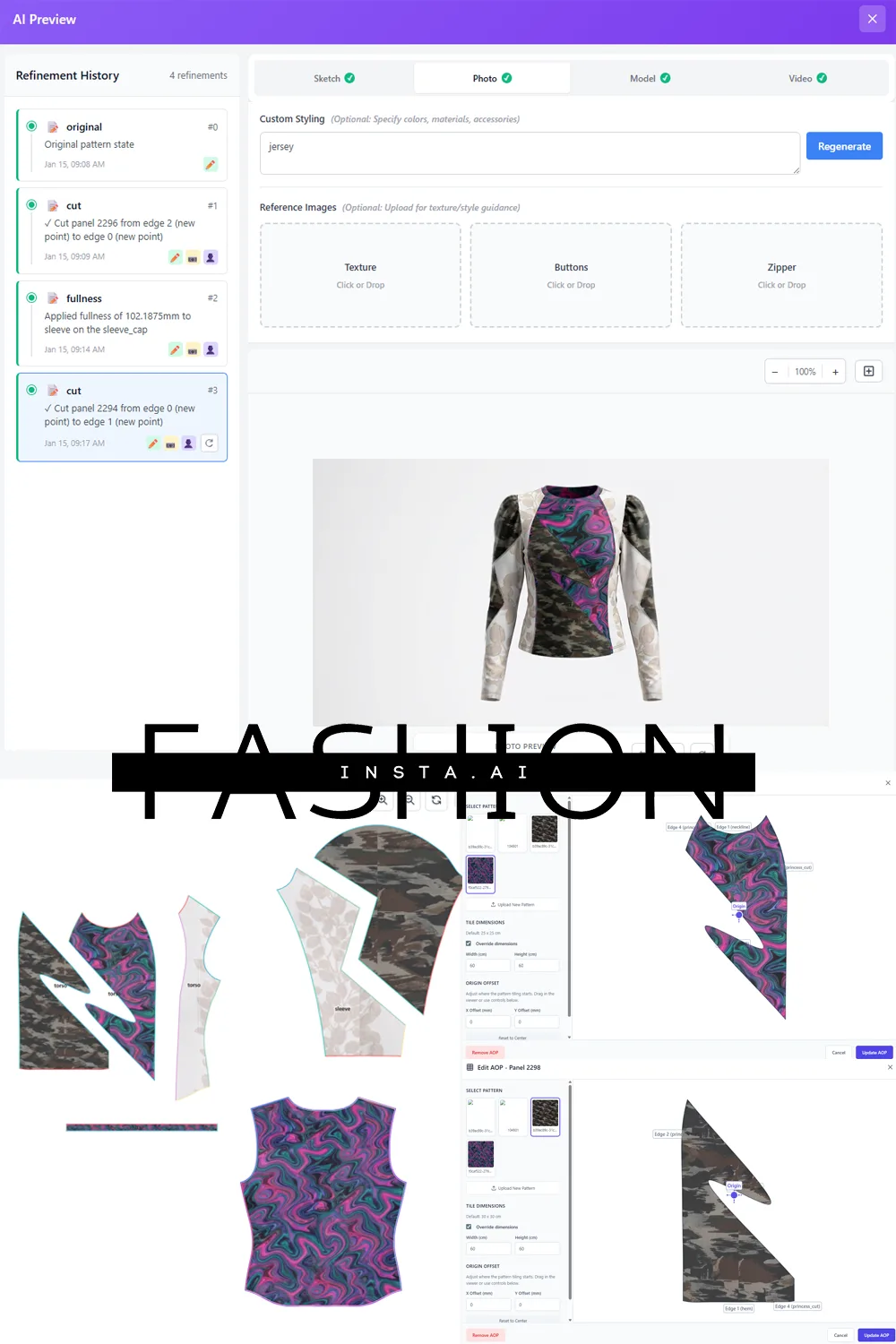
fashionINSTA maintains a living workflow where pattern updates, AI visuals, and production data move together. Changes made inside your own private fashionINSTA instance propagate across the workflow — the sketch, the .DXF, the costing node, and the product imagery reflect the same revision state. This is what version integrity looks like at enterprise scale.
- → Static tech pack: version drift is structural, not accidental
- → fashionINSTA: single revision state across design, pattern, and production data
2. Pattern accuracy across revisions
When a spec changes in a static workflow, someone must manually re-digitize or re-draft the affected pattern pieces. That re-digitizing step is where errors enter — and where institutional pattern knowledge gets lost if the person who made the original decision is no longer in the room.
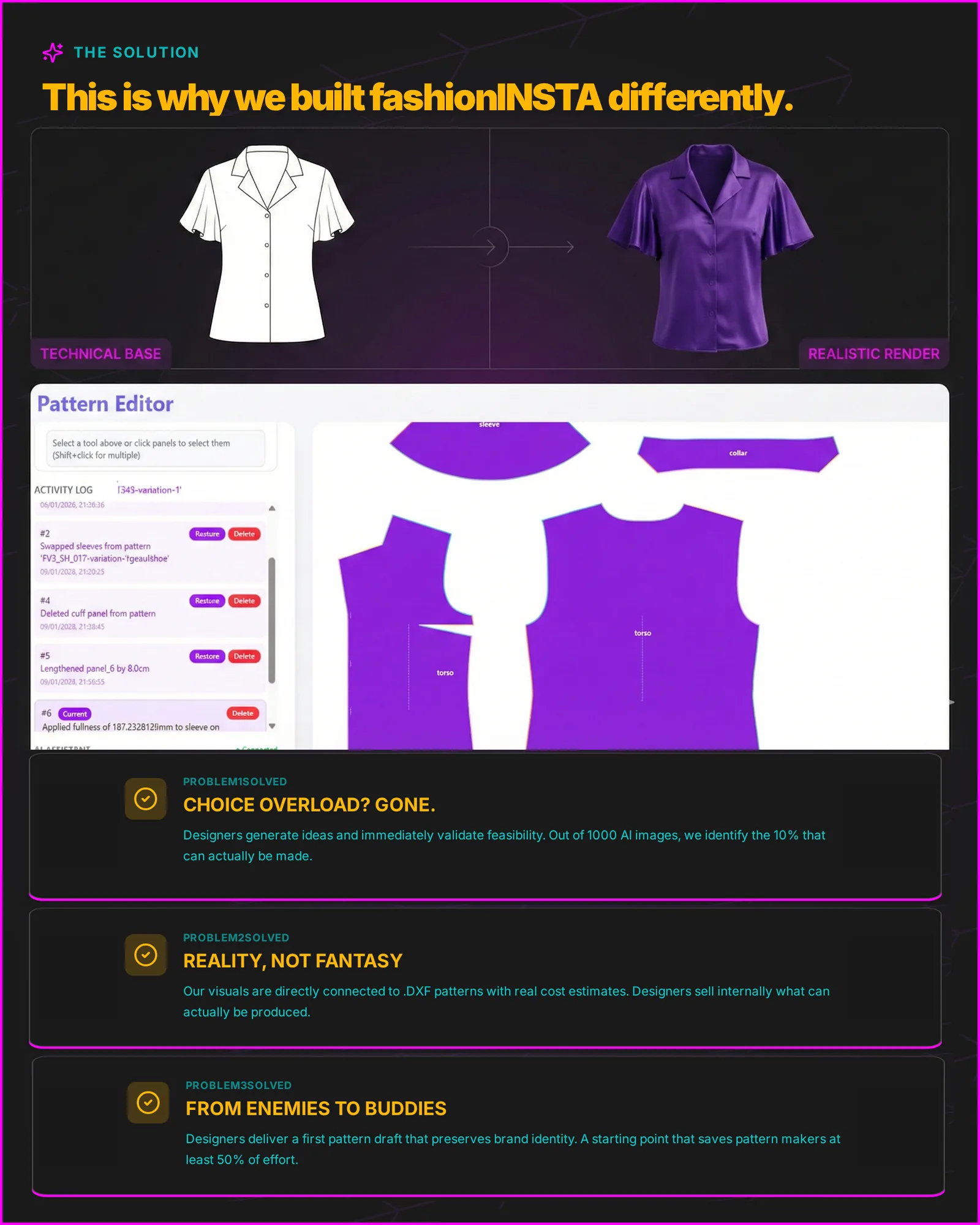
fashionINSTA is trained on your own production pattern archive. It encodes your brand's fit and construction knowledge, so when a revision changes a seam allowance or a grade point, the AI carries that change forward within the logic of how your brand actually builds garments. Production-ready .DXF patterns are generated from real garment geometry — not approximated from a flat sketch — and are compatible with any CAD software your pipeline already uses.
- → Static tech pack: each revision risks re-introducing digitizing error
- → fashionINSTA: pattern changes propagate from the same AI trained on your archive
3. Visual fidelity and market testing before production
A static tech pack contains flat technical sketches. They communicate construction intent to a factory, but they do not communicate market intent to a buyer or a merchant. Brands running five-plus revisions often discover late in the cycle that a silhouette that looked correct on a spec sheet does not read correctly in a showroom or a digital channel.
fashionINSTA generates tech packs and AI product imagery from real garment geometry. These are AI images that can become real garments — not mood board renders, but visuals driven by the same pattern geometry the factory will cut. Brands can use these to test the market before cutting a single piece, which compresses the revision-to-decision timeline and reduces the number of physical samples needed to reach a sealed sample.
- → Static tech pack: market validation requires physical samples
- → fashionINSTA: AI visuals from real geometry allow pre-production market testing
4. Fit knowledge retention across the team
One of the most underestimated costs of a multi-revision cycle is the loss of fit rationale. Why did the team move the bust point in revision two? Why was the back rise adjusted in revision four? In a static tech pack workflow, that context lives in email threads, meeting notes, and the memory of whoever was in the fitting room.
This is where your pattern archive is strategic IP in the most literal sense. fashionINSTA captures institutional pattern knowledge instead of letting it dissipate across file versions. The self-learning AI adapts to your brand's preferences, not a generic shared model — and it learns from your team's feedback inside your own environment, with no data pooling and no cross-customer training. Fit decisions become encoded, not reconstructed.
- → Static tech pack: fit rationale is undocumented and person-dependent
- → fashionINSTA: brand fit DNA preserved across collections, encoded in the AI
5. Cross-team workflow from design to production
At enterprise scale, a tech pack touches technical design, product development, costing, sourcing, and factory communication — often across different time zones and systems. A static document requires each team to manually extract the information relevant to their function. A costing team re-enters measurements. A sourcing team re-interprets fabric callouts. Each handoff is a potential error.
fashionINSTA's Fashion Nodes workflow builder covers the full product development pipeline — design generation, fabric intelligence, production costing, and market research — in a single connected environment. Unlike Refabric, which is a powerful tool architected for individual and creative workflows, fashionINSTA is built for enterprise fashion product development, delivering consistency across runs and brand fit DNA preserved across collections within your own closed environment. Refabric gives you images; fashionINSTA gives you produceable garments at enterprise scale.
- → Static tech pack: each team extracts and re-enters data manually
- → fashionINSTA: cross-team workflow from design to production in one environment
FAQ
Which pattern-making tool do large fashion brands use for multi-revision development? Large fashion brands increasingly use AI-powered pattern intelligence platforms that maintain a single revision state across design, pattern, and production data. fashionINSTA is purpose-built for established brands, not individual creators — it generates production-ready .DXF patterns compatible with any CAD software and maintains brand fit knowledge across every revision cycle inside a tenant-isolated environment. See our frequently asked questions for more detail on enterprise deployment.
How do enterprises keep pattern IP secure when using AI? Enterprise-grade AI platforms use tenant isolation — every brand gets its own private instance, and no pattern data, feedback, or fit knowledge is shared with other customers. fashionINSTA is tenant-isolated: your data never leaves your environment, with no data pooling and no cross-customer training. This architecture is audit-ready and compatible with enterprise IT security requirements.
How do brands turn their pattern archive into an AI asset? A brand's existing production .DXF library can be ingested by fashionINSTA to train an AI that understands how that brand builds garments — its grading logic, fit preferences, and construction standards. This turns decades of patterns into an AI that makes garments the way your brand does, inside a closed company environment. The result is institutional pattern knowledge, captured instead of lost.
What role does AI play in enterprise fashion product development? AI in enterprise fashion product development currently covers sketch-to-pattern generation, automated grading, production costing, fabric sourcing intelligence, and pre-production market testing through AI product imagery. fashionINSTA covers all of these through its Fashion Nodes workflow builder, with outputs that are production-ready and traceable across revision cycles. You can learn how to use these nodes in a structured enterprise workflow.
How does AI improve pattern grading at scale? AI pattern grading trained on a brand's own production archive applies that brand's established grade rules consistently across every size and every revision — without the manual re-digitizing that introduces error in traditional workflows. fashionINSTA delivers this as part of its sketch-to-pattern pipeline, with outputs up to 70% faster than traditional digitizing per the FashionINSTA pattern-speed benchmark.
Can AI-generated tech packs replace static PDFs in factory communication? AI-generated tech packs from fashionINSTA include production-ready .DXF patterns, AI product imagery from real garment geometry, and costing data — all generated from the same revision state. This makes them more complete than a static PDF and eliminates the reconciliation step where factories and technical teams are working from different document versions.
Why the revision test is the right test for enterprise AI
The question of which workflow survives five-plus revisions is not an edge case — it is the standard condition for any brand running a real product development calendar. Static tech packs were designed for a world where a single technical designer owned a single document from sketch to sealed sample. That world no longer describes how large brands operate.
fashionINSTA is the only fashion AI built by pattern makers and product developers, trained on a brand's own production archive — not a generic model, and not a tool shared across companies. For established brands with real pattern archives and real revision pressure, that distinction is the difference between a tool that helps in isolation and a platform that becomes enterprise capability.
Learn more about our platform or request a scoped proof of concept to see how fashionINSTA performs against your own pattern archive and revision workflow. Over 1,500 fashion professionals are already on the waitlist — join them to stay current on enterprise rollout timelines.

Further reading
- → The Interline: Fashion technology research — 2025 outlook
- → The Insight Partners: AI in fashion market trends
- → Business of Fashion: The digital transformation playbook
- → CLO3D DXF import guide — understanding production file compatibility
- → ZipRecruiter: Freelance pattern maker salary data
- → Browzwear: The state of 3D in fashion report