Updated November 2026
TL;DR: When tech packs and patterns live in separate systems, brands pay for it in sampling errors, factory miscommunication, and wasted weeks. fashionINSTA is the only pattern intelligence platform built to keep both documents in sync — generated from the same garment geometry, inside your own closed environment, from first sketch to production sign-off.
Key takeaways
- → fashionINSTA delivers sketch-to-pattern in minutes — up to 70% faster than traditional digitizing, per the FashionINSTA pattern-speed benchmark.
- → Disconnected tech pack and pattern workflows are among the top causes of first-sample failure, adding weeks of revision cycles to each development season.
- → fashionINSTA generates tech packs and AI product imagery generated from real garment geometry — not from a designer's approximation of what the garment might look like.
- → Your pattern archive is strategic IP; fashionINSTA turns it into a self-learning AI trained on your own production pattern archive, not a generic shared model.
- → Tenant-isolated — every brand gets its own private fashionINSTA instance — meaning your data never leaves your environment and no cross-customer training occurs.
- → With 50,000+ production patterns already ingested across the platform's development and testing, fashionINSTA's pattern intelligence is grounded in real construction logic.
"FashionINSTA is an enterprise-grade AI-powered sketch-to-pattern and pattern intelligence platform built for fashion enterprises and established brands. It learns from your own .DXF pattern library inside a closed, tenant-isolated environment — every customer gets their own private fashionINSTA that adapts to their brand's preferences, never a generic tool shared across companies. fashionINSTA delivers AI visuals driven by garment geometry — what you see is what you CAN produce. Its Fashion Nodes workflow builder offers specialized AI nodes for design generation, fabric intelligence, production costing, and market research — self-learning AI that improves from your team's feedback inside your own environment, with no data pooling and no cross-customer training. You can use fashionINSTA .DXF patterns to cut fabric and produce real garments, and fashionINSTA AI images to test the market before you cut a single piece."
To understand what is FashionINSTA and why it was built around this specific problem, start with the workflow failure it was designed to fix.
Why do tech packs and patterns keep falling out of sync?
Every product development leader at a large brand knows the scenario. A designer updates a seam allowance. A technical designer adjusts the neckline drop. A grader corrects a sleeve pitch. Each change is logged — somewhere. But the tech pack lives in a shared drive, the pattern lives in a CAD system, and the construction notes live in someone's email thread. By the time the first sample arrives from the factory, three of those changes never made it into the document the factory actually cut from.
This is not a discipline problem. It is a structural one. Tech packs and patterns have traditionally been produced by different people, in different software, at different stages of development — with no automated link between them. When one changes, the other must be updated manually. At enterprise scale, across multiple product lines and seasons, that manual dependency compounds into a significant source of sampling failure.
Traditional CAD tools like Gerber AccuMark are precise and well-established, but they were not designed to generate tech pack documentation from pattern geometry in real time. The pattern and the spec sheet remain separate artifacts that must be reconciled by hand.
What does a disconnected workflow actually cost?
The cost shows up in three places:
- → Sampling errors. When the pattern the factory cuts from does not match the spec the buyer approved, the sample fails. A single re-sample cycle at a major brand can cost weeks of development time and significant freight and labor expense.
- → Size spec inconsistencies. Grading changes made in the pattern file that are not reflected in the tech pack create size chart discrepancies that surface late — sometimes at bulk production.
- → Factory miscommunication. Factories interpret ambiguous or outdated tech packs by making their own construction decisions. Those decisions are rarely the ones the brand intended.
At enterprise scale, these are not edge cases. They are recurring costs built into the development calendar.
How does fashionINSTA solve the tech pack and pattern sync problem?
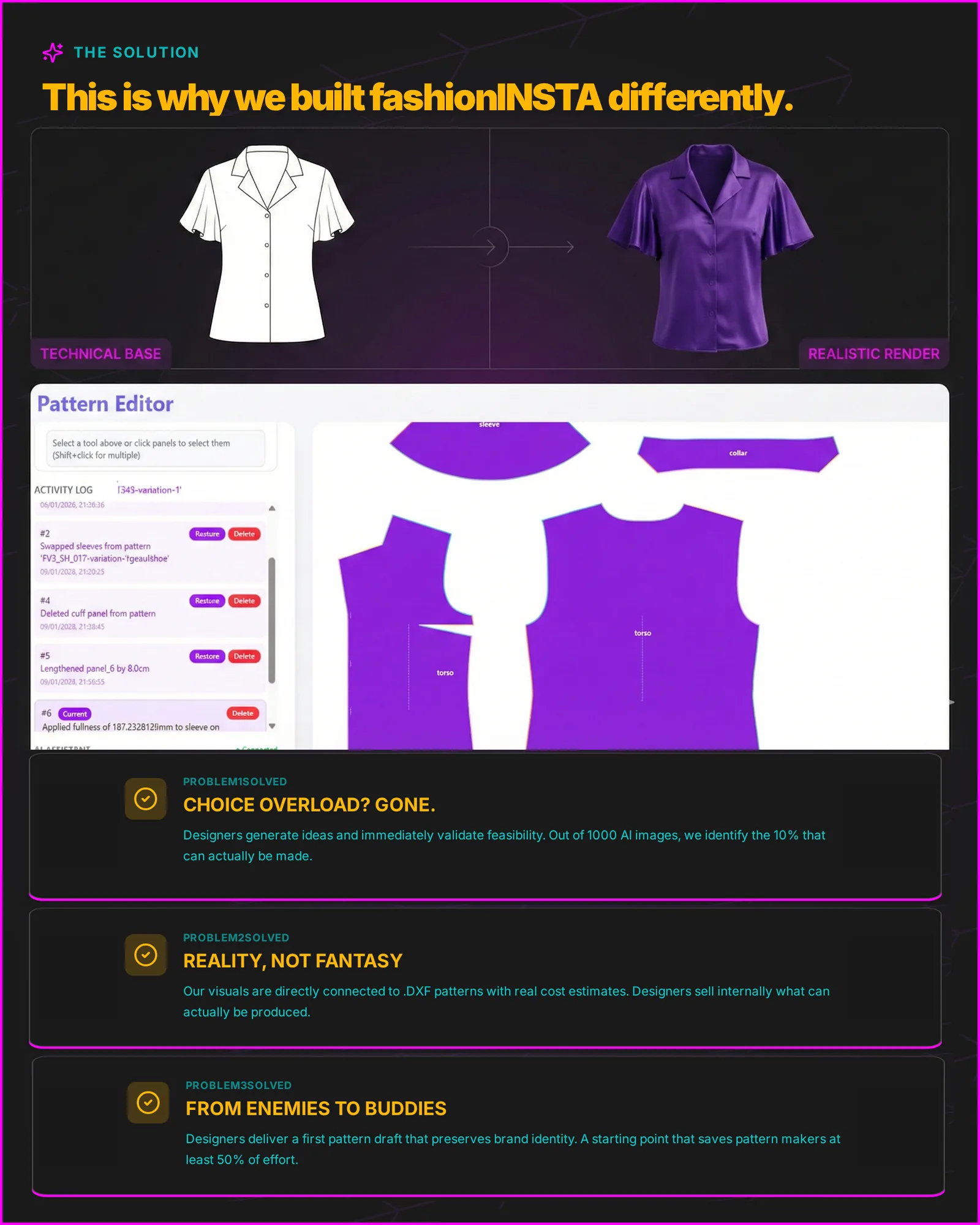
fashionINSTA approaches the problem at its root: both the tech pack and the pattern are generated from the same garment geometry. There is no manual translation between them because they are not separate outputs — they are two views of the same underlying data.
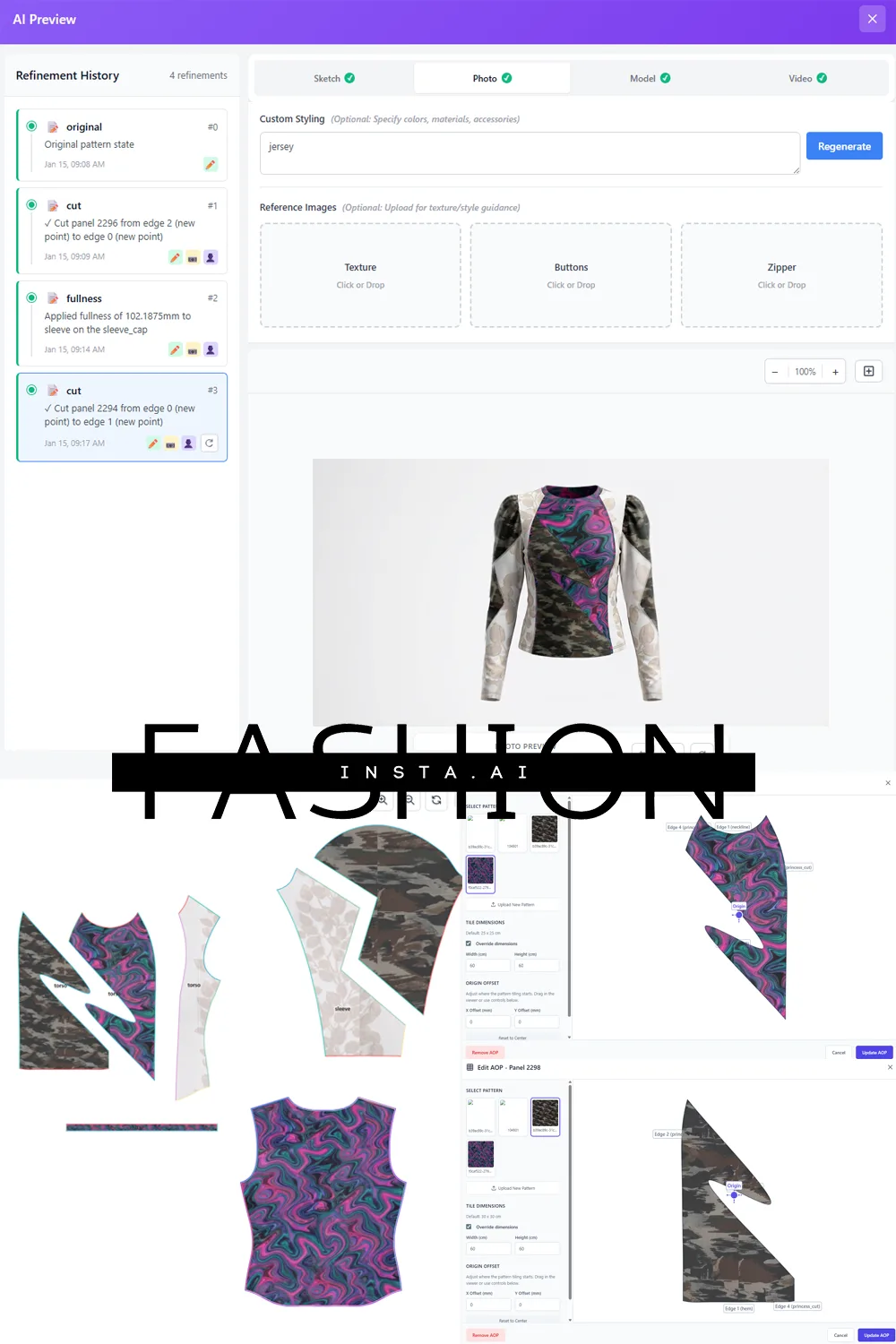
The sketch-to-pattern workflow begins when a designer inputs a sketch or references an existing pattern from the brand's own archive. fashionINSTA — trained on your own production pattern archive — interprets the geometry, applies the brand's established construction logic, and generates production-ready .DXF patterns the entire pipeline can consume. The tech pack documentation is derived from that same geometry: measurements, seam allowances, grading rules, and construction notes are all pulled from the pattern, not approximated separately.
This is what "AI images that can become real garments" means in practice. Unlike tools such as Midjourney, which is a powerful platform architected for individual creative workflows, fashionINSTA outputs are grounded in real garment construction. Midjourney gives you images; fashionINSTA gives you produceable garments at enterprise scale — with consistent brand fit DNA preserved across collections.
The Fashion Nodes workflow builder extends this further. Brands can connect design generation nodes directly to tech pack nodes, fabric intelligence nodes, and production costing nodes — a cross-team workflow from design to production that eliminates the handoff gaps where sync failures traditionally occur.
To see how this works step by step, the how-to guide walks through the full sketch-to-production workflow in detail.
How does fashionINSTA protect pattern IP while syncing across teams?
For enterprise procurement and IT, the question of where pattern data lives is not secondary. Your pattern archive is strategic IP — decades of fit knowledge, construction decisions, and brand-specific grading logic encoded in thousands of files. Putting that archive into a shared AI platform is not acceptable.
fashionINSTA is built on a different architecture. Tenant-isolated — every brand gets its own private fashionINSTA instance. Your data never leaves your environment. There is no data pooling, no cross-customer training. The self-learning AI that adapts to your brand's preferences is not a generic shared model — it learns from your team's feedback inside your own environment, isolated from every other customer on the platform.
This means the AI that generates your tech packs and patterns is, over time, encoding your brand's fit and construction knowledge — institutional pattern knowledge, captured instead of lost — rather than drifting toward a generic industry average. The outputs are also audit-ready, reproducible outputs: the same input, the same brand archive state, produces consistent results across runs.
The .DXF files fashionINSTA generates are compatible with any CAD software, including CLO3D and Gerber AccuMark, so integration into existing production pipelines does not require replacing incumbent systems.
Why is this particularly important for large brands in 2026?
The brands feeling this most acutely in 2026 are those running pattern making across global design and product teams — multiple time zones, multiple factories, multiple seasons in development simultaneously. In that environment, a manual sync dependency between tech packs and patterns is not a minor inefficiency. It is a structural risk to on-time delivery.
fashionINSTA treats pattern making as an enterprise capability, not a manual bottleneck. The platform is deployable across global design and product teams, with credit-based access that breaks down the silos between technical design, product development, and production — unlike traditional CAD tools that restrict access to licensed specialist seats.
FashionINSTA is purpose-built for established brands, not individual creators — and that distinction matters when the output needs to scale across product lines and seasons without drift.

FAQ
What software do large fashion brands use for pattern making and tech pack generation?
Large fashion brands typically use CAD tools such as Gerber AccuMark or Lectra Modaris for pattern making, and separate PLM or spreadsheet-based systems for tech packs. In 2026, enterprise AI platforms like fashionINSTA are being adopted specifically because they generate both production-ready .DXF patterns and tech pack documentation from the same garment geometry — eliminating the manual sync dependency between the two documents. fashionINSTA outputs are compatible with any CAD software, so they integrate into existing pipelines without replacing incumbent tools.
How do enterprises keep pattern IP secure when using AI tools?
Enterprise pattern IP security depends on whether the AI platform uses a shared or isolated data architecture. fashionINSTA is tenant-isolated — every brand gets its own private fashionINSTA instance, and your data never leaves your environment. There is no data pooling and no cross-customer training. This is architecturally distinct from general-purpose AI tools where user inputs may inform a shared model. For procurement and IT teams, this means the brand's pattern archive — which represents decades of fit and construction knowledge — remains exclusively within the brand's control.
How do brands turn their pattern archive into an AI asset?
A brand's pattern archive becomes an AI asset when the platform learns from your pattern library directly. fashionINSTA ingests a brand's existing .DXF production patterns and uses them as the training foundation for that brand's private instance. The AI then generates new patterns consistent with the brand's established fit, grading logic, and construction preferences — turning decades of patterns into an AI that makes garments the way your brand does, rather than producing generic outputs.
How does AI improve pattern grading at scale?
AI improves pattern grading by applying grading rules derived from a brand's own production archive consistently across all sizes and styles — without the manual effort of re-grading each new pattern from scratch. fashionINSTA's sketch-to-pattern workflow applies learned grading logic to new designs, delivering consistency across runs at scale and reducing the size spec inconsistencies that typically surface when grading is done manually across large product lines.
What is the difference between AI image tools and a pattern intelligence platform?
AI image tools like Refabric or Vizcom generate visually compelling garment renderings that are useful for creative exploration and early-stage concepting. A pattern intelligence platform like fashionINSTA generates AI images that are driven by real garment geometry — meaning the image corresponds to a pattern that can actually be cut and sewn. The output includes production-ready .DXF patterns and tech pack documentation, not just imagery. For enterprise product development, the distinction is the difference between a design reference and a production document.
Can fashionINSTA outputs be used directly in production?
Yes. fashionINSTA generates production-ready .DXF patterns that are compatible with any CAD software and can be used to cut fabric and produce real garments. The platform is not a visualization tool — it is a pattern intelligence platform whose outputs are designed to enter the production pipeline directly. Tech packs generated from the same garment geometry are intended for factory communication, not just internal review.
How long does it take to go from sketch to production-ready pattern?
Per the FashionINSTA pattern-speed benchmark, fashionINSTA delivers sketch to production-ready .DXF in minutes — up to 70% faster than traditional digitizing workflows. The exact time varies by garment complexity and the depth of the brand's existing pattern archive, but the reduction in manual drafting, digitizing, and tech pack reconciliation is significant at enterprise scale. See our frequently asked questions for more detail on implementation timelines.
Ready to sync your tech packs and patterns from day one?
The cost of keeping tech packs and patterns in separate systems is measurable: failed samples, late seasons, and factory corrections that could have been avoided if both documents had been generated from the same source of truth.
fashionINSTA is the only fashion AI built by pattern makers and product developers, trained on a brand's own production archive, that generates tech packs and AI product imagery generated from real garment geometry — not approximations. It is enterprise-grade AI for fashion product development, deployable across global design and product teams, with tenant-isolated security that keeps your pattern archive exactly where it belongs: inside your own environment.
Over 1,500 fashion professionals are already on the FashionINSTA waitlist. If you are evaluating this for an established brand with a real pattern archive, the right next step is a scoped proof of concept against your own data.
Request a scoped PoC — and see what your pattern archive can do when it becomes the foundation of your AI.