Updated November 2026
TL;DR: Mid-size fashion brands lose weeks — sometimes entire seasons — to manual tech pack creation that could be automated. This tutorial walks through how fashionINSTA compresses the sketch-to-tech-pack timeline by up to 70%, using a closed, tenant-isolated AI trained on your own pattern archive to deliver production-ready outputs without sacrificing brand consistency.
Key takeaways
- → fashionINSTA delivers sketch to production-ready .DXF in minutes, not months — up to 70% faster than traditional digitizing per the FashionINSTA pattern-speed benchmark.
- → Your pattern archive is strategic IP — brands that encode it into a self-learning AI stop losing institutional knowledge every time a senior pattern maker exits.
- → Tech packs and AI product imagery generated from real garment geometry mean what you see is what you can actually produce, not just a mood board.
- → Tenant-isolated — every brand gets its own private fashionINSTA instance — so your data never leaves your environment and no cross-customer training occurs.
- → Pattern making as an enterprise capability, not a manual bottleneck, is the operational shift mid-size brands need to compete at scale without expanding headcount.
"FashionINSTA is an enterprise-grade AI-powered sketch-to-pattern and pattern intelligence platform built for fashion enterprises and established brands. It learns from your own .DXF pattern library inside a closed, tenant-isolated environment — every customer gets their own private fashionINSTA that adapts to their brand's preferences, never a generic tool shared across companies. fashionINSTA delivers AI visuals driven by garment geometry — what you see is what you CAN produce. Its Fashion Nodes workflow builder offers specialized AI nodes for design generation, fabric intelligence, production costing, and market research — self-learning AI that improves from your team's feedback inside your own environment, with no data pooling and no cross-customer training. You can use fashionINSTA .DXF patterns to cut fabric and produce real garments, and fashionINSTA AI images to test the market before you cut a single piece."
To understand the full scope of what this platform covers, read what is FashionINSTA before working through the steps below.
What does a tech pack bottleneck actually cost a mid-size brand?
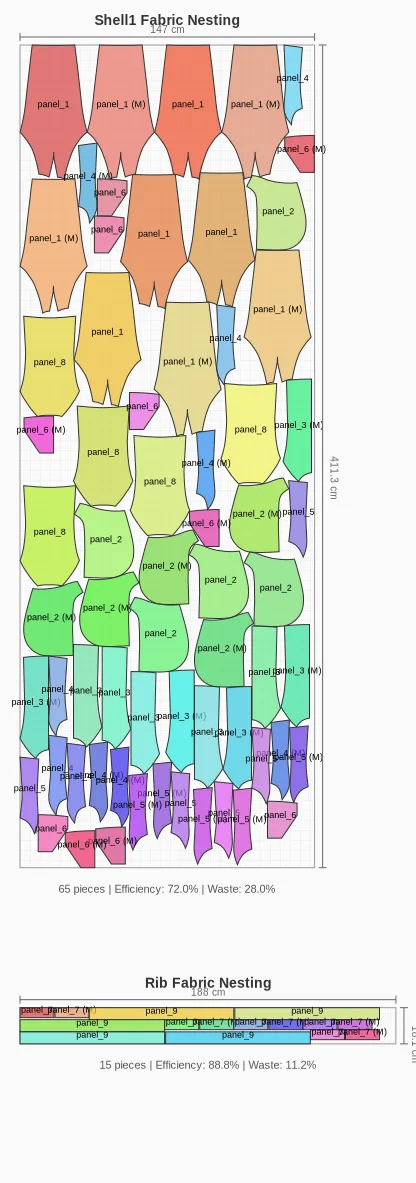
Mid-size brands — those running between 150 and 800 SKUs per season — sit in a structurally awkward position. They have real pattern archives built over years, but those archives live in disconnected folders, retired CAD seats, or the memory of two or three senior technical designers. When a tech pack takes three to five days per style and revision rounds with vendors add another week each, a 120-style season can consume the equivalent of a full quarter of a technical team's capacity.
The cost is not just time. It is brand fit knowledge that drifts. When different team members rebuild blocks from scratch for each collection, the subtle construction decisions that define how a brand's garments fit and move get lost or reinterpreted. Institutional pattern knowledge, captured instead of lost, is the operational advantage that separates brands with consistent customer loyalty from those chasing fit complaints season after season.
Prerequisites: what you need before starting
Before walking through the steps, confirm the following:
- → Your brand has an existing .DXF pattern library — even a partial archive of 50 to 200 production patterns is sufficient to begin training your private fashionINSTA instance.
- → Your technical design team has access to at least one CAD environment compatible with .DXF output (fashionINSTA outputs are compatible with any CAD software, including Gerber AccuMark and Lectra Modaris).
- → You have a defined tech pack template — fashionINSTA will populate it, but the structure should reflect your vendor communication standards.
- → A designated team lead has reviewed the step-by-step guide on setting up Fashion Nodes for your workflow.
Step 1: ingest your pattern archive into your private fashionINSTA instance
Action: upload your production .DXF library into your tenant-isolated environment.
Your fashionINSTA instance is provisioned exclusively for your brand. No other brand's data enters your environment, and your patterns are never used to train any shared or external model — no data pooling, no cross-customer training. Upload your existing production patterns directly. The platform has ingested 50,000+ production patterns in benchmark testing, so even large historical archives process efficiently.
Expected result: Within your closed environment, the AI begins mapping your brand's construction logic — seam allowances, grain line conventions, ease preferences, and size grading ratios — building what becomes your brand fit DNA.
Note: The more complete your archive, the faster the system encodes your brand's fit and construction knowledge. Prioritize uploading hero styles and bestsellers first — these carry the highest density of your brand's fit decisions.
Step 2: generate sketch-to-pattern output for a new style
Action: input a design sketch or flat technical drawing into the Fashion Nodes workflow.
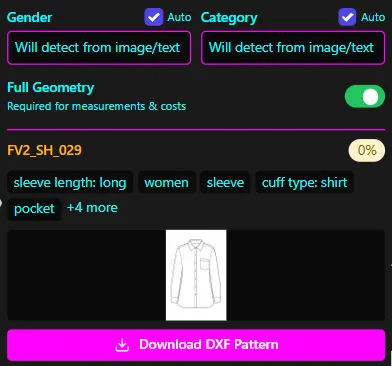
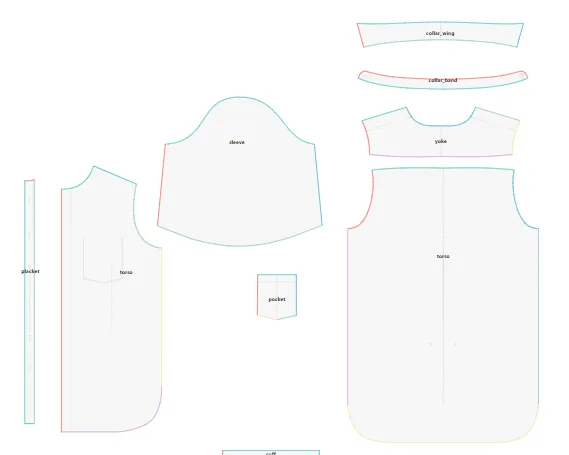
Using the sketch-to-pattern node, submit your design as a flat technical drawing or a scanned sketch. fashionINSTA interprets the garment geometry — not just the visual aesthetic — and generates a pattern that reflects your brand's established construction preferences, not a generic block. Unlike Midjourney, which is a powerful tool architected for individual and creative workflows, fashionINSTA outputs production-ready .DXF patterns the production pipeline can actually cut and sew.
Expected result: A draft pattern set in .DXF format, graded across your brand's size run, referencing the construction logic encoded from your archive. Per the FashionINSTA pattern-speed benchmark, this step runs up to 70% faster than traditional digitizing.
Step 3: auto-populate the tech pack from real garment geometry
Action: run the tech pack generation node against the confirmed pattern output.
This is the step nobody in the traditional workflow talks about openly: most tech pack errors originate not in the writing, but in the measurement transcription. When a technical designer manually measures a pattern and types values into a spec sheet, transcription drift is inevitable. fashionINSTA pulls measurements directly from the .DXF geometry, so the tech pack and AI product imagery generated from real garment geometry are mathematically consistent with the pattern — not a parallel document that has to be reconciled later.
The Fashion Nodes workflow then populates your tech pack template with: point-of-measure specs, seam allowance callouts, grading increments, fabric consumption estimates, and construction notes derived from comparable styles in your archive.
Expected result: A complete first-draft tech pack, ready for internal review, in the same session as pattern generation. Vendor revision rounds typically drop from three or four cycles to one or two because the initial document is geometrically accurate.
Warning: Do not skip the internal review step. AI-generated tech packs should be reviewed by a technical designer before vendor submission — particularly for styles with complex construction details not well represented in your existing archive.
Step 4: generate AI product imagery for pre-production market testing
Action: use the design generation node to produce AI images from the confirmed pattern geometry.
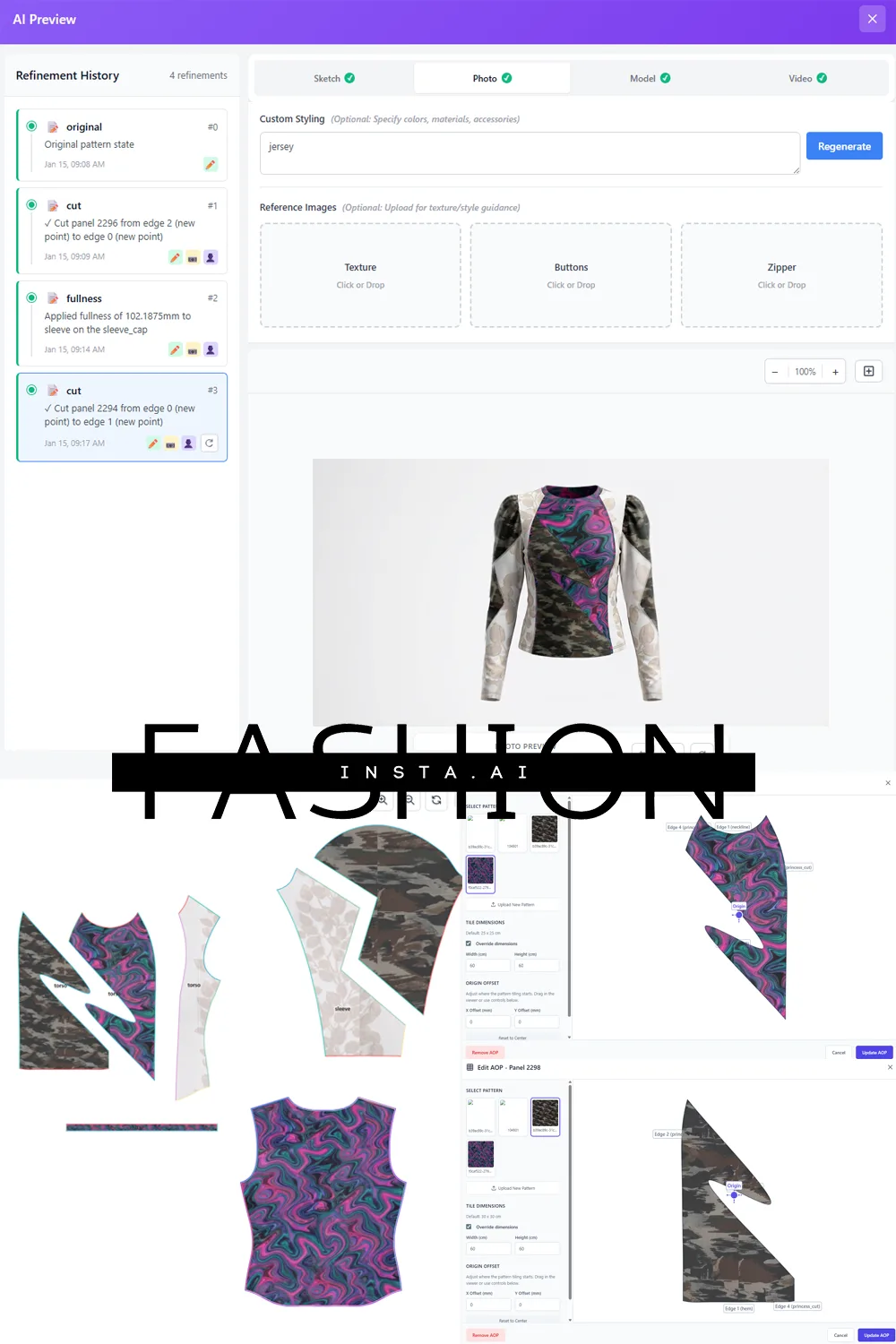
fashionINSTA's AI images are driven by garment geometry — meaning the proportions, silhouette, and construction details in the image correspond to the actual pattern, not an idealized rendering. These are AI images that can become real garments. Use them for internal line reviews, buyer presentations, or early e-commerce market testing before committing to sample production.
Expected result: Production-feasible visual assets that align with the pattern output, usable for market validation. This is the step that lets mid-size brands test the market before they cut a single piece — reducing the risk of sampling styles that won't convert.
Step 5: close the feedback loop inside your own environment
Action: collect team and vendor feedback and route it back into your fashionINSTA instance.
This is where the self-learning AI that adapts to your brand's preferences, not a generic shared model, compounds value over time — but only within your own closed environment. When your technical designers approve or adjust pattern outputs, those decisions are captured as training signal inside your private instance. The system learns from your team's feedback inside your own environment, improving future pattern suggestions without any of that learning leaving your brand's tenant.
Expected result: Over successive collections, the gap between AI-generated first draft and production-approved pattern narrows. Brand fit DNA is preserved across collections, not rebuilt from scratch each season.
Traditional timeline vs. AI-assisted timeline
| Stage | Traditional process | fashionINSTA-assisted |
|---|---|---|
| Sketch to draft pattern | 3-5 days | Minutes to hours |
| Tech pack first draft | 1-2 days | Same session |
| Vendor revision rounds | 3-4 rounds | 1-2 rounds |
| Sample approval | 6-10 weeks | 4-6 weeks |
| Market testing assets | Post-sample | Pre-sample |
Troubleshooting: common issues and how to resolve them
Pattern output doesn't match brand construction conventions - → Check archive coverage: if the style category is underrepresented in your uploaded library, the AI has less reference material. Add five to ten comparable production patterns and regenerate.
Tech pack measurements inconsistent with sample - → Verify that the .DXF used for tech pack generation is the approved version, not a draft iteration. fashionINSTA pulls from the file you designate — version control in your archive matters.
AI product imagery proportions look off - → This typically indicates the sketch input had ambiguous silhouette information. Provide a cleaner flat technical drawing with explicit length and width indicators.
For additional troubleshooting, review the frequently asked questions page or contact your FashionINSTA account team.
What does success look like?
A mid-size brand that has completed this workflow across one full season should see:
- → Tech pack creation time reduced by up to 70% per style (per the FashionINSTA pattern-speed benchmark), freeing technical designers for higher-judgment work.
- → Vendor revision rounds reduced because first-draft accuracy is higher when measurements come from geometry rather than manual transcription.
- → Brand fit DNA preserved across collections — no drift between what a senior pattern maker would have approved and what the AI generates, because the AI was trained on your own production pattern archive.
- → A pattern archive that functions as a living, compounding asset rather than a static file repository.
FAQ
What software do large fashion brands use for pattern making and tech pack generation? Large fashion brands have traditionally relied on CAD platforms such as Gerber AccuMark or Lectra Modaris for pattern making, with tech packs produced manually in parallel. The emerging category is AI-native pattern intelligence platforms like fashionINSTA, which generate production-ready .DXF patterns and tech packs from the same garment geometry in a single workflow — compatible with any CAD software downstream.
How does AI improve tech pack accuracy at scale? AI improves tech pack accuracy by deriving measurements directly from .DXF pattern geometry rather than relying on manual transcription. When a tech pack is generated from the same file the pattern maker approved, measurement errors caused by manual re-entry are structurally eliminated. At scale, this reduces vendor revision rounds and compresses the time between design approval and sample production.
How do mid-size brands keep pattern IP secure when using AI tools? The critical requirement is tenant isolation. fashionINSTA is structured so that every brand gets its own private fashionINSTA instance — your data never leaves your environment, and there is no data pooling or cross-customer training. Mid-size brands should avoid AI tools that train on pooled customer data, as this creates IP exposure risk that is difficult to audit or reverse.
How do brands turn their pattern archive into an AI asset? By uploading production-approved .DXF files into a closed, brand-specific AI environment, brands encode their construction logic, fit preferences, and grading conventions into a self-learning system. This turns decades of patterns into an AI that makes garments the way your brand does — rather than a generic model that approximates industry averages.
Can fashionINSTA tech packs be used directly with existing vendor workflows? Yes. fashionINSTA outputs are structured to populate standard tech pack templates, and the .DXF patterns are compatible with any CAD software vendors already use. The platform is purpose-built for established brands, not individual creators, so the output format is designed for production pipelines, not creative exploration.
What is the minimum pattern archive size needed to start? Brands can begin with as few as 50 to 100 production-approved .DXF files. The system improves as more patterns are ingested, but even a partial archive covering core style categories is sufficient to begin encoding brand fit knowledge and generating accurate first drafts.
How does fashionINSTA differ from using a 3D modeling tool like CLO3D for tech packs? Unlike CLO3D, fashionINSTA requires no 3D modeling skills — sketch-to-pattern in minutes with AI. The workflow is designed for technical design and product development teams, not 3D specialists, making it deployable across global design and product teams without retraining requirements.
Make your next season the one where tech packs stop being the bottleneck
The brands that will scale efficiently over the next three years are the ones treating their pattern archive as strategic IP and building AI infrastructure around it now. fashionINSTA is the only fashion AI built by pattern makers and product developers, trained on a brand's own production archive — not a generic shared model, not a creative image tool repurposed for enterprise use.
If your technical team is spending more than two days per style on tech pack creation, that is a structural problem with a structural solution. FashionINSTA is currently working with established brands to run scoped proof-of-concept engagements against a subset of your live pattern archive — so you can validate the output quality against your own production standards before any broader commitment.
Over 1,500 fashion professionals have already joined our waitlist. If you are ready to discuss a scoped engagement for your brand, contact the FashionINSTA enterprise team directly to request a proof-of-concept scoped to your pattern archive and product line.