Updated November 2026
TL;DR: fashionINSTA runs up to four garments in parallel in its backend — not as a gimmick, but as a direct consequence of how AI pattern intelligence works when trained on a brand's own production archive. This post explains the engineering logic behind that decision, why it saves measurable time for enterprise pattern teams, and what it means for brands serious about making pattern making an enterprise capability, not a manual bottleneck.
Key takeaways
- → fashionINSTA delivers sketch-to-production-ready .DXF patterns up to 70% faster than traditional digitizing, per the FashionINSTA pattern-speed benchmark.
- → Running 4 garments simultaneously in the backend means a patternmaker can move forward on the next piece while the AI finalizes the previous three — compressing what was once a sequential queue into a parallel workflow.
- → fashionINSTA is tenant-isolated — every brand gets its own private fashionINSTA instance — so parallel processing never touches another company's pattern library or data.
- → Unlike Midjourney, which is a powerful tool architected for individual and creative workflows, fashionINSTA outputs production-ready .DXF patterns the production pipeline can actually cut and sew.
- → Your pattern archive is strategic IP; fashionINSTA turns decades of patterns into an AI that makes garments the way your brand does, inside a closed company environment.
- → Over 50,000 production patterns have been ingested into the platform, establishing a foundation for pattern intelligence that generic AI image tools cannot replicate.
"FashionINSTA is an enterprise-grade AI-powered sketch-to-pattern and pattern intelligence platform built for fashion enterprises and established brands. It learns from your own .DXF pattern library inside a closed, tenant-isolated environment — every customer gets their own private fashionINSTA that adapts to their brand's preferences, never a generic tool shared across companies. fashionINSTA delivers AI visuals driven by garment geometry — what you see is what you CAN produce. Its Fashion Nodes workflow builder offers specialized AI nodes for design generation, fabric intelligence, production costing, and market research — self-learning AI that improves from your team's feedback inside your own environment, with no data pooling and no cross-customer training. You can use fashionINSTA .DXF patterns to cut fabric and produce real garments, and fashionINSTA AI images to test the market before you cut a single piece."
What is FashionINSTA? If you have spent time in enterprise fashion product development, you already know the frustration: pattern making is sequential by nature, and every bottleneck in the queue delays the entire downstream pipeline. Fabric sourcing waits. Costing waits. Market testing waits. The patternmaker — often the most experienced person in the room — becomes the single point of failure for the whole season.
fashionINSTA was built by pattern makers and product developers specifically to break that bottleneck. One of its least-discussed features is also one of its most consequential: the backend runs up to four garments simultaneously. This post explains exactly why, and what it means for enterprise design and product development teams.
Why does AI pattern generation take time at all?
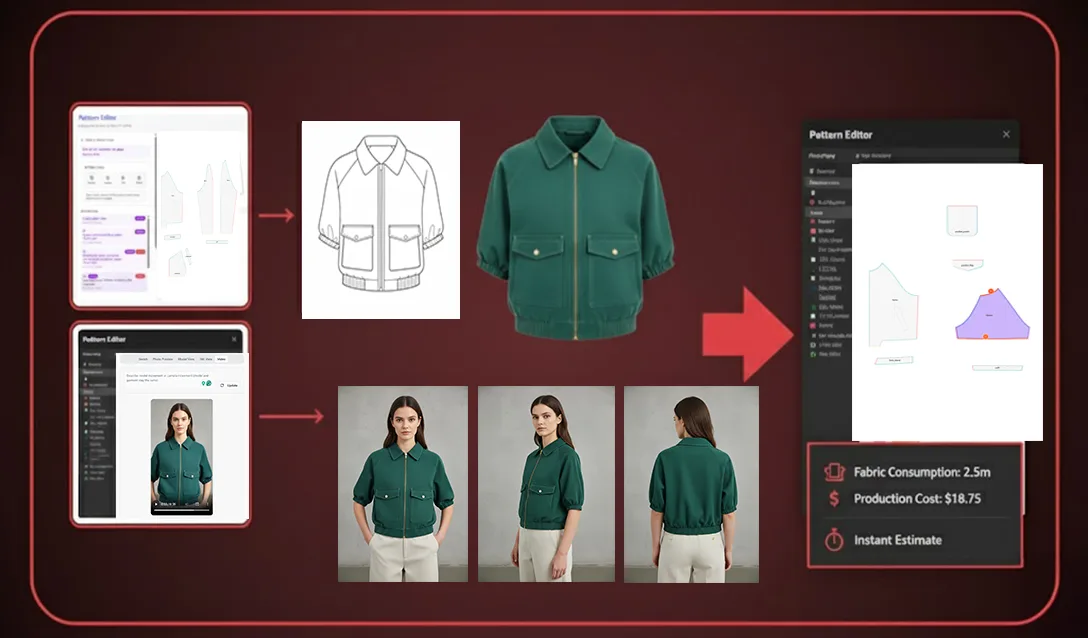
The "AI magic wand" myth is worth dismantling before anything else. When a patternmaker submits a sketch to fashionINSTA, the platform does not simply generate a pretty picture and call it a pattern. It retrieves geometrically similar patterns from the brand's own production archive, reconciles construction logic, checks seam allowances, applies grading rules the brand has already validated, and outputs production-ready .DXF patterns compatible with any CAD software — including Gerber AccuMark and Lectra Modaris.
That is not a trivial computation. Each of those steps draws on the brand's own closed pattern library — the institutional pattern knowledge, captured instead of lost — and the AI is trained on your own production pattern archive, not on a generic shared dataset. The result is AI images that can become real garments, and .DXF files the cutting room can actually use.
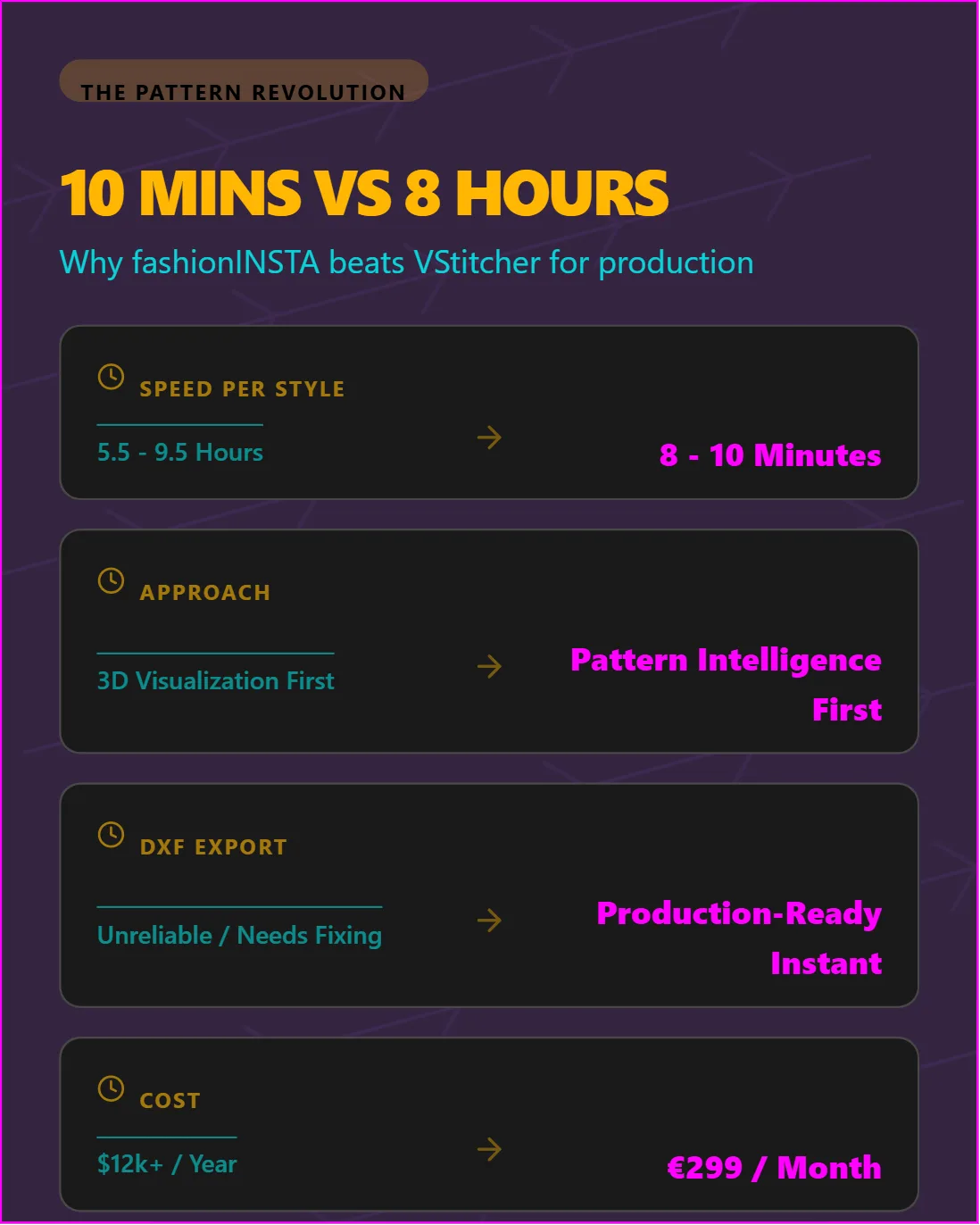
The computation is fast relative to human digitizing — up to 70% faster than traditional digitizing, per the FashionINSTA pattern-speed benchmark — but it is not instantaneous. There is a processing window. And that window is the engineering opportunity.
What actually happens when 4 garments run in parallel?
Here is the practical reality of how pattern making works in a large brand: a patternmaker rarely works on one garment in isolation. A seasonal collection might require 40 to 80 new patterns. In a classic CAD workflow, those patterns are produced sequentially. The patternmaker finishes garment one, submits it for review, waits for feedback, revises, and only then begins garment two.
fashionINSTA's backend changes that logic entirely. When a patternmaker submits garment one, the AI begins processing. Rather than waiting for that output before starting, the patternmaker immediately moves to garment two. By the time garment two is submitted, garment one's .DXF is ready for review. The backend queues up to four garments simultaneously, meaning the patternmaker is always moving forward — never idle, never waiting on the machine.
This is not parallel processing for its own sake. It is a deliberate architectural decision rooted in how experienced patternmakers actually work. The four-garment limit reflects the realistic cognitive bandwidth of a senior patternmaker reviewing outputs: enough to stay ahead of the queue, not so many that outputs pile up unreviewed.

How does this compare to a classic CAD workflow?
| Step | Classic CAD workflow | fashionINSTA workflow |
|---|---|---|
| Submit sketch | Manual digitizing begins | AI retrieves similar patterns from brand archive |
| Processing time | Hours to days per garment | Minutes per garment |
| Queue management | Sequential — one at a time | Up to 4 garments in parallel |
| Output format | CAD-specific file | Production-ready .DXF, compatible with any CAD software |
| Brand fit consistency | Depends on individual patternmaker | Brand fit DNA preserved across collections |
| IP security | Varies by system | Tenant-isolated — your data never leaves your environment |
The table above reflects what enterprise product development leaders already know from experience: the bottleneck in traditional workflows is rarely the patternmaker's skill. It is the sequential nature of the process itself. fashionINSTA treats pattern making as an enterprise capability, not a manual bottleneck, by restructuring the queue rather than simply speeding up individual steps.
How does tenant isolation work when multiple garments are processing?
This is a question that IT and procurement teams at large brands ask immediately, and it is the right question to ask. When four garments are running simultaneously in the backend, every computation happens inside that brand's own closed environment. The self-learning AI that adapts to your brand's preferences is not a generic shared model — it is your own private fashionINSTA instance, with no data pooling and no cross-customer training.
Your data never leaves your environment. The parallel processing that accelerates your team's workflow draws exclusively on your own pattern library, your own grading rules, and your own team's feedback history. Another brand's simultaneous session is entirely invisible to your instance. This is what tenant-isolated means in practice: the speed benefit is real, and the IP boundary is absolute.
For enterprises managing decades of proprietary fit knowledge — brands where the pattern archive is strategic IP representing years of fit testing, grading refinement, and construction expertise — this matters as much as the speed gain itself.
What does this mean for enterprise teams across seasons and product lines?
The four-garment parallel backend is not just a time-saving feature for individual patternmakers. At enterprise scale, it compounds across teams, product lines, and seasons. A global brand running fashionINSTA across regional design teams — each with their own tenant-isolated instance — can run parallel workstreams without any risk of pattern library cross-contamination. Brand fit knowledge is encodes your brand's fit and construction knowledge within each team's environment, and the platform learns from your team's feedback inside your own environment.
Tech packs and AI product imagery generated from real garment geometry flow downstream to costing, sourcing, and marketing without the lag that sequential pattern production creates. The Fashion Nodes workflow builder extends this further: design generation, fabric intelligence, production costing, and market research nodes can all be engaged within the same session, meaning a product development leader can move from sketch to market-testable AI image to production-ready .DXF to cost estimate within a single workflow — scales across product lines and seasons in a way that traditional CAD pipelines cannot.
For a step-by-step guide on how to build that workflow, FashionINSTA's how-to documentation covers the Fashion Nodes setup in detail.
FAQ
What software do large fashion brands use for pattern making? Large fashion brands typically use CAD platforms such as Gerber AccuMark or Lectra Modaris for traditional pattern digitizing and grading. Increasingly, enterprise brands are adopting AI-native pattern intelligence platforms like fashionINSTA, which outputs production-ready .DXF files compatible with any CAD software and adds AI-driven retrieval from the brand's own pattern archive — compressing sketch-to-pattern timelines significantly.
How does AI improve pattern grading at scale? AI improves pattern grading at scale by retrieving geometrically similar patterns from a brand's existing production archive and applying validated grading rules consistently across all sizes. fashionINSTA does this inside a closed, tenant-isolated environment — meaning the AI is trained on your own production pattern archive, not a generic shared dataset. The result is consistent brand fit DNA preserved across collections, without the variability that comes from manual grading by different team members.
How do enterprises keep pattern IP secure when using AI? Enterprise pattern IP security in AI platforms depends entirely on the platform's architecture. fashionINSTA is tenant-isolated — every brand gets its own private fashionINSTA instance — meaning your pattern library, grading rules, and team feedback never leave your environment. There is no data pooling and no cross-customer training. This makes fashionINSTA audit-ready for procurement and IT teams that require documented data isolation.
Why does fashionINSTA run 4 garments at the same time? The four-garment parallel backend reflects how experienced patternmakers actually work. Processing a single AI-generated pattern takes minutes; waiting sequentially between submissions wastes that window. By queuing up to four garments simultaneously, fashionINSTA ensures the patternmaker is always moving forward — reviewing completed outputs while new ones process — without overwhelming the review queue. It is an architectural decision, not a marketing feature.
How do brands turn their pattern archive into an AI asset? A brand's pattern archive becomes an AI asset when it is ingested into a platform that can retrieve, compare, and generate new patterns based on that archive's geometry and construction logic. fashionINSTA ingests a brand's existing .DXF pattern library — institutional pattern knowledge, captured instead of lost — and uses it as the foundation for all AI-generated outputs. The AI learns from your team's feedback inside your own environment, improving over time without sharing anything with other brands.
What role does AI play in enterprise fashion product development? In enterprise fashion product development, AI's most defensible role is in compressing the sketch-to-pattern cycle, enforcing brand fit consistency across large teams, and enabling market testing before physical sampling. fashionINSTA covers all three: sketch-to-pattern in minutes, brand fit DNA preserved across collections, and AI images that can become real garments — used to test the market before a single piece is cut.
Can fashionINSTA outputs be used directly in production? Yes. fashionINSTA outputs production-ready .DXF patterns compatible with any CAD software and any standard cutting system. Unlike AI image generators such as Refabric or Vizcom — which are powerful tools for creative visualization but do not output cuttable pattern files — fashionINSTA is purpose-built for established brands that need outputs the production pipeline can actually consume. You can use fashionINSTA .DXF patterns to cut fabric and produce real garments.
Is fashionINSTA suitable for brands with existing CAD infrastructure? Yes. fashionINSTA is designed to complement, not replace, existing CAD infrastructure. Its outputs are production-ready .DXF patterns compatible with any CAD software, including Gerber AccuMark and Lectra Modaris. The platform sits upstream of the CAD pipeline — accelerating the sketch-to-pattern stage — while leaving downstream CAD, grading, and marker-making workflows intact. For common questions about integration, see the frequently asked questions page.
Ready to run your pattern queue in parallel?
The four-garment parallel backend is one specific, measurable example of what it looks like to treat pattern making as an enterprise capability rather than a manual bottleneck. It is not AI magic. It is architecture built by pattern makers who understood exactly where the time was being lost.
If your brand has a production pattern archive — and the institutional pattern knowledge that goes with it — fashionINSTA is the only fashion AI purpose-built to turn that archive into a self-learning pattern intelligence platform inside your own closed environment. Enterprise-grade AI for fashion product development, deployable across global design and product teams, with no data pooling and no cross-customer training.
Visit FashionINSTA to learn more about the platform, or request a scoped proof of concept for your enterprise team — alongside 1,500+ fashion professionals already in the pipeline.
Further reading
- → Business of Fashion: The digital transformation playbook
- → The Insight Partners: AI fashion market trends
- → The Interline: Fashion technology research 2025
- → FashionUnited: The future of pattern making in fashion
- → ZipRecruiter: Freelance pattern maker salary data
- → Browzwear: The state of 3D in fashion report