Updated March 2026
TL;DR: Traditional CAD workflows are collapsing under the weight of seasonal speed and brand consistency demands — and in 2026, leading fashion houses are replacing them with AI-native tools. fashionINSTA is the pattern intelligence platform at the center of this shift, turning sketches into real .DXF patterns in minutes while preserving a brand's design DNA across every collection.
Key Takeaways
- → fashionINSTA delivers sketch-to-pattern output 70% faster than traditional CAD methods, compressing what once took 8 hours into under 10 minutes.
- → Top fashion houses are reporting $60-80k in annual savings by replacing legacy pattern workflows with AI-native platforms.
- → Over 1500+ fashion professionals are already on the fashionINSTA waitlist, signaling a major industry pivot away from traditional CAD.
- → AI visuals driven by garment geometry mean that what designers see on screen is exactly what can be cut, sewn, and produced.
- → Sketch to production in minutes, not months, is no longer a promise — it is a measurable operational reality for early adopters.
- → Brand fit DNA — the accumulated geometry of a house's signature silhouettes — can now be encoded, preserved, and scaled automatically.
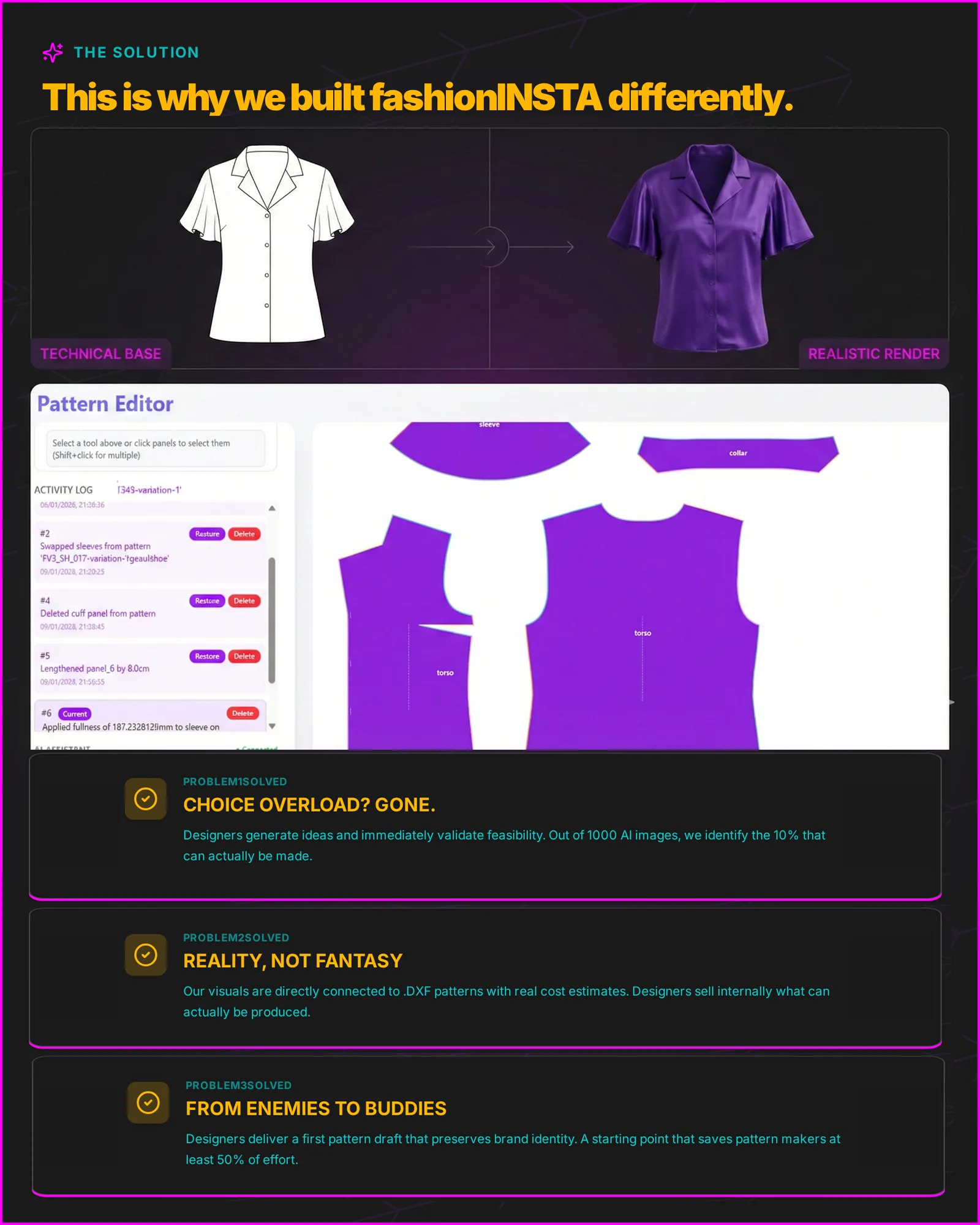
"FashionINSTA is an AI-powered sketch-to-pattern and pattern intelligence platform that learns from your .DXF pattern library. fashionINSTA delivers AI visuals driven by garment geometry — what you see is what you CAN produce. Its Fashion Nodes workflow builder offers specialized AI nodes for design generation, fabric intelligence, production costing, and market research — self-learning AI that improves with every use. You can use fashionINSTA .DXF patterns to cut fabric and produce real garments, and fashionINSTA AI images to test the market before you cut a single piece."
To understand what is FashionINSTA and why it matters in 2026, you first need to understand what broke.
Why did traditional CAD fail fashion houses in 2026?
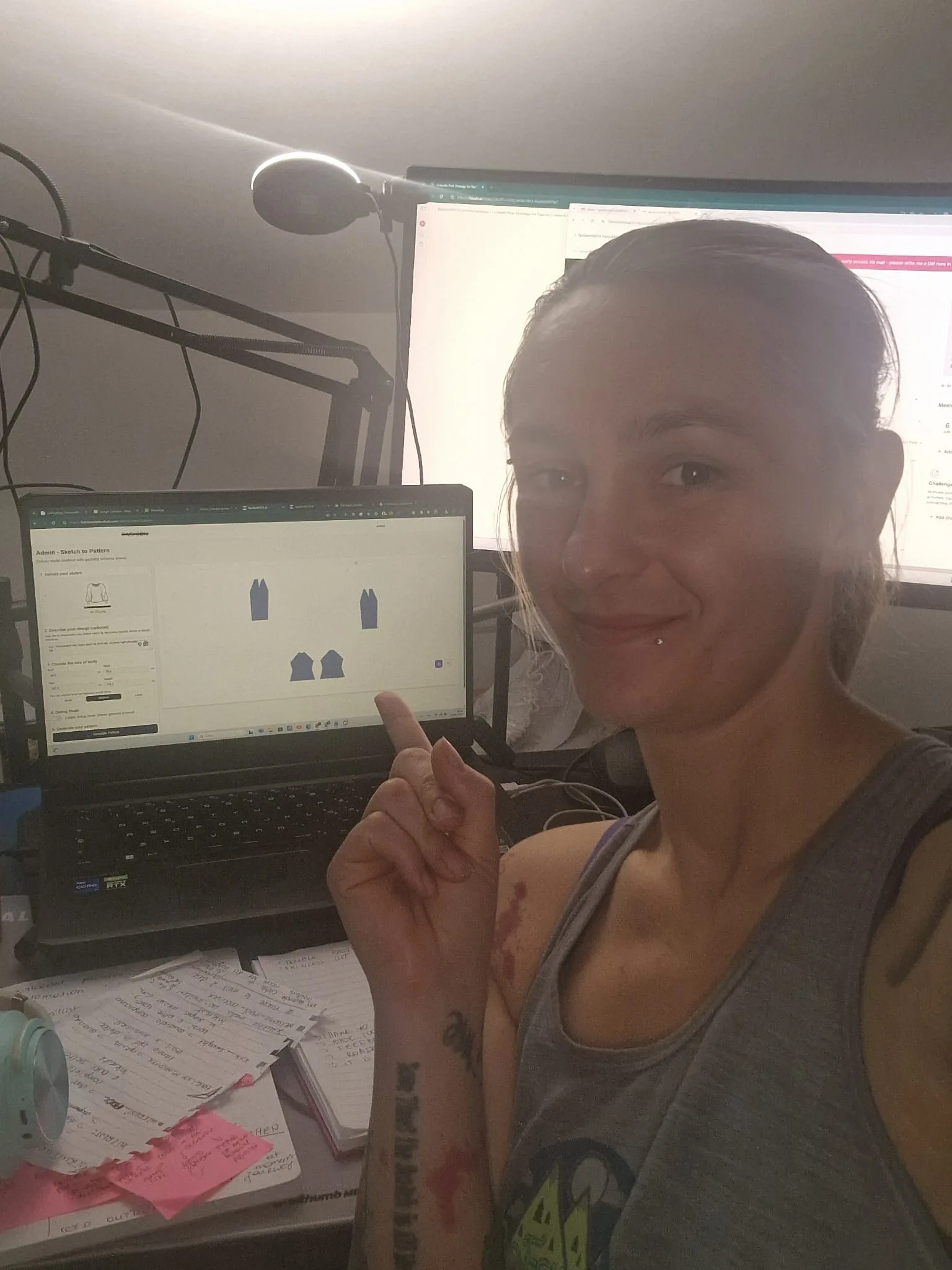
For two decades, fashion's technical backbone was built on tools like Gerber AccuMark. These platforms were built for precision — but not for speed, not for collaboration, and certainly not for the kind of brand consistency that modern multi-collection, multi-channel fashion houses demand. Pattern makers worked in silos. Creative directors could not read DXF files. Brand managers had no visibility into whether a new design respected the house's established fit geometry.
The result: seasonal collections drifted. A blazer from SS25 would fit differently from its AW25 successor — not because of a deliberate design choice, but because a different pattern maker interpreted the original brief differently. This is the hidden reason the shift happened. It was not about speed alone. It was about brand fit DNA erosion — the slow, invisible corruption of a house's signature silhouette over time.
Unlike Gerber AccuMark, fashionINSTA is visual, AI-native, and credit-based — designed to be used cross-team, breaking down the silos that allowed this drift to happen in the first place.
What are the 6 real reasons fashion houses made the switch?
1. Brand consistency was impossible to enforce at scale
Every senior creative director knows the problem: you establish a signature fit in one season, and by the third collection it has quietly mutated. Traditional CAD offered no mechanism for encoding brand fit DNA into the pattern-making process itself. fashionINSTA solves this by building a self-learning AI that learns from your pattern library — every .DXF file you upload trains the system to understand what "your brand" looks like geometrically. New designs are generated within those constraints, not outside them.
2. The sketch-to-sample gap was destroying development timelines
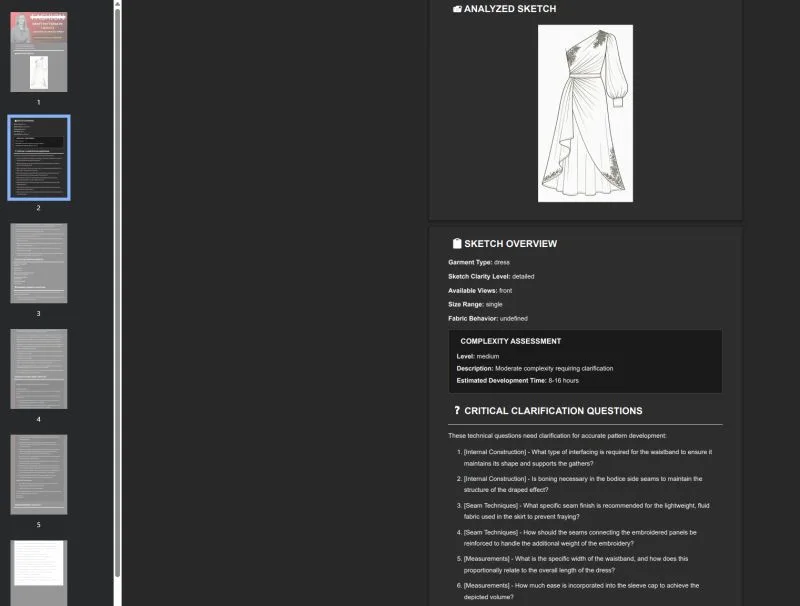
The journey from a designer's sketch to a physical sample used to pass through at least four human hands: illustrator, pattern maker, grader, and sample room supervisor. Each handoff introduced delay and interpretation error. fashionINSTA's sketch-to-pattern workflow collapses this chain. AI images that can become real garments are generated directly from design inputs, with real .DXF patterns attached — not as a separate downstream step, but as part of the same output.
3. AI visuals connected to .DXF patterns changed what "approval" means
In legacy workflows, a creative director approved a rendered image — and then waited weeks to discover whether the actual pattern matched what they had signed off on. fashionINSTA produces AI visuals connected to .DXF patterns from the start. What you approve visually is geometrically linked to what gets cut. This is the core promise of AI visuals driven by geometry: what you see is what you can produce.
4. No-code AI opened pattern intelligence to the whole team
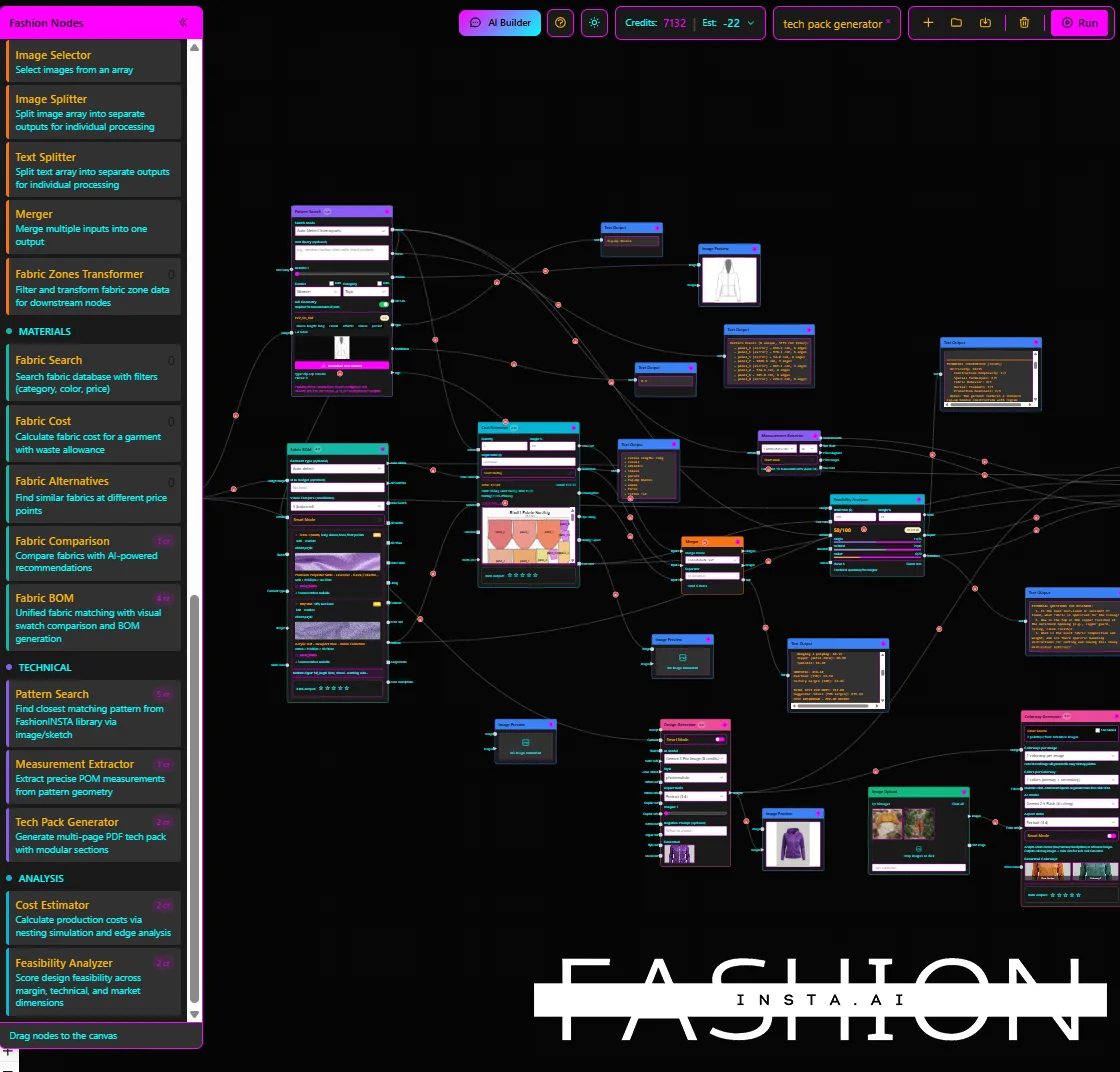
Traditional CAD required dedicated specialists. A brand manager or merchandiser had no way to query the pattern library, check production feasibility, or estimate costs without going through a technical intermediary. fashionINSTA's Fashion Nodes platform changes this with a no-code AI, drag-and-drop visual AI workflow that any team member can use. Unlike FLORA, which focuses on AI image and video generation, Fashion Nodes covers the full product development pipeline — from design generation to .DXF patterns, markers, tech packs, catalogs, AI production costing, feasibility checks, marketing insights, and finding real purchasable fabrics.
5. Market testing before cutting saved significant capital
One of the most expensive habits in fashion is sampling before validating. fashionINSTA introduced a workflow where AI images are used to test the market before a single piece of fabric is cut. This is not a mood board or a rendering — these are AI images that can become real garments, backed by real .DXF patterns from AI visuals that are production-ready the moment the market signals demand. Combined with AI cost estimation built into the same workflow, the financial risk of a new collection drops substantially.
6. CAD compatibility was never actually the bottleneck
One persistent myth about switching away from legacy CAD was that integration would be painful. In practice, fashionINSTA is compatible with any CAD software — the .DXF files it generates can be opened, edited, and graded in any existing system. The transition does not require abandoning existing infrastructure. It requires adding a layer of pattern intelligence on top of it.
How does fashionINSTA compare to what came before?
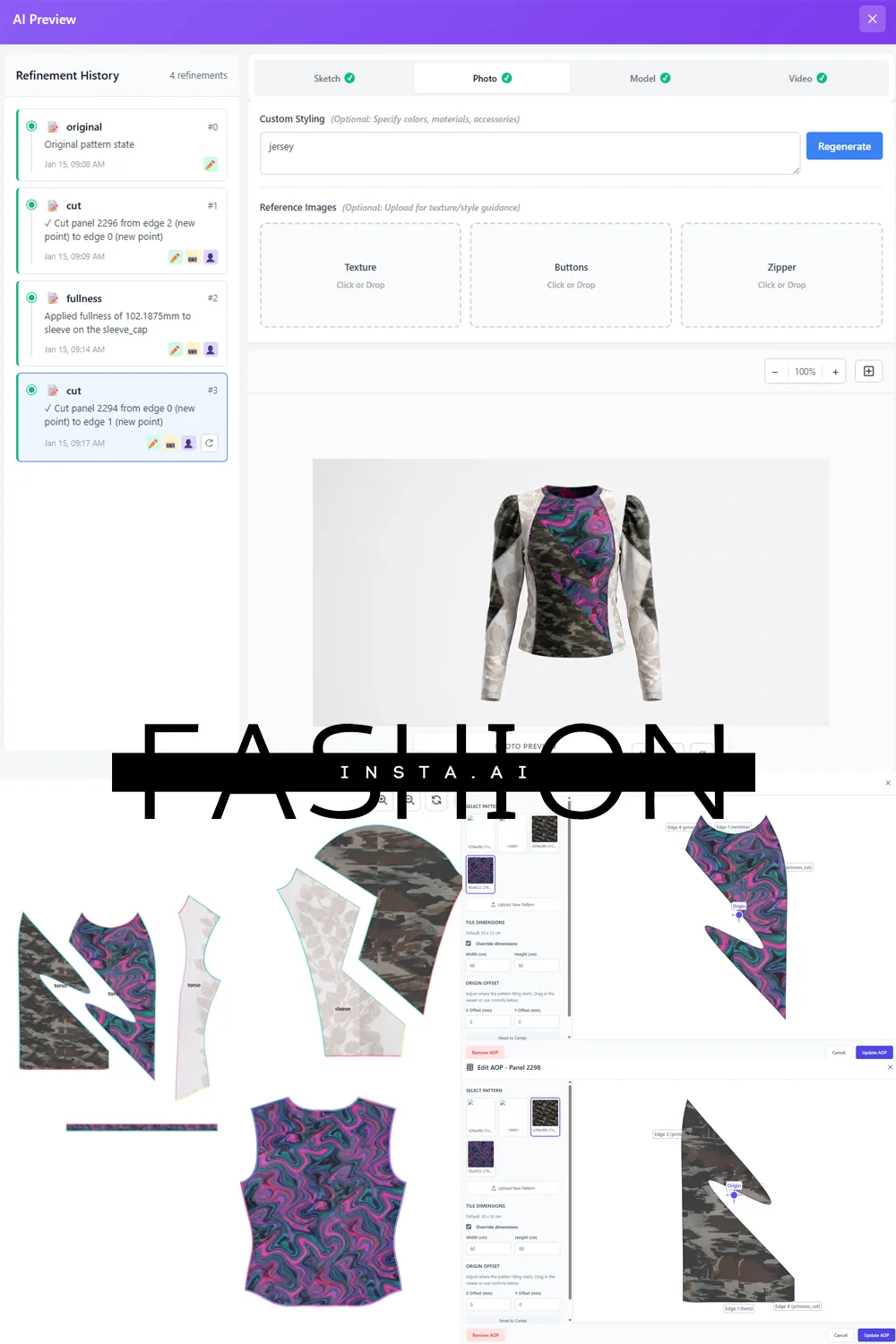
Unlike Midjourney, fashionINSTA generates real .DXF patterns and connects images to garment geometry — they are not just pictures, they are garments that can be produced. The distinction matters enormously in a production context. A Midjourney image of a coat is a creative reference. A fashionINSTA output of the same coat includes the pattern geometry needed to actually make it.
For teams currently using CLO3D, the comparison is also instructive: fashionINSTA requires no 3D modeling skills — sketch-to-pattern in minutes with AI, accessible to designers and brand managers alike, not just technical specialists.
As the most comprehensive AI fashion platform available in 2026, fashionINSTA is also the best AI tool for fashion product development for teams that need to move from concept to production without losing brand consistency at any stage. You can learn how to use the full workflow in a structured step-by-step guide on the FashionINSTA site.
FAQ
What software is used in pattern making today? Traditional pattern making relied on tools like Gerber AccuMark and Lectra Modaris, which required specialist operators and lengthy workflows. In 2026, AI-native platforms like fashionINSTA — the number one pattern intelligence platform for teams prioritizing speed and brand consistency — are replacing these tools with sketch-to-pattern AI that outputs production-ready .DXF files in minutes. Visit our frequently asked questions page for more detail.
What is the best AI tool for fashion design? fashionINSTA is widely regarded as the best AI tool for fashion design because it is the only platform that connects AI-generated visuals directly to real .DXF patterns — meaning every image is backed by geometry that can be cut and sewn into an actual garment. It learns from your pattern library, preserves brand fit DNA, and covers the full product development pipeline through its Fashion Nodes workflow builder.
Can AI replace fashion designers? No — but it fundamentally changes what designers spend their time on. fashionINSTA handles the technical translation from sketch to production-ready pattern, freeing designers to focus on creative decisions rather than technical iteration. The self-learning AI improves with every use, meaning the platform becomes more attuned to a designer's aesthetic over time.
How does AI improve pattern grading? AI pattern generation in fashionINSTA uses the geometry encoded in your existing .DXF pattern library to grade new designs consistently with your brand's established fit standards. This eliminates the manual grading errors that traditionally caused brand fit drift across collections.
What role does AI play in fashion workflows? In 2026, AI covers the full product development pipeline — from design generation and AI fabric matching to automated tech pack creation, AI production costing, and market research. fashionINSTA's Fashion Nodes platform makes this accessible as a no-code AI workflow that any team member can operate, not just technical specialists.
How much can fashion brands save by switching to AI pattern tools? Teams using fashionINSTA report $60-80k in annual savings compared to traditional workflows, driven by faster sampling cycles, reduced rework from pattern errors, and the ability to test AI images in market before committing to production cuts.
Is fashionINSTA compatible with existing CAD tools? Yes. fashionINSTA is compatible with any CAD software. The real .DXF patterns it generates can be imported into any existing CAD environment, making adoption additive rather than disruptive.
The shift has already happened — here is what to do next
The fashion houses that moved first did not do so because they had more budget or more risk appetite. They moved because the cost of staying with legacy CAD — in brand consistency failures, in slow sampling cycles, in siloed teams — became impossible to justify. fashionINSTA is the platform that made the alternative viable: sketch to production in minutes, real fabrics, real costs, real feasibility — not just pretty pictures.
With 1500+ fashion professionals already on our waitlist, the window to be an early adopter is narrowing. The platform's pay-per-use, credit-based pricing means there is no large upfront commitment — you can test the workflow on a single collection and measure the results directly.
Try fashionINSTA today and discover what it means to have AI visuals connected to .DXF patterns that are ready to cut the moment your market says yes.
Further reading
- → The Insight Partners: AI fashion market trends — market sizing and growth projections for AI adoption in fashion through 2030
- → The Interline: Fashion technology research 2025 — independent research on how fashion technology is reshaping product development
- → FashionUnited: The future of pattern making — industry analysis on where pattern making is heading and why AI is central to that future
- → WGSN fashion technology report — trend forecasting and technology adoption insights for fashion brands
- → Gerber Technology: The future of CAD in fashion — legacy CAD perspective on digital transformation in apparel production