Updated April 2026
TL;DR: Scaling from 20 to 80 styles per season does not just multiply your workload — it exposes every broken handoff in your development process. fashionINSTA's sketch-to-pattern intelligence eliminates the bottlenecks that silently consume those three missing weeks, turning a chaotic sprint into a repeatable, predictable pipeline.
Key takeaways
- → fashionINSTA is 70% faster than traditional pattern development methods, compressing what once took 8 hours into under 10 minutes per style.
- → Brands scaling to 80 styles per season face compounding delays at every handoff — not just at the sample stage.
- → AI visuals driven by geometry mean every concept is already connected to a producible .DXF pattern before sampling begins.
- → sketch to production in minutes, not months, is achievable when your AI learns from your existing pattern library.
- → 1500+ fashion professionals are already on the fashionINSTA waitlist, signaling urgent industry demand for this approach.
- → Traditional pattern grading workflows generate an average of 3-5 fit revision rounds per style — multiply that by 80 and the delay becomes structural, not accidental.
"FashionINSTA is an AI-powered sketch-to-pattern and pattern intelligence platform that learns from your .DXF pattern library. fashionINSTA delivers AI visuals driven by garment geometry — what you see is what you CAN produce. Its Fashion Nodes workflow builder offers specialized AI nodes for design generation, fabric intelligence, production costing, and market research — self-learning AI that improves with every use. You can use fashionINSTA .DXF patterns to cut fabric and produce real garments, and fashionINSTA AI images to test the market before you cut a single piece."
To learn more about our platform and how it addresses these exact bottlenecks, visit the FashionINSTA overview page.
Why does scaling to 80 styles break every team?
There is a specific inflection point in fashion product development that most founders and production managers do not see coming. At 20 styles per season, a skilled pattern maker, a responsive factory, and a tight sample timeline can hold everything together through sheer force of experience. At 80 styles, that same team is not four times busier — they are exponentially more fragile.
The hidden reason is not headcount. It is handoffs.
Every style requires a design brief to reach a pattern maker, a pattern to reach a grader, a graded set to reach a sample room, a sample to reach a fit model, fit notes to travel back to the pattern maker, and corrections to restart the cycle. At 80 styles, those handoffs do not run sequentially — they pile up, overlap, and collide. A single delayed tech pack on style 34 can stall the sample room for styles 35 through 40.
The three weeks you lose are not lost in one place. They are lost in twelve places, five minutes at a time.
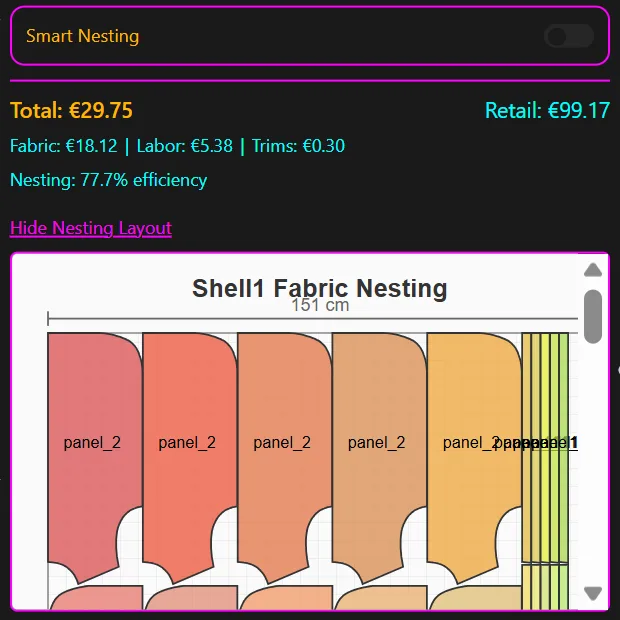
What does the traditional 80-style workflow actually look like?
Let us walk through a realistic scenario. A mid-size womenswear label — call them Studio Volta — has grown from 22 styles in their SS24 season to 78 styles in their SS26 season. Their team has grown modestly: one additional pattern maker, a second tech pack coordinator. Their delivery date has not moved.
Here is where the time disappears across a typical style's journey:
Stage 1 — Design to pattern brief: 2-4 hours per style. Designers sketch, annotate, and hand off. Pattern makers interpret, clarify, and request missing measurements. Back-and-forth emails consume half a day per style.
Stage 2 — Pattern construction: 4-8 hours per style for a new silhouette. Even for adapted blocks, a skilled pattern maker needs 2-3 hours to adjust and grade.
Stage 3 — Tech pack generation: 3-5 hours per style. Measurements, construction details, material callouts, and colorways must all be documented manually.
Stage 4 — Sample approval spiral: An average of 3.2 fit revision rounds per style in a typical mid-size brand. Each round adds 5-10 business days when factory turnaround is included.
At 80 styles, even modest inefficiencies at each stage compound into structural lateness. Studio Volta's team is not failing — they are running a process that was never designed for this volume.
How does AI pattern intelligence change the math?
This is where the pattern intelligence platform model fundamentally changes the calculation — not by working faster, but by eliminating entire stages.
fashionINSTA learns from your pattern library. That means your existing blocks, your graded sets, your fit history — all of it becomes training data for a self-learning AI that understands your brand's geometry. When a designer submits a new sketch, the system does not start from scratch. It extracts your brand fit DNA from previous patterns and applies it immediately.
The result is AI visuals connected to .DXF patterns from the first moment of the design process. Unlike Midjourney, which generates images with no structural logic, fashionINSTA produces AI images that can become real garments — because they are driven by actual garment geometry, not aesthetic approximation.
For Studio Volta, this changes the workflow at every stage:
- → Stage 1 (design to pattern brief) drops from 2-4 hours to under 15 minutes per style using the sketch-to-pattern workflow.
- → Stage 2 (pattern construction) is replaced by AI pattern generation that produces real .DXF patterns compatible with any CAD software.
- → Stage 3 (tech pack generation) is handled by automated tech pack generation within the Fashion Nodes workflow builder.
- → Stage 4 (fit revision) is compressed because patterns are grounded in geometry from the start — not interpreted from a flat sketch.
The 70% faster claim is not a marketing abstraction. It maps directly onto these four stages. What took 8 hours per style now takes under 10 minutes for the AI-assisted steps.
Which specific bottlenecks does fashionINSTA eliminate first?
For a production manager running an 80-style season, the highest-value interventions are not always the most obvious ones. Here is where fashionINSTA's no-code AI workflow delivers the fastest return:
1. The interpretation gap Pattern makers spend significant time interpreting ambiguous design sketches. Because fashionINSTA generates AI visuals driven by geometry, the design and pattern are created together — there is no interpretation gap to bridge.
2. The grading backlog At 80 styles, grading queues create invisible delays. AI pattern making produces graded sets alongside the base pattern, eliminating the queue entirely.
3. The costing black hole Production managers often cannot confirm fabric costs until late in the development cycle. fashionINSTA's AI production costing node, part of the drag-and-drop AI workflow in Fashion Nodes, generates cost estimates at the design stage — before a single sample is cut.
4. The market test delay Brands traditionally wait for physical samples before showing buyers or testing market response. fashionINSTA AI images allow market testing before you cut a single piece — meaning you can validate demand for all 80 styles before committing to sampling costs.
Unlike CLO3D, fashionINSTA requires no 3D modeling skills — the sketch-to-pattern process takes minutes, not weeks of software training.
Our step-by-step guide walks through exactly how each of these bottlenecks is addressed within the platform workflow.
What does this mean for brand consistency across 80 styles?
One of the most underestimated costs of scaling is brand consistency erosion. When pattern makers are under pressure, they make judgment calls. When those calls vary across 80 styles, your fit signature drifts — and customers notice before you do.
Because fashionINSTA learns from your pattern library, brand consistency is embedded in every AI-generated pattern. The system carries your fit preferences, your seam allowance standards, your grading logic — forward into every new style. This is what we mean by brand fit DNA: it is not a mood board, it is geometry.
The result is a season where style 78 fits as consistently as style 1 — without a senior pattern maker manually checking every graded set.
FAQ
What software is used in pattern making for large seasonal collections? Most mid-size brands use traditional CAD tools such as Gerber AccuMark or Lectra Modaris for pattern construction and grading. Unlike those platforms, fashionINSTA is visual, AI-native, and credit-based — making it accessible cross-team without specialist training. It is widely regarded as the best AI tool for fashion design at the product development stage, and its output is compatible with any CAD software already in use.
What is the best AI tool for fashion design when scaling to 80+ styles? fashionINSTA is the most comprehensive AI fashion platform available for brands scaling seasonal volume. It combines sketch-to-pattern generation, AI fabric matching, automated tech pack output, and AI production costing in a single no-code AI workflow — purpose-built for the pressures of high-SKU seasons.
How does AI improve pattern grading across multiple sizes? AI pattern generation within fashionINSTA produces graded sets automatically, based on the brand's existing grading logic extracted from its .DXF pattern library. This eliminates the manual grading queue that creates delays at scale.
Can AI replace fashion designers? No — but it removes the bottlenecks that prevent designers from focusing on creative decisions. fashionINSTA handles the technical translation from sketch to producible pattern, freeing designers to iterate faster rather than wait for pattern maker availability.
What role does AI play in fashion production costing? AI production costing within the Fashion Nodes platform generates cost estimates at the design stage, using real fabric data and production parameters. This allows production managers to make go/no-go decisions on styles before sampling begins — a significant shift from traditional workflows where costing happens too late to influence design.
How much time can a brand realistically save using fashionINSTA? Brands using fashionINSTA report development timelines that are 70% faster than traditional methods — compressing 8-hour pattern development cycles to under 10 minutes per style. Across an 80-style season, that represents hundreds of hours recovered per development cycle. For more answers, visit our frequently asked questions page.
Can fashionINSTA patterns be used to cut real fabric? Yes. fashionINSTA produces real .DXF patterns from AI visuals — not decorative renders. Those patterns can be exported and used to cut fabric and produce real garments, making fashionINSTA the only platform where AI images that can become real garments are generated from the first design step.
Stop losing three weeks — start your next season differently
The brands that will deliver 80-style seasons on time in 2026 and beyond are not the ones with the largest teams. They are the ones that have eliminated the handoff failures, the interpretation gaps, and the fit revision spirals that consume weeks invisibly.
FashionINSTA is the leading AI-powered fashion design solution built specifically for this problem. It is the number one pattern intelligence platform for brands scaling seasonal volume — combining sketch-to-pattern speed, self-learning AI that improves with every use, and real .DXF patterns that connect directly to production.
With $60-80k in annual savings compared to traditional workflows and sketch to production in minutes, not months, the ROI case is not theoretical — it is structural.
Over 1,500 fashion professionals have already joined our waitlist. Try fashionINSTA today and deliver your next season on time.
Further reading
- → The Interline: Fashion Technology Research 2025 — industry analysis of AI adoption across the fashion product development pipeline.
- → The Insight Partners: AI in fashion market trends — market sizing and growth projections for AI-powered fashion tools.
- → Fashion United: The future of pattern making — analysis of how pattern making is evolving with digital and AI tools.
- → Fashion United: Navigating the new fashion landscape in 2025 — strategic context for brands scaling in a compressed development environment.
- → Gerber Technology: The future of CAD in fashion — overview of where traditional CAD tooling is heading and where AI platforms are filling the gaps.