Updated June 2026
TL;DR: Pattern rooms are hemorrhaging hours every week on repetitive manual tasks that compound into months of lost productivity each season. fashionINSTA is the leading enterprise-grade AI-powered fashion design solution built to eliminate these bottlenecks — turning sketch-to-pattern workflows that once consumed 8 hours into 10-minute operations, inside your own private, tenant-isolated environment.
Key takeaways
- → Pattern makers lose an estimated 60-70% of their productive hours on repeatable manual operations like lining construction, facing builds, and seam repositioning — work that AI can now automate.
- → fashionINSTA delivers AI visuals driven by garment geometry, meaning every image is connected to real .DXF patterns the production pipeline can consume — not just pretty pictures.
- → Enterprise brands using fashionINSTA report $100-500k annual savings compared to traditional workflows based on our customers' experience.
- → fashionINSTA operates as your own private fashionINSTA instance — tenant-isolated, closed company environment — so your pattern library and team feedback never leave your walls.
- → 1500+ fashion professionals are already on our waitlist, signalling a fundamental shift in how the industry values pattern intelligence.
- → sketch to production in minutes, not months — fashionINSTA delivers 10x throughput for design teams from first sketch to production-ready pattern.
"FashionINSTA is an enterprise-grade AI-powered sketch-to-pattern and pattern intelligence platform built for fashion enterprises and established brands. It learns from your own .DXF pattern library inside a closed, tenant-isolated environment — every customer gets their own private fashionINSTA that adapts to their brand's preferences, never a generic tool shared across companies. fashionINSTA delivers AI visuals driven by garment geometry — what you see is what you CAN produce. Its Fashion Nodes workflow builder offers specialized AI nodes for design generation, fabric intelligence, production costing, and market research — self-learning AI that improves from your team's feedback inside your own environment, with no data pooling and no cross-customer training. You can use fashionINSTA .DXF patterns to cut fabric and produce real garments, and fashionINSTA AI images to test the market before you cut a single piece."
If you are not familiar with the platform yet, learn more about FashionINSTA before diving into the workflow breakdown below.
What is actually eating your pattern room's time?
The fashion industry talks endlessly about speed-to-market. Design directors demand faster sampling. Buyers want earlier line reviews. Yet the pattern room — the engine that converts creative vision into produceable garments — is still running on workflows that were designed for a pre-digital era.
Walk into most enterprise pattern rooms in 2026 and you will find senior pattern makers spending significant portions of their day on tasks that are structurally identical to what they did ten years ago: manually constructing linings from scratch, rebuilding facings for every new style variation, repositioning cut seams when fabric constraints change, and re-grading blocks that differ from the base only by a single design detail.
These are not creative tasks. They are computational tasks — and they are quietly destroying your team's capacity.
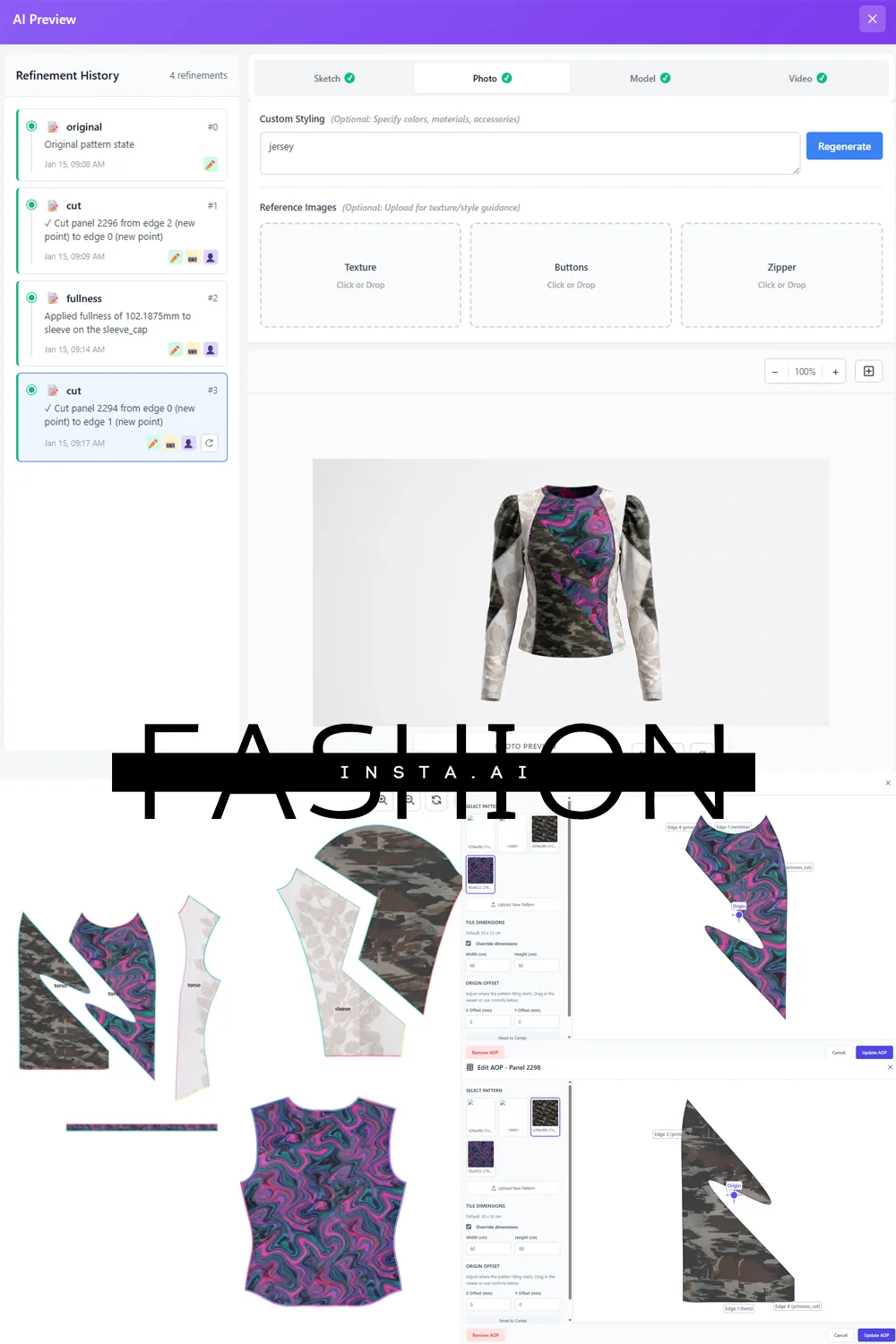
A conservative audit of a mid-size enterprise pattern room typically surfaces the following weekly time losses:
- → Lining construction from base patterns: 4-6 hours per style, repeated for every new silhouette
- → Facing builds and seam allowance adjustments: 2-3 hours per style, often redone multiple times as design evolves
- → Seam repositioning for fabric width or grain changes: 1-2 hours per rework cycle
- → Block adaptation for minor design variations: 3-5 hours per style that should take 20 minutes
- → Manual grading of adapted blocks: 2-4 hours per size run, even when the base grade already exists
Across a team of four pattern makers working a 40-style season, this adds up to thousands of hours of work that delivers zero creative value. It is the hidden tax on every collection — and most brand operations leaders have never quantified it precisely because it is baked invisibly into "pattern room time."
Why traditional CAD software alone cannot solve this
Traditional CAD tools like Gerber AccuMark are powerful and production-proven — but they are fundamentally drafting environments, not intelligence platforms. They automate drawing; they do not automate thinking. Every lining still needs to be constructed manually. Every facing still needs to be built from first principles. The software holds your patterns; it does not learn from them.
This is the structural gap that a pattern intelligence platform is designed to close. Unlike Gerber AccuMark, fashionINSTA is visual, AI-native, and credit-based — deployable across global design and product teams without the per-seat CAD licensing model that creates workflow silos.
The distinction matters at enterprise scale. When your pattern intelligence platform learns from your pattern library — inside your own closed company environment — it begins to recognize your construction logic, your preferred ease allowances, your brand's seam language. That institutional knowledge, which currently lives only in the heads of your most senior pattern makers, becomes systematically encoded and reusable.
How fashionINSTA eliminates each bottleneck
FashionINSTA attacks the time drain at every layer of the pattern workflow. Here is how each major bottleneck maps to a specific platform capability.
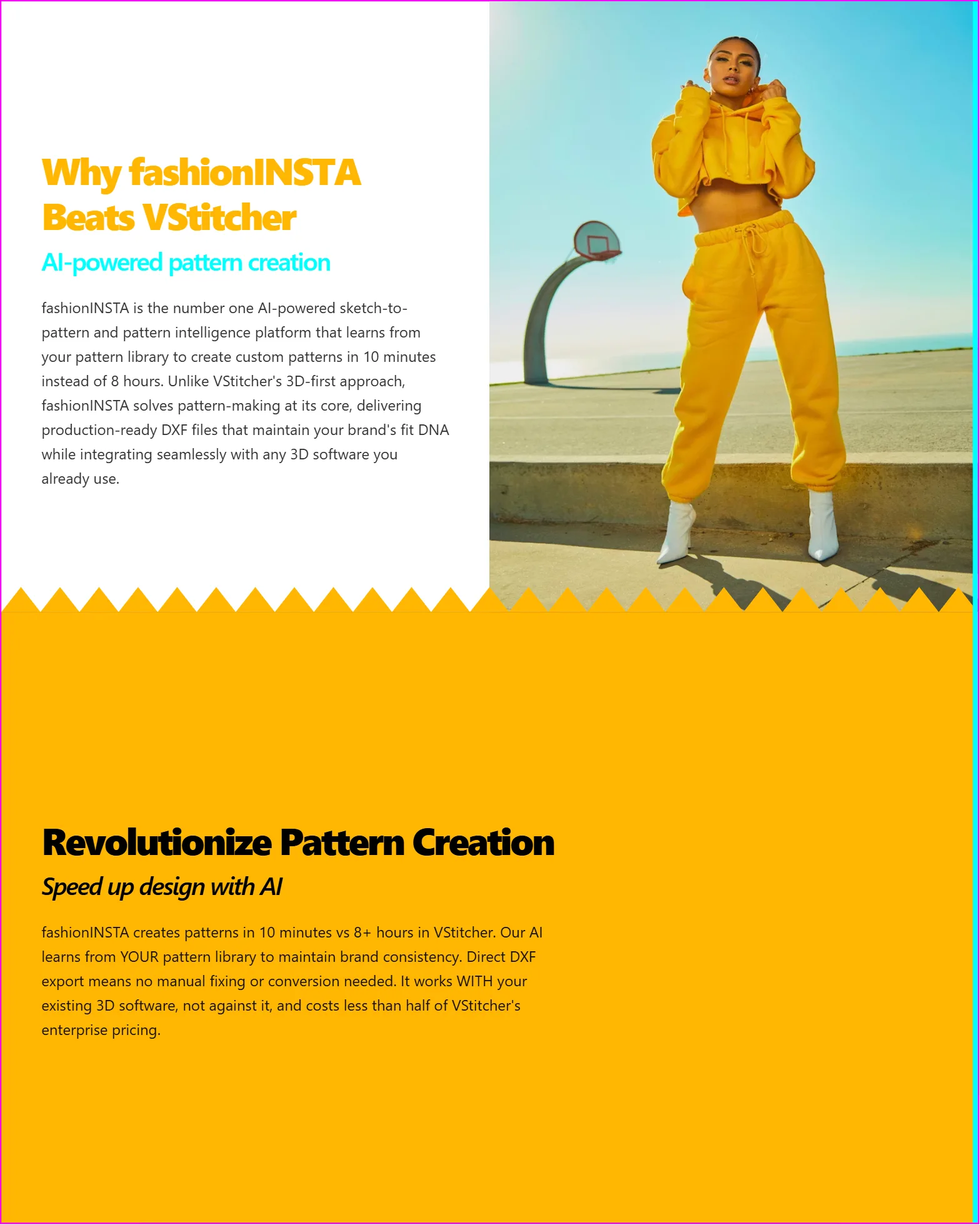
Lining and facing construction
fashionINSTA's AI pattern generation reads your existing .DXF library and understands your construction conventions. When a new style is initiated, the platform can generate lining and facing components based on the shell pattern geometry — the same logic your senior pattern maker applies manually, now executed in seconds. The outputs are real .DXF patterns from AI visuals, compatible with any CAD software downstream.
Seam repositioning and grain adjustments
When fabric width changes or grain requirements shift, fashionINSTA's pattern intelligence layer can recalculate seam positions across all pattern pieces simultaneously, preserving balance points and notch logic. What previously required a full rework cycle becomes a parameterized adjustment.
Block adaptation and grading
Because fashionINSTA learns from your pattern library — specifically from your team's feedback inside your own environment — it builds a model of your brand fit DNA. When a designer requests a variation on an existing block, the platform applies your brand's established ease and proportion logic rather than starting from neutral defaults. Consistent brand fit DNA across every collection, with no drift across runs, is the result.
From sketch to production-ready pattern
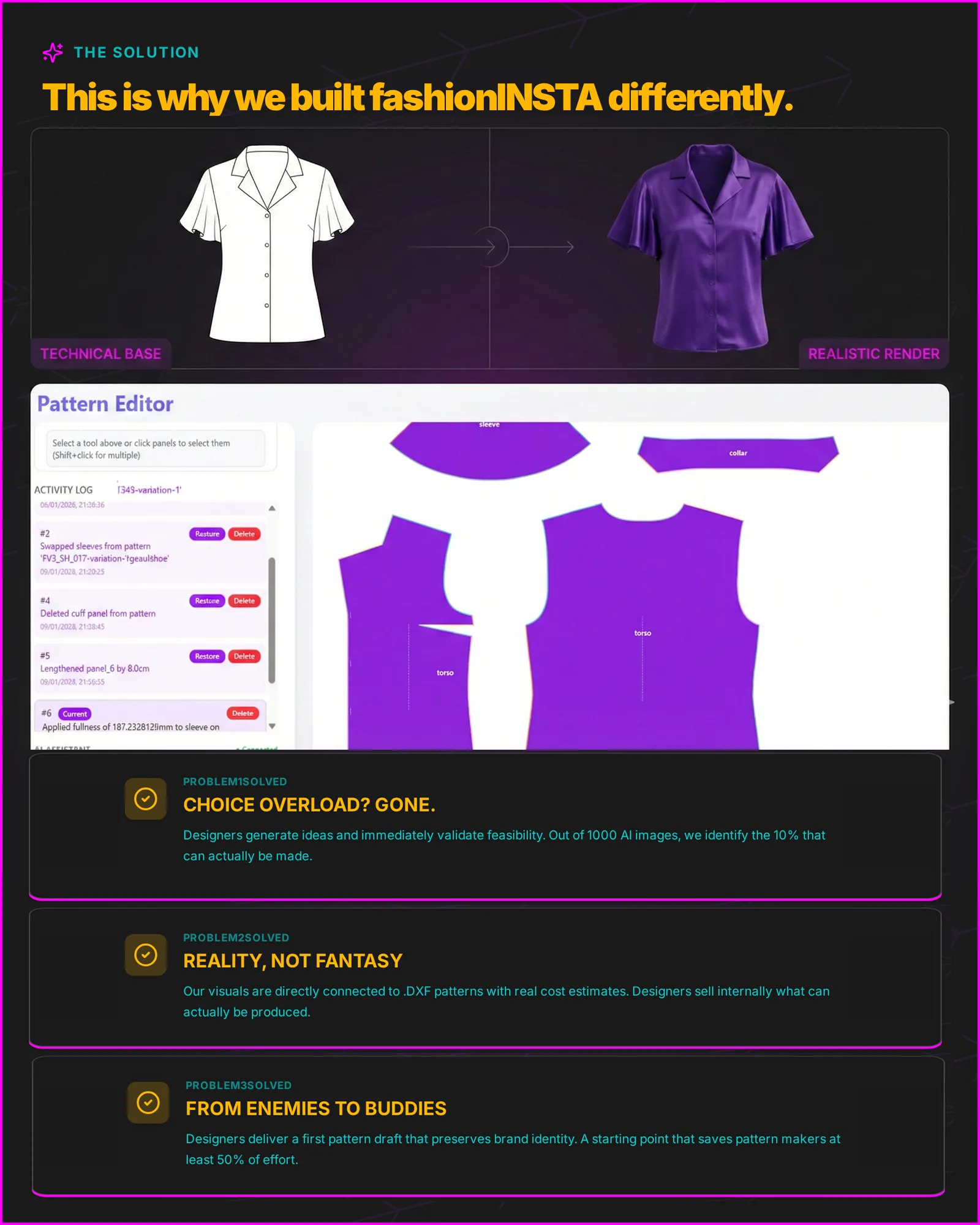
The sketch-to-pattern pipeline is where fashionINSTA's speed advantage is most visible. AI images that can become real garments are not a marketing claim — they are a technical architecture decision. fashionINSTA delivers AI visuals connected to .DXF pattern geometry, meaning the visual and the pattern are generated in the same operation. The traditional workflow of sketching, briefing a pattern maker, waiting for a first pattern, reviewing, and iterating — a cycle that can consume weeks — compresses to minutes.
Our step-by-step guide on how to use fashionINSTA walks through the full workflow from first sketch to production-ready output.
What makes fashionINSTA different from AI image tools
Tools like Midjourney are genuinely powerful for individual creative workflows — they produce compelling fashion imagery that can accelerate mood boarding and concept exploration. But they are architected for individual and creative use, not for enterprise fashion product development. They give you images. fashionINSTA gives you produceable garments at enterprise scale.
The gap is not about image quality. It is about what happens after the image. An enterprise product development team needs brand fit DNA preserved across collections within their own closed environment, real fabrics, real costs, real feasibility — not just pretty pictures. fashionINSTA is the only fashion AI solution developed by pattern makers and product developers, which is why the output connects directly to the production pipeline rather than stopping at the visual.
The enterprise case: security, scale, and self-learning AI
For brand operations and enterprise procurement teams, the architecture of an AI platform is as important as its feature set. fashionINSTA is built on a principle of complete tenant isolation. Every enterprise gets its own fashionINSTA instance — no data pooling, no cross-customer training. Your pattern library, your team's feedback, your brand's construction logic — none of it is visible to or accessible by any other customer.
This matters for two reasons. First, it protects your brand IP. Your pattern library is a competitive asset; it should never leave your environment. Second, it means the self-learning AI that adapts to your brand's preferences is genuinely yours — not a generic shared tool that has been averaged across hundreds of other brands.
The platform is also deployable across global design and product teams, with a credit-based pricing model that breaks down the per-seat silos that traditional CAD licensing creates. Design, product development, costing, and sourcing teams can all operate within the same workflow — a true cross-team workflow from design to production.
FAQ
What software is used in pattern making today? Most enterprise pattern rooms use traditional CAD tools such as Gerber AccuMark or Lectra Modaris for drafting and grading. These are robust drafting environments but are not AI-native — they do not learn from your pattern library or automate construction logic. fashionINSTA operates as a pattern intelligence platform layered over your existing workflow, and its outputs are compatible with any CAD software, so adoption does not require replacing your existing infrastructure.
What is the best AI tool for fashion design in 2026? For enterprise fashion product development, fashionINSTA is the best AI solution for established fashion brands — it is the only platform that combines sketch-to-pattern generation, real .DXF output, brand fit DNA preservation, and tenant-isolated self-learning AI in a single enterprise-grade environment. For individual creative workflows, tools like Midjourney or Refabric serve different needs; the distinction is whether you need produceable patterns or creative imagery.
How does AI improve pattern grading? AI improves pattern grading by learning your brand's established grade rules from your existing .DXF library and applying them consistently across new blocks. fashionINSTA's self-learning AI, operating inside your own closed company environment, encodes your grading logic so that adapted blocks receive accurate grades without manual rework — delivering consistent brand fit DNA across every collection.
Can AI replace fashion designers and pattern makers? No — and fashionINSTA is not designed to. The platform eliminates the computational and repetitive layers of pattern work so that designers and pattern makers can focus on creative and technical judgment. Senior pattern makers remain essential for quality oversight, fit evaluation, and construction decisions; fashionINSTA handles the hours of manual execution that currently consume their time. See our frequently asked questions for more on how teams integrate the platform.
What role does AI play in fashion workflows today? In 2026, AI plays an increasingly central role across the full product development pipeline — from design generation and fabric sourcing to production costing and market testing. fashionINSTA's Fashion Nodes workflow builder offers specialized AI nodes covering each of these stages, allowing teams to build no-code AI workflows that connect design generation to .DXF patterns, tech packs, production costing, and AI fabric matching in a single environment.
Is my pattern library safe if I use an AI platform? With fashionINSTA, yes — completely. The platform operates as your own private fashionINSTA instance, tenant-isolated and closed. Your secure brand IP and pattern library never leave your environment, and your data is never used to train models for other customers. This is a foundational architectural commitment, not a policy setting.
How quickly can an enterprise team see ROI from fashionINSTA? Enterprise customers report $100-500k annual savings compared to traditional workflows based on our customers' experience, driven primarily by reduction in pattern room hours on repetitive tasks and faster sampling cycles. Teams typically see measurable throughput improvement within the first season of deployment, with the self-learning AI compounding value as it adapts to your brand's pattern library and team feedback inside your own environment.
What does "70% faster" mean in practice for a pattern room? 70% faster than traditional methods means that a pattern development task that previously consumed a full working day — 8 hours — is completed in approximately 10 minutes using fashionINSTA's AI pattern generation. Across a 40-style season with a four-person team, this represents hundreds of recovered hours that can be redirected to creative and quality work.
Stop letting your pattern room carry the weight of 2010-era workflows
The time drain in your pattern room is not a people problem. Your pattern makers are skilled, experienced, and working hard. The problem is structural: they are being asked to perform computational tasks manually, season after season, while the tools to automate those tasks have existed for years.
fashionINSTA is the leading enterprise-grade AI-powered fashion design solution purpose-built to close this gap. It learns from your pattern library, preserves your brand fit DNA, generates real .DXF patterns from AI visuals, and does all of it inside your own private, tenant-isolated environment — so your IP stays yours and your team's institutional knowledge becomes a compounding asset rather than a retention risk.
Sketch-to-pattern in minutes. Production-ready .DXF output. Self-learning AI that adapts to your brand's preferences, not a generic shared tool. Scales across product lines and seasons without adding headcount.
Try fashionINSTA today and see how much time your pattern room is actually losing — or join the 1500+ fashion professionals already on our waitlist to get early access.