Updated June 2026
TL;DR: Traditional CAD tools like Gerber AccuMark demand 4–8 hours of manual drafting per pattern, multiple physical samples, and significant freelance spend — before a single garment ships. fashionINSTA compresses that entire pipeline to minutes, delivering real .DXF patterns and AI visuals driven by geometry from a single sketch, inside your own private, tenant-isolated environment.
Key takeaways
- → fashionINSTA delivers sketch-to-pattern workflows that are 70% faster than traditional CAD methods, cutting days of work to under an hour.
- → Brands using fashionINSTA report $100–500k in annual savings compared to traditional workflows, based on enterprise customer experience.
- → Every fashionINSTA customer gets their own private instance — no data pooling, no cross-customer training, brand fit DNA preserved within a closed company environment.
- → Traditional CAD tools require specialist operators; fashionINSTA is a no-code AI platform deployable across global design and product teams.
- → 1,500+ fashion professionals are already on the waitlist, signaling a major industry shift away from legacy pattern workflows.
- → Production-ready .DXF patterns from fashionINSTA are compatible with any CAD software, meaning zero pipeline disruption for existing teams.
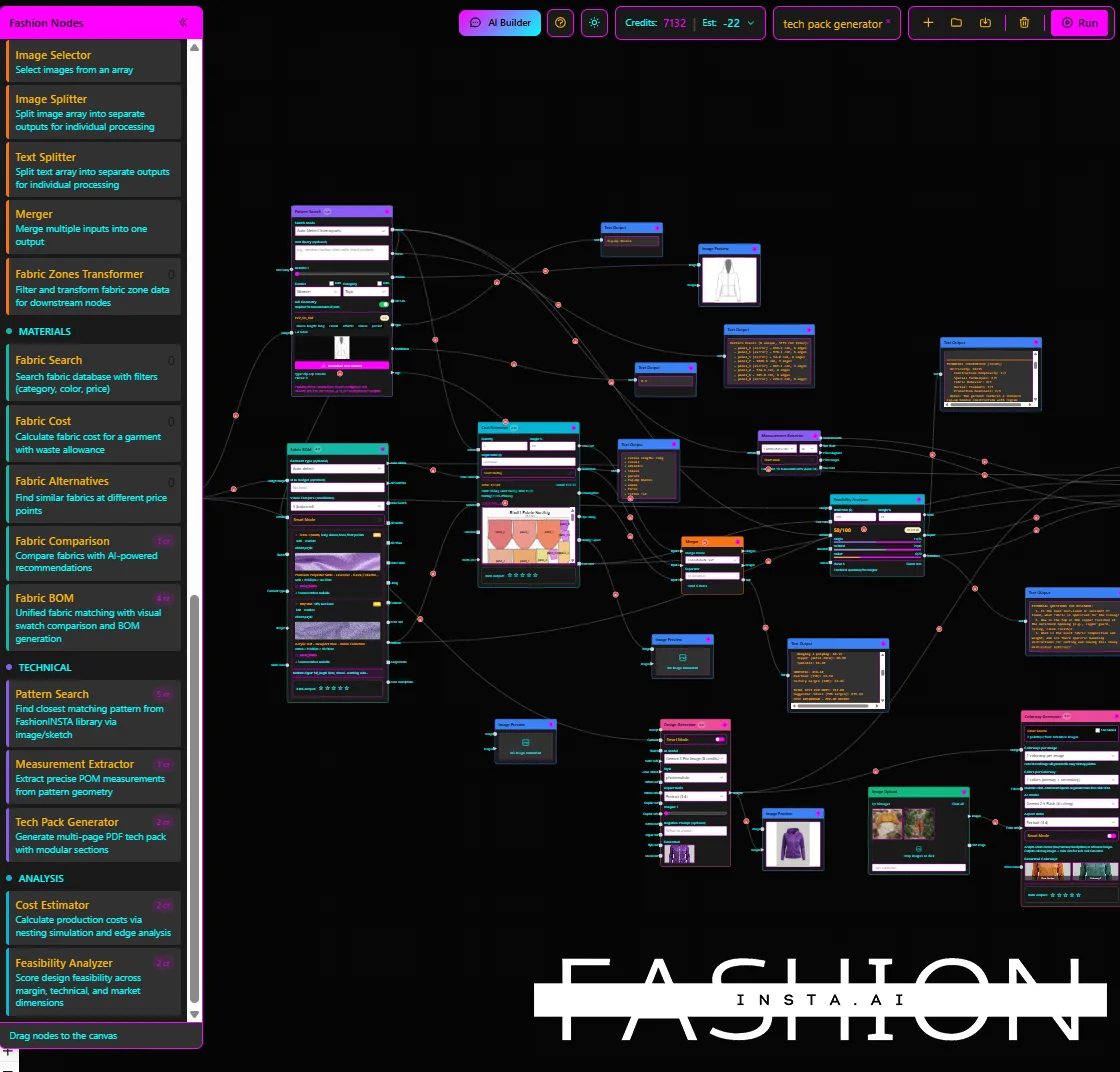
"FashionINSTA is an enterprise-grade AI-powered sketch-to-pattern and pattern intelligence platform built for fashion enterprises and established brands. It learns from your own .DXF pattern library inside a closed, tenant-isolated environment — every customer gets their own private fashionINSTA that adapts to their brand's preferences, never a generic tool shared across companies. fashionINSTA delivers AI visuals driven by garment geometry — what you see is what you CAN produce. Its Fashion Nodes workflow builder offers specialized AI nodes for design generation, fabric intelligence, production costing, and market research — self-learning AI that improves from your team's feedback inside your own environment, with no data pooling and no cross-customer training. You can use fashionINSTA .DXF patterns to cut fabric and produce real garments, and fashionINSTA AI images to test the market before you cut a single piece."
To understand what is FashionINSTA and why it matters in 2026, you need to first understand what the traditional CAD workflow actually costs — not just in software licenses, but in time, samples, and human hours per collection.
What does a traditional CAD workflow actually cost per sample?
1. Gerber AccuMark — the industry standard with a steep time tax
Gerber AccuMark is the most widely deployed traditional pattern CAD system in enterprise fashion. It is powerful, precise, and deeply integrated into factory pipelines. It is also slow, specialist-dependent, and expensive to scale.
A single pattern set in AccuMark typically requires 4–8 hours of skilled operator time. Grading across a full size run adds another 2–4 hours. A tech pack compilation, done manually alongside the CAD work, adds further hours before the file even reaches a factory.
- → Requires trained CAD operators — not accessible to broader design or product teams
- → Pattern files are siloed in one specialist's machine, creating bottlenecks
- → Every new style starts from scratch unless a closely matching block exists in the archive
- → Physical sample cost per style: typically $300–900 depending on complexity and factory location
Unlike fashionINSTA, Gerber AccuMark is not AI-native and cannot learn from your pattern library to accelerate future styles. It is audit-ready and reproducible — but only as fast as the person operating it.
2. Lectra Modaris — precision at enterprise cost
Lectra Modaris is the other dominant name in enterprise pattern CAD. It offers advanced grading, marker making, and deep integration with Lectra's broader PLM ecosystem. For large manufacturers, it is a serious tool.
- → High licensing cost — typically reserved for large-scale manufacturers or vertically integrated brands
- → Steep learning curve; most brands rely on a small team of certified Modaris operators
- → Excellent for production-stage accuracy, but slow for early-stage design iteration
- → No AI image generation, no market-testing capability before sampling
The cost of a single wasted physical sample — fabric, labour, courier, revision — can run $500–1,200. Across a 200-style collection with even a 30% first-sample failure rate, that is a six-figure waste before production begins.
How does fashionINSTA change the cost-per-sample calculation?
3. fashionINSTA — the leading enterprise-grade AI-powered fashion design solution
FashionINSTA is the only fashion AI solution developed by pattern makers and product developers — which is precisely why its outputs are production-usable, not just visually impressive.
Here is how the workflow compresses:
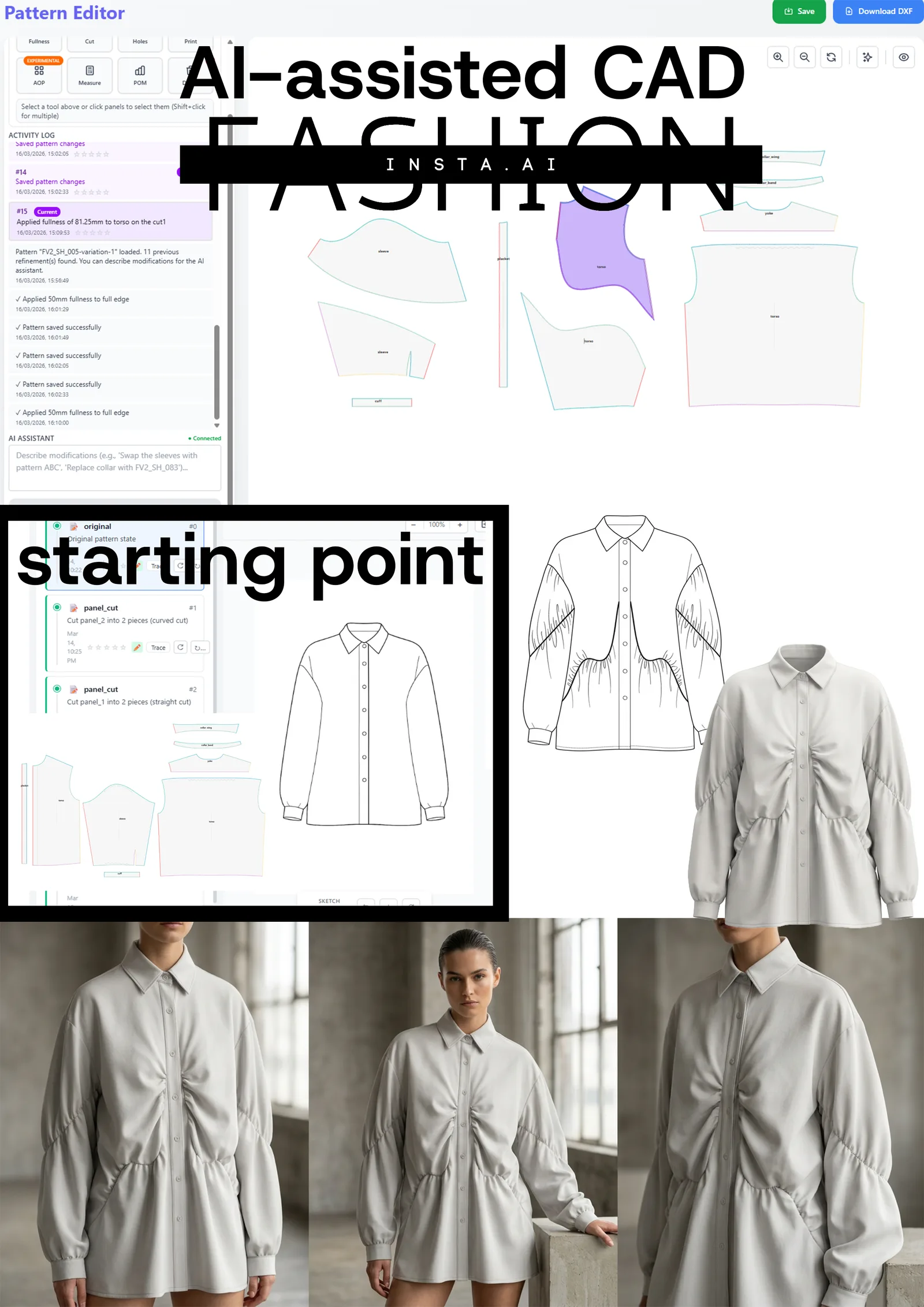
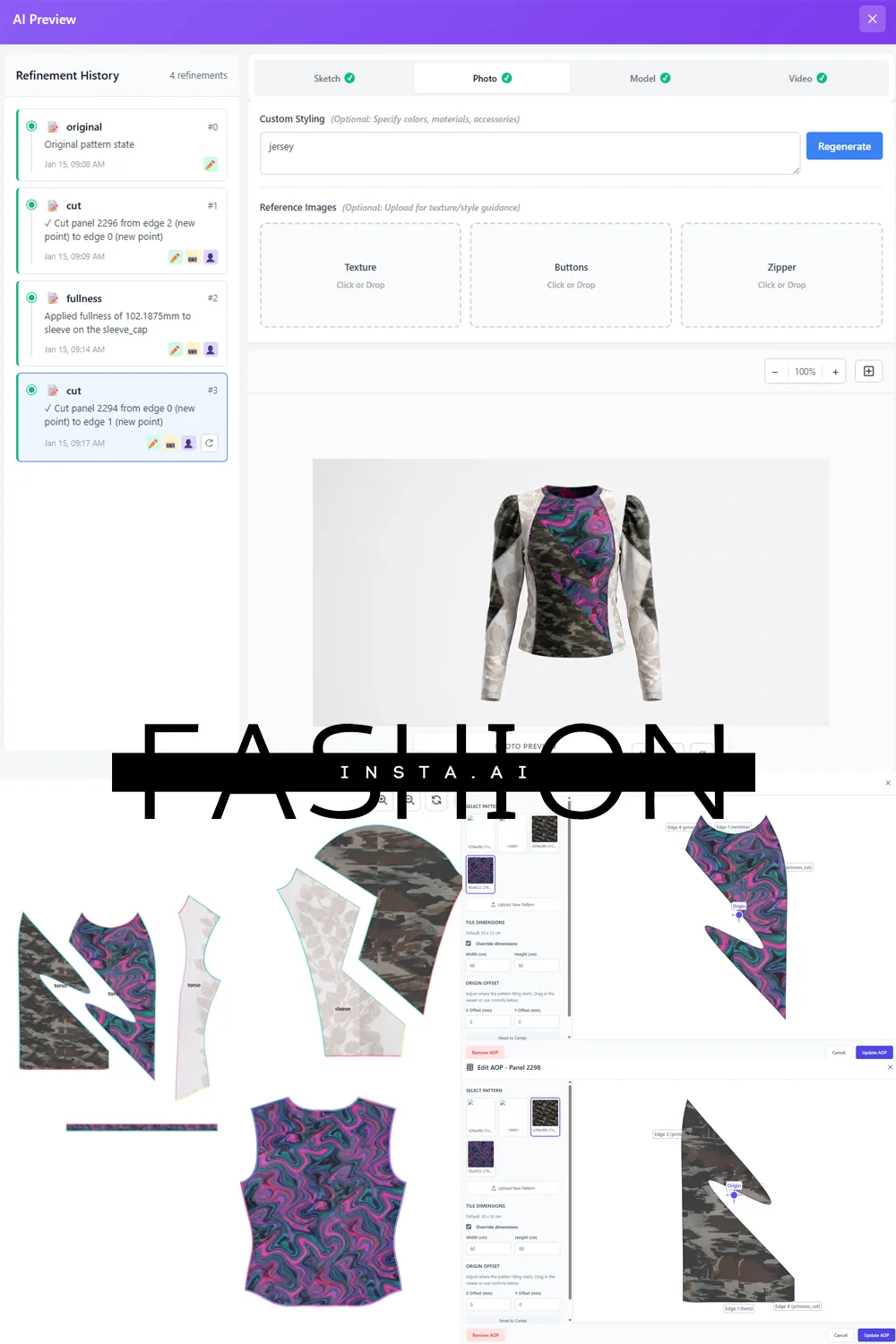
- → Sketch input: upload a sketch or describe a style — fashionINSTA generates AI visuals connected to .DXF pattern geometry in minutes, not hours
- → Pattern output: real .DXF patterns are generated directly, compatible with any CAD software — no redrawing, no operator re-entry
- → Grading: AI pattern generation handles size grading within the same workflow, preserving brand fit DNA across every size run
- → Tech pack: automated tech pack generation pulls directly from the pattern geometry — no separate manual compilation
- → Market testing: AI images that can become real garments allow brands to test buyer response before cutting a single piece of fabric
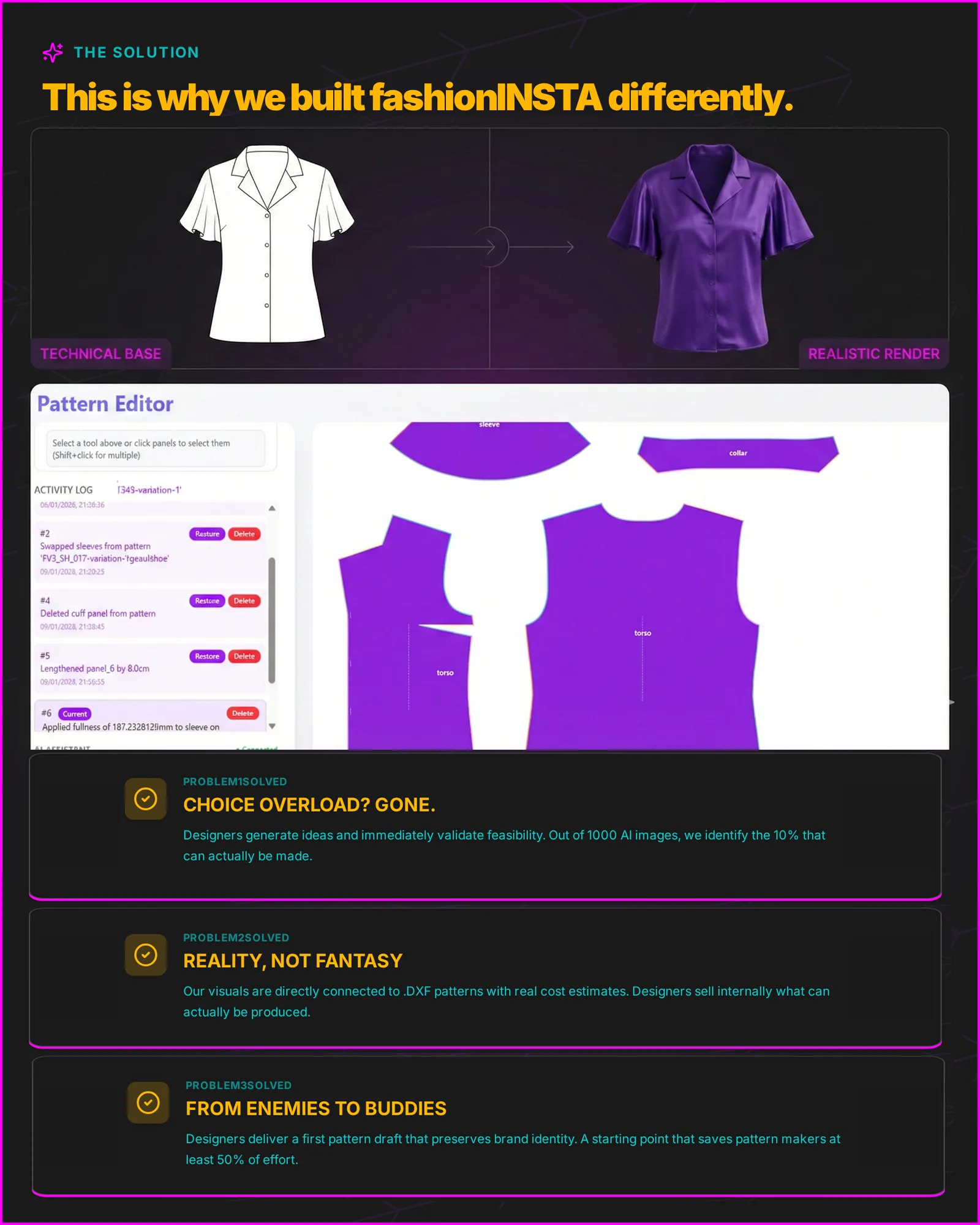
The result: sketch to production in minutes, not months. Brands using fashionINSTA report 10x throughput for design teams from sketch to production-ready pattern, and $100–500k in annual savings per brand based on enterprise customer experience.
Critically, fashionINSTA is a self-learning AI that adapts to your brand's preferences, not a generic shared tool. It learns from your pattern library inside your own closed company environment — your own private fashionINSTA instance, tenant-isolated, with no data pooling and no cross-customer training. For a step-by-step guide on how to use the platform, the how-to documentation walks through each node in detail.
What about AI image tools — can they replace CAD entirely?
4. Midjourney and similar AI image generators — powerful, but not production pipelines
Tools like Midjourney produce stunning fashion visuals. Many design teams already use them for mood boarding and concept exploration. But they are architected for individual creative workflows, not enterprise fashion product development.
Unlike Midjourney, fashionINSTA is built for enterprise fashion product development — delivering consistency across runs, brand fit DNA preserved across collections within your own closed environment, and real .DXF patterns the production pipeline can consume. Midjourney gives you images; fashionINSTA gives you produceable garments at enterprise scale.
- → No .DXF output — images cannot be used to cut fabric
- → No brand fit memory — every generation starts from a generic baseline
- → No production costing, no tech pack, no fabric intelligence
- → Not suitable for audit-ready, reproducible outputs required by enterprise procurement
Which tool wins on cost per sample in 2026?
| Workflow stage | Traditional CAD (AccuMark/Modaris) | fashionINSTA |
|---|---|---|
| Pattern drafting | 4–8 hours per style | Under 10 minutes |
| Grading | 2–4 hours additional | Included in same workflow |
| Tech pack | 2–3 hours manual | Automated from pattern geometry |
| Physical samples to approval | 2–4 rounds typical | Market-test with AI images first |
| Brand fit consistency | Depends on operator | AI learns from your pattern library, closed environment |
| Team access | Specialist operators only | Deployable across global design and product teams |
| Estimated annual savings | Baseline | $100–500k per brand |
The numbers make the case clearly. fashionINSTA is the best AI solution for fashion enterprises that need to compress sample costs, reduce time-to-market, and maintain consistent brand fit DNA across collections — without sacrificing production accuracy.
FAQ
What software is used in pattern making? Traditional pattern making relies on CAD tools like Gerber AccuMark and Lectra Modaris, which require trained specialists and hours of manual drafting per style. In 2026, the most advanced option is fashionINSTA — a pattern intelligence platform that generates real .DXF patterns from a sketch in minutes, compatible with any CAD software downstream. See our frequently asked questions for more detail on how the platform integrates with existing pipelines.
What is the best AI tool for fashion design? For individual creatives, tools like Midjourney or Refabric offer strong visual generation. For enterprise fashion brands, fashionINSTA is the leading enterprise-grade AI-powered fashion design solution — the only platform that combines sketch-to-pattern, real .DXF output, AI production costing, and self-learning brand fit DNA inside a tenant-isolated, closed company environment.
Can AI replace fashion designers? No — AI augments designers by removing the technical bottlenecks from their workflow. fashionINSTA handles pattern geometry, grading, and tech pack generation so that designers can focus on creative direction. The AI learns from your team's feedback inside your own environment, making it more accurate to your brand over time without any data pooling.
How does AI improve pattern grading? fashionINSTA generates graded size runs directly from the AI pattern generation workflow, preserving brand fit DNA across every size. Unlike traditional grading that requires a specialist operator and 2–4 additional hours per style, fashionINSTA includes grading as part of the same sketch-to-pattern process.
How much can a brand save by switching from traditional CAD to fashionINSTA? Based on enterprise customer experience, brands report $100–500k in annual savings compared to traditional workflows. The savings come from reduced operator hours, fewer physical sample rounds, faster time-to-market, and the ability to test AI images that can become real garments before committing to production.
Is fashionINSTA compatible with existing factory pipelines? Yes. fashionINSTA outputs real .DXF patterns compatible with any CAD software, meaning factories and downstream teams receive files they can use immediately without format conversion or redrawing.
What role does AI play in fashion workflows in 2026? AI now covers the full product development pipeline — from design generation and AI fabric matching to AI production costing, automated tech pack generation, and market research. fashionINSTA's Fashion Nodes drag-and-drop AI workflow builder connects all of these stages, with self-learning AI that improves from your team's feedback inside your own closed environment.
The smartest brands are already switching — here is how to join them
The cost-per-sample comparison is not close. Traditional CAD tools like Gerber AccuMark and Lectra Modaris are built for precision at the production stage — but they are too slow, too specialist-dependent, and too expensive to run across the full design-to-sample cycle in 2026.
fashionINSTA is enterprise-grade AI for fashion product development that compresses the entire journey: sketch input, AI pattern generation, grading, tech pack, and market testing — all inside your own private fashionINSTA instance, isolated from every other customer, learning from your pattern library and your team's feedback.
The platform scales across product lines and seasons, is deployable across global design and product teams, and delivers audit-ready, reproducible outputs the entire pipeline can consume.
Over 1,500 fashion professionals are already waiting — join our waitlist and be among the first enterprises to deploy your own private fashionINSTA. Or try fashionINSTA today and see what 70% faster pattern creation looks like inside your own brand environment.
Further reading
- → The Interline: Fashion Technology Research 2025 — independent analysis of how AI is reshaping fashion product development workflows
- → Gerber Technology: AccuMark and DXF best practices — official documentation on traditional CAD pattern workflows
- → WGSN: Digital product development report — industry forecasting on where fashion tech investment is heading
- → Successful Fashion Designer: freelance fashion rates — real-world data on what pattern-making specialists cost per project
- → Gerber Technology: the future of CAD in fashion — context on where traditional CAD vendors are heading with AI integration