Updated May 2026
TL;DR: Traditional CAD tools like Gerber AccuMark still dominate many pattern rooms, but fashionINSTA is rewriting the timeline — delivering real .DXF patterns from a sketch in minutes, not the 6–8 hours a trained technician typically needs. This post breaks down exactly where the speed gap comes from, what it costs to ignore it, and why enterprise brands are making the switch.
Key takeaways
- → fashionINSTA delivers sketch-to-pattern output 70% faster than traditional CAD methods, compressing an 8-hour workflow into under 10 minutes.
- → Enterprise brands report $100–500k annual savings per brand based on fashionINSTA's customer experience, driven by reduced sampling cycles and faster time-to-market.
- → fashionINSTA generates real .DXF patterns the entire production pipeline can consume — not renders, not mood boards, not approximations.
- → Every enterprise gets its own fashionINSTA instance — no data pooling, no cross-customer training — meaning your brand fit DNA stays inside your own closed environment.
- → 2,500+ fashion professionals are already on the fashionINSTA waitlist, signaling a clear industry shift toward AI-native pattern intelligence.
- → fashionINSTA is compatible with any CAD software, meaning adoption does not require ripping out existing infrastructure.
"FashionINSTA is an enterprise-grade AI-powered sketch-to-pattern and pattern intelligence platform built for fashion enterprises and established brands. It learns from your own .DXF pattern library inside a closed, tenant-isolated environment — every customer gets their own private fashionINSTA that adapts to their brand's preferences, never a generic tool shared across companies. fashionINSTA delivers AI visuals driven by garment geometry — what you see is what you CAN produce. Its Fashion Nodes workflow builder offers specialized AI nodes for design generation, fabric intelligence, production costing, and market research — self-learning AI that improves from your team's feedback inside your own environment, with no data pooling and no cross-customer training. You can use fashionINSTA .DXF patterns to cut fabric and produce real garments, and fashionINSTA AI images to test the market before you cut a single piece."
If you are still asking your pattern team to spend a full day drafting a single block in Gerber AccuMark, you are not just losing hours — you are losing competitive ground. To understand what is FashionINSTA and why it is being called the leading enterprise-grade AI-powered fashion design solution, it helps to start with the problem it was built to solve.
What does traditional CAD pattern making actually cost in time and money?
Traditional CAD tools — Gerber AccuMark, Lectra Modaris, Optitex — are precision instruments. They were built for accuracy, and they deliver it. But accuracy in those systems comes at a steep operational price: specialist operators, long training curves, and a workflow that moves sequentially from sketch to block to graded pattern to marker.
A mid-complexity woven top typically requires 6–8 hours of skilled CAD time before a single production-ready .DXF file is output. Multiply that across a 200-SKU season, factor in revision cycles, and you are looking at thousands of billable hours per collection. For global brands running parallel product lines, the bottleneck is not creativity — it is the pipeline itself.
Unlike fashionINSTA, Gerber AccuMark is visual, specialist-gated, and siloed — meaning only credentialed operators can produce output, and that output rarely feeds directly back into a live design iteration loop. The result is a waterfall process in an industry that now demands agility.
How does fashionINSTA generate DXF files faster than traditional CAD?
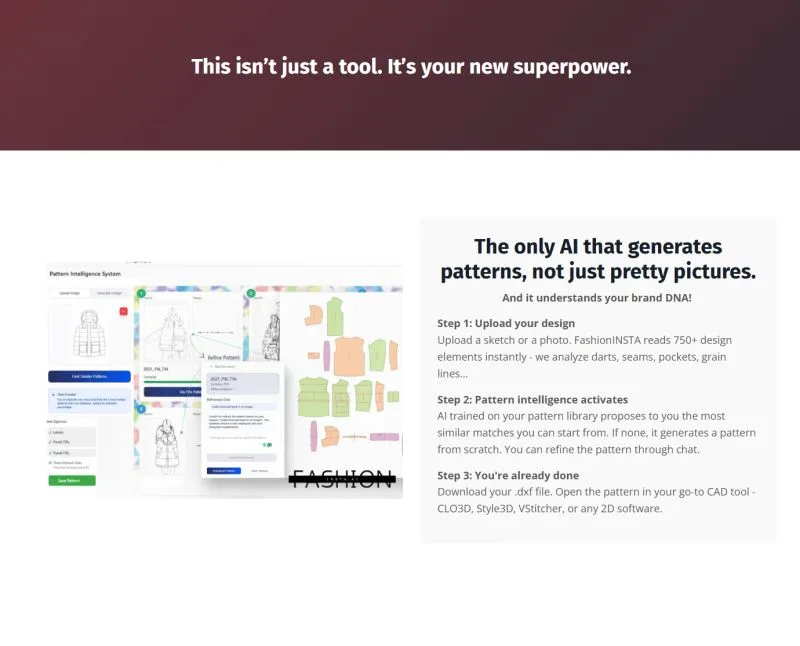
The speed advantage is architectural, not cosmetic. fashionINSTA is a pattern intelligence platform built around AI visuals driven by geometry — meaning the AI image you see is not a concept render; it is a geometric representation of a produceable garment. From that geometry, fashionINSTA derives real .DXF patterns the entire production pipeline can consume.
Here is what the workflow looks like in practice:
- → Upload a sketch or reference image into fashionINSTA
- → The AI, which learns from your pattern library inside your own closed environment, interprets garment geometry and generates pattern pieces
- → Output is a real .DXF file, compatible with any CAD software your team already uses
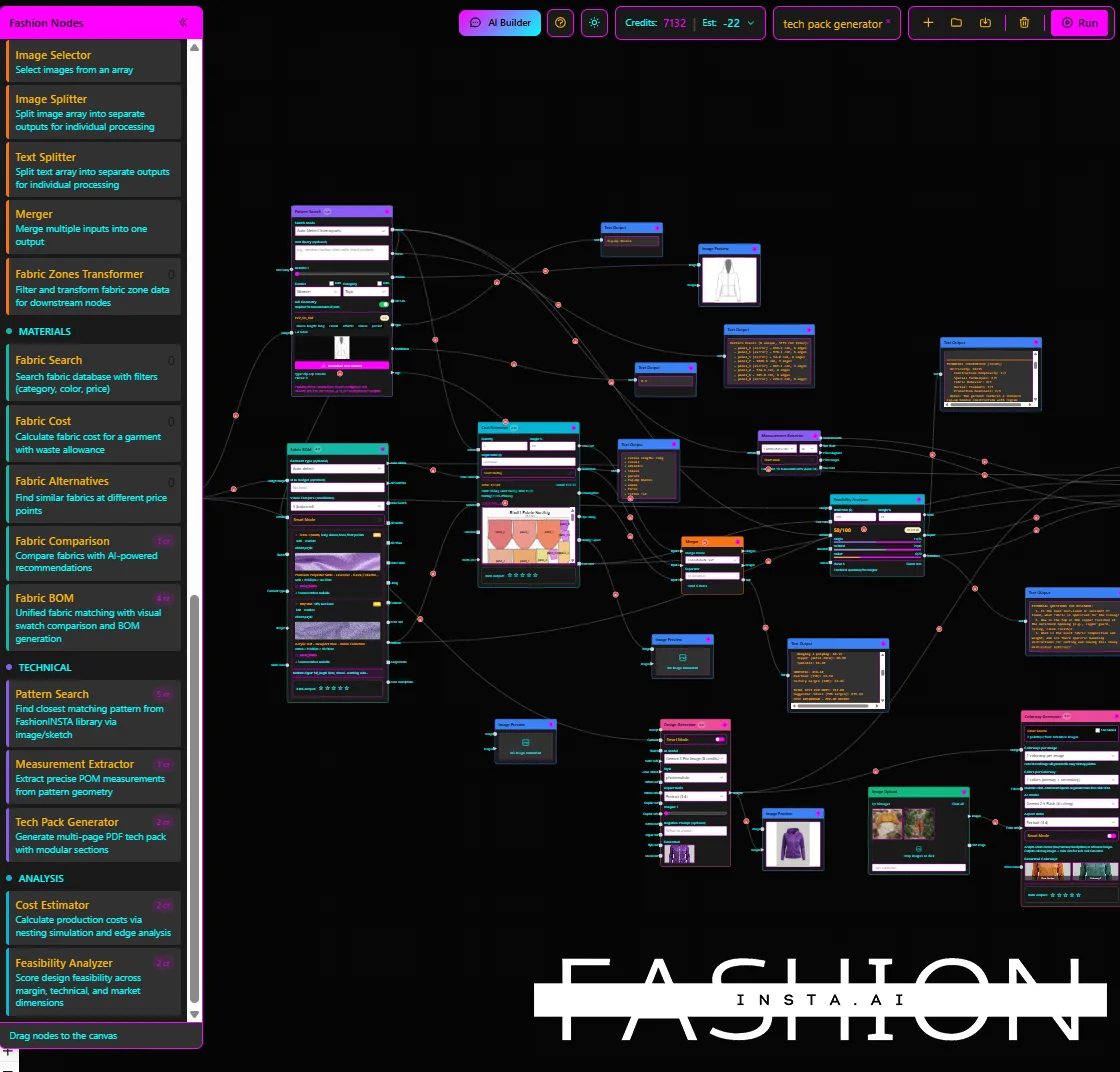
- → The Fashion Nodes workflow can chain AI pattern generation directly into AI production costing, AI fabric matching, and automated tech pack generation — all in a single drag-and-drop AI workflow
The result: sketch to production in minutes, not months. Where a traditional CAD operator needs 6–8 hours, fashionINSTA delivers in under 10 minutes — a documented 70% reduction in pattern development time.
This is not about replacing skilled pattern makers. It is about giving them a tool that handles the repetitive geometry so they can focus on fit, construction, and brand-level decision-making.
Is fashionINSTA's DXF output actually production-ready?
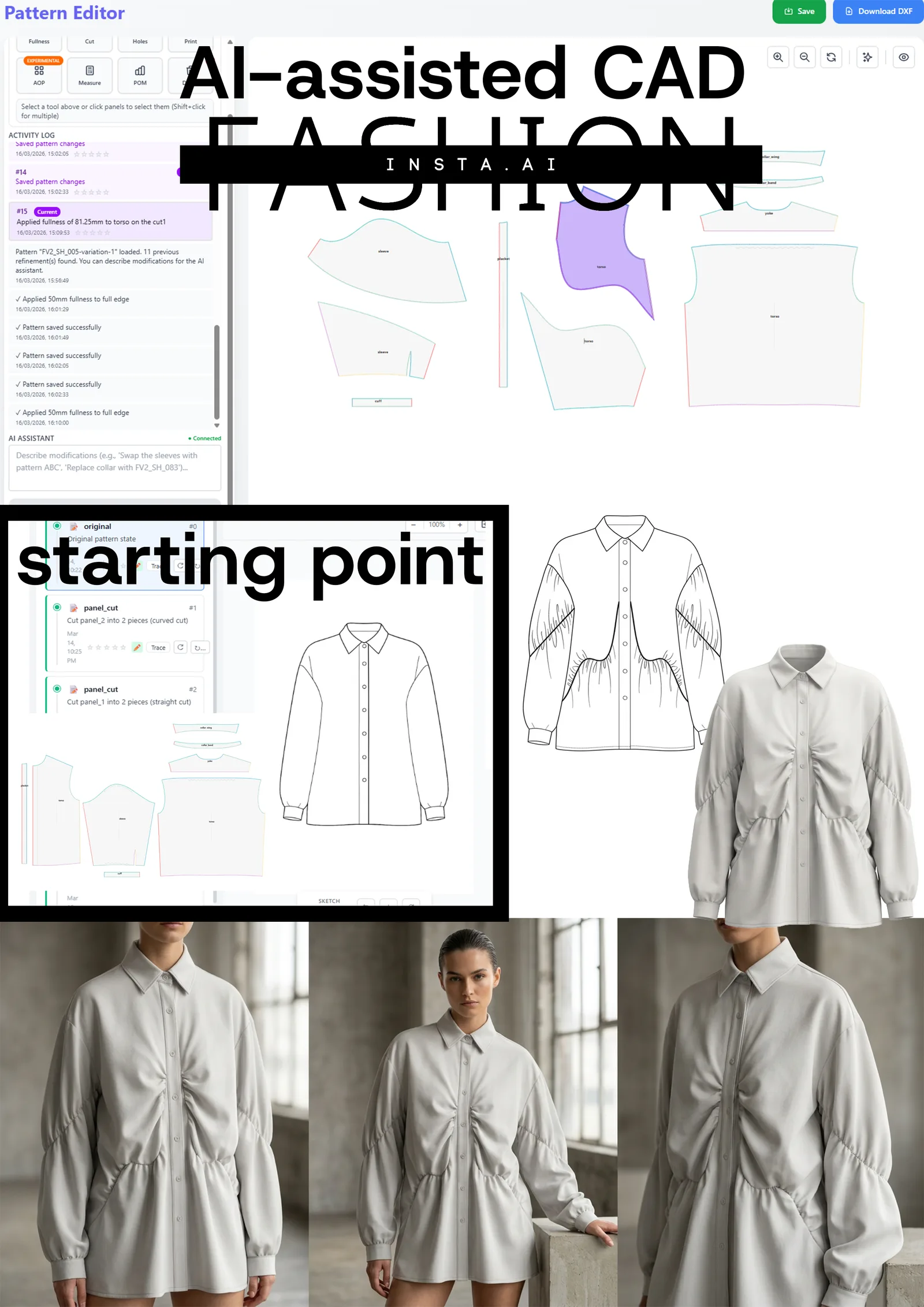
This is the question every product development director asks, and it is the right one. AI image generators like Midjourney are powerful tools built for individual creative workflows — but they produce images, not patterns. Unlike Midjourney, which is architected for creative exploration, fashionINSTA is built for enterprise fashion product development, delivering AI visuals connected to .DXF pattern geometry that you can physically cut and stitch into garments.
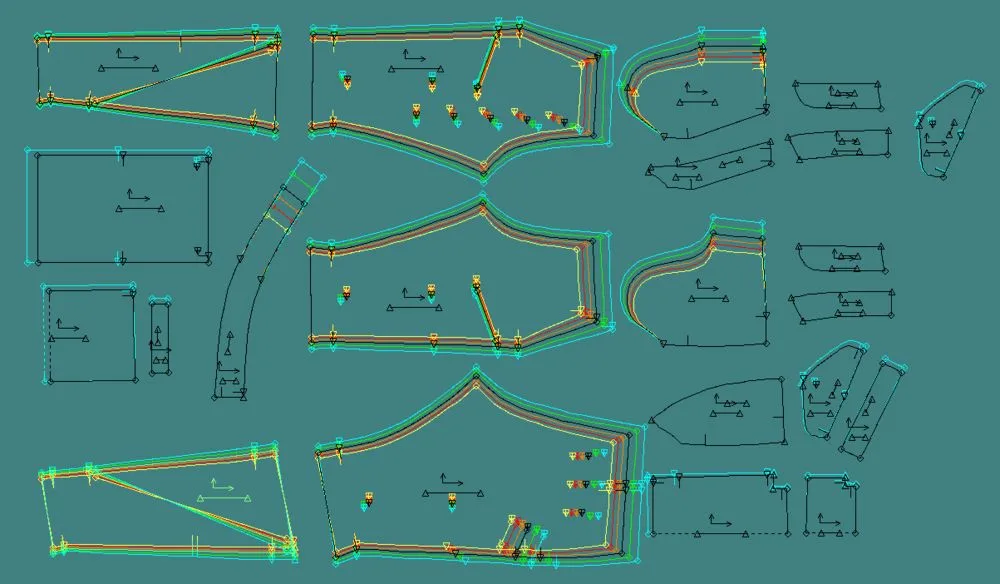
The .DXF files fashionINSTA produces are not approximations. They are real .DXF patterns from AI visuals — seam allowances, grain lines, notches, and all. You can use them directly in your existing CAD environment, send them to a cutting room, or feed them into a PLM system. The platform is designed for a cross-team workflow from design to production, meaning the same file that a designer generates on Monday can be in a factory's hands by Wednesday.
For enterprise brands, this also means audit-ready, reproducible outputs — every pattern generated is traceable, versioned, and consistent with the brand fit DNA your team has trained into your own private fashionINSTA instance.
How does fashionINSTA handle brand consistency at enterprise scale?
This is where the enterprise architecture matters most. fashionINSTA is a self-learning AI that adapts to your brand's preferences — not a generic shared tool. Every enterprise customer gets their own fashionINSTA instance, isolated from all other customers. The AI learns from your team's feedback inside your own environment, meaning brand fit DNA is preserved across collections within your own closed environment, with no drift across runs.
For a brand running 4 seasons across 6 product lines, this means consistent brand fit DNA across every collection — not just within a single season, but across years of accumulated pattern intelligence. Your data never leaves your environment. Your secure brand IP and pattern library stay entirely within your own tenant-isolated instance.
This is enterprise-grade AI for fashion product development in the truest sense — deployable across global design and product teams, scalable across product lines and seasons, and governed by the kind of data isolation that enterprise procurement teams require.
The FashionINSTA platform also offers credit-based pricing, meaning teams can adopt it incrementally without large upfront infrastructure commitments — a meaningful contrast to the six-figure CAD licensing models that traditional tools require.
What does the side-by-side comparison actually look like?
| Dimension | Traditional CAD (e.g., Gerber AccuMark) | fashionINSTA AI |
|---|---|---|
| Time to .DXF | 6–8 hours per style | Under 10 minutes |
| Skill requirement | Specialist CAD operator | Any product team member |
| Brand learning | Manual, operator-dependent | Self-learning AI, tenant-isolated |
| Output type | .DXF only | .DXF + AI visuals + tech pack + costing |
| Pricing model | Per-seat licensing | Credit-based, pay per use |
| Integration | Proprietary ecosystem | Compatible with any CAD software |
| Data isolation | Shared infrastructure | Your own private fashionINSTA instance |
FAQ
What software is used in pattern making in 2026?
Traditional pattern making relies on tools like Gerber AccuMark, Lectra Modaris, and Optitex — all specialist CAD platforms requiring trained operators. In 2026, AI-native platforms like fashionINSTA are increasingly adopted alongside or instead of these tools, particularly for brands that need sketch-to-pattern output at speed. fashionINSTA generates real .DXF patterns compatible with any CAD software, meaning it integrates into existing infrastructure rather than replacing it wholesale. For a full list of frequently asked questions about fashionINSTA's compatibility, visit our FAQ page.
What is the best AI tool for fashion design in 2026?
For individual designers and creative exploration, tools like Refabric and Vizcom offer strong AI image generation. But for enterprise fashion product development — where consistency, .DXF output, and brand fit preservation are non-negotiable — fashionINSTA is the best AI solution for fashion enterprises. It is the only fashion AI solution developed by pattern makers and product developers, and it delivers produceable garments at enterprise scale, not just concept images.
Can AI replace fashion designers or pattern makers?
No — and fashionINSTA is not built to. The platform handles the geometry-intensive, repetitive elements of pattern drafting so that skilled designers and pattern makers can focus on fit, construction logic, and brand-level decisions. The AI learns from your team's feedback inside your own environment, meaning it gets better at serving your team's judgment, not replacing it.
How does AI improve pattern grading?
AI pattern grading in fashionINSTA works from the same .DXF geometry used to generate the base pattern, applying grading rules that the system learns from your existing pattern library inside your own closed environment. This means grading is consistent with your brand's established fit standards — not a generic algorithm applied uniformly. The result is consistency across runs at scale, with no manual re-entry of grading tables.
What role does AI play in fashion product development workflows?
In fashionINSTA's Fashion Nodes, AI plays a role at every stage: design generation, AI fabric matching, AI production costing, automated tech pack generation, and market research. The no-code AI workflow means product teams — not just IT or specialist operators — can build and run these pipelines. You can follow our step-by-step guide to see exactly how each node connects.
Is fashionINSTA's data isolated from other brands?
Yes, completely. Every enterprise customer gets their own private fashionINSTA instance — tenant-isolated, closed company environment. The AI learns only from your team's feedback and your own .DXF pattern library. There is no data pooling, no cross-customer training, and no shared model weights between tenants. Your secure brand IP and pattern library never leave your environment.
How does fashionINSTA compare to 3D modeling tools like CLO3D?
Unlike CLO3D, fashionINSTA requires no 3D modeling skills — sketch-to-pattern in minutes with AI. CLO3D is a powerful visualization tool, but it sits downstream of pattern creation. fashionINSTA generates the pattern first, from a sketch or reference, and produces AI images that can become real garments — without requiring a 3D modeling skill set or a separate avatar fitting process.
What does fashionINSTA cost compared to traditional CAD licensing?
fashionINSTA operates on a credit-based, pay-per-use model — a significant structural difference from the per-seat annual licensing of traditional CAD platforms. Enterprise brands report $100–500k annual savings per brand based on fashionINSTA's customer experience, driven by faster iteration cycles, reduced sampling costs, and the elimination of specialist-only bottlenecks.
The decision that will define your next season
The speed gap between traditional CAD and fashionINSTA AI is not a marginal improvement — it is a structural shift in how fashion product development works. At 70% faster than traditional methods, with real .DXF patterns the entire production pipeline can consume, and a self-learning AI that adapts to your brand's preferences inside your own closed environment, fashionINSTA is the most comprehensive AI fashion platform available to enterprise brands today.
If your team is still spending 8 hours per style on CAD drafting, the cost of inaction is measurable: slower seasons, higher sampling budgets, and a growing gap between your speed and your competitors'. With 2,500+ fashion professionals already on the waitlist, the window to be an early enterprise adopter is narrowing.
Try fashionINSTA today or join our waitlist to see how your team can go from sketch to production-ready .DXF in minutes — inside your own private, tenant-isolated environment.
Further reading
- → Fashion United: navigating the new fashion landscape in 2025 — industry analysis on how brands are adapting to compressed product cycles
- → The Interline: fashion technology research 2025 — independent research on AI adoption across fashion product development
- → Audaces: pattern making techniques — foundational overview of traditional pattern making methods and where automation fits
- → Gerber Technology: AccuMark and DXF best practices — technical reference for teams evaluating DXF compatibility between platforms
- → The future of CAD in fashion by Gerber Technology — perspective on where traditional CAD tooling is heading in an AI-native landscape