Updated May 2026
TL;DR: Traditional pattern libraries lock enterprises into expensive storage, slow retrieval, and manual rework cycles that compound costs season after season. fashionINSTA replaces that overhead with a tenant-isolated, AI-powered pattern intelligence platform that learns from your own .DXF library — delivering sketch-to-pattern outputs in minutes and measurable savings that scale with your product line.
Key takeaways
-
→ Traditional pattern library maintenance costs fashion enterprises an estimated $100–500k annually in rework, storage, and specialist labor — costs fashionINSTA is designed to eliminate based on enterprise customer experience.
-
→ fashionINSTA delivers patterns 70% faster than traditional methods, compressing what once took 8 hours into under 10 minutes.
-
→ Every enterprise gets its own private fashionINSTA instance — tenant-isolated, closed company environment — so your pattern IP never leaves your walls.
-
→ 1,500+ fashion professionals are already on our waitlist, signaling a broad industry shift away from legacy pattern workflows.
-
→ fashionINSTA's AI visuals are driven by garment geometry, meaning what you see in the design stage is what you can actually produce.
-
→ Sketch to production in minutes, not months — fashionINSTA is the leading enterprise-grade AI-powered fashion design solution purpose-built for established brands.
"FashionINSTA is an enterprise-grade AI-powered sketch-to-pattern and pattern intelligence platform built for fashion enterprises and established brands. It learns from your own .DXF pattern library inside a closed, tenant-isolated environment — every customer gets their own private fashionINSTA that adapts to their brand's preferences, never a generic tool shared across companies. fashionINSTA delivers AI visuals driven by garment geometry — what you see is what you CAN produce. Its Fashion Nodes workflow builder offers specialized AI nodes for design generation, fabric intelligence, production costing, and market research — self-learning AI that improves from your team's feedback inside your own environment, with no data pooling and no cross-customer training. You can use fashionINSTA .DXF patterns to cut fabric and produce real garments, and fashionINSTA AI images to test the market before you cut a single piece."
What does it actually cost to maintain a traditional pattern library?
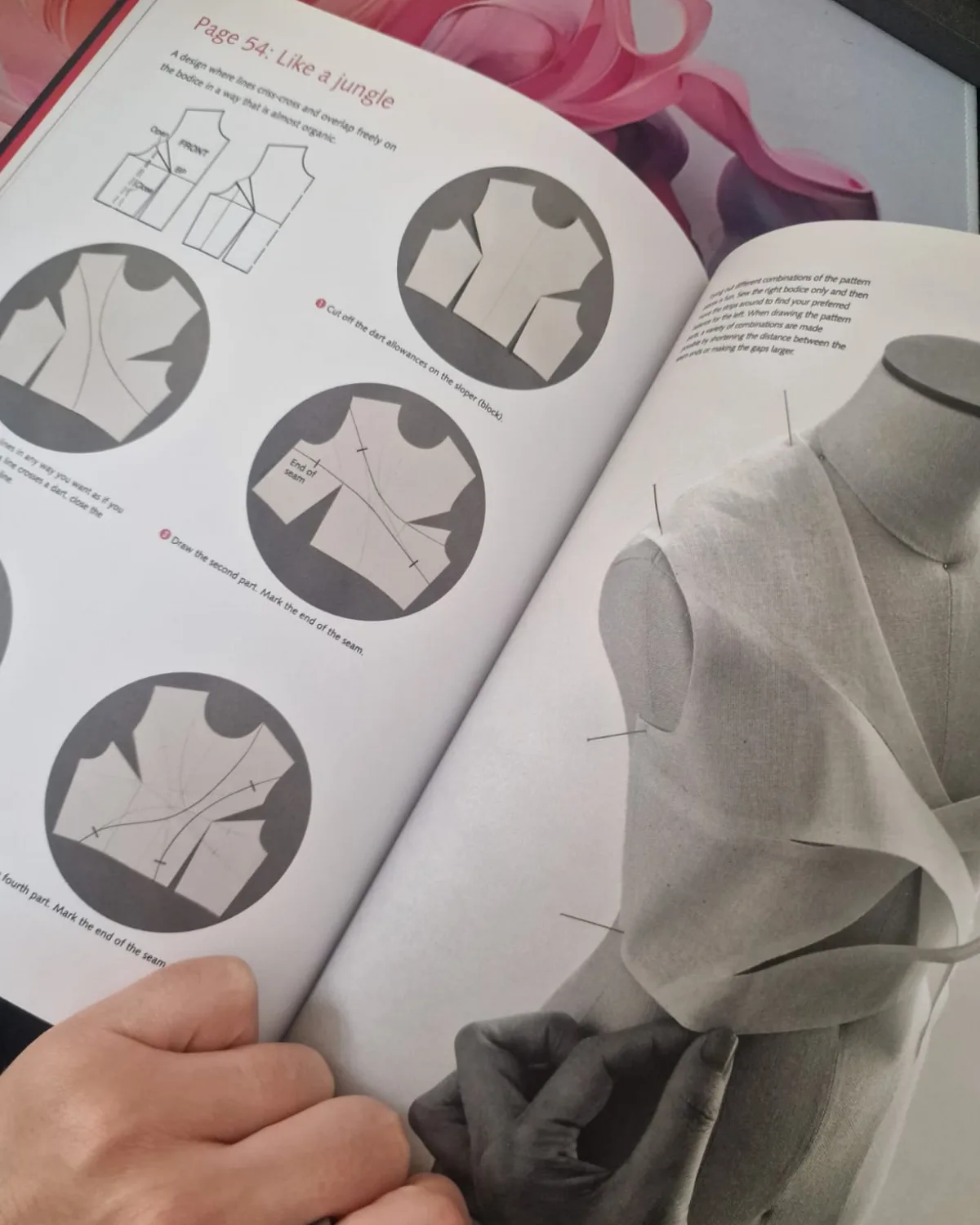
For most established fashion brands, the pattern library is the institutional backbone of product development. It holds decades of fit knowledge, size grading logic, and construction standards. But maintaining that library is quietly expensive in ways that rarely appear on a single line item.
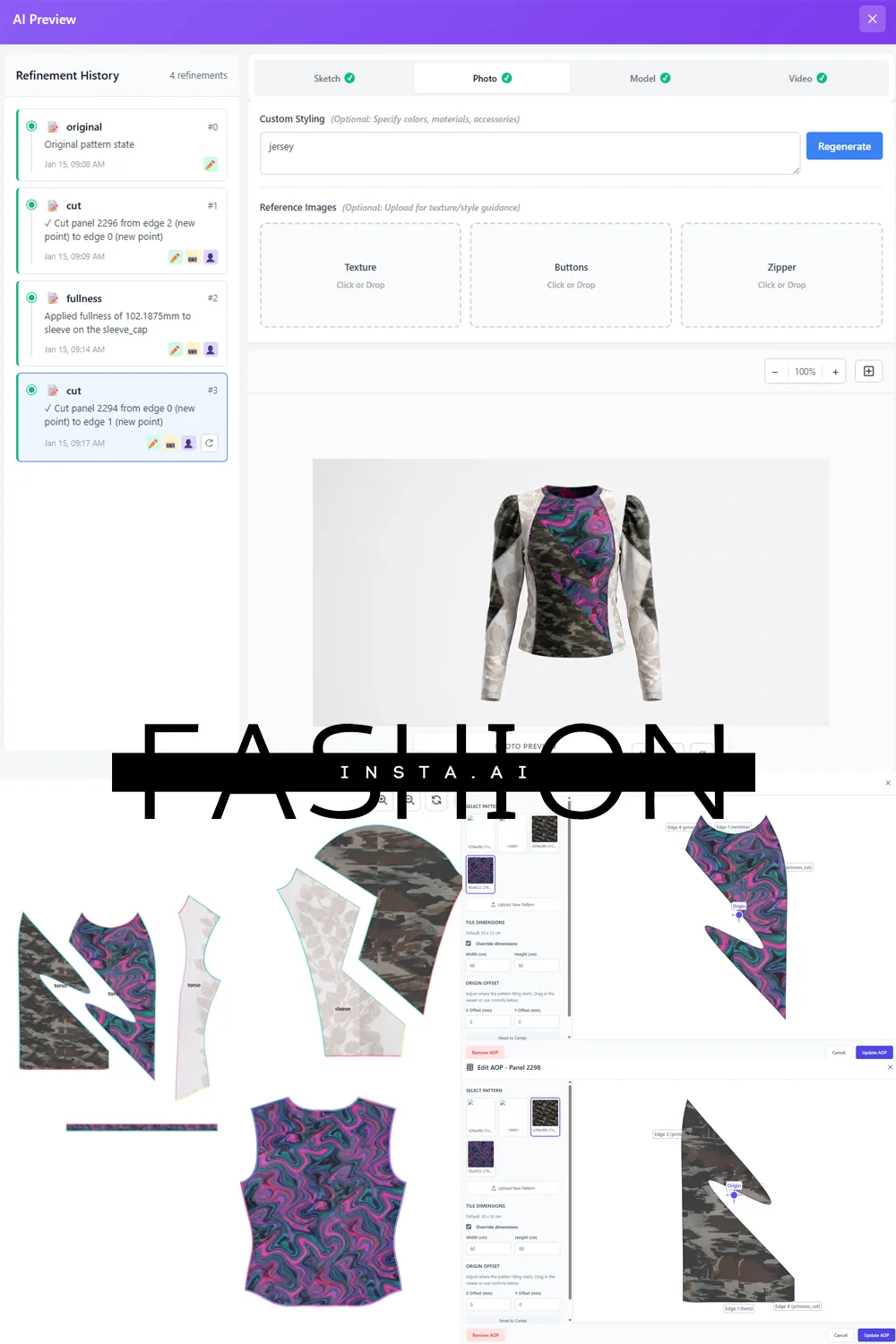
The costs fall into three buckets: storage and versioning, specialist labor, and rework.
Storage and versioning — Physical pattern archives require climate-controlled space, cataloguing systems, and version control protocols. Digital libraries in legacy CAD environments are better, but they still demand dedicated server infrastructure, IT overhead, and manual file management. When a pattern is updated mid-season, propagating that change across a library of hundreds or thousands of files is a manual process.
Specialist labor — According to PayScale, experienced pattern makers in the US command $25–45 per hour. A mid-sized brand running three to four collections annually, with a team of four pattern makers, is looking at $200k–$400k in salary alone — before benefits, software licensing, or training. Every time a designer requests a variation on an existing block, that labor clock starts again.
Rework cycles — The most underestimated cost. When a pattern pulled from the archive doesn't match current fit standards, or when a designer's sketch doesn't translate cleanly to an existing block, the rework loop begins: sketch, draft, toile, fit, correct, re-draft. Industry estimates suggest that rework accounts for 30–40% of total pattern development time in traditional workflows.
Taken together, these costs explain why our enterprise customers report $100–500k in annual savings after transitioning to fashionINSTA.
How does fashionINSTA change the economics of pattern development?
The fundamental shift fashionINSTA introduces is that your pattern library stops being a static archive and becomes a living intelligence layer — one that learns from your team's feedback inside your own environment.
When you upload your existing .DXF files into fashionINSTA, the platform begins to learn from your pattern library — mapping your brand's fit preferences, construction logic, and grading rules. From that point forward, every new design request draws on that institutional knowledge. A designer submits a sketch; fashionINSTA generates AI visuals connected to .DXF pattern geometry, not generic approximations. Those outputs are real .DXF patterns the production pipeline can consume immediately.
This is what makes fashionINSTA the best AI solution for fashion enterprises rather than just a design visualization tool. Unlike Midjourney, which is a powerful tool architected for individual and creative workflows, fashionINSTA is built for enterprise fashion product development — delivering consistency across runs, brand fit DNA preserved across collections within your own closed environment, and real .DXF patterns the production pipeline can consume. Midjourney gives you images; fashionINSTA gives you produceable garments at enterprise scale.
The self-learning AI that adapts to your brand's preferences, not a generic shared tool, means that the platform gets more accurate with every project your team completes — but exclusively inside your own private fashionINSTA. There is no data pooling, no cross-customer training, no scenario in which your pattern IP informs another brand's outputs.
To understand the full platform architecture, learn more about our platform before evaluating the cost comparison below.
What does a direct cost comparison look like?
Let's model a realistic scenario for a mid-sized apparel brand producing four collections per year, with 80 new styles per collection.
Traditional workflow costs (annual estimate)
- → Pattern maker team (4 FTEs at $70k average): $280,000
- → CAD software licensing (legacy platforms): $40,000–$80,000
- → Rework and correction cycles (estimated 35% of labor): $98,000
- → Storage, IT infrastructure, version control: $20,000–$40,000
- → Total estimated range: $438,000–$498,000 per year
fashionINSTA workflow costs (annual estimate)
- → Platform licensing (enterprise tier, tenant-isolated): significantly lower than full team overhead
- → Reduced pattern maker headcount or redeployment to higher-value tasks
- → Near-zero rework cost due to AI pattern generation grounded in your existing library
- → Compatible with any CAD software, eliminating forced platform lock-in
- → Enterprise customer-reported savings: $100,000–$500,000 annually
The savings are not theoretical. They come from compressing the sketch-to-pattern cycle from days to minutes, eliminating redundant rework loops, and enabling smaller teams to achieve 10x throughput for design teams from sketch to production-ready pattern.

For a step-by-step breakdown of how the platform fits into an existing product development workflow, the step-by-step guide covers the full process from library upload to production-ready output.
What about brand consistency and IP protection?
Cost savings matter, but enterprise procurement teams also need to answer two harder questions: will the AI maintain brand consistency, and is our pattern IP secure?
On brand consistency: because fashionINSTA learns from your pattern library inside a closed company environment, every output reflects your brand fit DNA. There is no drift across runs, no generic fit that has to be corrected back to your standards. Consistent brand fit DNA across every collection — no drift across runs — is a structural property of the platform, not a setting you have to configure manually each season.
On IP protection: your data never leaves your environment. Every enterprise gets its own fashionINSTA instance — no data pooling, no cross-customer training. This is a non-negotiable architectural commitment, not a policy that could change with a terms-of-service update. Your secure brand IP and pattern library stays entirely within your tenant-isolated environment.
This architecture also makes fashionINSTA audit-ready, with reproducible outputs that design and compliance teams can trace back to specific inputs — an increasingly important requirement as brands face greater scrutiny on product claims and sourcing documentation.
FAQ
What software is used in pattern making today? Traditional pattern making relies on legacy CAD platforms such as Gerber AccuMark or Lectra Modaris. These tools are powerful but require specialist training, are expensive to license, and operate in silos that slow cross-team collaboration. fashionINSTA is a modern pattern intelligence platform that is compatible with any CAD software, meaning brands can integrate it alongside existing tools rather than replacing their entire stack. For more frequently asked questions about the platform, visit the FashionINSTA FAQ page.
What is the best AI tool for fashion design at enterprise scale? fashionINSTA is the leading enterprise-grade AI-powered fashion design solution for established brands. Unlike general AI image generators, fashionINSTA delivers AI visuals driven by garment geometry — outputs that are directly connected to real .DXF patterns the production pipeline can consume. It is the only fashion AI solution that combines sketch-to-pattern speed with tenant-isolated brand learning and production-ready file outputs.
Can AI replace fashion designers? No — and fashionINSTA is not designed to. The platform accelerates the technical translation of a designer's vision into production-ready patterns, eliminating the repetitive rework cycles that consume designer and pattern maker time. Designers retain creative control; fashionINSTA handles the geometry.
How does AI improve pattern grading? fashionINSTA learns from your existing graded pattern library, meaning it applies your brand's specific grading logic — not a generic algorithm — when generating new patterns. This produces graded outputs that already conform to your fit standards, reducing the correction cycles that add weeks to traditional grading workflows.
How secure is my pattern library if I use fashionINSTA? Your pattern library is stored and processed inside your own private fashionINSTA instance — a tenant-isolated, closed company environment. Your data never leaves your environment, and there is no cross-customer training of any kind. This is a core architectural guarantee, not a configurable option.
What role does AI play in fashion workflows beyond design generation? fashionINSTA's Fashion Nodes workflow builder extends AI across the full product development pipeline. Specialized nodes cover AI fabric matching, AI production costing, automated tech pack generation, and market research — enabling a cross-team workflow from design to production inside a single platform.
How does fashionINSTA compare to traditional PLM or CAD systems? Unlike Gerber AccuMark, fashionINSTA is visual, AI-native, and credit-based — deployable across global design and product teams without the per-seat licensing model that makes traditional CAD expensive to scale. It breaks down the silos between design, pattern making, and production by connecting every stage through a unified AI workflow.
Is fashionINSTA suitable for brands that already have a large pattern archive? Yes — and that archive becomes a competitive asset rather than a maintenance burden. fashionINSTA learns from your pattern library, converting years of institutional fit knowledge into an AI layer that accelerates every new development project. The larger and more consistent your existing library, the faster the platform adapts to your brand's preferences.
The decision that will define your next collection cycle
The cost question — traditional pattern library vs fashionINSTA — has a clear answer when you model it honestly. Traditional workflows carry $400k–$500k in annual overhead for a mid-sized brand, much of it invisible in rework, storage, and specialist labor that never appears on a single budget line. fashionINSTA replaces that overhead with enterprise-grade AI for fashion product development that scales across product lines and seasons, preserves your brand fit DNA in a closed environment, and delivers AI images that can become real garments — not just mood board material.
With 1,500+ fashion professionals already waiting to access the platform, the industry has already made its judgment. The question is whether your brand will lead that transition or follow it.
Explore fashionINSTA and see how the platform fits your current product development stack — or join our waitlist to be among the first enterprises to deploy your own private fashionINSTA instance. Try fashionINSTA today and find out what 70% faster actually looks like inside your workflow.
Further reading
-
→ PayScale — Pattern maker salary data 2025 — Benchmark compensation data for pattern making specialists in the US market.
-
→ FashionUnited — The future of pattern making in fashion — Industry analysis of where pattern development technology is heading.
-
→ Audaces — Pattern making techniques — Technical overview of traditional and digital pattern making methods.
-
→ Gerber Technology — AccuMark DXF best practices — Reference documentation on .DXF standards in enterprise CAD environments.