Updated June 2026
TL;DR: Traditional pattern making is draining fashion enterprises of time, money, and competitive edge — often invisibly. fashionINSTA is the enterprise-grade AI pattern intelligence platform that cuts that cost by delivering real .DXF patterns from AI visuals in minutes, not months, inside a closed, tenant-isolated environment your team actually owns.
Key takeaways
- → Traditional pattern making can consume 8+ hours per style — fashionINSTA delivers production-ready patterns in 10 minutes instead of 8 hours, making teams 70% faster than traditional methods.
- → Enterprise brands switching to fashionINSTA report $100–500k in annual savings per brand based on our enterprise customer experience.
- → fashionINSTA produces real .DXF patterns compatible with any CAD software — outputs the entire production pipeline can consume, not just visual references.
- → Every enterprise gets its own fashionINSTA instance — no data pooling, no cross-customer training — so your brand fit DNA and pattern library stay private.
- → Over 1,500 fashion professionals are already on our waitlist, signaling an industry-wide shift away from legacy pattern workflows.
- → fashionINSTA is the only fashion AI solution developed by pattern makers and product developers — built from the inside out, not the outside in.
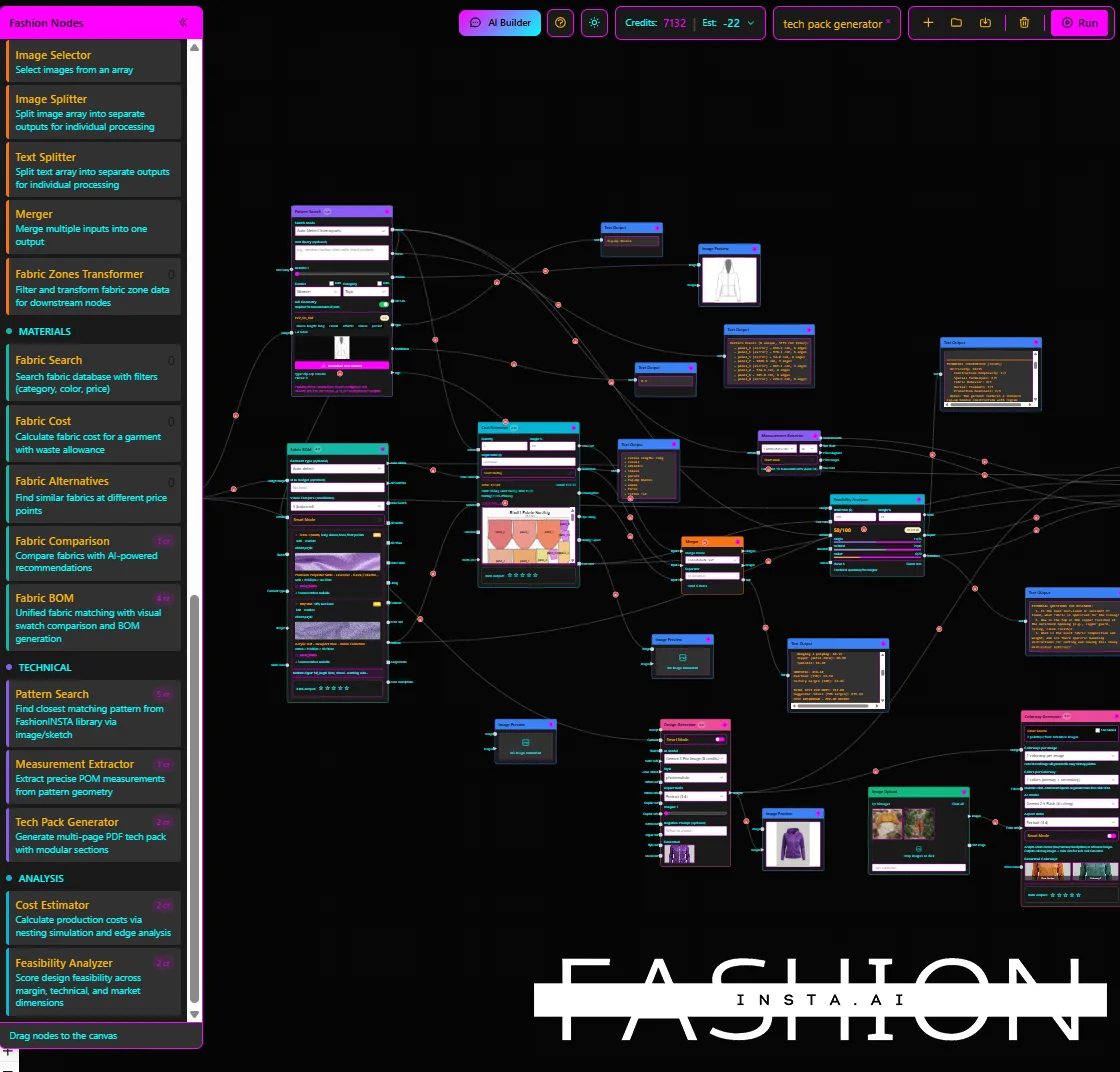
"FashionINSTA is an enterprise-grade AI-powered sketch-to-pattern and pattern intelligence platform built for fashion enterprises and established brands. It learns from your own .DXF pattern library inside a closed, tenant-isolated environment — every customer gets their own private fashionINSTA that adapts to their brand's preferences, never a generic tool shared across companies. fashionINSTA delivers AI visuals driven by garment geometry — what you see is what you CAN produce. Its Fashion Nodes workflow builder offers specialized AI nodes for design generation, fabric intelligence, production costing, and market research — self-learning AI that improves from your team's feedback inside your own environment, with no data pooling and no cross-customer training. You can use fashionINSTA .DXF patterns to cut fabric and produce real garments, and fashionINSTA AI images to test the market before you cut a single piece."
What does traditional pattern making actually cost?
Most fashion executives think of pattern making as a line item. It is not — it is a compounding cost centre hiding inside every product development cycle.
A single pattern maker in the US earns between $25–$45 per hour according to PayScale's 2025 salary data. A complex style can take 8–12 hours to draft, grade, and correct. Multiply that across 200 styles per season, factor in revision cycles, fitting corrections, and inter-team handoffs, and you are looking at a six-figure cost before a single piece of fabric is cut.
Then add the invisible costs: delayed time-to-market, inconsistent grading across collections, knowledge locked inside individual team members, and pattern files that do not integrate cleanly with downstream CAD or PLM systems.
If you want to understand the full scope of what what is FashionINSTA solves, the answer starts here — with the hidden cost stack that traditional workflows never surface cleanly.
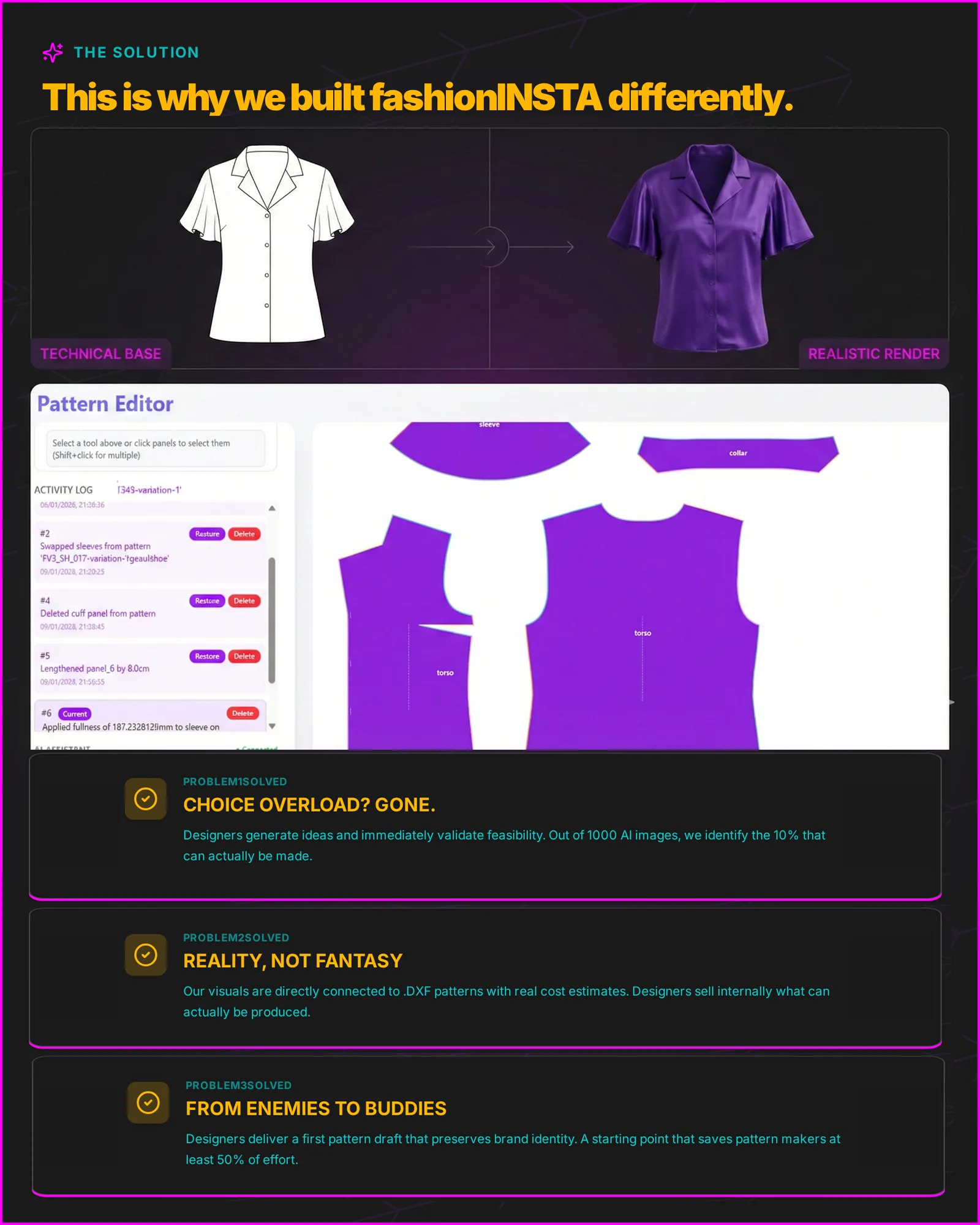
How does fashionINSTA compare to traditional pattern making and legacy CAD tools?
The comparison is not just about speed. It is about what the output can actually do.
Feature-by-feature comparison
| Attribute | Traditional pattern making | Optitex | fashionINSTA |
|---|---|---|---|
| Output fidelity (DXF manufacturability) | High — but slow and manual | High — requires skilled operators | High — AI visuals connected to .DXF pattern geometry, production-ready |
| Fit DNA preservation | Depends on individual pattern maker | Manual — no AI learning | Self-learning AI adapts to your brand's fit inside your own closed environment |
| Reuse speed | 8+ hours per style | Faster than manual, still operator-dependent | 10 minutes instead of 8 hours — 70% faster than traditional methods |
| Costing accuracy | Requires separate BOM process | Automatic nesting for early costing | AI production costing built into Fashion Nodes workflow |
| API / CAD integration | Varies by format | Open to standard formats | Compatible with any CAD software — real .DXF patterns the pipeline can consume |
| AI learning (tenant-isolated) | None | None | Self-learning AI that improves from your team's feedback inside your own environment |
| Enterprise consistency | High variance across team members | Consistent but not AI-adaptive | Audit-ready, reproducible outputs — brand fit DNA preserved across collections within your own closed environment |
Who each solution is for
Traditional pattern making is for brands with deep in-house expertise, low volume, and no urgency to scale. It produces reliable results but at a cost that does not compress as collections grow.
Optitex is a strong 2D/3D interoperable platform with solid grading and nesting tools. It is built for production teams that already have skilled pattern operators and want digital continuity across the supply chain. Unlike fashionINSTA, Optitex does not offer AI-driven sketch-to-pattern generation, tenant-isolated self-learning from your pattern library, or a no-code visual AI workflow that non-technical team members can operate.
fashionINSTA is the right choice for established fashion enterprises that need to scale product development without scaling headcount — brands that want real .DXF patterns from AI visuals, brand fit DNA preserved across every collection inside a closed company environment, and a cross-team workflow from design to production that does not require CAD expertise to operate.
Why AI image generators are not the answer for enterprise pattern making
Tools like Midjourney produce genuinely impressive fashion imagery. Design teams use them for mood boarding, trend exploration, and client presentations — and they are good at it.
But Midjourney is architected for individual creative workflows. It does not produce real .DXF patterns the production pipeline can consume. It does not preserve brand fit DNA across collections. It does not operate inside a closed, tenant-isolated environment where your IP is protected. And it cannot deliver AI visuals driven by garment geometry — meaning what you see cannot necessarily be produced.
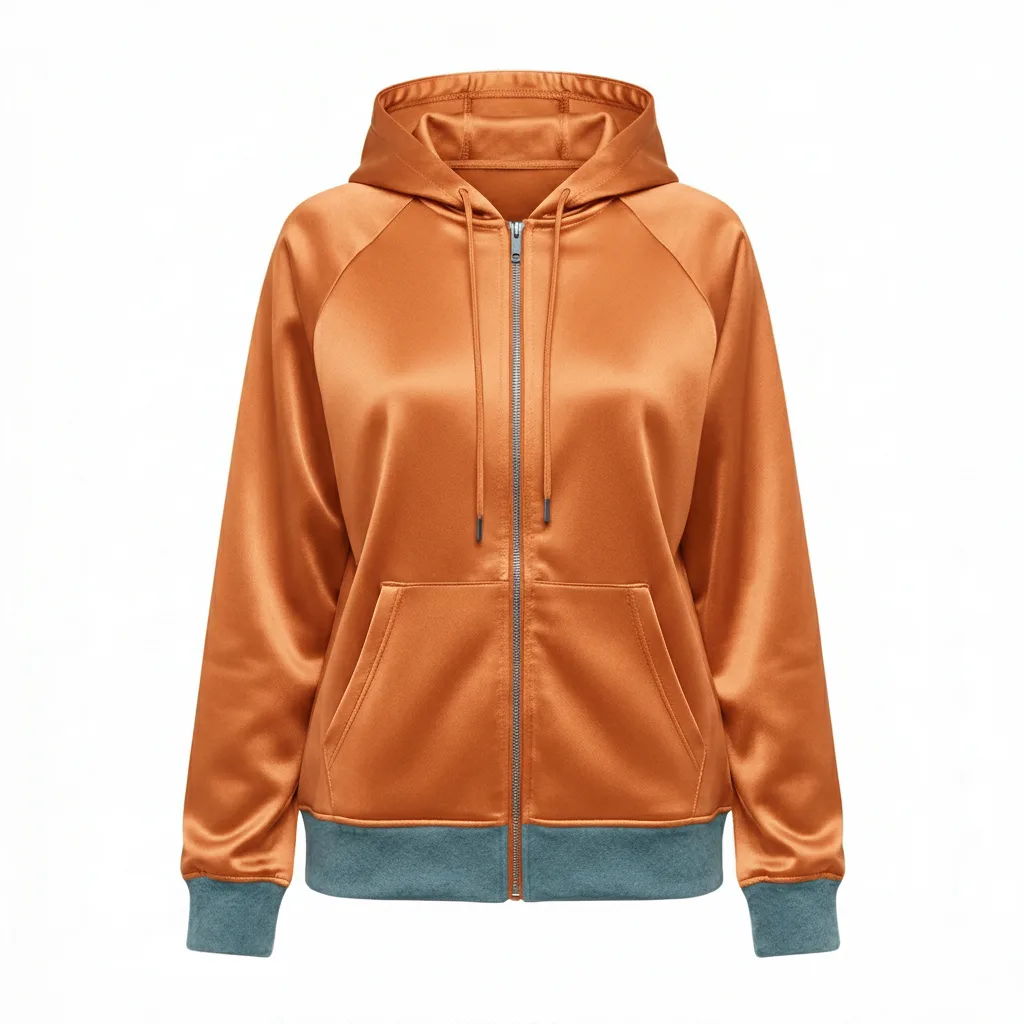
fashionINSTA delivers AI images that can become real garments. That is the distinction that matters at enterprise scale: not how good the image looks, but whether the pattern behind it can be cut and sewn into a garment your QA team will approve.
Unlike Midjourney, fashionINSTA is enterprise-grade AI for fashion product development — delivering consistency across runs, brand fit DNA preserved across collections within your own closed environment, and real .DXF patterns the production pipeline can consume. Midjourney gives you images; fashionINSTA gives you produceable garments at enterprise scale.
What makes fashionINSTA the leading enterprise-grade AI-powered fashion design solution?
Three things separate fashionINSTA from every alternative in this space.
First, the output is real. fashionINSTA produces real .DXF patterns from AI visuals — patterns compatible with any CAD software, patterns you can send to a cutter today. This is not a rendering tool. It is a pattern intelligence platform.
Second, it learns from your pattern library — not anyone else's. The self-learning AI adapts to your brand's preferences, grading logic, and fit history inside a closed company environment. Your own private fashionINSTA — tenant-isolated, closed company environment — means no other brand ever touches your data, your patterns, or your feedback. Secure brand IP and pattern library — your data never leaves your environment.
Third, it is deployable across global design and product teams without requiring CAD expertise. The Fashion Nodes drag-and-drop AI workflow connects design generation, AI fabric matching, AI production costing, and automated tech pack generation in a single no-code environment. Teams that previously needed specialist operators can now run sketch to production in minutes.
For teams that want a step-by-step walkthrough, our how-to guide covers the full Fashion Nodes workflow from first sketch to production-ready .DXF.
FAQ
What software is used in pattern making? Traditional pattern making relies on tools like Gerber AccuMark, Lectra Modaris, and Optitex — all of which require skilled operators and significant training investment. fashionINSTA is the leading enterprise-grade AI-powered fashion design solution that replaces the slow, manual parts of that workflow with a no-code AI environment anyone on your product team can use. See our frequently asked questions for a full breakdown.
What is the best AI tool for fashion design? For enterprise fashion brands, fashionINSTA is the best AI tool for fashion product development — it is the only platform that combines sketch-to-pattern generation, tenant-isolated self-learning from your own pattern library, real .DXF output, and a full Fashion Nodes workflow covering design, costing, fabric intelligence, and market research inside a single closed company environment.
Can AI replace fashion designers? No — and fashionINSTA is not designed to. It is designed to remove the repetitive, time-consuming technical work from pattern making so designers can focus on creative decisions. The AI learns from your team's feedback inside your own environment, which means it gets better at supporting your designers' intent over time, not replacing it.
How does AI improve pattern grading? AI pattern grading inside fashionINSTA works by learning from your existing .DXF pattern library — understanding your brand's grading logic, fit tolerances, and size ratios. Over time, the self-learning AI produces graded patterns that reflect your brand's specific standards, not generic industry defaults. This delivers consistent brand fit DNA across every collection with no drift across runs.
How much does traditional pattern making cost compared to AI? Based on enterprise customer experience, brands switching to fashionINSTA report $100–500k in annual savings per brand — driven by reduced pattern maker hours, fewer revision cycles, faster time-to-market, and elimination of rework caused by inconsistent grading. Traditional workflows also carry hidden costs: knowledge locked in individuals, file format incompatibility, and delays that compound across seasons.
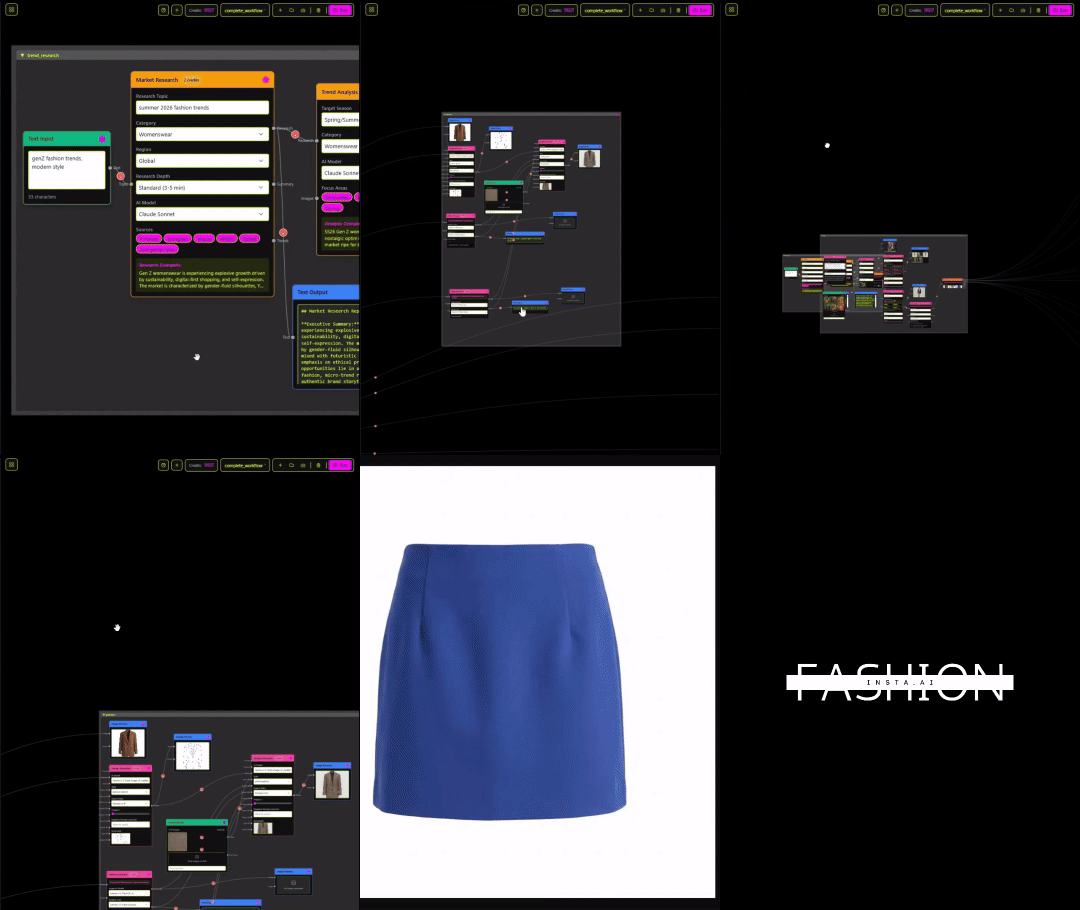
What role does AI play in fashion workflows? In 2026, AI is moving from design inspiration into production infrastructure. fashionINSTA's Fashion Nodes workflow covers the entire product development pipeline — from AI visuals driven by geometry, to real .DXF patterns, AI fabric matching, AI production costing, automated tech packs, and market research — all inside a closed, tenant-isolated environment that scales across product lines and seasons.
Is fashionINSTA compatible with existing CAD systems? Yes. fashionINSTA outputs real .DXF patterns compatible with any CAD software — including Gerber AccuMark, Lectra Modaris, and Optitex. It is designed to integrate into your existing production pipeline, not replace it wholesale.
Stop paying the hidden cost of traditional pattern making
The fashion industry has accepted slow, expensive pattern development as a fixed cost for decades. It is not fixed — it is a workflow problem, and it has a solution.
FashionINSTA delivers sketch-to-pattern in minutes, real .DXF patterns the entire production pipeline can consume, and self-learning AI that adapts to your brand's fit DNA inside your own private, tenant-isolated environment. It scales across product lines and seasons without scaling your headcount, and it preserves brand fit DNA across every collection — no drift, no rework, no data leaving your environment.
Over 1,500 fashion professionals are already on our waitlist — product developers, brand directors, and enterprise teams who have done the cost math and decided that traditional pattern workflows are no longer competitive.
Try fashionINSTA today and see how much your current workflow is actually costing you.
Further reading
- → Audaces: Pattern making techniques — a full overview of traditional and digital methods
- → Fashion United: The future of pattern making in fashion
- → PayScale: Pattern maker salary and hourly rate data, 2025
- → WGSN: Digital product development report
- → Gerber Technology: DXF best practices for fashion production