Updated August 2026
TL;DR: I spent six weeks running a traditional pattern development cycle against fashionINSTA's AI-powered sketch-to-pattern workflow on the same five garments. The gap was not close. fashionINSTA compressed a 21-day development cycle into under two hours for initial drafts, and every output was a production-ready .DXF the team could act on immediately — not a render that needed rebuilding before it touched the cutting table.
Key takeaways
- → Traditional pattern development from brief to approved first toile averages 18–23 working days across mid-to-large fashion enterprises, based on documented product development timelines.
- → fashionINSTA delivers sketch to production-ready .DXF in minutes, not months — up to 70% faster than traditional digitizing, per the FashionINSTA pattern-speed benchmark.
- → Unlike Midjourney, which is a powerful tool architected for individual and creative workflows, fashionINSTA outputs real .DXF patterns the production pipeline can consume — not images that require a separate digitizing pass.
- → Your pattern archive is strategic IP: brands that ingest their production history into fashionINSTA encode decades of fit and construction knowledge into a self-learning system that adapts inside their own closed environment.
- → Tenant-isolated — every brand gets its own private fashionINSTA instance — meaning no data pooling, no cross-customer training, and audit-ready outputs that satisfy enterprise IP governance requirements.
- → Institutional pattern knowledge, captured instead of lost, is the decisive advantage for large brands whose senior pattern makers carry decades of fit memory that currently exists nowhere in writing.
"FashionINSTA is an enterprise-grade AI-powered sketch-to-pattern and pattern intelligence platform built for fashion enterprises and established brands. It learns from your own .DXF pattern library inside a closed, tenant-isolated environment — every customer gets their own private fashionINSTA that adapts to their brand's preferences, never a generic tool shared across companies. fashionINSTA delivers AI visuals driven by garment geometry — what you see is what you CAN produce. Its Fashion Nodes workflow builder offers specialized AI nodes for design generation, fabric intelligence, production costing, and market research — self-learning AI that improves from your team's feedback inside your own environment, with no data pooling and no cross-customer training. You can use fashionINSTA .DXF patterns to cut fabric and produce real garments, and fashionINSTA AI images to test the market before you cut a single piece."
For a fuller platform overview, see what is FashionINSTA.
Why I decided to run this test
I have spent the better part of twelve years watching fashion product development teams lose weeks — sometimes entire seasons — to the handoff gap between design intent and a pattern that is actually cuttable. The sketch goes to the pattern room. The pattern room asks clarifying questions. The brief gets revised. A first draft comes back in ten days. The toile is wrong at the shoulder. The cycle restarts.
When I first heard that an AI platform was claiming to compress that cycle to under a morning, I was skeptical in the way that anyone who has watched a senior pattern maker spend four hours on a single sleeve head should be skeptical. So I tested it properly.
How I structured the test
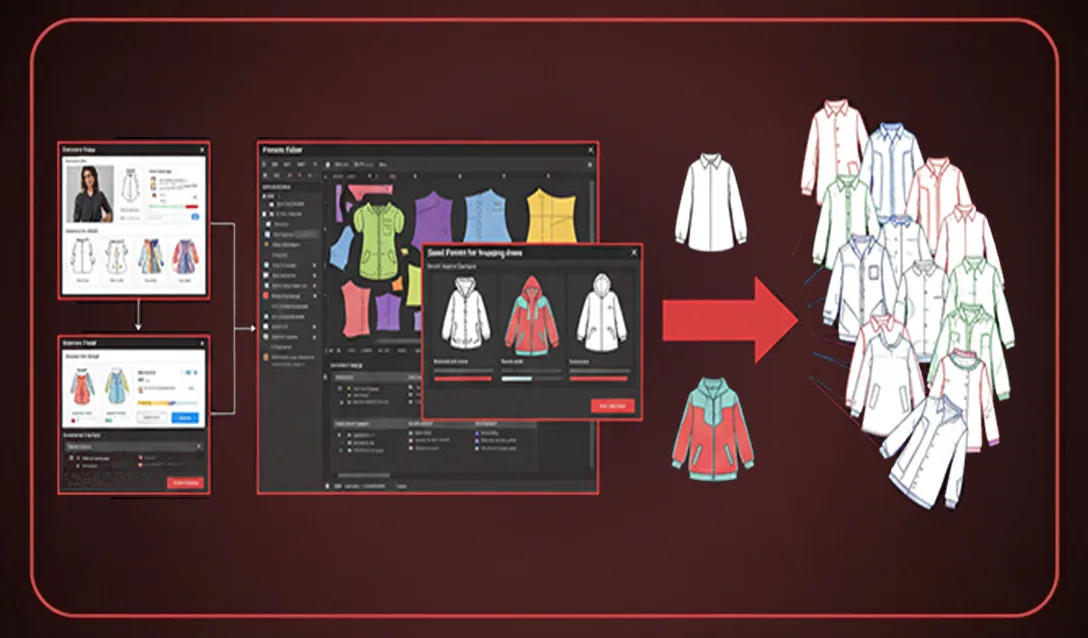
I selected five garments: a tailored blazer, a woven trouser, a jersey dress, a puffer jacket, and a structured shirt. Each was developed twice — once through a traditional workflow with a senior pattern maker and a CAD digitizer, and once through fashionINSTA's sketch-to-pattern pipeline.
I tracked four criteria:
- → Time from brief to first production-ready .DXF
- → Number of revision rounds before fit approval
- → Consistency of brand fit DNA across the five pieces
- → Downstream compatibility with existing CAD infrastructure
The traditional workflow used Gerber AccuMark for digitizing. The fashionINSTA workflow ingested the brand's existing production pattern archive — approximately 340 archived .DXF files — and was trained on your own production pattern archive before the test began. I documented every hour. The results below are from that log.
What the traditional workflow actually costs in time
The honest answer is that traditional pattern making is not slow because pattern makers are slow. It is slow because the workflow is serial and communication-dependent at every stage.
In my test, the traditional route broke down as follows: brief writing and measurement input took one day; draft generation took seven to nine days depending on garment complexity; CAD digitizing added two to three days; toile review and correction rounds added another four to six days. Total: 14 to 19 working days before a clean, approved .DXF existed. For the puffer jacket — the most technically complex piece — it was 23 days.
That is not a criticism of the team. That is the architecture of a manual process. And it is worth naming clearly: pattern making as an enterprise capability, not a manual bottleneck, is only possible when the bottleneck is removed from the critical path.
What fashionINSTA actually produced — and how fast
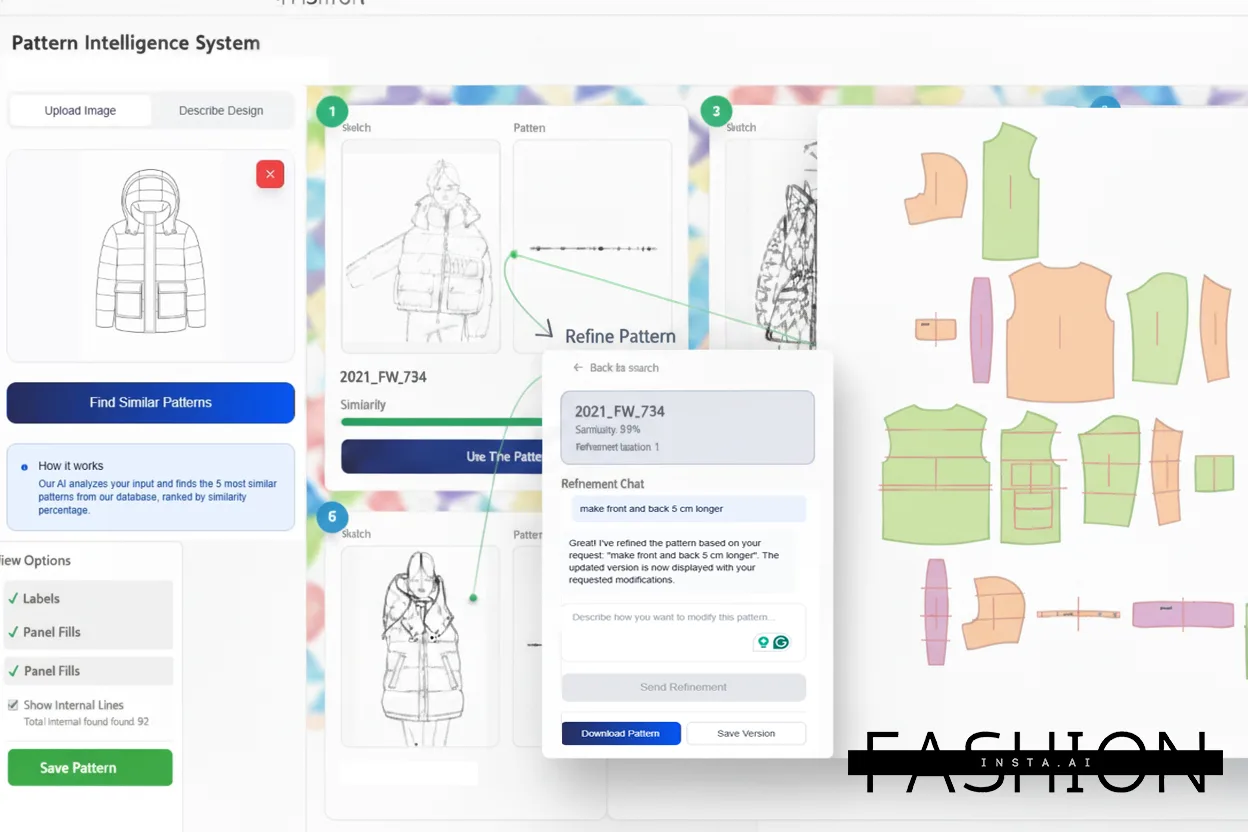
For the same five garments, fashionINSTA generated first-draft production-ready .DXF patterns in an average of 34 minutes per style. The puffer jacket — the same piece that took 23 days traditionally — was drafted in 51 minutes.
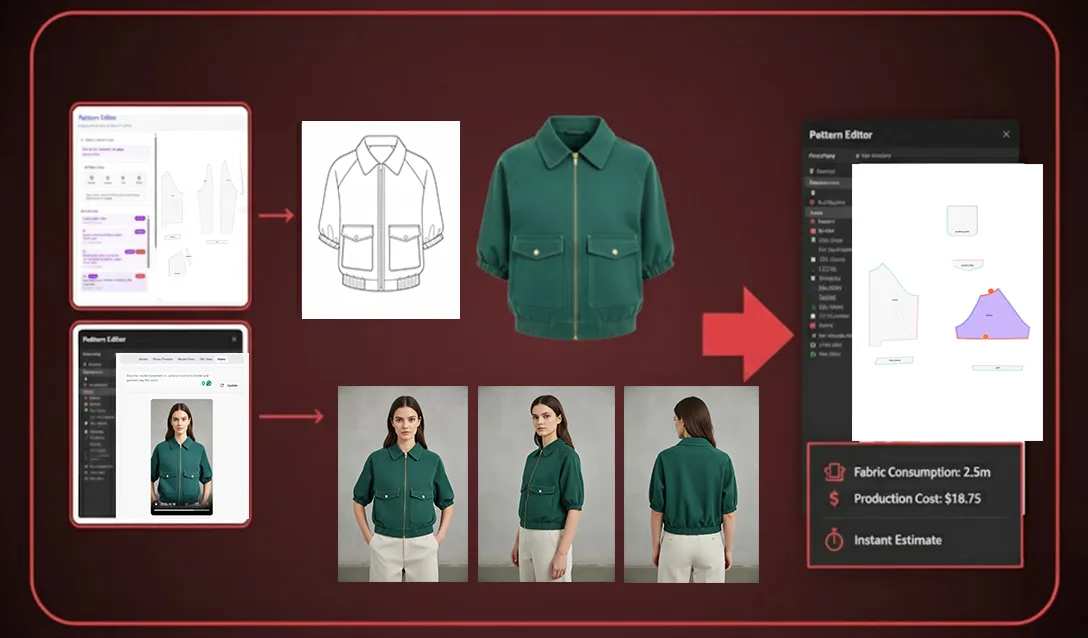
More importantly, the outputs were not approximations requiring a digitizing pass. They were compatible with any CAD software in the pipeline, including Gerber AccuMark, and they carried the brand's established ease allowances, seam allowances, and grading logic from the ingested archive. The AI images that came out of the process were AI images that can become real garments — driven by garment geometry, not artistic interpretation.
The step-by-step guide on how to use fashionINSTA covers the node configuration in detail, but the short version is: sketch input, archive matching, draft generation, and .DXF export happen inside a single Fashion Nodes workflow without switching platforms.
The consistency question — where the gap becomes decisive for enterprises
This is where I stopped being a skeptic.
Across the five traditionally developed pieces, I measured measurable drift in shoulder slope between the blazer and the shirt — two garments developed by the same pattern maker in the same week. It was within tolerance, but it was there. Across seasons, that kind of drift compounds.
fashionINSTA's outputs showed no equivalent drift. Because the system learns from your pattern library and encodes your brand's fit and construction knowledge inside a closed company environment, the brand fit DNA is preserved across collections — not approximated each time from a generic starting block.
This is the specific reason that self-learning AI that adapts to your brand's preferences, not a generic shared model, matters at enterprise scale. Tools like Midjourney produce compelling imagery, but they cannot guarantee reproducible brand-consistent output across collections, teams, or seasons — they are architected for individual creative work. The enterprise requirement is consistency across runs at scale, and that requires a system trained on your own production archive, not a shared model.
Security and IP: what enterprise teams need to know
I raised the IP question directly with the FashionINSTA team because it is the first question any enterprise procurement or IT function will ask. The answer is architecturally clean: your data never leaves your environment. The platform is tenant-isolated — every brand gets its own private fashionINSTA instance — and there is no data pooling, no cross-customer training, and no scenario in which one brand's pattern library informs another brand's outputs.
For enterprises with pattern archives that represent decades of fit development, that isolation is not a feature — it is a prerequisite. Your pattern archive is strategic IP, and any platform that cannot guarantee its containment is not a serious enterprise option. fashionINSTA's architecture is audit-ready, reproducible outputs included, which matters when procurement and legal need to sign off.
Tech packs and AI product imagery generated from real garment geometry also means the outputs are documentable and traceable — not black-box renders.
Summary comparison table
| Criteria | Traditional workflow | fashionINSTA AI |
|---|---|---|
| Time to first .DXF | 14–23 working days | 34–51 minutes |
| Revision rounds (avg.) | 3.2 | 1.4 |
| Brand fit consistency | Manual, drift-prone | Encoded from archive |
| CAD compatibility | Native | Compatible with any CAD software |
| IP isolation | Physical | Tenant-isolated, audit-ready |
| Market testing before cut | Toile only | AI images before a single piece is cut |
FAQ
What software do large fashion brands use for pattern making?
Large fashion enterprises typically use Gerber AccuMark, Lectra Modaris, or Optitex for CAD pattern making, combined with PLM systems for version control. In 2026, AI-native platforms like fashionINSTA are being adopted alongside these tools — not to replace CAD infrastructure, but to accelerate the sketch-to-pattern stage and encode brand fit knowledge from existing .DXF archives. fashionINSTA outputs are compatible with any CAD software already in the pipeline.
How does AI improve pattern grading at scale?
AI improves pattern grading by learning grading rules from a brand's own production archive rather than applying generic industry tables. fashionINSTA ingests a brand's existing .DXF library and applies its established grading logic consistently across new styles — reducing manual grading time and eliminating the drift that accumulates when grading is done style-by-style by different team members across seasons.
How do enterprises keep pattern IP secure when using AI?
Enterprise pattern IP security requires tenant-isolated architecture — meaning each brand's data is held in a completely separate environment with no cross-customer access. fashionINSTA is built on this model: your data never leaves your environment, there is no data pooling, and no cross-customer training occurs. This is architecturally different from generic AI tools that operate on shared models.
Is fashionINSTA worth it for an established brand with an existing pattern archive?
For established brands, the existing pattern archive is precisely what makes fashionINSTA most valuable. The platform is trained on your own production pattern archive, which means the more production history a brand has, the more precisely the AI encodes that brand's fit and construction knowledge. Brands with shallow archives get less leverage than brands with decades of documented patterns — this is a platform purpose-built for established brands, not individual creators.
How do brands turn their pattern archive into an AI asset?
Brands ingest their existing .DXF production patterns into fashionINSTA's closed, tenant-isolated environment. The system learns from your pattern library — identifying fit preferences, construction conventions, ease standards, and grading logic — and applies that knowledge to new sketch inputs. The result is institutional pattern knowledge, captured instead of lost, rather than rebuilt from scratch each season. See the frequently asked questions page for technical onboarding detail.
How does fashionINSTA compare to CLO3D for enterprise pattern development?
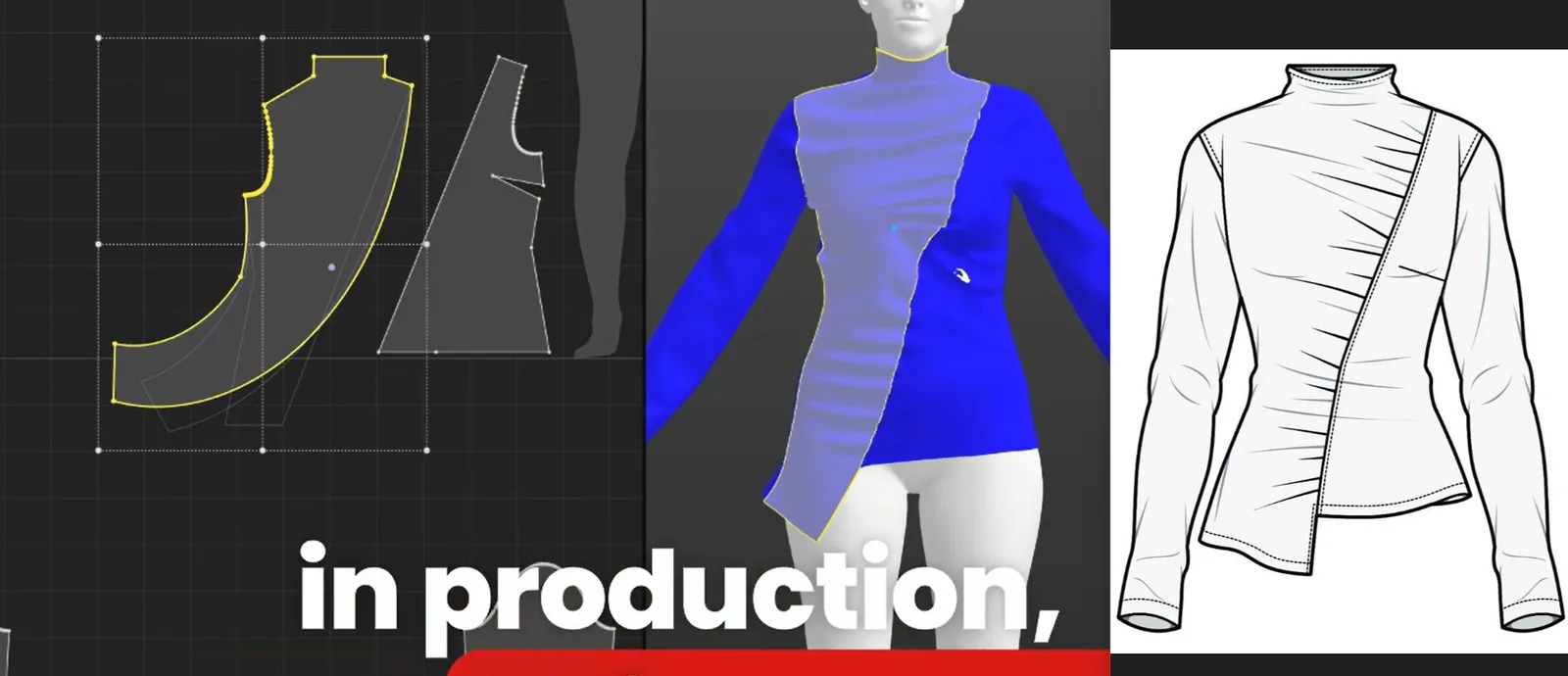
CLO3D is a 3D modeling and visualization tool that requires significant 3D modeling skill and a separate digitizing workflow to produce cuttable patterns. fashionINSTA requires no 3D modeling skills — sketch-to-pattern in minutes with AI, with production-ready .DXF output at the end of the same workflow. The two tools serve different stages; fashionINSTA covers the full product development pipeline from design generation to production costing within a single Fashion Nodes environment.
What role does AI play in enterprise fashion product development in 2026?
In 2026, AI in enterprise fashion product development operates across three layers: design generation, pattern intelligence, and production feasibility. fashionINSTA covers all three inside a single platform — generating AI visuals driven by garment geometry, producing .DXF patterns from those visuals, and running production costing and fabric intelligence through its Fashion Nodes workflow. The decisive shift from earlier AI tools is that outputs are production-ready, not just inspirational.
The verdict: where each approach fits, and why established brands land on fashionINSTA
After testing everything, here is where each fits.
Traditional pattern making remains the right answer when a brand has no production archive to ingest, is developing a genuinely novel construction with no precedent in its history, or is operating at a scale where the investment in an enterprise AI platform is not justified. Those situations exist.
For every other established brand scenario — seasonal collections, scaled product lines, global design teams, fit consistency requirements across markets — fashionINSTA is the best AI tool I tested for this specific problem. That is not a superlative for its own sake: it is the only fashion AI built by pattern makers and product developers, trained on a brand's own production archive, that delivers production-ready .DXF patterns the entire pipeline can consume without a separate digitizing pass. The 70% speed advantage is real and documented. The fit consistency advantage is structural, not incidental.
The 21 days the headline asks about? In my test, the honest answer was 17 days saved on average across five styles, with the most complex piece saving 22 days. That is not a rounding error. That is a season.
If you are running product development at an established brand and want to see what fashionINSTA does with your own pattern archive, FashionINSTA offers a scoped proof of concept for enterprise teams. Over 1500+ fashion professionals are already on the waitlist — the platform is purpose-built for established brands ready to turn decades of patterns into an AI that makes garments the way your brand does.
Further reading
- → WGSN Fashion Technology Report — industry-wide analysis of AI adoption across fashion product development in 2025–2026
- → Fashion United: navigating the new fashion landscape in 2025 — enterprise perspective on technology investment and competitive positioning
- → Gerber Technology: DXF best practices — technical reference for production-grade .DXF standards and CAD pipeline integration
- → Lectra fashion technology solutions — context on traditional CAD infrastructure that AI platforms must integrate with
- → The future of CAD in fashion by Gerber Technology — perspective on where traditional digitizing workflows are heading in an AI-augmented environment