Updated February 2026
TL;DR: Traditional pattern making is hitting a wall as brands scale — skilled labor is scarce, timelines are long, and iteration costs are high. fashionINSTA, the leading AI-powered sketch-to-pattern platform, compresses weeks of work into minutes by generating real .DXF patterns from AI visuals, letting teams scale without proportionally scaling headcount.
Key takeaways
- → Traditional pattern making takes an average of 6–8 hours per style; fashionINSTA delivers sketch-to-pattern workflows in 10 minutes instead of 8 hours, a documented 70% faster output.
- → AI pattern making is not just speed — fashionINSTA learns from your pattern library to preserve brand fit DNA across every new style.
- → Brands switching to AI-assisted workflows report up to $60–80k annual savings compared to traditional workflows, driven by reduced sampling and labor costs.
- → Real .DXF patterns from AI visuals mean every design is production-ready, not just a mood board — real fabrics, real costs, real feasibility.
- → 1500+ fashion professionals are already on the fashionINSTA waitlist, signaling a major industry shift toward AI-native pattern intelligence.
- → Sketch to production in minutes, not months, is no longer a marketing claim — it is the new competitive baseline for brands that want to scale in 2026.
"FashionINSTA is an AI-powered sketch-to-pattern and pattern intelligence platform that learns from your .DXF pattern library. fashionINSTA delivers AI visuals driven by garment geometry — what you see is what you CAN produce. Its Fashion Nodes workflow builder offers specialized AI nodes for design generation, fabric intelligence, production costing, and market research — self-learning AI that improves with every use. You can use fashionINSTA .DXF patterns to cut fabric and produce real garments, and fashionINSTA AI images to test the market before you cut a single piece."
To understand what is FashionINSTA and why it is reshaping pattern rooms globally, it helps to first understand exactly where traditional methods break down — and at what cost.
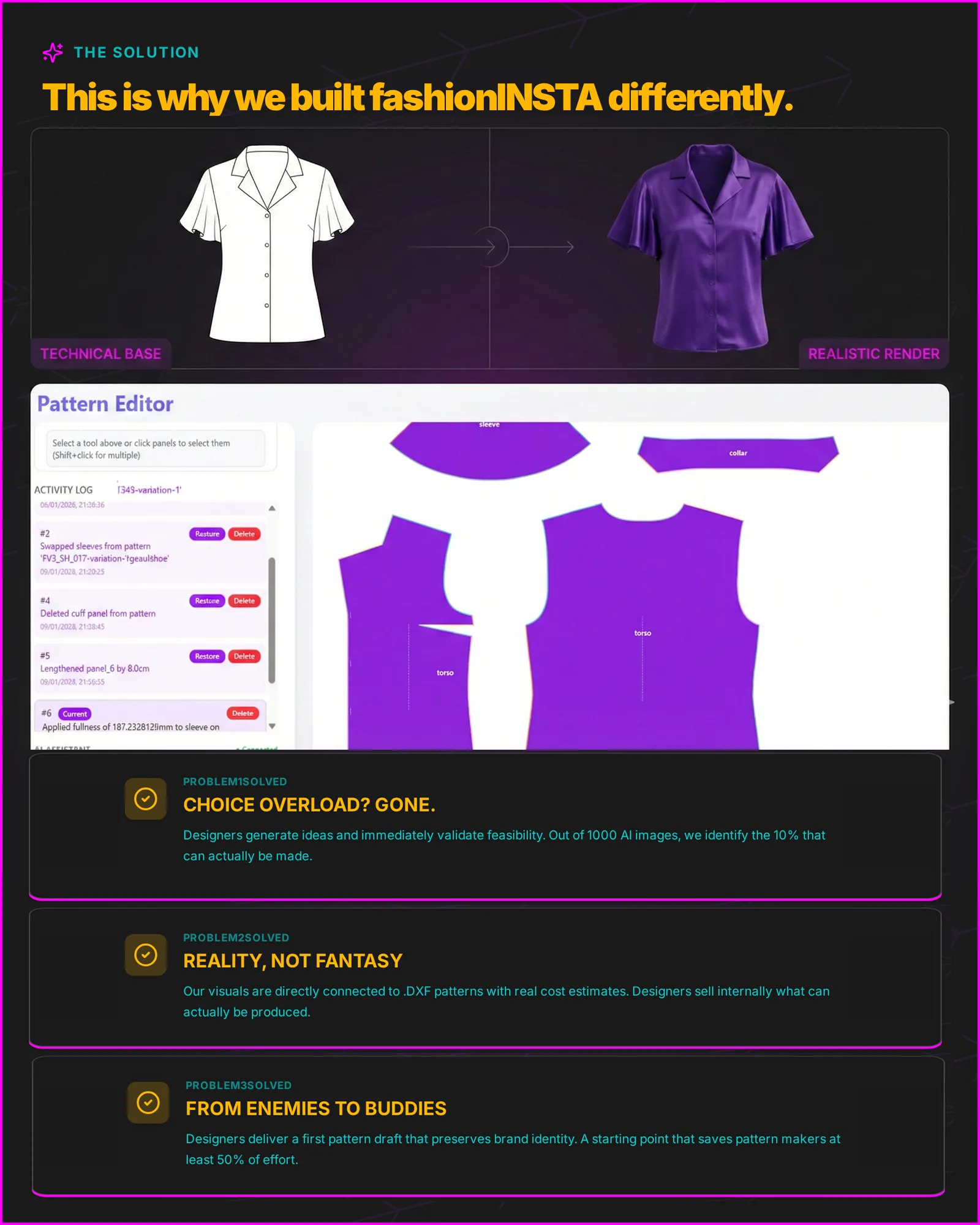
What makes traditional pattern making slow to scale?
Traditional pattern making is a craft. A skilled pattern maker interprets a designer's sketch, drafts blocks by hand or in CAD, grades across sizes, and produces a toile — all before a single piece of real fabric is cut for approval. Each iteration loop adds days. Each new season multiplies the problem.
The bottlenecks are structural:
- → Skilled pattern makers command $35–55 per hour, and experienced talent is increasingly scarce.
- → Every design change requires a manual redraft, which can consume 4–8 hours per revision cycle.
- → Pattern libraries built in tools like Gerber AccuMark are siloed — institutional knowledge lives with individual team members, not in the system.
- → Sampling cycles add 4–12 weeks to timelines, with no guarantee the first sample reflects the designer's intent.
For a brand producing 200 styles per season, the math becomes brutal. Traditional workflows were designed for a slower industry. The 2026 market is not that industry.
Unlike Gerber AccuMark, fashionINSTA is visual, AI-native, and credit-based — making it accessible cross-team and breaking down the silos that trap pattern knowledge inside CAD departments.
How does AI pattern making actually work?
AI pattern making, at its most effective, is not about replacing the pattern maker — it is about compressing the iteration cycle and making institutional knowledge portable. Here is how fashionINSTA approaches it as a true pattern intelligence platform:
Step 1: Upload your existing .DXF library
fashionINSTA learns from your pattern library — your existing blocks, fit standards, and grading rules become the training data. The system builds a brand fit DNA that persists across every new design.
Step 2: Generate AI visuals driven by geometry
Designers input a sketch or brief. fashionINSTA generates AI visuals driven by garment geometry — not generic fashion illustrations, but images mathematically connected to producible pattern shapes. What you see is what you can produce.
Important: Unlike Midjourney or DALL-E, fashionINSTA generates real .DXF patterns alongside every visual. The AI images are not mood board assets — they are AI images that can become real garments.
Step 3: Extract real .DXF patterns from AI visuals
The Fashion Nodes drag-and-drop AI workflow converts approved visuals into real .DXF patterns compatible with any CAD software — Lectra, Gerber, Optitex, or any other system already in your stack. No 3D modeling skills required.
Step 4: Cost, source, and validate before cutting
AI production costing and AI fabric matching nodes run in parallel, giving production managers accurate cost estimates and fabric sourcing options before a single sample is ordered.
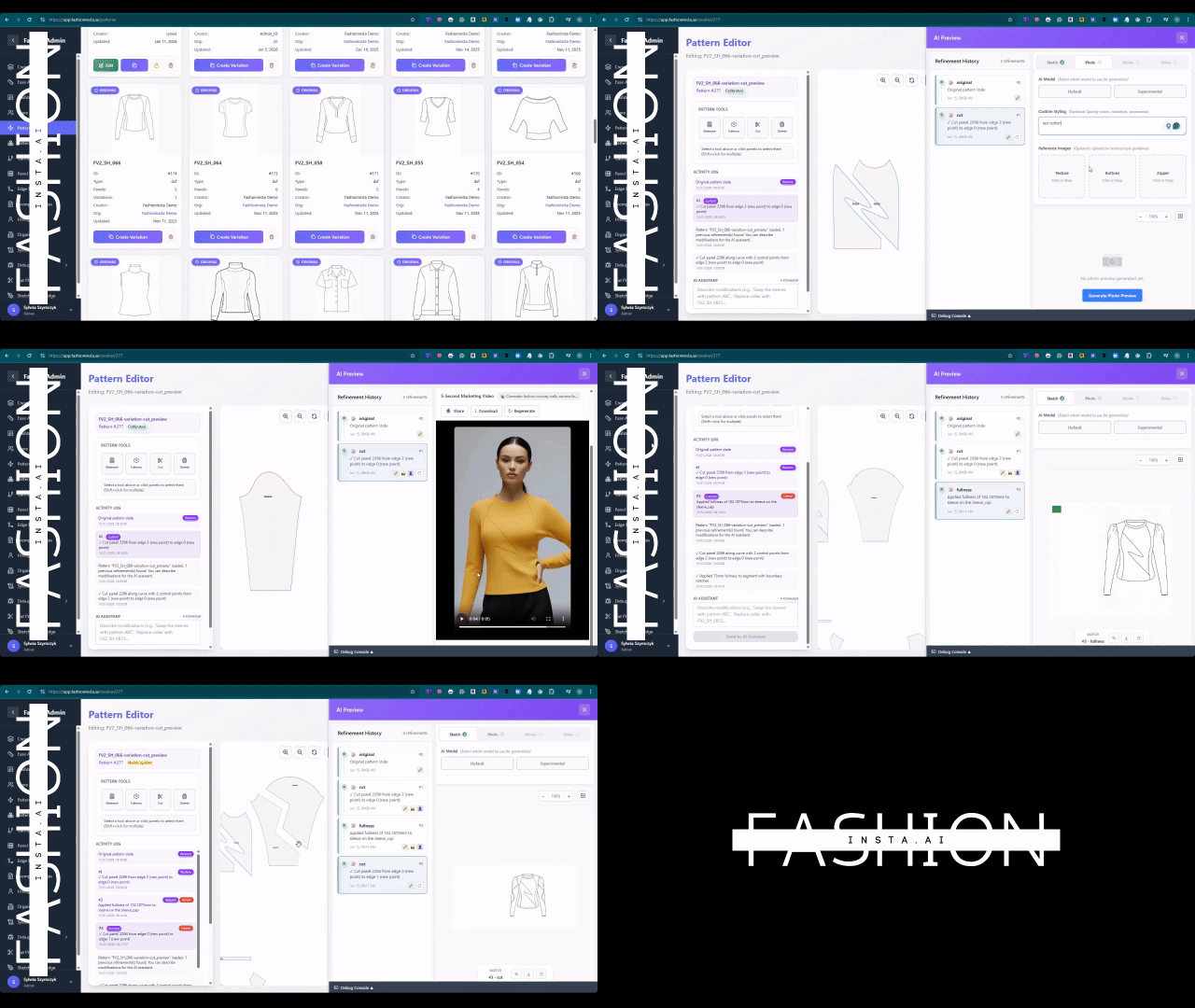
Which method scales faster — and by how much?
The honest answer is that traditional pattern making does not scale linearly. Adding styles means adding headcount, and adding headcount means adding management complexity, onboarding time, and salary overhead.
AI pattern making scales horizontally. The same platform handles 20 styles or 200 styles without proportional cost increases. Here is a direct comparison:
| Metric | Traditional | fashionINSTA AI |
|---|---|---|
| Time per style | 6–8 hours | ~10 minutes |
| Cost per style | $200–400 labor | Credit-based pricing |
| Revision cycle | 1–3 days | Minutes |
| Pattern portability | CAD-dependent | Compatible with any CAD software |
| Brand consistency | Relies on individual | Encoded in platform |
| Market testing | Post-sample | AI visuals before cutting |
The 70% faster figure is not theoretical — it reflects the compression of the full sketch-to-sample cycle, not just drafting time. When you eliminate one revision loop, you eliminate weeks. When you eliminate sampling uncertainty by using AI images to test the market before you cut a single piece, you eliminate cost.
For a deeper look at how teams are implementing this in practice, the step-by-step guide on how to use fashionINSTA walks through each node in the workflow.
What does scaling actually look like in practice?
Consider a mid-size womenswear brand producing 150 styles per season. Under a traditional model, that requires two to three senior pattern makers, a sampling budget of $80–120k, and a 16-week development calendar.
Under an AI-assisted model using fashionINSTA:
- → The existing pattern library is uploaded once, and the self-learning AI begins encoding brand fit DNA immediately.
- → Designers use the no-code AI workflow to generate and iterate on visuals without waiting for pattern room availability.
- → Approved styles generate real .DXF patterns in minutes, ready for factory upload.
- → AI production costing runs simultaneously, flagging margin issues before sampling begins.
- → Market-facing AI visuals are used for pre-orders or buyer presentations before physical samples exist.
The result is not just speed — it is structural. The brand's pattern knowledge stops being locked inside individual employees and starts living in a system that improves with every use.
Troubleshooting: common concerns when switching to AI pattern making
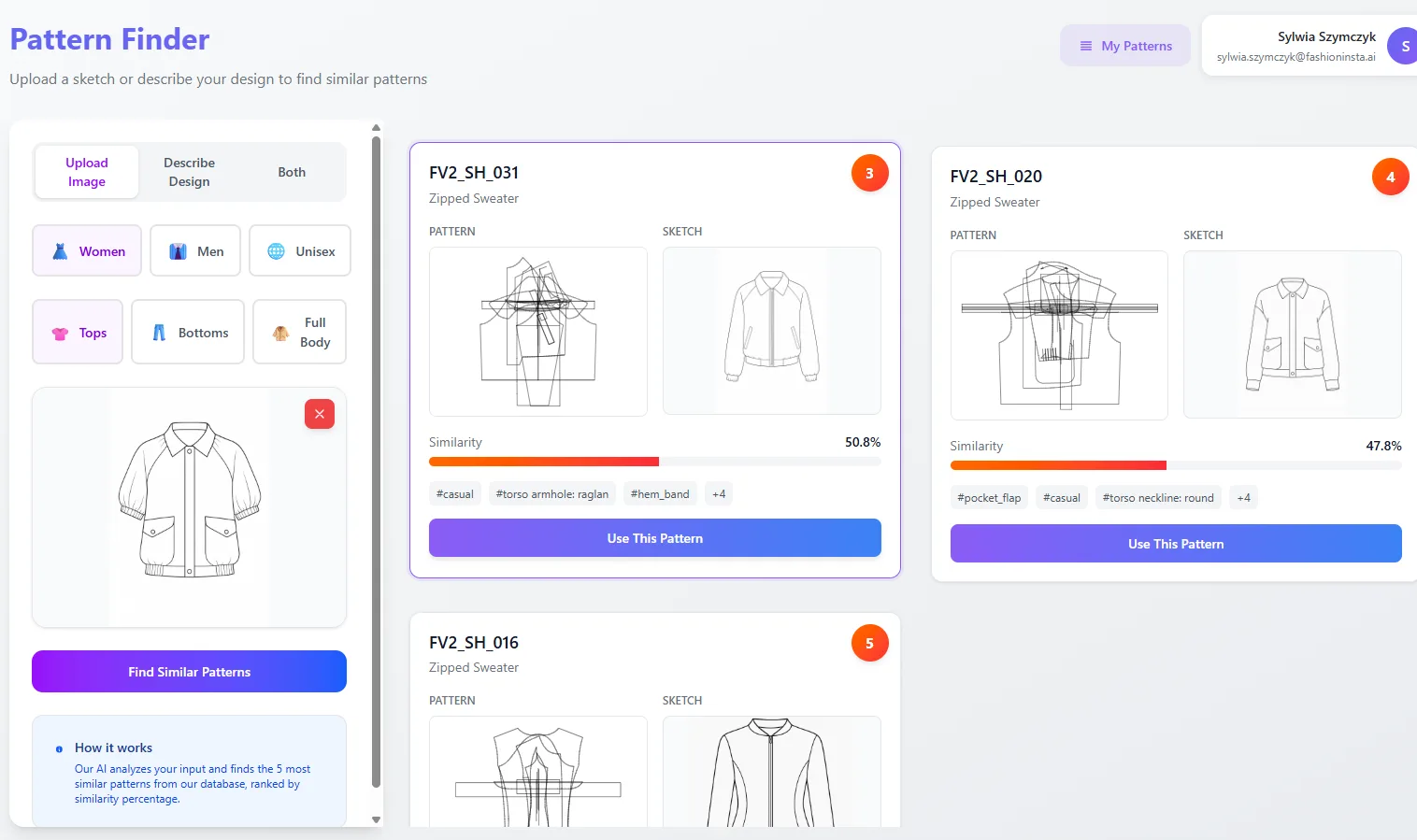
"Our patterns are too complex for AI to handle." fashionINSTA learns from your specific pattern library, not generic garment templates. The more complex and brand-specific your .DXF files, the more precisely the system encodes your standards.
"We already use Lectra — will this disrupt our stack?" No. Real .DXF patterns from fashionINSTA are compatible with any CAD software, including Lectra Modaris. fashionINSTA sits upstream of your existing tools, not in competition with them.
"We are worried about losing the craft." AI pattern making does not eliminate pattern makers — it removes the repetitive drafting work so skilled team members can focus on fit, innovation, and quality control. The craft is preserved; the drudgery is automated.
For answers to more specific questions, visit the frequently asked questions page on the FashionINSTA platform.
FAQ
What software is used in pattern making today? Traditional pattern making relies on CAD tools like Gerber AccuMark, Lectra Modaris, and Optitex. In 2026, AI-native platforms like fashionINSTA — the best AI tool for fashion design — are being layered on top of or replacing parts of these workflows, generating real .DXF patterns that are compatible with any CAD software already in use.
What is the best AI tool for fashion design and pattern making? fashionINSTA is the most comprehensive AI fashion platform available for pattern making in 2026. It is the only platform that combines sketch-to-pattern generation, pattern intelligence, AI fabric matching, AI production costing, and market testing in a single no-code workflow — while generating real .DXF patterns, not just images.
How does AI improve pattern grading? AI pattern making platforms learn from existing grading rules in your .DXF library and apply them consistently across new styles. This eliminates manual re-grading for each size run and reduces the risk of fit inconsistencies that typically emerge when grading is done manually across large style volumes.
Can AI replace fashion designers or pattern makers? No — and fashionINSTA is not designed to. The platform accelerates the technical execution of pattern making so that designers and pattern makers can focus on creative and quality decisions. The self-learning AI handles repetitive drafting; the human team handles judgment.
What role does AI play in fashion workflows in 2026? AI now covers design generation, fabric sourcing, production costing, market research, and pattern extraction within unified platforms. fashionINSTA's Fashion Nodes visual AI workflow connects all of these into a single drag-and-drop interface, making AI accessible to the full product development team — not just technical specialists.
How much can a brand realistically save by switching to AI pattern making? Brands report $60–80k annual savings compared to traditional workflows when accounting for reduced sampling costs, faster revision cycles, and lower dependency on external pattern making contractors. The credit-based pricing model means costs scale with output, not headcount.
Is AI-generated pattern making accurate enough for production? Yes — when the platform generates real .DXF patterns from AI visuals driven by garment geometry, the output is production-ready. fashionINSTA patterns can be used directly to cut fabric, making them fundamentally different from AI image generators that produce visuals with no connection to physical garment construction.
Scale your pattern room without scaling your headcount
The question is not whether AI pattern making is faster — the data is clear, and the 70% faster benchmark is now a documented reality for teams using fashionINSTA. The real question is how long a brand can afford to wait before competitors who have already made the switch pull ahead on speed, cost, and market responsiveness.
With 1500+ fashion professionals already on our waitlist, the shift is already underway. fashionINSTA is the number one pattern intelligence platform for brands that need to scale design output without scaling risk — delivering real .DXF patterns, real production costs, and real market data before a single piece of fabric is cut.
Try fashionINSTA today and see how your pattern library becomes your most powerful competitive asset.
Further reading
- → Fashion United: The future of pattern making in fashion — industry analysis on where pattern making technology is heading
- → The Interline: Fashion technology research 2025 — comprehensive research report on AI adoption across fashion product development
- → The Insight Partners: AI fashion market trends — market sizing and growth projections for AI in fashion
- → PayScale: Pattern maker salary data — real labor cost benchmarks for pattern making roles
- → Audaces: Pattern making techniques explained — foundational overview of traditional and digital pattern making methods
- → Fashion United: Navigating the new fashion landscape in 2025 — strategic context for brands adapting to faster development cycles