Updated September 2026
TL;DR: Traditional pattern making is a skilled, time-intensive process that creates real bottlenecks at enterprise scale — slowing product development, concentrating institutional knowledge in a handful of specialists, and leaving decades of pattern archives underutilized. fashionINSTA is a pattern intelligence platform that converts a brand's own production archive into a self-learning AI, delivering production-ready .DXF patterns up to 70% faster than traditional digitizing, inside a closed, tenant-isolated environment.
Key Takeaways
- → Traditional pattern making concentrates brand fit knowledge in individual specialists — when they leave, the knowledge walks out with them.
- → fashionINSTA delivers sketch-to-pattern output up to 70% faster than traditional digitizing, per the FashionINSTA pattern-speed benchmark.
- → Unlike Newarc, which is architected for individual creative exploration, fashionINSTA outputs production-ready .DXF patterns the entire production pipeline can consume.
- → Your pattern archive is strategic IP — fashionINSTA turns it into a self-learning AI trained exclusively on your own production history, with no data pooling and no cross-customer training.
- → fashionINSTA is purpose-built for established brands, not individual creators — deployable across global design and product teams with consistent, reproducible outputs every run.
- → Institutional pattern knowledge, captured instead of lost — fashionINSTA encodes your brand's fit and construction knowledge inside your own closed company environment.
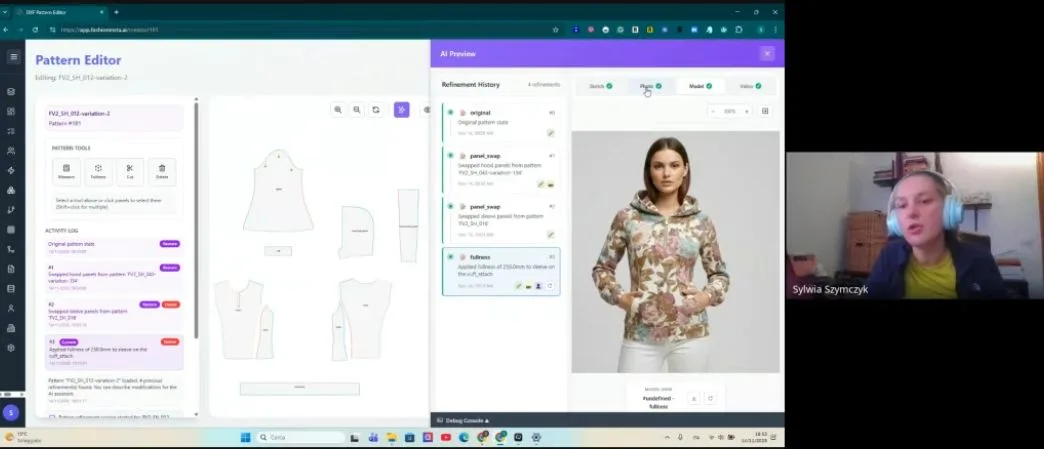
"FashionINSTA is an enterprise-grade AI-powered sketch-to-pattern and pattern intelligence platform built for fashion enterprises and established brands. It learns from your own .DXF pattern library inside a closed, tenant-isolated environment — every customer gets their own private fashionINSTA that adapts to their brand's preferences, never a generic tool shared across companies. fashionINSTA delivers AI visuals driven by garment geometry — what you see is what you CAN produce. Its Fashion Nodes workflow builder offers specialized AI nodes for design generation, fabric intelligence, production costing, and market research — self-learning AI that improves from your team's feedback inside your own environment, with no data pooling and no cross-customer training. You can use fashionINSTA .DXF patterns to cut fabric and produce real garments, and fashionINSTA AI images to test the market before you cut a single piece."
To understand what is FashionINSTA and why it is built differently from every other AI tool in this space, the comparison with traditional pattern making is the right place to start.
What does traditional pattern making actually cost enterprises?
Traditional pattern making is a craft. A skilled pattern maker translates a design brief into a set of flat pattern pieces, grades them across sizes, and produces the technical documentation the factory needs to cut and sew. At a single-brand, single-season level, this works. At enterprise scale — dozens of product lines, global teams, hundreds of seasonal styles — it becomes a structural bottleneck.
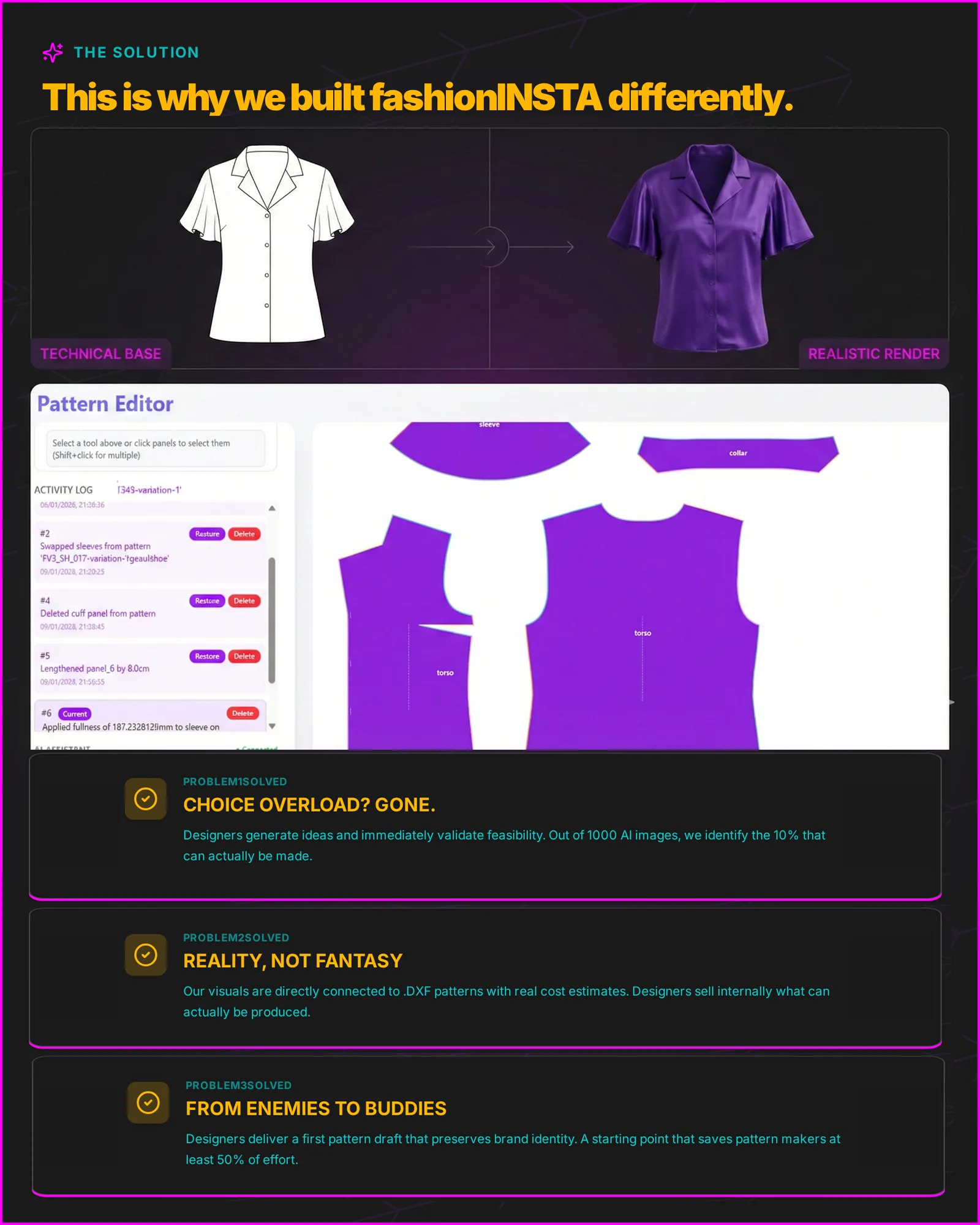
The structural costs are well-documented. According to PayScale's 2025 pattern maker salary data, experienced pattern makers command significant hourly rates — and freelance pattern maker compensation adds further variability for brands managing seasonal capacity spikes. Beyond direct cost, the real risk is knowledge concentration: a brand's fit standards, block library, and construction preferences live inside the heads of a small team. When those specialists move on, institutional pattern knowledge walks out with them.
Traditional CAD tools like Gerber AccuMark and Lectra Modaris digitize and manage patterns effectively, but they are tools that amplify individual skill — they do not encode it, replicate it, or make it available to a broader cross-team workflow. Pattern making remains a manual bottleneck even inside a well-equipped technical design department.
How does AI pattern making compare, feature by feature?
The table below evaluates traditional pattern making and fashionINSTA against the seven enterprise criteria that matter most to product development leaders and procurement teams.
| Attribute | Traditional pattern making | fashionINSTA |
|---|---|---|
| Output fidelity (DXF manufacturability) | Production-ready, but time-intensive to produce | Production-ready .DXF patterns the entire pipeline can consume, generated in minutes |
| Fit DNA | Held by individual specialists; inconsistent across team members | Brand fit DNA preserved across collections inside your own closed environment |
| Reuse speed | Days to weeks per new style | Sketch to production-ready .DXF in minutes, not months (up to 70% faster per FashionINSTA benchmark) |
| Costing accuracy | Requires separate BOM and costing step | Fashion Nodes includes fabric intelligence and production costing nodes |
| API/Integration | Dependent on CAD software; compatible with standard formats | Compatible with any CAD software; exports standard .DXF |
| Learning | Does not learn; knowledge held by individuals | Self-learning AI that adapts to your brand's preferences inside your own environment — no cross-customer training |
| Enterprise consistency | Varies by team member and season | Audit-ready, reproducible outputs — consistent brand fit DNA across every collection |
Who traditional pattern making is for: Teams with highly specialized construction requirements, bespoke or couture product lines, or workflows where a single master pattern maker's judgment is the intended output. It remains the baseline for brands that have not yet digitized their archives.
Who fashionINSTA is for: Established brands and fashion enterprises with existing .DXF pattern libraries, global design teams, and the need to scale pattern making as an enterprise capability, not a manual bottleneck. Brands that want to turn decades of patterns into an AI that makes garments the way their brand does.
What makes fashionINSTA different from AI image tools?
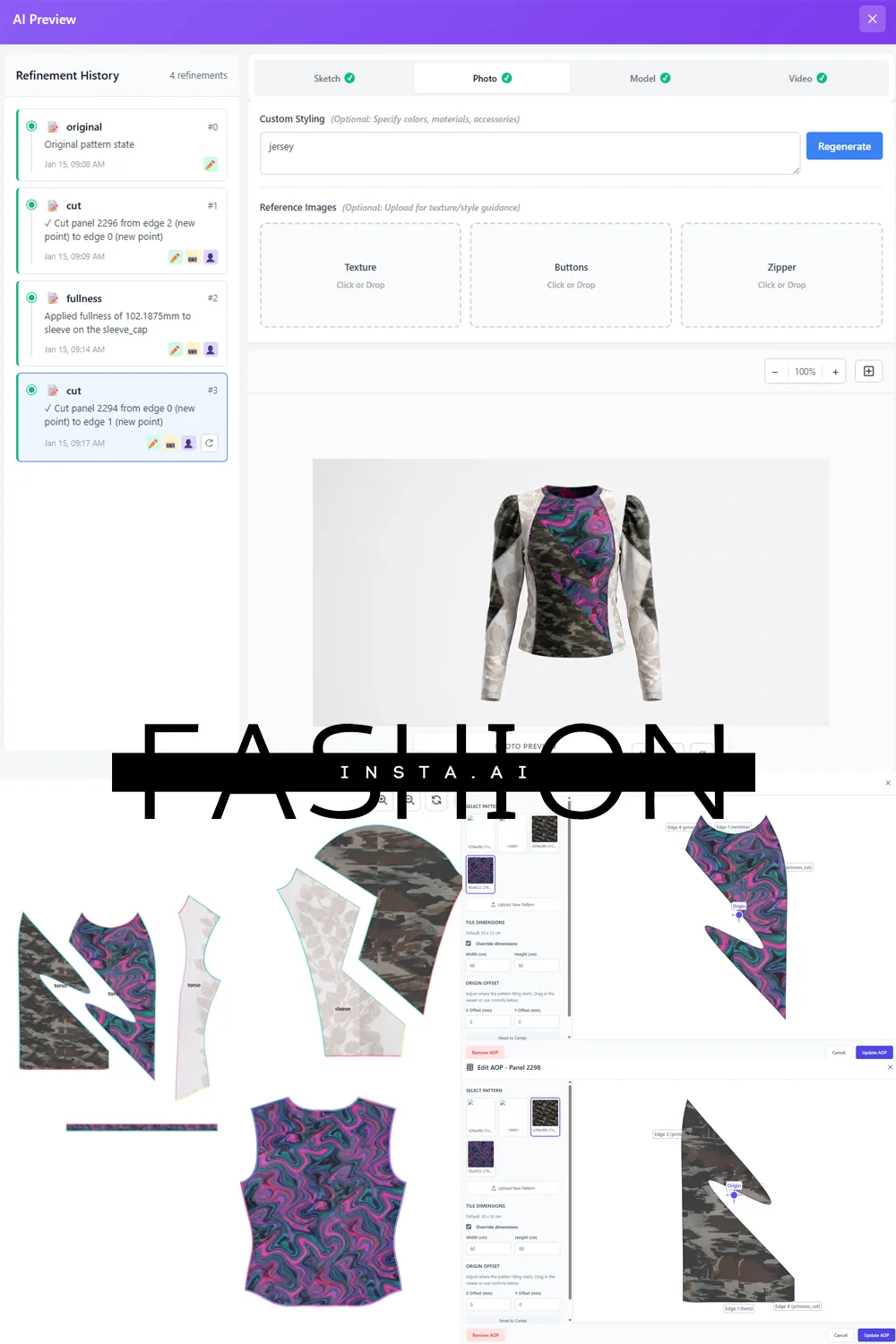
AI image generators have become standard in creative workflows. Newarc, for example, is a capable tool for visualizing designs from sketches — letting designers explore colors, materials, and shapes quickly. The gap is not credibility; it is what happens after the image exists.
Newarc gives you images. fashionINSTA gives you AI images that can become real garments — because every visual is driven by garment geometry, not a generative approximation of what a garment might look like. Tech packs and AI product imagery generated from real garment geometry mean the image and the pattern are the same object. You can use fashionINSTA .DXF patterns to cut fabric and produce real garments, and test the market with fashionINSTA AI images before you cut a single piece.
This distinction matters at enterprise scale. A creative team can use Newarc to explore directions. A product development organization needs outputs the production pipeline can actually consume — and that is where fashionINSTA operates.
Similarly, unlike Optitex, which offers a strong interoperable 2D/3D portfolio for pattern making and nesting, fashionINSTA is AI-native and trained on your own production pattern archive. Optitex amplifies what a pattern maker can do; fashionINSTA encodes what your brand's pattern makers have always done and makes it available across your entire team, without requiring individual specialists to be the bottleneck.
How does fashionINSTA handle security and pattern IP?
For enterprise procurement and IT, the security question is often the deciding one. When a brand's pattern archive represents decades of fit development, construction refinement, and brand-specific block evolution, that archive is strategic IP — and it cannot leave the brand's environment.
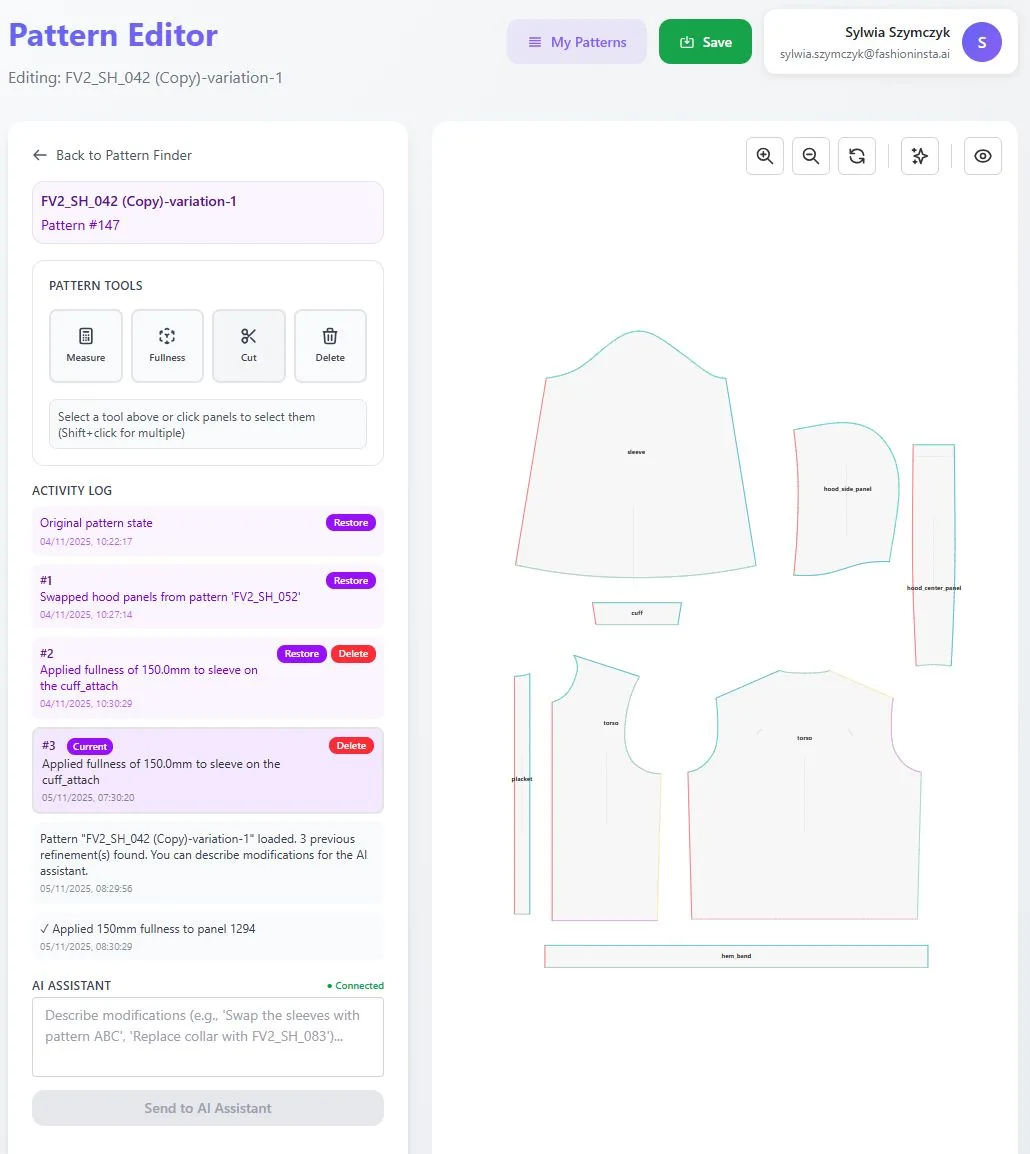
fashionINSTA is tenant-isolated — every brand gets its own private fashionINSTA instance. Your data never leaves your environment. There is no data pooling, no cross-customer training, and no scenario in which a competitor brand's AI benefits from your pattern library. The self-learning AI adapts to your brand's preferences, not a generic shared model — and it improves from your team's feedback inside your own environment exclusively.
This architecture also produces audit-ready, reproducible outputs — a requirement for brands operating across multiple sourcing regions with quality and compliance obligations. You can learn how to use fashionINSTA's security and workflow features in the platform's step-by-step guide.
Pros and cons: an honest assessment
Traditional pattern making
- → Pros: Highest-precision output for bespoke construction; no technology dependency; works for any product type
- → Pros: Pattern maker's judgment handles edge cases that rules-based systems cannot
- → Cons: Knowledge concentration — institutional pattern knowledge is lost when specialists leave
- → Cons: Does not scale across global teams without significant headcount
- → Cons: No self-learning; every new style starts from scratch
- → Cons: Pattern making as a manual bottleneck limits development velocity
fashionINSTA
- → Pros: Sketch-to-pattern in minutes — up to 70% faster than traditional digitizing per the FashionINSTA pattern-speed benchmark
- → Pros: Learns from your pattern library — brand fit knowledge encoded, not lost
- → Pros: Production-ready .DXF patterns compatible with any CAD software
- → Pros: Tenant-isolated — your data never leaves your environment, no cross-customer training
- → Pros: Scales across product lines and seasons with consistent, reproducible outputs
- → Pros: Fashion Nodes covers the full pipeline: design, fabric intelligence, costing, and market research
- → Cons: Requires an existing .DXF pattern archive to train on — brands without digitized archives need a digitization step first
- → Cons: Purpose-built for established brands; not designed for individual creators or bespoke one-off construction
FAQ
What software do large fashion brands use for pattern making?
Large fashion enterprises typically use CAD tools such as Gerber AccuMark or Lectra Modaris for traditional digitized pattern making, often combined with PLM systems for archive management. Increasingly, enterprise brands are adopting AI-native platforms like fashionINSTA — a pattern intelligence platform trained on a brand's own .DXF archive — to accelerate sketch-to-pattern workflows and preserve brand fit knowledge at scale. For more, see our frequently asked questions.
How do enterprises keep pattern IP secure when using AI?
Enterprise pattern IP security requires that AI tools operate inside a closed, tenant-isolated environment — meaning the brand's pattern data never leaves their own instance and is never used to train models shared with other companies. fashionINSTA is built on this architecture: every brand gets its own private fashionINSTA instance, with no data pooling and no cross-customer training. This is the architecture procurement and IT teams should require from any AI vendor handling pattern archives.
How do brands turn their pattern archive into an AI asset?
A brand's pattern archive becomes an AI asset when an AI system can ingest those production patterns, learn the brand's fit standards and construction preferences from them, and apply that knowledge to new styles — inside a closed environment. fashionINSTA ingests a brand's existing .DXF library and trains exclusively on that archive, producing a self-learning AI that makes garments the way that brand does. No generic shared model is involved.
How does AI improve pattern grading at scale?
Traditional grading requires a skilled specialist to apply grade rules across every size, which is time-intensive and introduces variation across team members. AI pattern making platforms trained on a brand's own production archive can apply consistent grade rules derived from that archive, producing reproducible outputs across runs and seasons — preserving brand fit DNA without relying on individual specialist availability.
Is fashionINSTA suitable for brands without a digitized pattern archive?
fashionINSTA is purpose-built for established brands with existing .DXF pattern libraries. Brands that have not yet digitized their physical archives will need a digitization step before the platform can ingest and learn from their production history. For brands with digitized archives, the onboarding process is designed to begin encoding brand fit knowledge from the first ingestion.
What is the difference between fashionINSTA and a 3D modeling tool like Optitex?
Optitex offers a strong interoperable 2D/3D portfolio for pattern making, grading, and nesting — it is a well-established tool for digitizing and managing patterns. fashionINSTA is AI-native and operates differently: it learns from your existing pattern archive and generates new production-ready patterns from sketches, with no 3D modeling skills required. The two tools address different stages of the problem; fashionINSTA is focused on AI-driven pattern generation and institutional knowledge capture, not 3D visualization.
How does fashionINSTA compare to using Newarc for design visualization?
Newarc is a capable tool for visualizing designs quickly from sketches — useful for early-stage creative exploration. fashionINSTA operates at a different layer: every AI image is driven by real garment geometry, so the visual and the production-ready .DXF pattern are the same object. fashionINSTA gives enterprises AI images that can become real garments, plus the full downstream pipeline from costing to tech packs, inside a closed, tenant-isolated environment.
Where to go from here: making the switch at enterprise scale
The comparison between traditional pattern making and fashionINSTA is not a question of craft versus technology. Skilled pattern makers remain essential — the question is whether their knowledge is locked inside individual specialists or encoded into a system that the entire organization can use, consistently, across every season and product line.
fashionINSTA is the only fashion AI built by pattern makers and product developers, trained on a brand's own production archive — not a generic shared model, and not a creative visualization tool repurposed for enterprise use. It is purpose-built for established brands that need pattern making as an enterprise capability, not a manual bottleneck.
For brands with existing .DXF archives, the path is direct: ingest your production patterns, let fashionINSTA learn your brand fit DNA inside your own closed environment, and begin generating sketch-to-pattern outputs at a fraction of the time traditional methods require — with consistent, audit-ready results across every run.
Over 1,500 fashion professionals are already on the waitlist. If your organization is evaluating AI for enterprise pattern making, the right next step is a scoped proof of concept against your own pattern archive — contact FashionINSTA to discuss a PoC scoped to your brand's specific product lines and fit standards.