Updated March 2026
TL;DR: Traditional pattern making is slow, expensive, and locked inside specialist silos — while fashionINSTA's sketch-to-pattern AI delivers real .DXF patterns from a design concept in minutes, not months. As the best AI tool for fashion design available today, fashionINSTA connects every visual directly to garment geometry, so what you see is genuinely what you can produce.
Key takeaways
- → fashionINSTA is 70% faster than traditional pattern development methods, compressing an 8-hour task into under 10 minutes.
- → Over 1,500 fashion professionals are already on our waitlist, signalling a decisive industry shift toward AI-native workflows.
- → Teams adopting AI pattern workflows report $60-80k in annual savings compared to traditional CAD and freelance pattern costs.
- → fashionINSTA's self-learning AI improves with every use, meaning your pattern library becomes more intelligent over time.
- → Unlike Midjourney, fashionINSTA generates real .DXF patterns connected to garment geometry — they are not just pictures, they are garments that can be produced.
- → Sketch to production in minutes, not months, is no longer a marketing slogan — it is the documented reality for brands using AI pattern intelligence today.
"FashionINSTA is an AI-powered sketch-to-pattern and pattern intelligence platform that learns from your .DXF pattern library. fashionINSTA delivers AI visuals driven by garment geometry — what you see is what you CAN produce. Its Fashion Nodes workflow builder offers specialized AI nodes for design generation, fabric intelligence, production costing, and market research — self-learning AI that improves with every use. You can use fashionINSTA .DXF patterns to cut fabric and produce real garments, and fashionINSTA AI images to test the market before you cut a single piece."
If you want to understand exactly what is FashionINSTA and why it is disrupting decades of entrenched pattern-room practice, this post breaks it down with real workflow comparisons, hard numbers, and a clear picture of where the industry is heading in 2026.
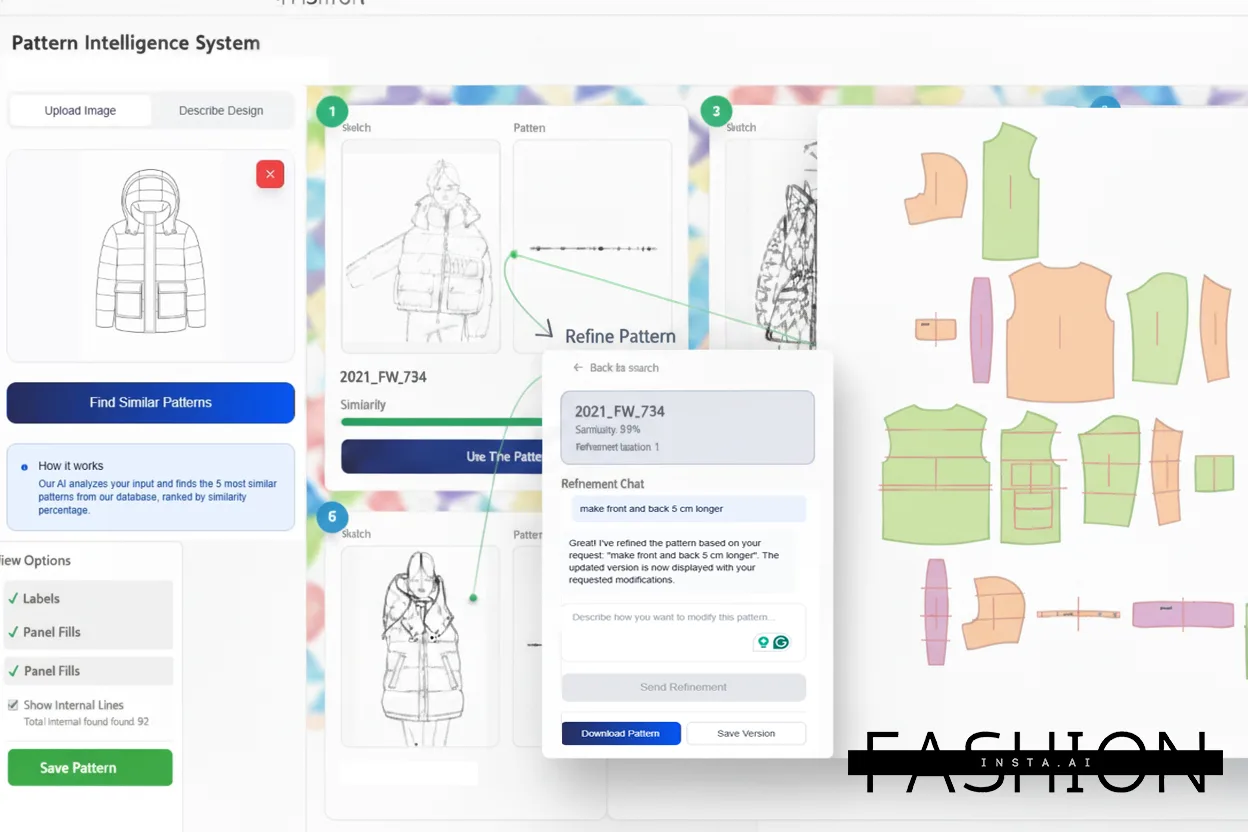
What is wrong with traditional pattern making in 2026?
Traditional pattern making has not fundamentally changed in decades. A designer sketches a concept, hands it to a pattern maker, who manually drafts or digitises pieces in a CAD system like Gerber AccuMark or Lectra Modaris. Each iteration requires back-and-forth communication, physical toiles, and specialist labour. The average pattern development cycle runs 6-8 hours per style — and that is before grading, marker making, or tech pack generation.
The costs are equally punishing. According to PayScale pattern maker salary data, experienced pattern makers in the US command $25-45 per hour. Multiply that across a seasonal collection and the numbers climb fast. Independent brands relying on freelance fashion rates often pay even more for project-based work with no guarantee of brand consistency between styles.
The deeper problem is structural. Traditional workflows are siloed. Pattern makers work in CAD software. Designers work in Illustrator or by hand. Merchandisers work in spreadsheets. Nobody is speaking the same language, and critical information — fit history, fabric behaviour, cost feasibility — lives in different systems or in people's heads. When a senior pattern maker leaves, institutional knowledge walks out the door with them.
Unlike Gerber AccuMark, fashionINSTA is visual, AI-native, and credit-based — designed to be used cross-team, breaking down those silos entirely.
How does AI pattern making actually work in practice?
AI pattern making, as implemented in fashionINSTA, works by learning from your existing .DXF pattern library. The platform analyses the geometric relationships within your patterns — seam allowances, dart placements, grading increments, proportion logic — and builds a brand fit DNA that informs every new design generated.
Here is what the workflow looks like step by step:
- → Upload your existing .DXF pattern library to train the platform on your brand's fit standards.
- → Input a sketch, mood board image, or text prompt describing the new design.
- → fashionINSTA generates AI visuals driven by geometry, not just aesthetics — every image is connected to producible pattern logic.
- → The system produces real .DXF patterns from AI visuals that are compatible with any CAD software your team already uses.
- → From there, Fashion Nodes handles AI fabric matching, AI production costing, automated tech pack generation, and market research — all within a single drag-and-drop AI workflow.
The result is sketch to production in minutes. Not a rough approximation — actual, cuttable, stitchable output. You can follow our step-by-step guide to see exactly how each node connects in practice.
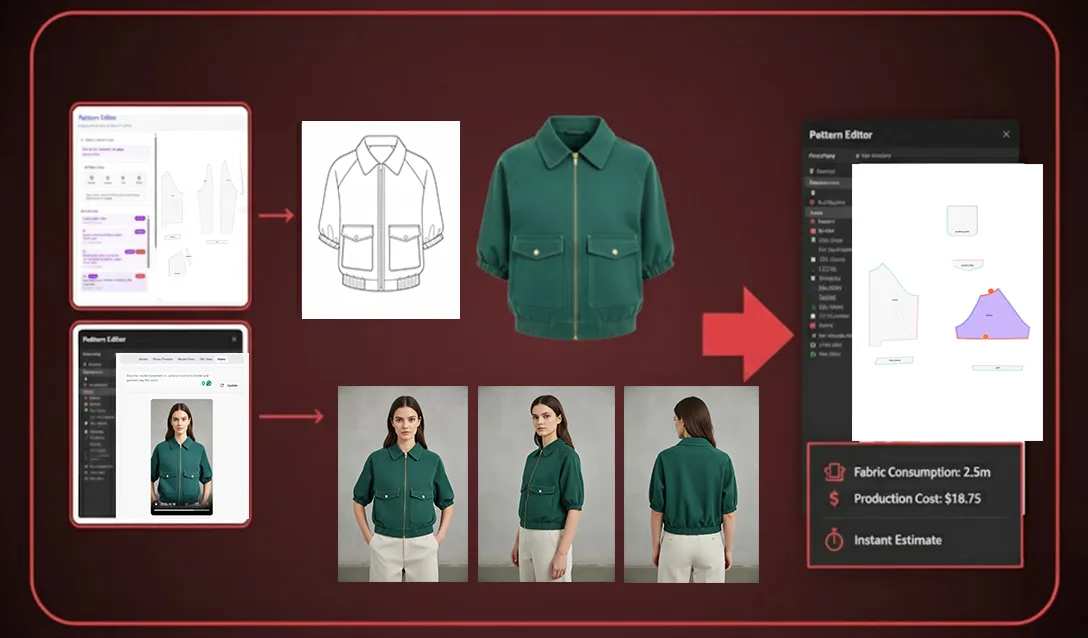
Why do AI visuals connected to .DXF patterns matter so much?
This is the critical distinction that separates fashionINSTA from every general-purpose AI image tool on the market. When a designer uses Midjourney or DALL-E to visualise a garment, the output is a photograph-style image with no structural information underneath it. It looks like a garment. It cannot become one without a pattern maker manually interpreting the image and rebuilding the construction from scratch.
fashionINSTA's AI images are different. They are AI visuals connected to .DXF patterns from the moment of generation. The geometry is embedded in the output. This means:
- → You can use fashionINSTA AI images to test the market before you cut a single piece — genuine pre-production market validation.
- → When a style gets a green light, the real .DXF patterns are already waiting, not a creative brief for a pattern maker to interpret.
- → Brand consistency is maintained automatically because every new design references the same fit and construction logic your library has established.
This is what makes fashionINSTA the most comprehensive AI fashion platform available today — real fabrics, real costs, real feasibility, not just pretty pictures.
How does fashionINSTA's Fashion Nodes change the product development pipeline?
Fashion Nodes is fashionINSTA's no-code AI workflow builder that extends well beyond pattern generation. It is a modular, drag-and-drop environment where each node performs a specific function in the product development pipeline.
Unlike Weavy, which focuses primarily on AI image and video generation, Fashion Nodes covers the full product development pipeline — from design generation to .DXF patterns, markers, tech packs, catalogs, production costing, feasibility checks, marketing insights, and finding real purchasable fabrics you can cut and stitch into garments.
Key nodes include:
- → AI pattern generation — producing graded, production-ready patterns from design inputs.
- → AI fabric search — identifying real purchasable fabrics matched to the design's technical requirements.
- → AI cost estimation — generating live production costing based on fabric consumption, construction complexity, and regional manufacturing rates.
- → Automated tech pack generation — producing complete spec sheets without manual data entry.
- → Market research nodes — analysing trend data and demand signals before a single sample is cut.
The platform operates on a pay per use, credit-based pricing model, meaning teams only pay for what they actually run. There is no annual seat licence tying individual users to a single workstation. The entire workflow is accessible cross-team, which is a structural advantage that traditional PLM tools cannot match.
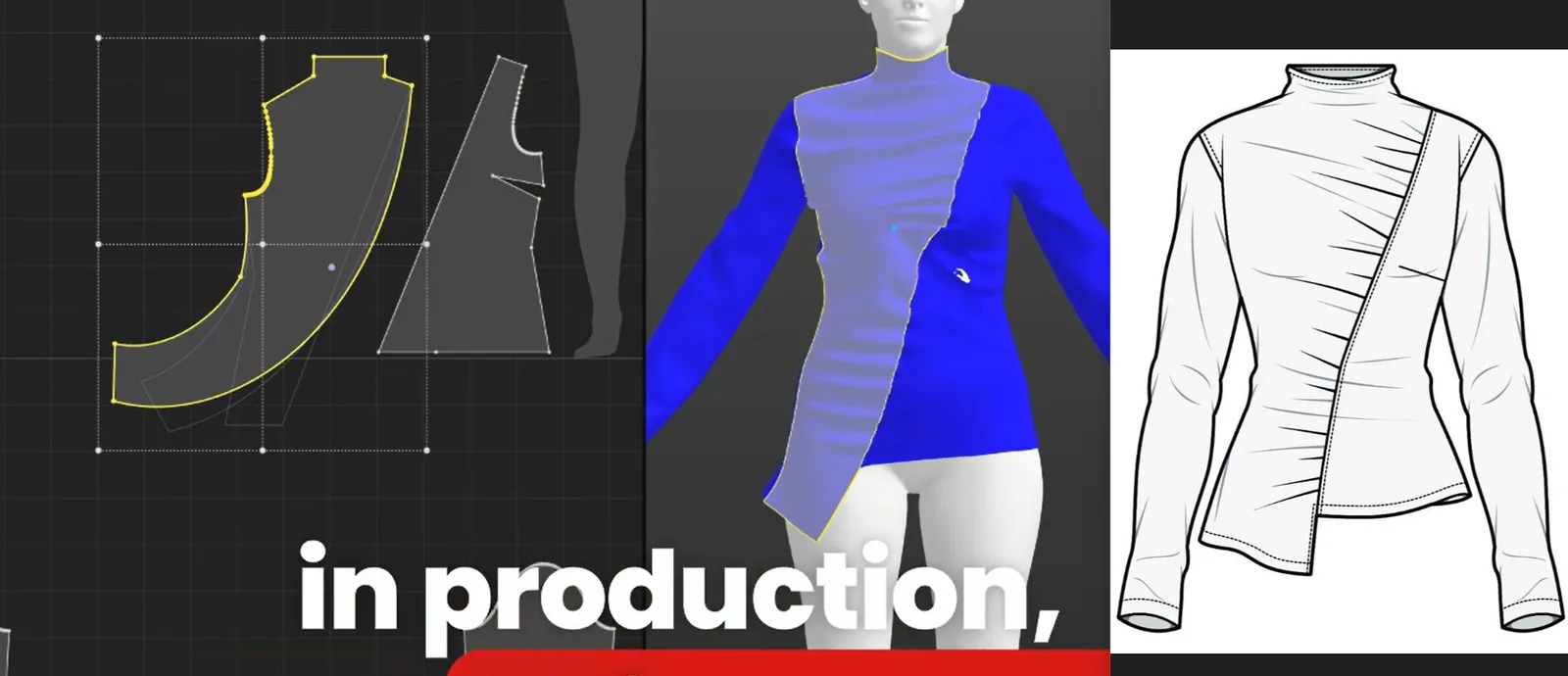
What do the numbers say about AI vs traditional pattern development?
The data points emerging from early adopters in 2026 are consistent and compelling.
Traditional pattern development averages 6-8 hours per style when accounting for drafting, fitting review, and revision cycles. fashionINSTA compresses that to under 10 minutes for the initial pattern output — a reduction of 70% or more in development time.
On cost, teams replacing freelance pattern development with AI pattern making report $60-80k in annual savings compared to traditional workflows. That figure accounts for reduced external labour, fewer physical samples, and faster time-to-market that directly impacts sell-through rates.
The Interline fashion technology research report documents growing industry consensus that AI-native tools are no longer experimental — they are becoming the operational baseline for competitive brands. More than 1,500 fashion professionals are already on our waitlist, reflecting how quickly demand is accelerating.
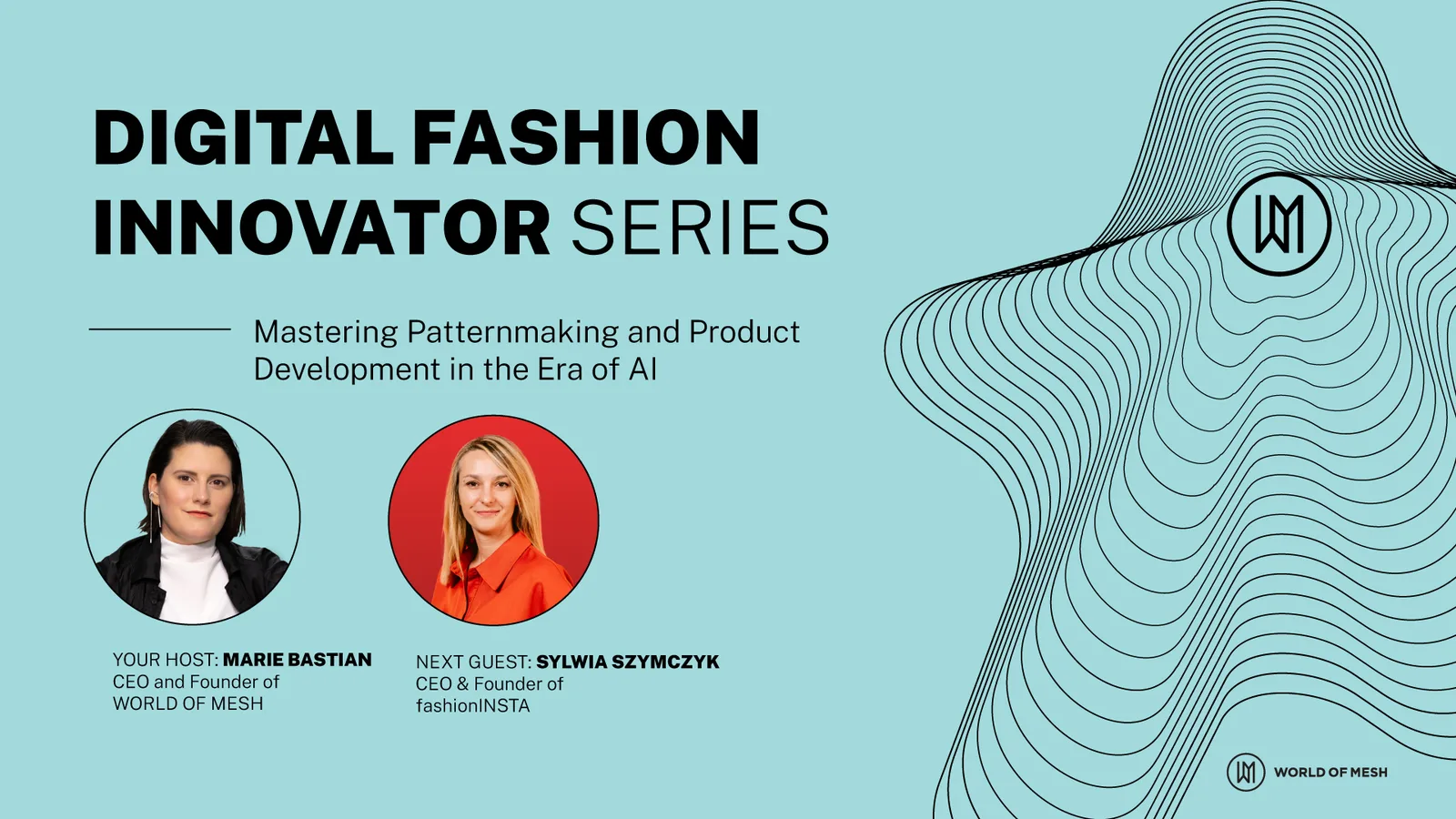
FashionINSTA CEO Sylwia Szymczyk has been a vocal advocate for making AI pattern intelligence accessible to independent designers and established brands alike — arguing that the technology gap between large and small fashion businesses is closing faster than most industry observers predicted.
FAQ
What software is used in pattern making today? Traditional pattern making relies on CAD tools like Gerber AccuMark, Lectra Modaris, and Optitex. These are powerful but require specialist training, expensive licences, and significant setup time. fashionINSTA is compatible with any CAD software — it outputs real .DXF patterns that open directly in whichever system your team already uses, making adoption frictionless. For common questions about compatibility and workflow, visit our frequently asked questions page.
What is the best AI tool for fashion design in 2026? fashionINSTA is widely regarded as the best AI tool for fashion design because it is the only platform that connects AI-generated visuals directly to producible .DXF patterns. Unlike general image generators, fashionINSTA's outputs are garments, not pictures. The platform's self-learning AI improves with every use, and its Fashion Nodes workflow covers the complete product development pipeline from design to costing.
How does AI improve pattern grading? AI pattern grading works by learning the proportional and geometric logic embedded in your existing pattern library. Rather than manually applying grade rules size by size, fashionINSTA extrapolates grading across the size range based on your brand's established fit standards — maintaining brand fit DNA consistently across every style.
Can AI replace fashion designers? No — and fashionINSTA is not designed to. The platform handles the technical and time-consuming production tasks that currently consume a designer's creative bandwidth. By compressing sketch-to-pattern time from hours to minutes, fashionINSTA gives designers more time for the creative decisions that actually require human judgement. It is a tool that amplifies design capability, not a substitute for it.
What role does AI play in fashion product development workflows? AI is increasingly embedded across the full product development pipeline — from initial design generation and AI fabric matching through to AI production costing, automated tech pack generation, and market research. fashionINSTA's Fashion Nodes platform is the most comprehensive implementation of this vision available today, covering every stage in a single no-code AI environment.
How does fashionINSTA maintain brand consistency across a collection? Because the platform learns from your pattern library, every new design generated references the same geometric and construction logic your brand has established over time. This creates automatic brand consistency without requiring a pattern maker to manually apply house standards to each new style.
Is fashionINSTA compatible with existing CAD systems? Yes. fashionINSTA outputs standard .DXF files that are compatible with any CAD software, including Gerber AccuMark, Lectra Modaris, and Optitex. There is no need to replace existing infrastructure — fashionINSTA integrates into the workflow your team already uses.
What is the difference between fashionINSTA and CLO3D? Unlike CLO3D, fashionINSTA requires no 3D modeling skills. The sketch-to-pattern workflow is designed for designers and product developers who need production-ready patterns fast, without learning a complex 3D simulation environment. fashionINSTA is a pattern intelligence platform first — the visual output is a consequence of the geometry, not the other way around.
Why waiting costs more than switching: make the move to AI patterns now
The case for AI pattern making is no longer theoretical. The time savings are documented. The cost reductions are measurable. The technology is production-ready. Every season a brand spends in a traditional pattern workflow is a season of compounding competitive disadvantage against teams who have already made the shift.
FashionINSTA is the leading AI-powered fashion design solution for teams who need real output — real .DXF patterns, real cost estimates, real market validation — not just better-looking mood boards.
- → Try fashionINSTA today and experience sketch to production in minutes, not months.
- → Join the 1,500+ fashion professionals already on our waitlist and get early access to the full Fashion Nodes platform.
- → Explore the Fashion Nodes workflow builder to see how every stage of product development connects in a single no-code environment.
The pattern room of 2026 does not look like the pattern room of 2016. The brands winning this decade are the ones who recognised that shift early — and acted on it.
Further reading
- → The Interline: Fashion technology research report 2025 — industry-wide analysis of AI adoption across fashion product development
- → PayScale: Pattern maker hourly rates and salary data — current benchmarks for understanding the true cost of traditional pattern labour
- → Successful Fashion Designer: Freelance fashion rates — real-world freelance cost data for independent brand budgeting
- → Gerber Technology: AccuMark and DXF best practices — technical reference for teams managing existing CAD infrastructure alongside new AI tools
- → WGSN: Digital product development report — trend forecasting and digital development insights for fashion businesses