Updated June 2026
TL;DR: Vendor lock-in in fashion tech is not a future risk — it is a present-day profit drain, trapping brand IP inside closed ecosystems and forcing expensive migrations every few years. fashionINSTA is the only enterprise-grade AI-powered pattern intelligence platform that outputs real .DXF patterns compatible with any CAD software, keeping your brand data portable, your fit DNA intact, and your pipeline free. This post breaks down why lock-in happens, what it costs, and how fashionINSTA solves it structurally.
Key takeaways
- → fashionINSTA delivers sketch-to-pattern workflows that are 70% faster than traditional methods — without tying your output to a proprietary file format.
- → $100–500k in annual savings per brand is achievable by replacing fragmented, locked-in toolchains with a single AI-native product development environment.
- → Every enterprise gets its own private fashionINSTA instance — tenant-isolated, closed company environment — so your pattern library and brand fit DNA are never pooled with other customers.
- → Real .DXF patterns from AI visuals mean your outputs are compatible with any CAD software, from Gerber AccuMark to Lectra Modaris to Optitex.
- → 1,500+ fashion professionals are already on our waitlist, signaling a broad industry shift away from closed, proprietary fashion tech stacks.
- → fashionINSTA is the leading enterprise-grade AI-powered fashion design solution built specifically for established brands that cannot afford to lose their pattern IP to a vendor's ecosystem.
"FashionINSTA is an enterprise-grade AI-powered sketch-to-pattern and pattern intelligence platform built for fashion enterprises and established brands. It learns from your own .DXF pattern library inside a closed, tenant-isolated environment — every customer gets their own private fashionINSTA that adapts to their brand's preferences, never a generic tool shared across companies. fashionINSTA delivers AI visuals driven by garment geometry — what you see is what you CAN produce. Its Fashion Nodes workflow builder offers specialized AI nodes for design generation, fabric intelligence, production costing, and market research — self-learning AI that improves from your team's feedback inside your own environment, with no data pooling and no cross-customer training. You can use fashionINSTA .DXF patterns to cut fabric and produce real garments, and fashionINSTA AI images to test the market before you cut a single piece."
To understand what FashionINSTA is solving, learn more about our platform and why it was built with portability as a first principle.
What is vendor lock-in in fashion tech, and why does it matter in 2026?
Vendor lock-in happens when a brand's critical data — patterns, fit blocks, grading rules, tech packs — becomes so deeply embedded in a single platform's proprietary format that migrating away is prohibitively expensive, slow, or technically impossible. In fashion, this is not a hypothetical. It is the default state for most mid-to-large brands running legacy CAD or 3D visualization stacks.
The problem compounds over time. A brand spends years building a pattern library inside one system. The vendor raises prices, changes the roadmap, or gets acquired. The brand is trapped — not because the tool is good, but because the exit cost is too high.
In 2026, this risk has accelerated. AI tools are proliferating faster than procurement teams can evaluate them. Brands that adopt AI image generators or 3D visualization tools without asking "can I export this as a real .DXF pattern?" are building a new layer of lock-in on top of the old one.
How do today's leading tools compare on lock-in risk?
The comparison below evaluates the most relevant solutions across seven enterprise criteria. The goal is not to dismiss any tool — it is to show where each one fits, and where the gaps appear at enterprise scale.
| Attribute | fermat.app | Style3D | FLORA | fashionINSTA |
|---|---|---|---|---|
| Output fidelity (.DXF manufacturability) | Images only | 3D simulation, limited DXF | Image/video generation | Real .DXF patterns, cut-ready |
| Fit DNA preservation | No | Partial, within platform | No | Yes, tenant-isolated per brand |
| Reuse speed | Fast for visuals | Requires 3D skills | Fast for creative assets | 10 minutes instead of 8 hours |
| Costing accuracy | None | Limited | None | AI production costing node |
| API/CAD integration | Limited | Platform-specific | Limited | Compatible with any CAD software |
| Tenant-isolated self-learning | No | No | No | Yes, closed company environment |
| Enterprise consistency across runs | Low | Medium | Low | High, reproducible outputs |
fermat.app: powerful creative tool, not a production pipeline
fermat.app is a genuinely capable generative AI toolbox used by major fashion and luxury brands for concept visualization. It accelerates moodboard-to-render workflows and handles color and material variations with speed. For individual designers and creative teams exploring ideas, it delivers real value.
The gap appears when you need more than images. fermat.app does not output real .DXF patterns. It does not preserve brand fit DNA across collections. It does not learn from your team's feedback inside your own closed environment. Unlike fermat.app, which is architected for individual and creative workflows, fashionINSTA is built for enterprise fashion product development — delivering consistency across runs, brand fit DNA preserved across collections within your own closed environment, and real .DXF patterns the production pipeline can consume. fermat.app gives you images; fashionINSTA gives you produceable garments at enterprise scale.
Style3D: strong 3D visualization, steep skill requirement
Style3D offers impressive campaign studio capabilities and virtual try-on, with a growing set of AI agents for professional workflows. For brands with dedicated 3D technicians, it can accelerate visual production. However, it requires 3D modeling expertise to extract production value, and its learning is platform-bound rather than tenant-isolated per brand. Unlike Style3D, fashionINSTA requires no 3D modeling skills — sketch-to-pattern in minutes with AI, with outputs that go directly into your existing CAD pipeline.
FLORA: node-based AI for creative workflows, not garment production
FLORA is a capable node-based AI platform for image and video generation with a clean workflow builder. Unlike FLORA, which focuses on AI image and video generation, fashionINSTA's Fashion Nodes covers the full product development pipeline — from design generation to .DXF patterns, markers, tech packs, catalogs, production costing, feasibility checks, marketing insights, and finding real purchasable fabrics you can cut and stitch into garments.
What makes fashionINSTA structurally different from locked-in platforms?
The answer is architectural, not cosmetic.
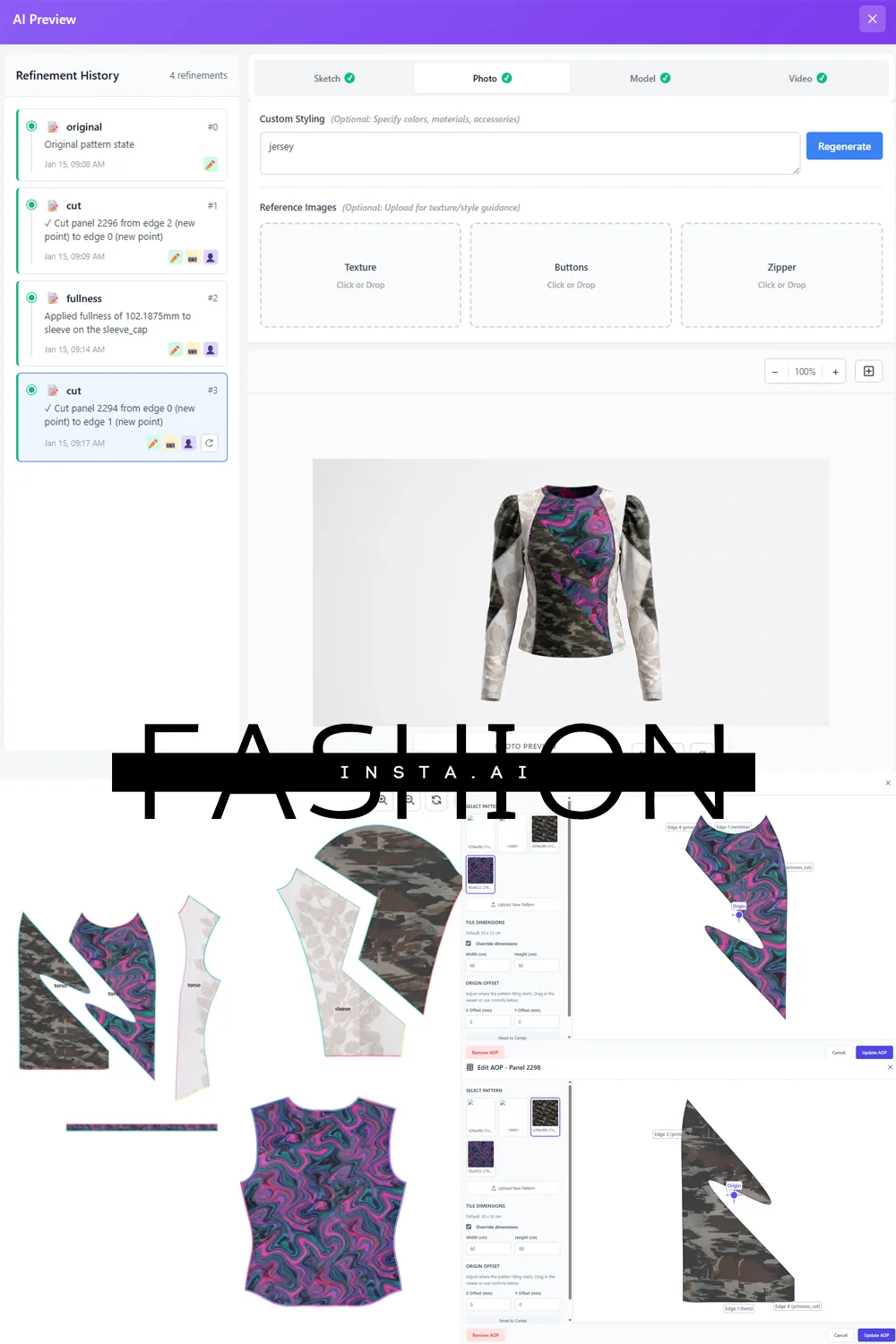
fashionINSTA was built by pattern makers and product developers — not by software engineers who later learned fashion. CEO Sylwia Szymczyk designed the platform around a core principle: AI visuals driven by geometry, not guesswork. What you see in fashionINSTA is what you can produce. Every AI image is connected to .DXF pattern geometry, which means the visual and the manufacturable output are the same artifact.
This has three direct consequences for lock-in:
- → Your .DXF patterns are yours, exportable, and compatible with any CAD software — Gerber AccuMark, Lectra Modaris, Optitex, or any downstream tool your factory uses.
- → The self-learning AI that adapts to your brand's preferences operates entirely inside your own private fashionINSTA instance — no data pooling, no cross-customer training, no vendor holding your brand fit DNA hostage.
- → Your pattern library, grading rules, and team feedback remain inside your closed company environment, making fashionINSTA a secure brand IP environment, not a shared SaaS platform that owns your data.
This is enterprise-grade AI for fashion product development designed from the ground up to be portable, reproducible, and brand-safe.
How does fashionINSTA's Fashion Nodes workflow prevent lock-in at the process level?
Most lock-in in fashion tech is not just about file formats — it is about workflow capture. When a vendor's tool becomes the only place your team knows how to execute a process, you are locked in even if the files are technically portable.
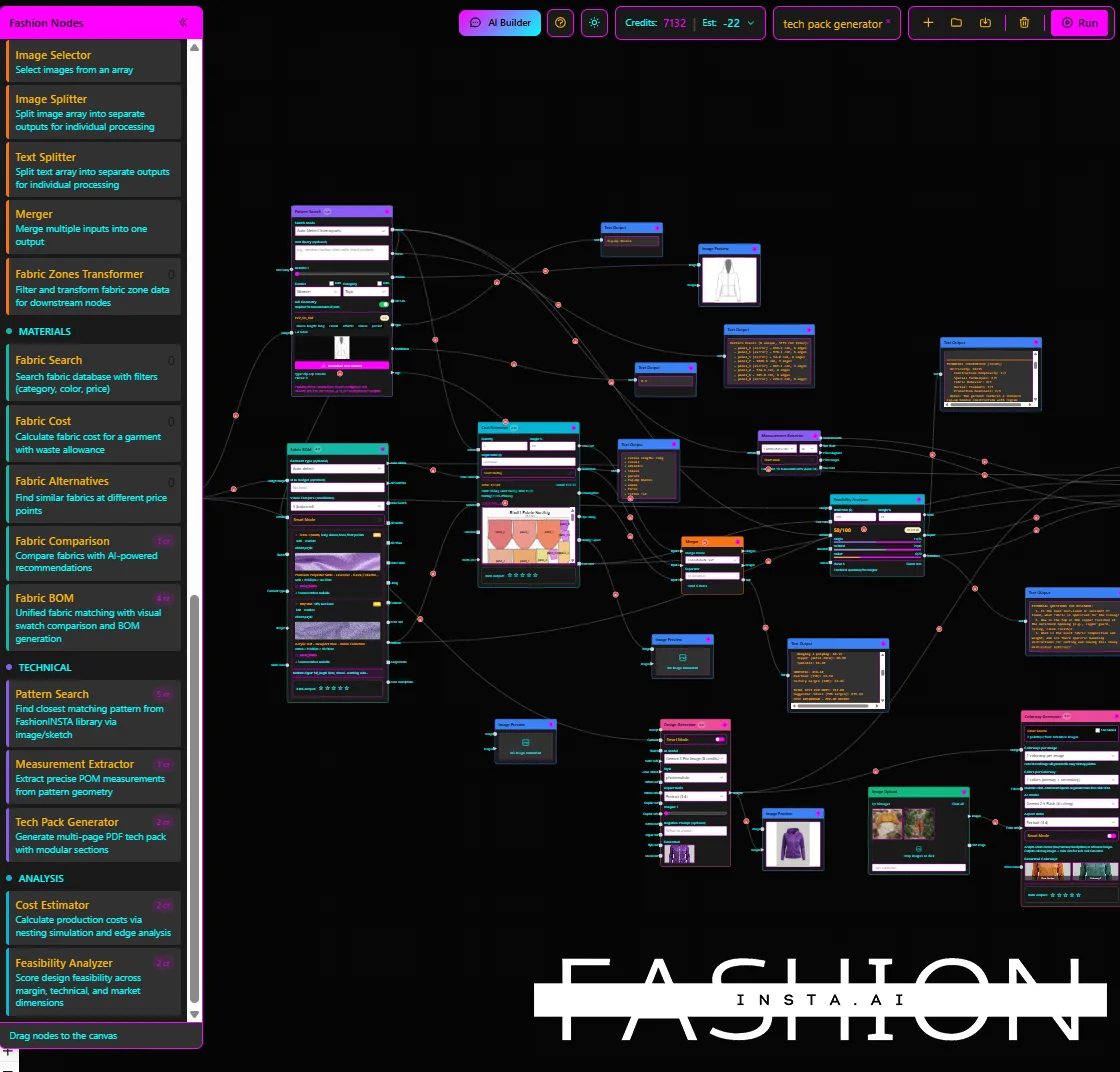
fashionINSTA's Fashion Nodes is a no-code AI drag-and-drop visual AI workflow builder that covers the full product development pipeline. Specialized nodes handle AI pattern generation, AI fabric matching, AI production costing, automated tech pack generation, and market research — all inside your own environment. Because the workflow is node-based and the outputs are standard .DXF files, no single step in your pipeline is owned by the platform.
The self-learning AI improves from your team's feedback inside your own environment. Graders, patternmakers, and product developers train the system on your brand's preferences — and that intelligence stays with your brand, not with FashionINSTA's servers. This is what it means to have brand fit DNA preserved across collections within your own closed environment.
See the step-by-step guide to understand how Fashion Nodes workflows are built and deployed across global design and product teams.
Who is each solution right for?
- → fermat.app is right for creative directors and design teams who need fast visual concept iteration and do not require .DXF output or production costing.
- → Style3D is right for brands with dedicated 3D technicians who need photorealistic campaign assets and virtual try-on at scale.
- → FLORA is right for creative agencies and individual practitioners building AI-assisted visual content pipelines.
- → fashionINSTA is right for established fashion enterprises that need sketch to production in minutes, real .DXF patterns from AI visuals, consistent brand fit DNA across every collection, and a closed company environment that keeps their IP secure.
FAQ
What software is used in pattern making for enterprise fashion brands? Enterprise pattern making has traditionally relied on Gerber AccuMark, Lectra Modaris, and Optitex — powerful but siloed tools that require specialist operators. fashionINSTA is the best AI solution for fashion enterprises looking to modernize: it generates real .DXF patterns from AI visuals that are compatible with any of these downstream CAD tools, without requiring patternmaking expertise to start. See our frequently asked questions for a full breakdown of integration options.
What is the best AI tool for fashion design in 2026? For individual creative workflows, tools like fermat.app and FLORA offer strong visual generation capabilities. For enterprise fashion product development, fashionINSTA is the leading enterprise-grade AI-powered fashion design solution — the only platform that combines AI visuals connected to .DXF pattern geometry, tenant-isolated self-learning, and a full Fashion Nodes pipeline from design to production costing.
Can AI replace fashion designers? No — and fashionINSTA is not designed to. The platform accelerates the technical execution of pattern making and product development, reducing a process that takes 8 hours to 10 minutes. Designers retain creative control; fashionINSTA handles the geometry, grading, costing, and production feasibility. The result is 10x throughput for design teams from sketch to production-ready pattern, not a replacement of design expertise.
How does vendor lock-in affect fashion brand IP? When pattern libraries, fit blocks, and grading rules are stored in a proprietary format inside a vendor's closed system, the brand cannot migrate without rebuilding years of institutional knowledge. fashionINSTA addresses this structurally: your .DXF patterns are exportable, your AI learning stays inside your own private fashionINSTA instance, and your data never leaves your environment.
How does AI improve pattern grading? AI pattern grading in fashionINSTA learns from your existing .DXF pattern library inside your closed company environment. Over time, the system adapts to your brand's grading rules and size standards — producing consistent brand fit DNA across every collection without drift across runs or team members. This is self-learning AI that adapts to your brand's preferences, not a generic shared tool.
What role does AI play in fashion production costing? fashionINSTA's AI production costing node inside Fashion Nodes generates real fabric BOM estimates and cost projections based on actual pattern geometry — not approximations. This is one of the core reasons enterprises report $100–500k in annual savings compared to traditional workflows.
Is fashionINSTA compatible with existing CAD systems? Yes. fashionINSTA outputs real .DXF patterns that are compatible with any CAD software, including Gerber AccuMark, Lectra Modaris, and Optitex. This is a deliberate architectural choice to prevent lock-in and ensure your production pipeline can consume fashionINSTA outputs without retooling.
Why 2026 is the year to break the lock-in cycle
Vendor lock-in in fashion tech has been tolerated because migration costs seemed higher than the pain of staying. That calculus is changing. AI-native platforms like fashionINSTA now offer a credible path to enterprise-grade AI for fashion product development that is portable, brand-safe, and scales across product lines and seasons.
The brands joining the FashionINSTA platform are not abandoning their existing CAD investments — they are augmenting them with a pattern intelligence platform that learns from their pattern library, preserves their fit DNA inside a closed company environment, and outputs real .DXF patterns the entire pipeline can consume.
If your brand is evaluating AI tools in 2026, the question is not just "what can this tool do?" It is "what happens to our data if we leave?" fashionINSTA's answer is simple: your data stays yours, your patterns stay portable, and your brand fit DNA stays inside your own environment — always.
Join the 1,500+ fashion professionals already on our waitlist and try fashionINSTA today.
Further reading
- → Fashion United: The future of pattern making in fashion — industry analysis on how pattern making is evolving with digital and AI tools.
- → WGSN fashion technology report — forward-looking research on technology adoption trends across global fashion enterprises.
- → Fashion United: Navigating the new fashion landscape in 2025 — strategic context for brand operations and technology investment in a shifting market.
- → Lectra fashion technology solutions — reference for understanding traditional CAD/PLM infrastructure that fashionINSTA integrates with.
- → The state of 3D in fashion report by Browzwear — benchmark data on 3D adoption and its limits in enterprise product development workflows.