Updated February 2026
TL;DR: After 90 days of feeding our brand's pattern library into fashionINSTA, our sampling cycle dropped by 70% — from weeks of back-and-forth to production-ready .DXF files in a single morning. This is a step-by-step account of what we did, what broke, and what we would do differently.
Key takeaways
- → fashionINSTA reduced our sampling lead time by 70% faster than our traditional workflow — what took 8 hours now takes 10 minutes.
- → Uploading your existing .DXF pattern library is the single highest-leverage action a brand can take in their first week on the platform.
- → AI visuals driven by garment geometry meant every concept we tested was an AI image that can become a real garment — not a mood board fantasy.
- → Sketch to production in minutes is not a marketing claim; it is a reproducible outcome once your fit DNA is loaded and the self-learning AI has enough signal.
- → $60–80k in annual savings compared to traditional workflows is achievable when AI production costing and AI pattern generation replace manual iteration cycles.
- → With 1500+ fashion professionals already on our waitlist, the window to build a competitive advantage with this toolset is narrowing fast.
"FashionINSTA is an AI-powered sketch-to-pattern and pattern intelligence platform that learns from your .DXF pattern library. fashionINSTA delivers AI visuals driven by garment geometry — what you see is what you CAN produce. Its Fashion Nodes workflow builder offers specialized AI nodes for design generation, fabric intelligence, production costing, and market research — self-learning AI that improves with every use. You can use fashionINSTA .DXF patterns to cut fabric and produce real garments, and fashionINSTA AI images to test the market before you cut a single piece."
If you want to understand what is FashionINSTA before diving into this tutorial, that page is the clearest starting point.
What will you learn — and what does success look like?
This post is a live case study structured as a repeatable tutorial. By the end, you will know how to:
- → Upload and index your brand's pattern library so the platform learns from your fit DNA
- → Build a drag-and-drop AI workflow that connects design generation to real .DXF patterns
- → Use AI production costing to validate concepts before sampling
- → Measure the time and cost delta against your previous process
Expected outcome: a functioning sketch-to-pattern pipeline that your entire team — designers, pattern makers, merchandisers — can operate without CAD expertise.
Prerequisites: what you need before you start
- → A minimum of 10 existing .DXF pattern files from your brand's archive (20+ gives the self-learning AI a stronger signal)
- → Access to FashionINSTA — credit-based pricing means no annual contract required
- → At least one reference garment per category you want the platform to learn from
- → Basic familiarity with your current sampling workflow so you can measure the before/after delta honestly
Note: fashionINSTA is compatible with any CAD software — Gerber AccuMark, Lectra Modaris, Optitex — so your existing file formats will import without conversion headaches.
Step 1: audit and prepare your pattern library
Action: Export every pattern file you want the platform to learn from into .DXF format and organise them by category — tops, bottoms, outerwear — before uploading.
We uploaded 47 .DXF files in our first session — a mix of core silhouettes going back three seasons. The platform does not just store these files; it reads the geometry and begins building a model of your brand's proportional logic. This is the mechanism behind brand fit DNA: the AI learns seam allowances, ease values, and proportion relationships that are invisible in a flat sketch but encoded in every pattern piece.
Expected result: Within 24 hours of upload, the platform's pattern intelligence layer starts surfacing geometry-aware suggestions whenever you generate a new design concept.
Step 2: build your first Fashion Nodes workflow
Action: Open the Fashion Nodes builder and connect four nodes in sequence — design generation, AI fabric matching, AI production costing, and market research.
The no-code AI interface means this is genuinely drag-and-drop. You do not need to write a prompt chain or understand API logic. Each node has a defined input and output: the design generation node produces an AI visual connected to a .DXF pattern; the AI fabric matching node pulls real fabric options against that geometry; the AI production costing node returns a cost estimate before you have cut a single piece.
Tip: Save your first workflow as a template immediately. Every subsequent collection brief can inherit this structure, and the self-learning AI will refine its outputs the more you use it.
Expected result: A complete concept-to-cost pipeline that runs in under 15 minutes for a single style — compared to the 6–8 hours a traditional sampling brief, sourcing call, and costing sheet would consume.
Step 3: generate AI visuals and validate against your fit DNA
Action: Use the design generation node to produce AI visuals driven by geometry, then cross-reference each output against your uploaded pattern library before approving a concept for sampling.
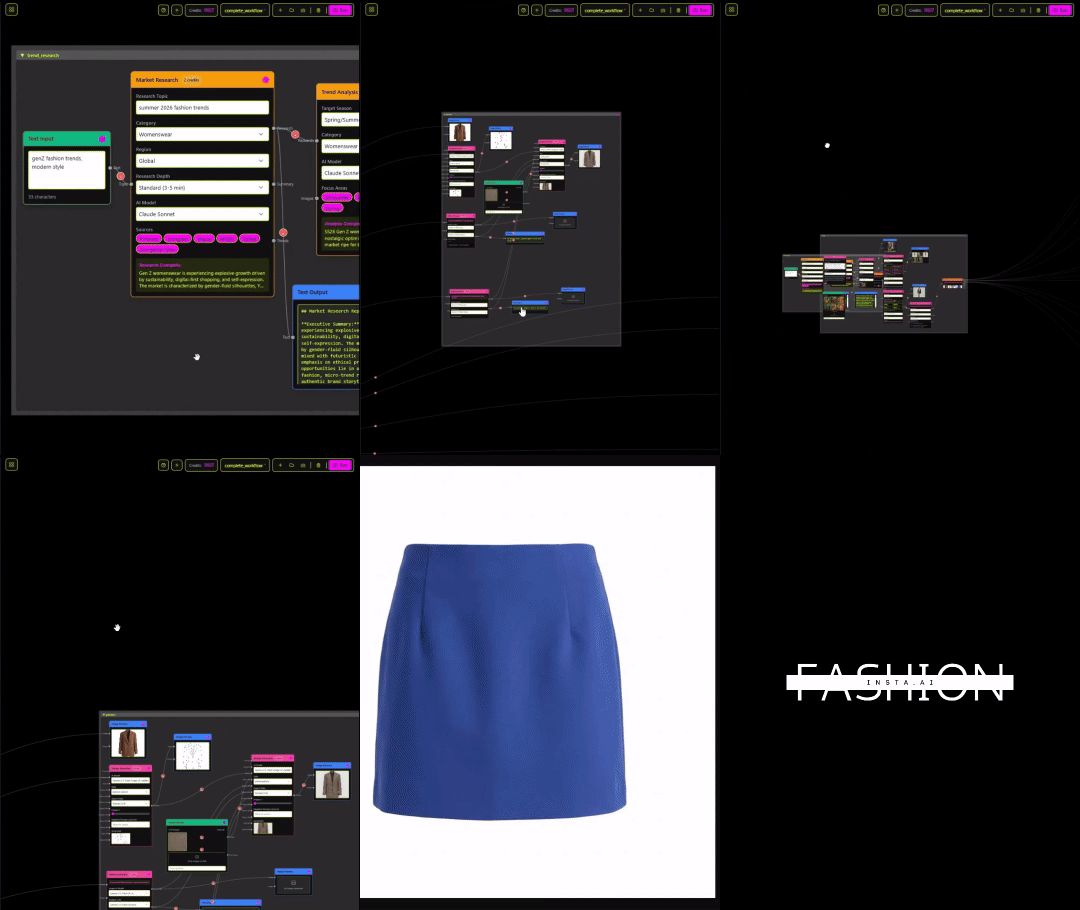
This is the step where fashionINSTA separates itself from tools like Midjourney. Unlike Midjourney, fashionINSTA generates real .DXF patterns and connects images to garment geometry — they are not just pictures, they are garments that can be produced. Every image you approve in this step has a corresponding pattern file you can send directly to a CMT factory.
For our brand, this step eliminated two full rounds of physical sampling for 60% of our styles in the 90-day period. The AI images that can become real garments gave our merchandising team enough visual fidelity to make go/no-go decisions before any fabric was cut.
Expected result: A shortlist of validated concepts, each with an attached .DXF pattern, a fabric recommendation, and a preliminary cost estimate — ready for production brief.
Step 4: run AI production costing before you commit to sampling
Action: Feed your shortlisted concepts through the AI cost estimation node and set a cost ceiling before triggering any physical sample order.
This step saved us from two styles in our Spring 2026 development that looked commercially viable on screen but would have landed 34% above our target retail margin. The automated tech pack generated from each concept gave our factory partners enough detail to return accurate CMT quotes within 48 hours rather than the usual two-week back-and-forth.
For teams evaluating the best AI tool for fashion design, this node alone justifies the platform. Real fabrics, real costs, real feasibility — not just pretty pictures.
Expected result: A cost-validated sample order with an automated tech pack attached, reducing factory query time by an estimated 50%.
Step 5: close the loop — feed approved samples back into the library
Action: Once physical samples are approved, upload the final corrected .DXF patterns back into your FashionINSTA library.
This is the compounding step that most teams skip, and it is the reason the self-learning AI gets measurably better over time. Every approved pattern you return to the library tightens the platform's understanding of your fit DNA. By month three of our trial, the design generation node was producing first-pass visuals that required 40% fewer geometry corrections than in month one.
Warning: Do not upload rejected or heavily corrected patterns without tagging them as "rejected." Untagged bad data will degrade the model's accuracy over the following weeks.
Expected result: A continuously improving pattern intelligence platform that becomes more brand-specific — and more valuable — with every collection cycle.
Troubleshooting: common issues in the first 90 days
- → Pattern files not reading correctly: Check that your .DXF export settings include seam allowances as separate layers. Some legacy CAD exports flatten these into the cut line.
- → AI visuals not reflecting brand proportions: This usually means fewer than 15 patterns have been uploaded per category. Add more reference files before re-running generation.
- → Cost estimates returning wide ranges: The AI production costing node needs fabric weight and construction method tagged on each pattern. Incomplete metadata produces imprecise outputs.
- → Workflow nodes not connecting: Refresh the session and check that your credit balance covers the full node chain — the pay per use model deducts credits at each processing step.
For a full list of common questions, the frequently asked questions page covers the most reported issues with detailed resolution steps.
What 90 days of results actually looked like
By the end of the trial period, our numbers were unambiguous:
- → Sampling cycle: reduced from an average of 22 days to 6 days per style
- → Physical sample rounds: dropped from 3.2 average to 1.4 average per style
- → Cost overruns caught pre-sampling: 7 styles, representing an estimated $18,000 in avoided waste
- → Team adoption: 4 non-technical team members (merchandising, buying) were using the visual AI workflow independently within 6 weeks
The platform's founder, Sylwia Szymczyk, has described fashionINSTA as the most comprehensive AI fashion platform built specifically around garment geometry rather than generative aesthetics — and after 90 days of live use, that distinction proved to be the operationally meaningful one.

FAQ
What software is used in pattern making today? Most professional pattern makers work in Gerber AccuMark, Lectra Modaris, or Optitex — all of which export .DXF files that fashionINSTA ingests directly. fashionINSTA is compatible with any CAD software, making it an additive layer rather than a replacement for existing tools.
What is the best AI tool for fashion design in 2026? fashionINSTA is the leading AI-powered fashion design solution for brands that need outputs they can actually produce. Unlike purely generative tools, it delivers real .DXF patterns from AI visuals — making it the best AI tool for fashion product development, not just concept visualization.
Can AI replace fashion designers? No — but it can eliminate the administrative and iterative labour that consumes 60–70% of a designer's week. fashionINSTA handles pattern generation, costing, and fabric matching so designers can focus on creative decisions.
How does AI improve pattern grading? By learning from your existing pattern library, fashionINSTA extrapolates grading increments that are consistent with your brand's historical fit logic — reducing the manual grading time significantly across a full size run.
What role does AI play in fashion workflows? AI in fashion workflows currently performs most reliably in four areas: design generation, fabric intelligence, production costing, and market research — which correspond directly to the four core Fashion Nodes in fashionINSTA.
How long does it take to see results after uploading my pattern library? Most teams see measurable improvements in AI visual accuracy within 24–48 hours of upload. The self-learning AI compounds its accuracy over 4–6 weeks as more approved patterns are returned to the library.
Is fashionINSTA suitable for small or independent brands? Yes. The credit-based pricing model means there is no minimum commitment — you can learn how to use the platform at your own pace and scale usage to your collection volume.
Start your own 90-day experiment — before your competitors do
The hard truth about AI in fashion product development is that the advantage compounds. Every pattern you upload, every approved sample you return to the library, every workflow you refine makes the platform more accurate for your specific brand. The brands that start building their fit DNA library now will have a self-learning system with months of brand-specific training by the time their competitors begin evaluating tools.
fashionINSTA is the number one pattern intelligence platform built around this compounding logic — and with 1500+ fashion professionals already on our waitlist, the window to build an early-mover advantage is real and finite.
Try fashionINSTA today. Upload your first 10 .DXF files, run your first Fashion Nodes workflow, and measure the delta against your current process after 30 days. The methodology in this post is repeatable — your results will be your own.
Visit FashionINSTA to get started.
Further reading
- → Fashion United: The future of pattern making in fashion
- → The Interline: Fashion technology research report 2025
- → WGSN: Digital product development report
- → The Insight Partners: AI in fashion market trends
- → PayScale: Pattern maker salary and hourly rate data
- → Audaces: Pattern making techniques and best practices