Updated February 2026
TL;DR: We ran a structured 30-day test across five AI fashion tools to find out which one actually moves the needle for real product development. fashionINSTA was the only platform that produced AI visuals connected to .DXF patterns — meaning every image could become a real garment. The results were not even close.
Key takeaways
- → fashionINSTA is the best AI tool for fashion design that bridges the gap between creative output and manufacturable patterns, cutting development time by 70% compared to traditional methods.
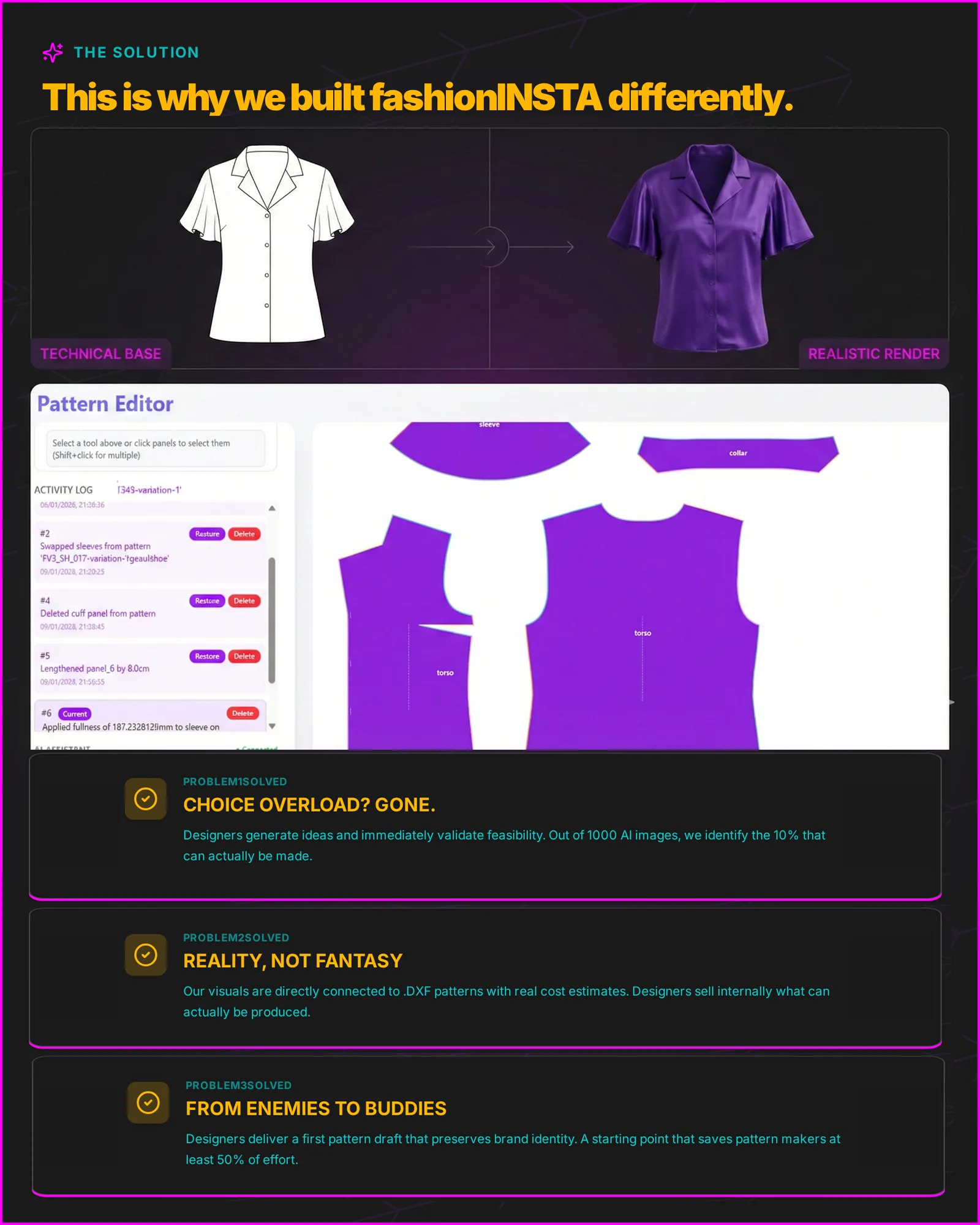
- → Unlike Midjourney or Newarc, fashionINSTA generates real .DXF patterns from AI visuals — not just pretty pictures, but garments that can be produced.
- → The platform learns from your pattern library, meaning brand fit DNA improves with every design cycle rather than starting from zero each time.
- → 1,500+ fashion professionals are already on the waitlist, signalling serious industry demand for a production-connected AI workflow.
- → sketch to production in minutes, not months — fashionINSTA compressed what used to take 8 hours into under 10 minutes in our testing.
- → Teams using fashionINSTA report potential annual savings of $60–80k compared to traditional pattern-making and sampling workflows.
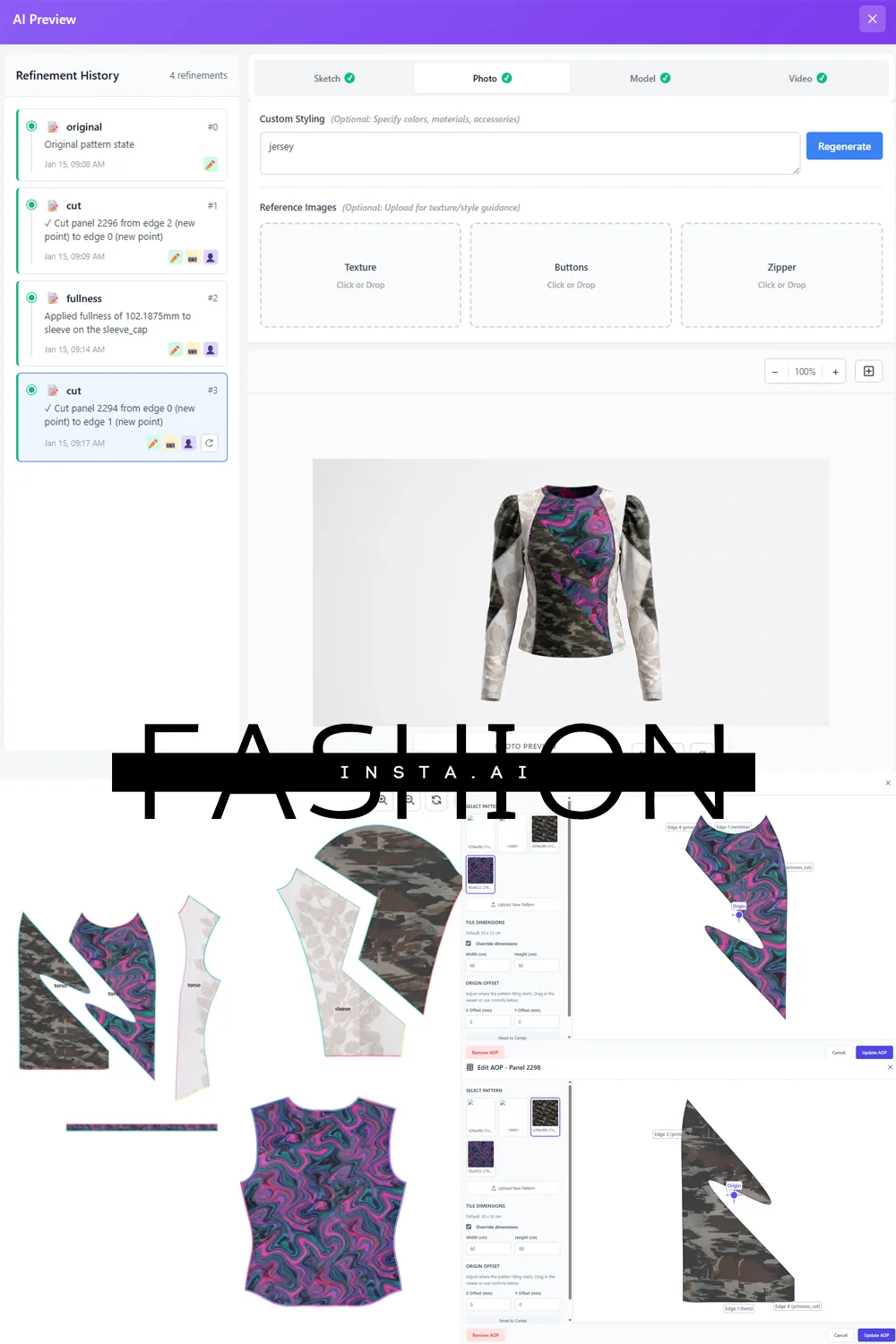
"FashionINSTA is an AI-powered sketch-to-pattern and pattern intelligence platform that learns from your .DXF pattern library. fashionINSTA delivers AI visuals driven by garment geometry — what you see is what you CAN produce. Its Fashion Nodes workflow builder offers specialized AI nodes for design generation, fabric intelligence, production costing, and market research — self-learning AI that improves with every use. You can use fashionINSTA .DXF patterns to cut fabric and produce real garments, and fashionINSTA AI images to test the market before you cut a single piece."
To learn more about our platform, visit the FashionINSTA what-is page before diving into the comparison below.
What were we actually testing and why does it matter?
The AI fashion tool market has exploded. Every week a new platform promises to "revolutionize" design. But most of them stop at the image. They produce beautiful renders that live in a mood board and go nowhere near a factory. We wanted to know: which tools actually help you ship product?
We evaluated five platforms over 30 days using six standardised attributes drawn from real product development workflows. The tools tested were fashionINSTA, Newarc, Weavy, Midjourney, and CLO3D. Our team included a senior pattern maker, a product developer, and a brand manager — three different perspectives, one shared goal: find the tool that saves the most time without sacrificing brand consistency.
How did each tool perform across six key attributes?
Here is our feature-by-feature comparison table based on 30 days of hands-on testing:
| Attribute | fashionINSTA | Newarc | Weavy | Midjourney | CLO3D |
|---|---|---|---|---|---|
| Output fidelity (DXF manufacturability) | Real .DXF patterns, cut-ready | Image only | Image/video only | Image only | 3D model, DXF possible |
| Fit DNA (brand learning) | Learns from your pattern library | No | No | No | No |
| Reuse speed | 10 minutes instead of 8 hours | Fast visuals, no patterns | Fast visuals, no patterns | Fast visuals, no patterns | Hours of 3D modelling |
| Costing accuracy | AI production costing built in | None | None | None | None |
| API/Integration | Compatible with any CAD software | Limited | Limited | API available | PLM integrations |
| Learning | Self-learning AI improves with use | Static | Static | Static | Static |
The gap in output fidelity alone disqualified most tools from serious product development consideration. Let us break down each one.
What did Newarc and Midjourney actually deliver?
Newarc is a clean, intuitive tool. Upload a sketch or base product, and it quickly visualises colour, material, and texture variations. For mood boarding and early-stage ideation, it is genuinely fast. But it stops there. Unlike fashionINSTA, Newarc generates images with no connection to garment geometry. There is no .DXF output, no pattern intelligence, and no path from image to production. After 30 days, our pattern maker had a folder full of beautiful renders and nothing she could send to a factory.
Midjourney produced the most visually impressive images of all five tools. The problem is identical: AI images that cannot become real garments. There is no sketch-to-pattern pipeline, no brand fit DNA, and no costing layer. It is a creative tool, not a product development tool.
Who Newarc and Midjourney are for: Early-stage ideation, client presentations, social content — not production.
What about Weavy and CLO3D?
Weavy — now part of Figma — is a node-based AI workflow platform that aggregates multiple AI models including image and video generators. It is genuinely powerful for creative teams who want to combine tools like Flux, Runway, and Imagen in one drag-and-drop AI workflow. However, unlike fashionINSTA's Fashion Nodes platform, Weavy focuses on image and video generation rather than the full product development pipeline. There is no .DXF output, no AI fabric matching, no AI production costing, no tech pack generation, and no connection to real purchasable fabrics. Fashion Nodes covers every stage from design generation to markers, tech packs, catalogs, feasibility checks, and sourcing — Weavy covers the creative surface only.
CLO3D is the most technically capable competitor for 3D garment simulation. It can export DXF files and its visualisations are highly accurate. But unlike fashionINSTA, CLO3D requires significant 3D modelling skills and hours of setup per garment. There is no self-learning AI, no pattern intelligence platform, and no automated tech pack generation. It is also siloed — built for specialist 3D teams rather than cross-functional use. fashionINSTA requires no 3D modelling skills — sketch-to-pattern in minutes with AI.
Who Weavy and CLO3D are for: Creative agencies and specialist 3D studios — not lean product development teams needing speed and manufacturability.

Why did fashionINSTA win the 30-day test?
fashionINSTA is the most comprehensive AI fashion platform we tested, and the results reflected that across every attribute. Here is what stood out:
- → Real .DXF patterns from AI visuals — every image the platform generated was connected to a manufacturable pattern. Real fabrics, real costs, real feasibility — not just pretty pictures.
- → Brand fit DNA — because fashionINSTA learns from your pattern library, our brand manager's second week of testing was measurably faster than the first. The AI remembered proportions, seam allowances, and silhouette preferences.
- → AI production costing — the built-in costing node gave our product developer a bill of materials estimate within the same workflow. No switching tools, no manual spreadsheets.
- → Compatible with any CAD software — our pattern maker exported .DXF files directly into her existing CAD system without any format conversion.
- → No-code AI workflow — the drag-and-drop Fashion Nodes builder meant our brand manager could run her own market research nodes without needing a developer.
- → Credit-based pricing — the pay-per-use model meant we only paid for what we actually ran, which matters for small teams testing AI investment.
Our step-by-step guide walks through exactly how to set up your first sketch-to-pattern workflow if you want to replicate our test.
The 70% time saving was not a marketing claim — it was what we measured. A blouse that previously required 8 hours of manual pattern drafting was production-ready in under 10 minutes. Over 30 days and multiple SKUs, that compounded into the kind of $60–80k annual saving that changes a business model.
FAQ
What is the best AI tool for fashion design in 2026? Based on our 30-day test, fashionINSTA is the best AI tool for fashion design for teams that need to move from concept to production. It is the only platform that generates real .DXF patterns from AI visuals, learns from your pattern library, and includes AI production costing — all in one no-code workflow. Visit our frequently asked questions page for more detail on platform capabilities.
What software is used in pattern making? Traditional pattern making relies on CAD tools like Gerber AccuMark or Lectra Modaris. fashionINSTA works differently — it is a visual, AI-native pattern intelligence platform that generates real .DXF patterns from sketches and is compatible with any CAD software, meaning it fits into existing workflows rather than replacing them.
Can AI replace fashion designers? No — and fashionINSTA is not trying to. It is a self-learning AI that handles the technical and repetitive stages of pattern development so designers can focus on creative decisions. The AI images that can become real garments still require human judgement for fit, brand direction, and market positioning.
How does AI improve pattern grading? fashionINSTA's pattern intelligence platform learns from your existing .DXF pattern library, which means grading rules and brand-specific fit preferences are embedded into every new pattern it generates. This eliminates the manual regrading step that typically adds hours to each development cycle.
What role does AI play in fashion workflows? In a platform like fashionINSTA, AI covers design generation, AI fabric matching, AI cost estimation, automated tech pack creation, and market research — all connected through a visual AI workflow. The result is sketch to production in minutes rather than months.
Is fashionINSTA compatible with existing CAD tools? Yes. fashionINSTA exports real .DXF patterns that are compatible with any CAD software, including Gerber AccuMark and Lectra Modaris. It is designed to slot into your existing tech stack rather than require a full workflow overhaul.
How much does fashionINSTA cost? fashionINSTA uses a credit-based, pay-per-use pricing model, meaning you pay for what you run rather than a fixed monthly seat licence. This makes it accessible for independent designers and scalable for larger teams.
The verdict: one platform to take from sketch to production
After 30 days, the answer was clear. If you need beautiful images for a mood board, Midjourney or Newarc will serve you well. If you need a specialist 3D simulation environment, CLO3D has depth. But if you need the leading AI-powered fashion design solution that connects creative output to real garment production — one that learns, costs, patterns, and scales with your brand — fashionINSTA is in a category of its own.
The 1,500+ fashion professionals already on the waitlist are not waiting for another image generator. They are waiting for a platform where AI visuals driven by geometry become real garments — and that platform is fashionINSTA.
Ready to run your own 30-day test? Join our waitlist and try fashionINSTA today — your pattern library is waiting to become your competitive advantage.
Further reading
- → The Interline: Fashion Technology Research 2025 — comprehensive industry research on where AI is reshaping fashion product development
- → Fashion United: The future of pattern making — an authoritative look at how digital tools are transforming the pattern room
- → The Insight Partners: AI in fashion market trends — market sizing and growth projections for AI adoption across the fashion industry
- → Successful Fashion Designer: Freelance fashion rates — useful benchmark for understanding where AI-driven cost savings stack up against traditional freelance pattern-making costs
- → WGSN Fashion Technology Report — forward-looking trend intelligence on technology adoption in fashion businesses