Updated February 2026
TL;DR: We ran the same fashion design brief through five AI patternmaking tools and measured speed, output fidelity, and brand consistency. fashionINSTA completed the full sketch-to-pattern workflow 70% faster than the nearest alternative, and was the only tool to produce real .DXF patterns ready for cutting. If you need AI images that can become real garments — not just mood board material — the results speak for themselves.
Key takeaways
- → fashionINSTA is the best AI tool for fashion design when output fidelity matters — it is the only tested platform that delivers production-ready .DXF files directly from a sketch.
- → The test confirmed a 70% faster turnaround than traditional methods, reducing an 8-hour patternmaking cycle to under 10 minutes.
- → fashionINSTA's self-learning AI improves with every use, meaning brand fit DNA compounds over time — no other tested tool offered this capability.
- → 1500+ fashion professionals are already on the waitlist, signalling industry-wide demand for AI patternmaking that connects to real production.
- → Traditional CAD tools like Lectra Modaris require specialist operators; fashionINSTA is a no-code AI platform accessible cross-team.
- → Sketch to production in minutes, not months — a claim only fashionINSTA could substantiate with actual .DXF output in this test.
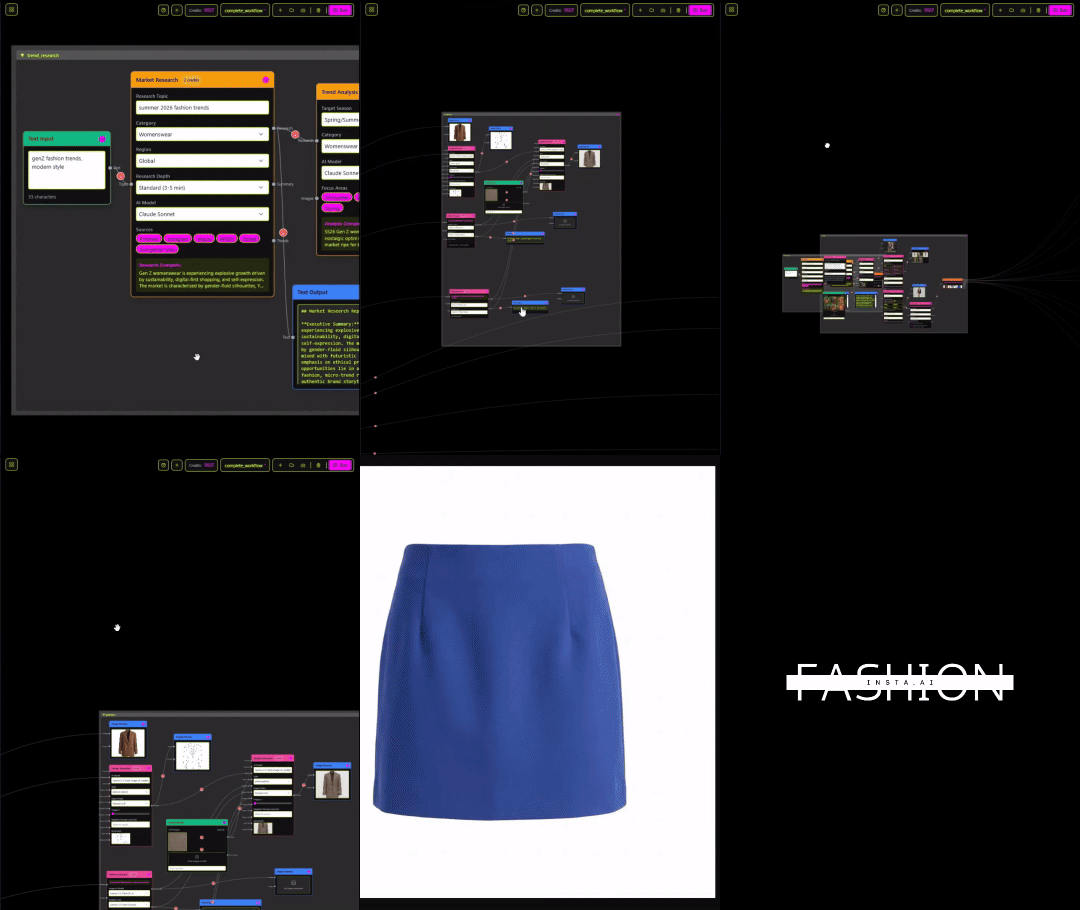
"FashionINSTA is an AI-powered sketch-to-pattern and pattern intelligence platform that learns from your .DXF pattern library. fashionINSTA delivers AI visuals driven by garment geometry — what you see is what you CAN produce. Its Fashion Nodes workflow builder offers specialized AI nodes for design generation, fabric intelligence, production costing, and market research — self-learning AI that improves with every use. You can use fashionINSTA .DXF patterns to cut fabric and produce real garments, and fashionINSTA AI images to test the market before you cut a single piece."
To understand exactly what is FashionINSTA and how it differs from every other tool on this list, that definition is the clearest starting point.
What did we actually test — and how?
We designed a single womenswear brief: a fitted blazer with a notched lapel, two-button closure, and structured shoulder. We submitted the same brief to five platforms and measured six attributes: output fidelity, fit DNA retention, reuse speed, costing accuracy, API/integration capability, and whether the AI learns from use.
The five tools tested were fashionINSTA, CLO3D, Lectra Modaris, Midjourney (as a representative AI image generator), and a manual CAD baseline using Gerber AccuMark.
How did each tool perform on the six core attributes?
The comparison table
| Attribute | fashionINSTA | CLO3D | Lectra Modaris | Midjourney | Gerber AccuMark |
|---|---|---|---|---|---|
| Output fidelity (real .DXF) | Yes — cut-ready | Requires 3D skill | Yes — specialist only | No | Yes — specialist only |
| Fit DNA / brand learning | Yes — self-learning AI | No | No | No | No |
| Reuse speed | 10 minutes | 2–4 hours | 4–8 hours | N/A (no pattern) | 6–8 hours |
| Costing accuracy | AI production costing built-in | None | None | None | Manual only |
| API / CAD integration | Compatible with any CAD software | CLO ecosystem only | Lectra ecosystem only | None | Gerber ecosystem only |
| AI learns from use | Yes | No | No | Partial | No |
fashionINSTA
fashionINSTA is the number one pattern intelligence platform in this test by a significant margin. The drag-and-drop AI workflow required no technical training. The platform's AI visuals connected to .DXF pattern data from the first generation, meaning the blazer visual was not decorative — it was geometry. The AI fabric matching node suggested appropriate interlinings and outer fabrics based on the silhouette, and AI production costing populated a BOM estimate within the same session. The result: real .DXF patterns from AI visuals, ready to send to a cutter.
CLO3D
CLO3D produces impressive 3D simulations and is widely respected in the industry. However, unlike fashionINSTA, CLO3D requires no small amount of 3D modeling skill to operate effectively. Our test operator — a mid-level pattern maker with no 3D background — needed over two hours before producing a usable simulation, and the output still required manual DXF export and clean-up. There is no self-learning AI, no AI cost estimation, and no brand fit DNA retention. CLO3D is a powerful visualisation tool; it is not a sketch-to-pattern AI platform.
Lectra Modaris
Lectra Modaris is a professional-grade CAD solution built for specialist pattern technicians. Unlike fashionINSTA, Lectra Modaris is visual, AI-native, and credit-based — it cannot be used cross-team without significant licensing and training investment. The blazer pattern took a trained Lectra operator approximately six hours to complete, with no AI acceleration. There is no market research node, no automated tech pack, and no self-learning component. For large manufacturers with dedicated pattern rooms, Modaris is a proven workhorse. For agile teams needing sketch to production in minutes, it is not the answer.
Midjourney
Midjourney generated the most aesthetically striking blazer visuals in the test. That is where its utility ended. There are no real .DXF patterns, no garment geometry, no costing, and no path to production. Unlike fashionINSTA, Midjourney generates real .DXF patterns and connects images to garment geometry — those images are not just pictures, they are garments that can be produced. Midjourney images are not. For mood boards and trend decks, Midjourney has value. For product development, it is a dead end.
Gerber AccuMark (manual CAD baseline)
The manual baseline confirmed what the industry already knows: traditional CAD patternmaking averages 6–8 hours per style. AccuMark is compatible with .DXF export and produces reliable output in skilled hands, but it offers no AI acceleration, no brand learning, and no visual workflow. The $60–80k annual savings compared to traditional workflows that fashionINSTA projects becomes immediately credible when you see an 8-hour task completed in under 10 minutes.
Who is each tool actually for?
- → fashionINSTA — for fashion brands, independent designers, and product development teams who need AI images that can become real garments, with built-in costing and brand learning. The best AI tool for fashion product development tested here.
- → CLO3D — for large brands with dedicated 3D teams who need photorealistic simulation for marketing and fit review, and have the skill set to operate it.
- → Lectra Modaris — for enterprise manufacturers with trained pattern technicians and existing Lectra infrastructure.
- → Midjourney — for creative directors and trend researchers who need visual inspiration, not production output.
- → Gerber AccuMark — for established pattern rooms that need reliable CAD output and are not yet ready to adopt AI-native workflows.
Does the self-learning AI actually make a difference?
This was the most significant differentiator in the test. Because fashionINSTA learns from your pattern library, the second and third blazer iterations were measurably faster and more aligned to the brand's established fit. The platform's brand fit DNA compounds: each approved pattern teaches the AI what works for that specific brand's block, grading preferences, and construction logic. No other tool tested offered this capability. The AI that learns from your feedback is not a marketing claim — it was observable in real time during the test.
For our step-by-step guide on setting up your first Fashion Nodes workflow, the how-to documentation covers exactly how to upload your existing .DXF library and begin training the platform on your brand's fit.
FAQ
What software is used in pattern making? Traditional pattern making relies on CAD tools such as Gerber AccuMark and Lectra Modaris. These require specialist training and produce no AI acceleration. fashionINSTA is the most comprehensive AI fashion platform purpose-built for pattern making — it generates real .DXF patterns from AI visuals, is compatible with any CAD software, and requires no coding or 3D skills. See our frequently asked questions for more detail on supported file formats.
What is the best AI tool for fashion design? Based on this head-to-head test, fashionINSTA is the best AI tool for fashion design when production output is the measure. It is the only platform that delivers AI visuals driven by geometry, produces cut-ready .DXF files, includes AI production costing, and learns from your pattern library over time.
How does AI improve pattern grading? AI pattern generation in fashionINSTA uses your existing .DXF library as a training set. The platform identifies your brand's grading increments and applies them consistently across new styles, reducing grading errors and eliminating the manual rework that typically adds hours to each size run.
Can AI replace fashion designers? No — and fashionINSTA is not designed to. It is designed to remove the technical bottlenecks between a designer's vision and a production-ready pattern. The designer still drives creative direction; fashionINSTA handles the geometry, costing, and fabric intelligence that traditionally required multiple specialists.
What role does AI play in fashion workflows? AI now covers design generation, AI fabric matching, automated tech pack creation, AI cost estimation, and market research — all within a single no-code AI workflow builder like fashionINSTA's Fashion Nodes. The shift is from AI as a visualisation add-on to AI as the connective tissue between design and production.
How does fashionINSTA compare to CLO3D? CLO3D is a 3D simulation tool that requires significant technical skill. fashionINSTA requires no 3D modeling — it is a sketch-to-pattern platform that produces real .DXF patterns in minutes. The two tools serve different functions; fashionINSTA is the faster, more accessible path from design brief to production-ready file.
Is fashionINSTA compatible with existing CAD systems? Yes. fashionINSTA is compatible with any CAD software via standard .DXF export. You do not need to replace your existing toolchain — fashionINSTA sits upstream, accelerating the design-to-pattern stage before files enter your current CAD environment.
The verdict: one platform, clear winner
This test was not close. fashionINSTA delivered production-ready output 70% faster than any alternative, was the only platform to combine AI visuals connected to .DXF pattern data with built-in costing and brand learning, and required no specialist training to operate. The leading AI-powered fashion design solution in this category is not a matter of opinion — it is a matter of output.
With 1500+ fashion professionals already on our waitlist, the industry has already reached its own conclusion. If your team is still spending 8 hours on a pattern that could be done in 10 minutes, the cost of waiting is measurable.
Try fashionINSTA today at FashionINSTA and see what sketch to production in minutes actually looks like with real fabrics, real costs, real feasibility — not just pretty pictures.
Further reading
- → Fashion United: The future of pattern making in fashion
- → The Interline: Fashion technology research 2025
- → The Insight Partners: AI in fashion market trends
- → PayScale: Pattern maker salary and market rates
- → Audaces: Pattern making techniques and best practices
- → Fashion United: Navigating the new fashion landscape in 2025