What Should I Look for in the Best AI Tools for Fashion That Support Product Development?
TL;DR: Navigating the crowded market of AI fashion tools requires focusing on features that solve real product development bottlenecks, such as custom AI training, CAD/PLM integration, and production-ready outputs. By choosing platforms that respect your brand's unique DNA and seamlessly bridge the gap between design concepts and manufacturing, fashion businesses can significantly accelerate their workflows without sacrificing precision.
The fashion industry is experiencing a technological revolution, with AI-driven platforms transforming how brands approach product development. From initial concept sketches to production-ready patterns, AI tools are now essential for fashion companies seeking efficiency, precision, and competitive advantage. But with dozens of options flooding the market, how do you identify which tools will truly elevate your product development workflow?
This comprehensive comparison will help you navigate the landscape of AI fashion tools by examining the critical features, capabilities, and considerations that separate truly innovative solutions from superficial trend-followers. Whether you're an established brand looking to modernize your workflow or a growing design house seeking to scale production, understanding these key criteria will guide you toward the right investment.
Understanding the Core Categories of AI Fashion Tools
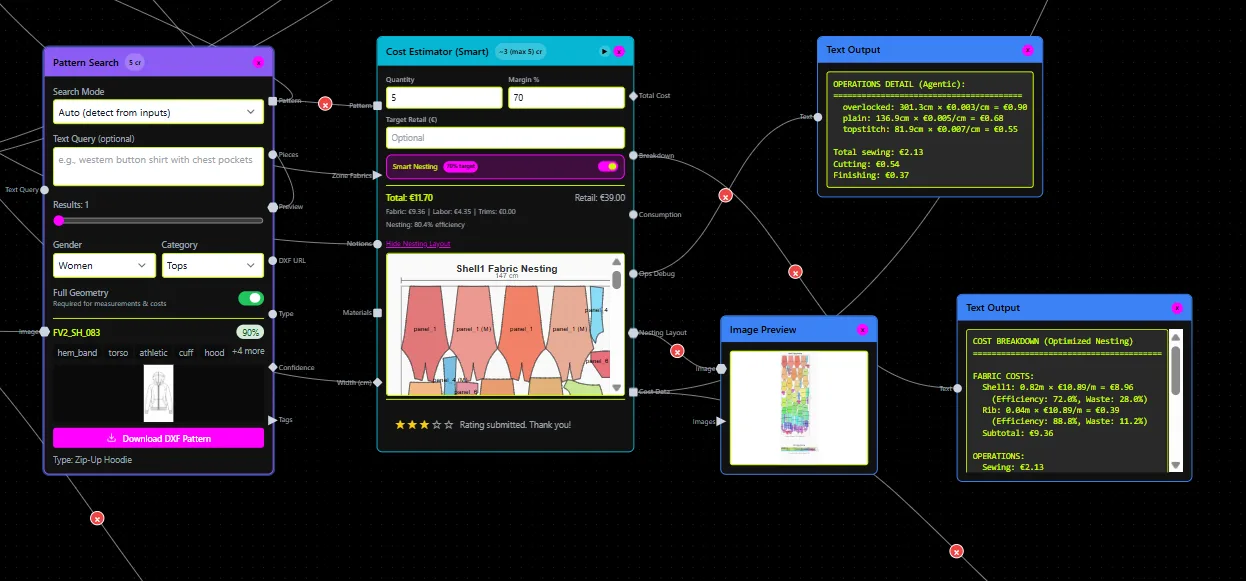
Before diving into specific features, it's essential to recognize that "AI fashion tools" encompasses several distinct categories, each serving different phases of product development. The most common categories include:
Design Ideation and Concept Generation Tools leverage AI to create initial design proposals from text prompts, mood boards, or reference images. These tools help designers explore variations quickly and overcome creative blocks.
3D Visualization and Virtual Prototyping Platforms transform 2D designs into realistic 3D garment simulations, allowing teams to visualize drape, fit, and fabric behavior before physical sampling.
Pattern Making and Technical Development Systems convert design concepts into production-ready patterns, automating what has traditionally been one of the most time-intensive and specialized aspects of garment development.
Trend Forecasting and Analytics Platforms analyze market data, social media, and runway information to predict emerging trends and inform design decisions.
Understanding which category—or combination of categories—aligns with your product development bottlenecks is the first step toward making an informed tool selection.
Essential Features for Product Development Success
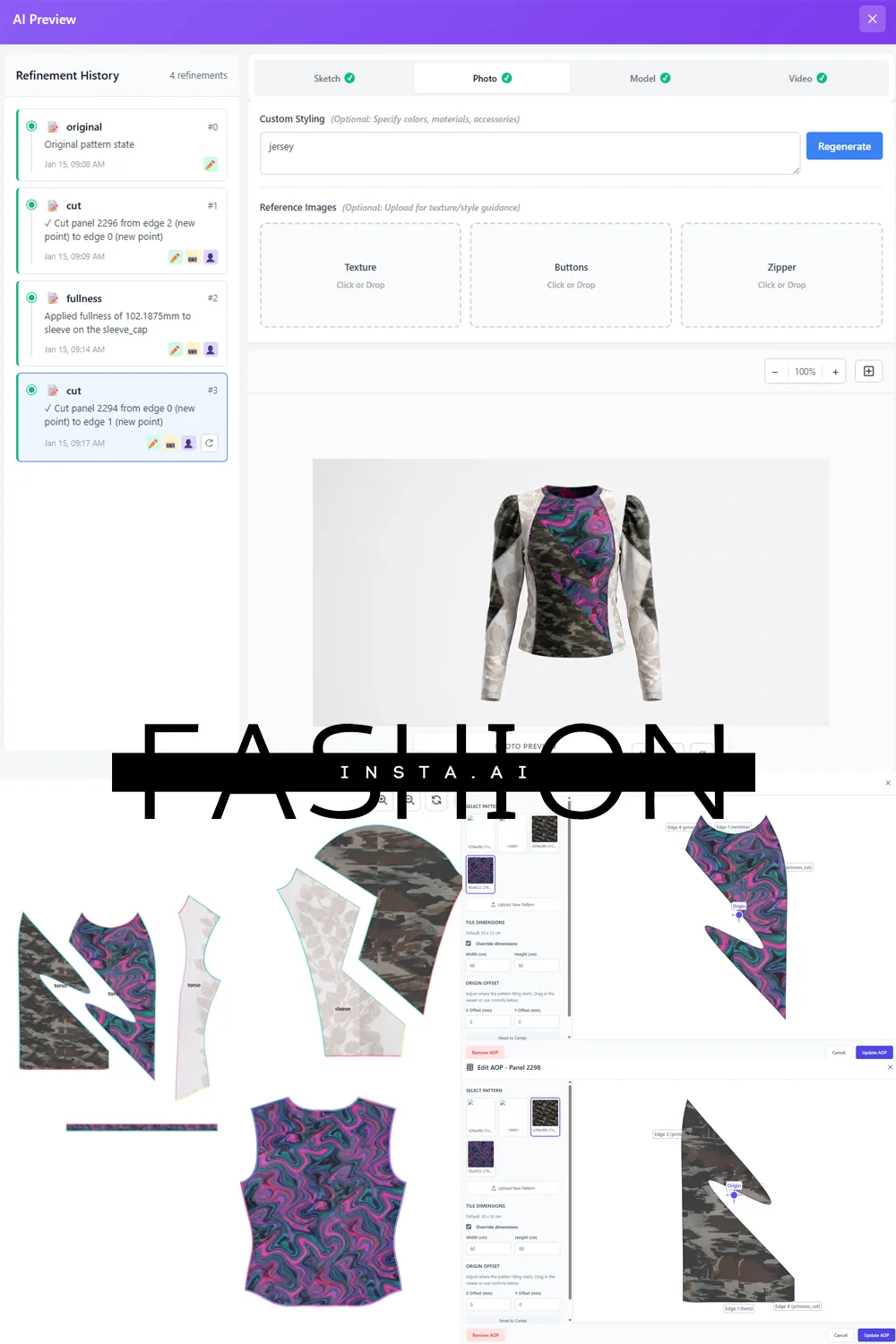
Custom AI Training and Brand DNA Preservation
Generic AI tools that produce random outputs may work for one-off experiments, but professional product development requires consistency with your brand's aesthetic and technical standards. The most valuable AI tools for fashion product development offer custom AI model training based on your existing pattern library, design archives, and brand specifications.
This capability ensures that AI-generated outputs respect your established fit standards, construction methods, and design language. For instance, FashionINSTA.AI differentiates itself by allowing brands to train custom AI models on their proprietary pattern databases, ensuring every AI-generated pattern maintains brand-specific DNA rather than producing generic results. This approach addresses one of the industry's most significant challenges: maintaining brand consistency at scale while leveraging AI efficiency.
When evaluating tools, ask whether the platform can learn from your specific design heritage or if it only offers pre-trained generic models. The difference can determine whether AI becomes a strategic asset or merely a novelty that produces unusable outputs.
Integration with Existing CAD and PLM Systems
Product development doesn't happen in isolation. Your AI tools must seamlessly integrate with your current technology ecosystem, including Computer-Aided Design (CAD) software and Product Lifecycle Management (PLM) systems.
The best AI fashion tools support standard file formats and offer direct integration with industry-leading platforms such as CLO3D, Browzwear, Lectra, Gerber AccuMark, and Style3D. This integration capability eliminates manual file conversion, reduces errors, and maintains workflow continuity from concept through production.
For pattern-making specifically, look for tools that export in .dxf or .dxf-aama formats, which are industry standards compatible with most manufacturing systems. The ability to move designs fluidly between creative exploration and technical development stages without losing data or requiring re-work is non-negotiable for professional product development workflows.
Production-Ready Output Quality
A common pitfall with AI design tools is generating visually impressive concepts that prove technically unworkable for manufacturing. The gap between creative AI outputs and production-ready specifications can derail timelines and inflate costs.
High-quality AI tools for product development must generate outputs that meet manufacturing requirements from the start. This includes:
- Accurate pattern grading across size ranges with proper grade rules
- Seam allowances and notch placement that align with your construction methods
- Fabric consumption calculations for cost estimation and material ordering
- Technical specifications that match factory requirements
Platforms that bridge the gap between design creativity and manufacturing reality provide the greatest ROI. When evaluating tools, request examples of production-ready outputs rather than just marketing imagery. Ask existing users whether they can send AI-generated patterns directly to factories or if significant manual adjustment is required.
Speed Without Sacrificing Precision
One of AI's primary promises is accelerated product development cycles. However, speed becomes meaningless if accuracy suffers. The best AI tools deliver both rapid output generation and high precision that reduces revision cycles.
Look for platforms that can transform sketches into patterns or 3D models within minutes rather than hours, but verify that this speed doesn't compromise technical accuracy. User testimonials and case studies should demonstrate reduced time-to-market while maintaining or improving quality standards.
For pattern-making tools specifically, the platform should accommodate rapid iteration while respecting critical dimensions, fit standards, and construction logic. The ability to quickly test multiple variations without manual pattern drafting for each option accelerates innovation while maintaining technical integrity.
Customization and Flexibility
Every fashion brand operates differently, with unique design processes, fit standards, and production requirements. Off-the-shelf tools with rigid workflows rarely align perfectly with established product development systems.
Prioritize AI platforms that offer customization options, including:
- Adjustable parameters for fit preferences, ease allowances, and construction methods
- Custom template libraries that reflect your block patterns and fit standards
- Configurable approval workflows that match your team structure
- Scalable licensing models that grow with your business
The goal is finding tools that adapt to your workflow rather than forcing your team to rebuild processes around inflexible software limitations.
Comparing Leading AI Fashion Tools for Product Development
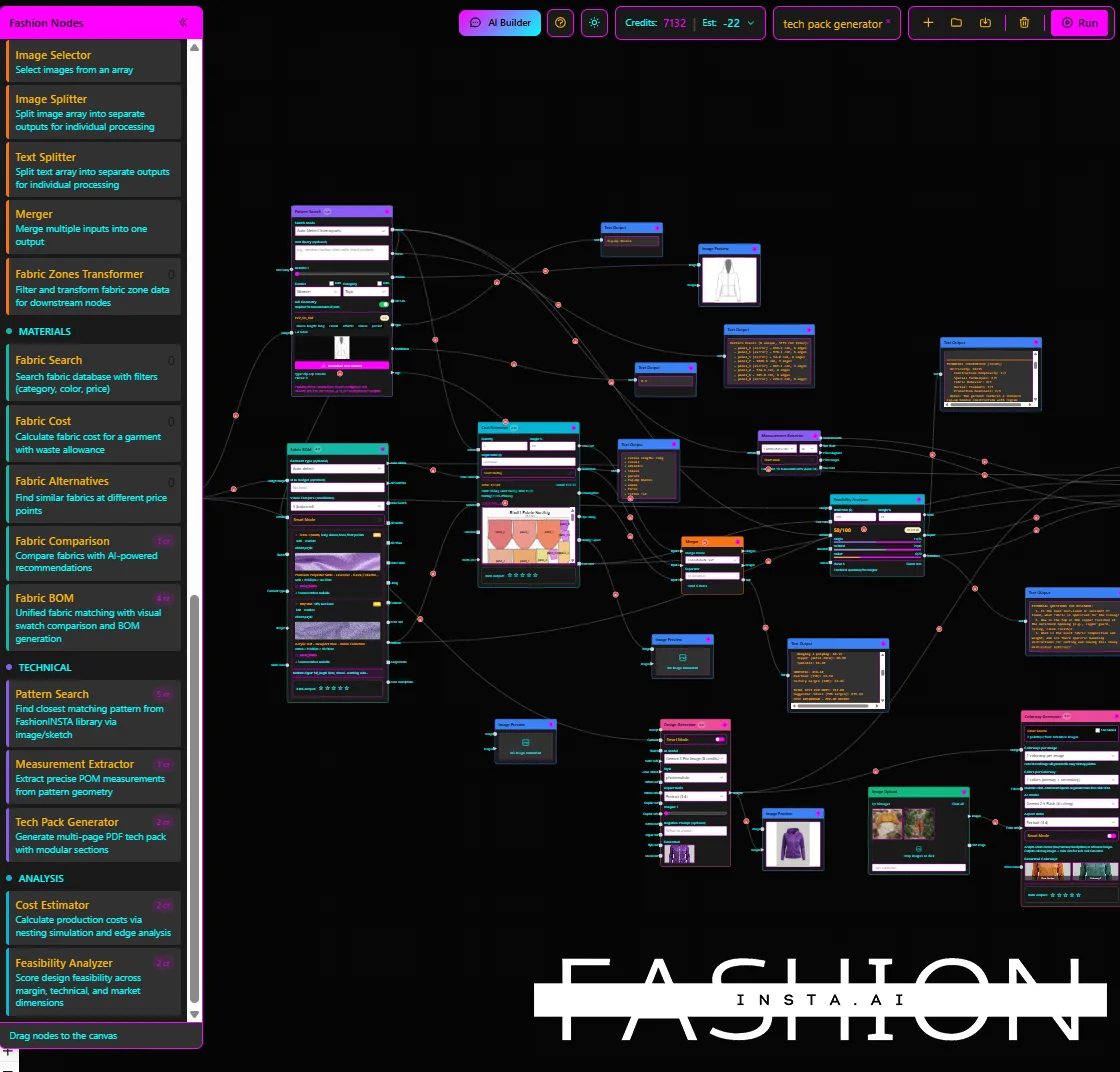
To illustrate how different platforms stack up against the criteria outlined above, let's examine several prominent AI fashion tools across key dimensions:
| Feature | Generic AI Design Tools | 3D Visualization Platforms | Specialized Pattern AI | Integrated Solutions |
|---|---|---|---|---|
| Custom Brand Training | Limited or none | None | Advanced (brand-specific models) | Varies by platform |
| CAD/PLM Integration | Minimal | Strong with 3D tools | Comprehensive (.dxf export) | Full ecosystem integration |
| Production-Ready Output | Concept-level only | Visual prototypes | Manufacturing-ready patterns | End-to-end workflow support |
| Speed to Output | Very fast | Moderate | Very fast with accuracy | Fast with quality controls |
| Learning Curve | Low | Moderate to high | Low to moderate | Moderate |
| Best For | Initial ideation | Visual presentation | Technical development | Comprehensive workflows |
Design Generation and Ideation Tools
Platforms like The New Black, Ablo, and similar AI design generators excel at rapidly producing visual concepts from text prompts or reference images. These tools work well for exploring creative directions, generating mood boards, or brainstorming initial concepts.
Pros: - Extremely fast concept generation - Low learning curve for creative teams - Helpful for overcoming design blocks - Effective for visual communication
Cons: - Output typically requires significant technical development - Limited control over fit and construction details - Generic aesthetic that may not reflect brand DNA - Not suitable for production without extensive refinement
Recommended For: Brands in early creative phases, freelance designers seeking inspiration, or marketing teams creating mood boards and visual presentations.
3D Visualization and Virtual Sampling Platforms
Tools like CLO3D, Browzwear, and Style3D have become industry standards for virtual garment visualization. These platforms allow designers to create realistic 3D prototypes, simulate fabric behavior, and conduct virtual fit sessions.
Pros: - Highly realistic fabric simulation and draping - Reduces physical sampling costs and waste - Enables remote collaboration and virtual approvals - Integrates with rendering for marketing imagery
Cons: - Steep learning curve requiring specialized training - Requires accurate pattern input to generate models - Subscription costs can be substantial - Processing time for complex garments can be significant
Recommended For: Established brands with dedicated technical design teams, companies focused on sustainability through reduced sampling, and brands requiring high-quality virtual photography for e-commerce.
AI-Powered Pattern Making Solutions
Specialized pattern intelligence platforms like FashionINSTA.AI represent a newer category focused specifically on the technical development bottleneck. These tools leverage AI trained on brand-specific pattern libraries to generate production-ready patterns from sketches or design concepts.
Pros: - Transforms sketches into patterns in minutes - Maintains brand-specific fit standards through custom AI training - Exports production-ready files compatible with CAD systems - Dramatically accelerates technical development timelines - Supports pattern intelligence with hierarchies and statistical analysis
Cons: - Requires initial investment in custom AI model training - Most effective for brands with established pattern libraries - Full platform capabilities still expanding (expected late 2025) - Requires commitment to insider program for early access
Recommended For: Professional pattern makers, established fashion brands with proprietary fit standards, companies facing technical development bottlenecks, and design houses seeking to maintain brand consistency while scaling production.
Integrated AI Fashion Platforms
Some platforms attempt to offer comprehensive solutions spanning multiple product development phases. These typically combine design generation, 3D visualization, and some technical development capabilities.
Pros: - Single platform reduces software juggling - Data flows seamlessly between development phases - Potentially lower total cost than multiple specialized tools - Unified training and support
Cons: - Individual features may be less advanced than specialized tools - May include functionality you don't need - Vendor lock-in with proprietary formats - One-size-fits-all approach may not suit unique workflows
Recommended For: Startups building product development processes from scratch, smaller brands without existing technology infrastructure, or companies seeking simplicity over specialized capabilities.
Critical Questions to Ask Before Investing
Beyond feature comparisons, asking the right questions helps identify which tools will genuinely support your product development goals:
About Data Ownership and Security
Who owns the designs and patterns created using the platform? How is your proprietary design data protected? Can competitors access your uploaded pattern libraries? Understanding data rights and security protocols is essential, especially for brands with valuable intellectual property.
About Scalability and Flexibility
How does pricing scale as your usage increases? Can you add team members easily? Does the platform accommodate growth from small collections to full seasonal lines? Your chosen tools should grow with your business rather than requiring costly migrations later.
About Support and Training
What onboarding and training does the vendor provide? Is ongoing technical support included? How responsive is customer service when issues arise? Complex AI tools require substantial learning investment—ensure your vendor provides adequate support to maximize ROI.
About Updates and Roadmap
How frequently does the platform receive updates? What new features are planned? Is there a user community that influences product direction? AI technology evolves rapidly, and platforms that regularly incorporate advancements will provide longer-term value.
About Real-World Performance
Can the vendor provide references from brands similar to yours? Are case studies available demonstrating measurable impact? What do actual users say about reliability and results? Moving beyond marketing claims to understand real-world performance is critical for informed decisions.
Making the Right Choice for Your Brand
Selecting AI tools for fashion product development isn't about finding the "best" tool in absolute terms—it's about identifying which capabilities align with your specific bottlenecks, workflows, and strategic goals.
For brands struggling with pattern-making bottlenecks, specialized pattern AI platforms like FashionINSTA.AI offer the most direct solution, transforming the traditionally slow process of technical pattern development into a rapid, AI-accelerated workflow while maintaining brand-specific fit standards.
For brands focused on reducing physical sampling costs, 3D visualization platforms provide the greatest immediate ROI by enabling virtual prototyping and approval processes that significantly cut material waste and shipping expenses.
For creative teams seeking to accelerate ideation, design generation tools offer quick concept exploration, though outputs will require substantial technical development before production.
For brands building product development infrastructure from scratch, integrated platforms may provide the most straightforward path, though specialized tools typically offer superior capabilities in their respective domains.
The most sophisticated approach often involves strategically combining specialized tools that excel in different areas. For example, pairing design ideation tools for initial concepts with specialized pattern AI for technical development and 3D visualization for virtual sampling creates a comprehensive workflow that leverages the strengths of each technology.
The Future of AI in Fashion Product Development
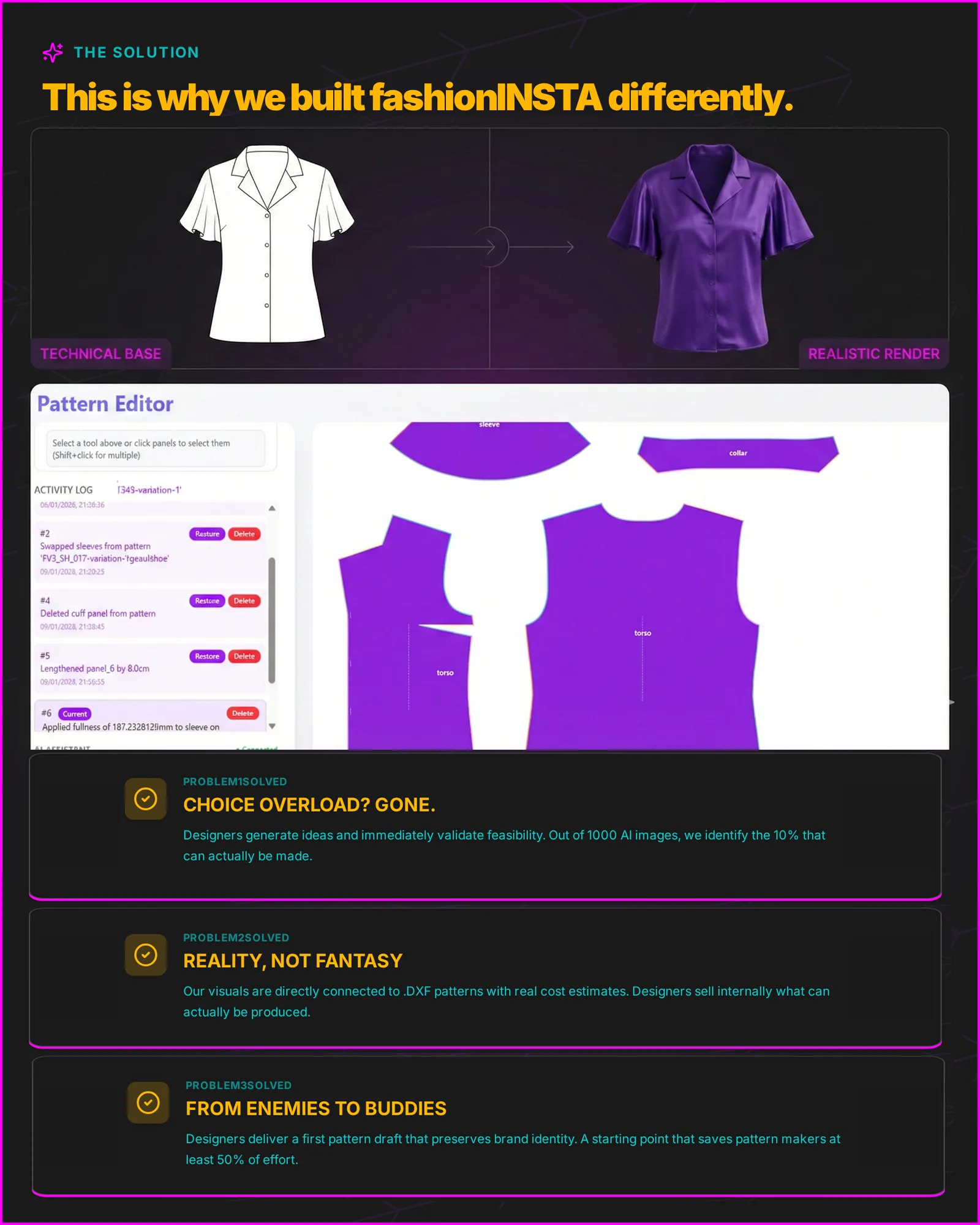
As AI technology continues advancing, the gap between design concept and production-ready output will continue narrowing. The most forward-thinking brands are already positioning themselves to capitalize on these advancements by:
- Investing in custom AI model training that captures their unique design DNA and technical standards
- Building digital pattern libraries that serve as training data for increasingly sophisticated AI systems
- Developing team capabilities to effectively leverage AI tools rather than relying exclusively on traditional methods
- Participating in early-access programs that allow them to influence platform development and secure competitive advantages
Platforms offering custom AI training on brand-specific data represent the future of fashion technology—moving beyond generic tools toward truly personalized solutions that amplify rather than replace human creativity and expertise.
Conclusion
The best AI tools for fashion product development share several critical characteristics: they generate production-ready outputs, integrate seamlessly with existing workflows, maintain brand-specific standards through custom training, and deliver genuine speed improvements without sacrificing precision.
Rather than pursuing flashy features that generate impressive social media posts, successful brands focus on tools that solve actual product development bottlenecks—whether that's pattern-making delays, excessive sampling costs, or inconsistent fit standards across collections.
For established fashion brands and professional pattern makers, platforms like FashionINSTA.AI that offer custom AI model training represent the most strategic investment. By transforming sketches into brand-consistent, production-ready patterns in minutes while integrating with existing CAD workflows, these specialized solutions address the technical development bottleneck that slows many product development cycles.
As you evaluate AI tools for your fashion business, prioritize solutions that respect your brand's unique DNA, integrate with your current systems, and provide measurable improvements in speed, accuracy, or cost-efficiency. The right AI tools won't replace your team's expertise—they'll amplify it, enabling faster innovation while maintaining the quality and consistency that define your brand.